Zero Retries 0243
2026-02-20
Zero Retries is an independent newsletter promoting technological innovation in and adjacent to Amateur Radio, and Amateur Radio as (literally) a license to experiment with and learn about radio technology. Radios are computers - with antennas! Now in its fifth year of publication, with 3500+ subscribers.
Steve Stroh N8GNJ, Editor
Tina Stroh KD7WSF, Business / Conference Manager
Ghost says this issue is too big for email clients? YES
Thus, it might be easier to read this in a web browser -
https://www.zeroretries.radio/zero-retries-0243
In This Issue...
- I-Frame
- Missing email subscribers...
- A Confession...
- HamSCI 2026 and ARRL Headquarters Tour
- The People and Zero Retries Interesting Conversations
- ARRL Lab Visit
- Wrapping Up HamSCI 2026
- Thought Experiment - Frequency Hopping (But Not Spread Spectrum) Radio System
- ZR > BEACON
- Hush's first release is FINALLY OUT!!!!
- RPC Electronics ESP32 LoRA-Pi Modem Now Shipping
- What if I told you that you could do Ethernet over LoRA?
- Michigan Radio Amateurs Technological Society (MIRATS)
- ARDC is Hiring (Contract Roles)
- GRCon26 Key Dates
- Using M17 Without a Radio
- NEWSDR 2026
- Ground Station: An Open Source SDR Orchestration Platform for Satellite Tracking And Decoding
- Automatic Signal Recognition With AI Machine Learning And RTL-SDR
- Video - Andy's Ham Radio Linux ~ 03/11/2026
- Video - Pluto+ Clone SDR Review
- Request To Send
- Zero Retries Photo Essay Page Coming Soon
- (Yet Another) Future Project - Zero Retries Fiction Series
- Finally Scored a Raspberry Pi 500 Plus
- Sad Hams - Route Around Them
- Hamvention 2026 Ho!
- Weekends Are For Amateur Radio!
- Closing Thanks
- The Usual Administrivia
I-Frame
This is a new section of Zero Retries. One time mention - from the recently updated Zero Retries About page:
I-Frame (IF) is "The Least I Think You Need To Know - Tersely" section at the beginning of each issue of Zero Retries beginning in Zero Retries 0243. IF replaced the Request To Send (Editorial) section - see below. In Amateur Radio Packet Radio (AX.25 protocol) an I-Frame is an Information Frame; frames are one of the fundamental unit of transmission in Amateur Radio / Packet Radio and it seemed a suitable term for the "Least I Think You Need To Know" about an issue of Zero Retries. Two other common types of frames are S-frames (Supervisory), and U-frames (Unnumbered).
Missing email subscribers...
I haven't yet figured this out, but Ghost says that there are 3509 folks currently signed up to receive Zero Retries via email. But when I queue it up, Ghost says that it will go out to "All 3,432 subscribers". I have no idea what the story is about the gap of "77" between those two numbers. Zero Retries might not be going out to everyone who's tried to sign up to receive Zero Retries via email. Please advise if you've signed up to receive Zero Retries via email, but aren't receiving it via email.
A Confession...
A lot of stuff that folks mention to me, that really deserves to get mentioned here in Zero Retries... doesn't, and that's my fault. I drop (forget) stuff, it doesn't get bookmarked properly so that I see again it after the initial mention / email, it gets pushed down too far into the "potential mention" queue... many sins of omission.
Please don't take such lacks of mention personally. It's (generally) not you (or the potential story). It's generally me. Please feel free to remind me about the thing you found Zero Retries Interesting if you don't see it appear in Zero Retries within a reasonable interval of when you first brought it to my attention. I really want to do a good job of promoting Technological Innovation in Amateur Radio here in Zero Retries.
I need a better system of queuing and tracking potential articles, especially now that the trauma and chaos of the transition to Ghost and the zeroretries.radio domain is complete. (Suggestions are welcome.)
Please direct comments / feedback about I-Frame to the Zero Retries email list with the #ZR0243 hashtag.
HamSCI 2026 and ARRL Headquarters Tour
By Steve Stroh N8GNJ
HamSCI is the Ham Radio Science Citizen Investigation to make use of Amateur Radio (mostly High Frequency - HF spectrum below 30 MHz) to conduct scientific research. For more detail about HamSCI, reference the HamSCI About page. As "Citizen" indicates, participation in HamSCI is not confined to academic personnel. Any Amateur Radio Operator can participate in HamSCI activities, programs, and ongoing research. Some HamSCI activities are "receive only" / do not require transmitting, thus those activities do not require an Amateur Radio license.
ARRL is the American Radio Relay League, the largest organization of Amateur Radio Operators in the US.
The weekend of 2026-03-14 and 03-15, Tina KD7WSF at I attended the HamSCI 2026 conference. We had a great time learning from the presentations, posters and poster sessions, and having many stimulating and informative conversations.
The conference was efficiently directed by Bob Inderbitzen NQ1R, ARRL's Director of Marketing and Innovation and Dr. Nathaniel A. Frissell W2NAF, Lead HamSCI Organizer. The venue of the conference was the Student Center of Central Connecticut State University (CCSU) in New Britain, Connecticut, USA. The venue was very nice and conducive to not just the conference activities, but lots of face to face conversations and the poster session. Unlike at HamSCI 2025, I didn't participate in the Poster Session at HamSCI 2026... and I should have. The posters presented weren't limited to just topics presented at HamSCI 2026, but were generally related to Amateur Radio, science, and technological innovation. For example, two that I was personally interested in were Unauthorized Use Of Military Satellites: Threats To Mission Security And Integrity and Radioconda: Gateway to Software Radio. The time allocated for viewing and interacting with poster authors was another substantial block of time - three hours on Sunday morning, and thus these one-to-many interactions. That changed my perspective on the utility of poster sessions at a conference, from "interesting" to a highly useful way to "multiplex" various topics rather than one or two central presentations. I now want to figure out how to implement a Poster Session into the Zero Retries Digital Conference.
ARRL offered a good video recap of the Poster Session:
I'm not a scientist, and not currently involved in HamSCI activities, but a number of the presentations were engaging to me as a "typical" Amateur Radio Operator.
- Meteor Scatter Science by Robert Suggs NN4NT discussed implementations of radio communication by bouncing radio off of meteor scatter... and the science behind it. Something I learned - there are meteors... and there are meteoroids. There's no such thing as micrometeoroids - using that (invented) word is a quick way to irritate a meteor specialist like NN4NT.
- Remembering and Honoring Paul Nicholson G8LMD: Passionate VLF Enthusiast and Master by Jonathan Rizzo KC3EEY was (in addition to learning about the life's work of G8LMD) a mini tutorial on Very Low Frequency radio. I learned that G8LMD was integral in the development of the Indian Lighting Detection Network.
- The third annual HamSCI book club: a discussion on shortwave radio as it was used in World War II by Aaron Bilow W3WAM was a passionate discussion of the book All the Light We Cannot See. I had known of this book... but had not considered reading it until listening to why it was so interesting.
One of the activities of HamSCI 2026 was a visit on Saturday afternoon to ARRL Headquarters and ARRL's flagship bulletin station W1AW which was < 5 miles from CCSU in nearby Newington, Connecticut, USA. It was interesting to see W1AW in person for the first time, and W1AW Manager Joe Carcia NJ1Q gave a great tour and ably answered every (often obscure) question thrown at him. It was Zero Retries Interesting to see the mix of HF radios, amplifiers and other equipment that W1AW uses for its regular bulletin transmissions. It was also interesting to see that W1AW is largely utilitarian, rather than "showpiece" in how it presents Amateur Radio operations. There were multiple big screens... but the radio hardware was the most prominent feature of W1AW.
W1AW's regular, sustained operation and resulting duty cycle is taxing on "Amateur grade" equipment. I expected to see more commercial grade equipment, but most of it was typical Amateur Radio equipment, albeit rack mounted with lots of fans and dedicated (air conditioned? I forgot to ask) space behind glass doors. W1AW was divided into the bulletin equipment section (about half of the total floor space), and then there were some "studios" where ARRL members visiting W1AW could operate independently using dedicated radios and antennas.
It's been quite a while since I looked at W1AW's transmission schedule:
Digital Transmissions
Frequencies are 3.5975, 7.095, 14.095, 18.1025, 21.095, 28.095, 50.350, and 147.555 MHz.
Bulletins are sent using 45.45-baud Baudot, PSK31 in BPSK mode and MFSK16 on a daily revolving schedule. The actual daily schedule can be found here.
From the Zero Retries perspective, if I had any influence on W1AW, I would transmit a rotating variety of (more) data modes to allow individuals to try out reception of those increasingly sophisticated data modes. I would also have W1AW transmit some voice bulletins with FreeDV RADE as a demonstration of how far Amateur Radio technology has come. FreeDV RADE is open source, and runs on a typical Windows computer, so there's no "resource" or "proprietary" concerns about using it.
There was some VHF / UHF equipment at W1AW, including some that was ground mounted clearly for satellite use, but that equipment wasn't demonstrated or highlighted during the tour segment, that I was on. I think there was some Meshtastic equipment at W1AW, but again, not demonstrated or highlighted during the tour segment that I was on.
The People and Zero Retries Interesting Conversations
Most of the conversations I had at HamSCI 2026 were off the record at their individual's request. Some of the folks I met were:
- Doug Leber N0MM who is a friend and fan of Zero Retries for some time. N0MM and I had a number of conversations about his participation in Edge of Space Sciences.
- Jason Johnston KC5HWB of the Ham Radio 2.0 YouTube channel, who was busy recording the presentations. We chatted briefly about his videos and my response(s) in Zero Retries about the MMDVM / M17 controversy in 2025.
- I enjoyed meeting Rick Ciervo W1CIE, Mark Derks KC1RVQ, and Steve Bossert K2GOG all of whom work at ARRL in various roles.
- At ARRL Headquarters, the highlight of the tour there for me was seeing the ARRL Lab and meeting John Jobin McAuliffe W1DRF who is the Digital RF Engineer at the ARRL Lab (easily the coolest job title of all of the ARRL folks I met). W1DRF was the one of the most Zero Retries Interesting people I met during the weekend, and he's a fan of Zero Retries. More about the visit to the ARRL Lab below.
- David Siddall K3ZJ has a fascinating career background including working for the FCC (thus his deep understanding of Amateur Radio issues at the FCC in his current role as ARRL Washington Counsel). K3ZJ and I discussed a number of Amateur Radio / FCC issues and I learned a number of things about FCC "process", and some reasons to be optimistic about improvement of US Amateur Radio regulations.
- I caught up briefly with Rich Moseson W2VU who now works with ARRL on various projects. W2VU conducted video interviews at the Poster Session.
- I had a number of conversations with Ed Wilson N2XDD who is the ARRL Hudson Division Director. N2XDD was involved in Zero Retries Interesting activities such as M17 for years. His Director duties (especially the extensive travel to represent ARRL) now consume most of his time.
- I met separately with Conrad Trautmann N2YCH who is the ARRL Technical Editor and Ron Diehl NQ8W who is the Editor of QEX. I expressed my opinion to them that to be more relevant to the current generation of new and prospective Amateur Radio Operators, both QST and QEX really need to feature more Zero Retries Interesting articles. Neither was committal (to be expected), but didn't overtly disagree about featuring more articles on Software Defined Radio (I mentioned LinHT prominently), data networking, packet radio (still a thing), microwave communications (beyond contesting), television, and space communications.
- Ryan Volz and John Swoboda of the MIT Haystack Observatory had a poster about their project Radioconda. They were attending HamSCI to promote Radioconda and gather feedback. I chatted with them for some time. One of the most notable things about Radioconda was that incorporates a number of radio related applications (not just the usual collection of Software Defined Radio apps) into an easy to manage installer for multiple platforms including MacOS (yay!). Radioconda also supports a variety of radio hardware including Software Defined Transceivers including ADALM-PLUTO, and Software Defined Receivers as minimal as RTL-SDRs. Notably, Radioconda includes GNU Radio which can often be a challenge for mortals like me, so for that alone, Radioconda is a win. I had a number of suggestions about other packages that I think would be beneficial to include that I'll be forwarding to them.
I just discovered this video - an interview with Volz at HamSCI 2026 on the Digital Rancher YouTube channel by Robert Theiss W5ITR; Amateur Radio YouTube channels based in Texas were well represented at HamSCI 2026:
ARRL Lab Visit
As mentioned above, the tour of the ARRL Lab conducted by John Jobin McAuliffe W1DRF was a highlight for me. In addition to conducting testing in support of Amateur Radio product reviews in QST, the ARRL Lab is equipped to do extensive testing (including a screen room that, of necessity, isolates the powerful transmissions of W1AW which is literally next door). The ARRL Lab also is able to test consumer devices that may be generating Radio Frequency Interference (at power levels greater than FCC regulations permit) in Amateur Radio spectrum.
I was surprised to learn that the ARRL Lab is intimately involved in working with Amateur Radio Operators that want to operate on the 420-450 MHz / 70cm band in areas adjacent to the US Space Force's PAVE PAWS RADAR installations. The ARRL Lab developed operating standards that allow Amateur Radio operations to continue, at reduced power (instead of being displaced entirely as a secondary user of 70cm in the US).
I jokingly chided W1DRF for the apparent lack of Amateur Radio data communications equipment in the ARRL Lab, and he showed me the OpenTNC (not sure of the version that I saw) that he had built and tested in the ARRL Lab. Thus Amateur Radio data communications was represented in the ARRL Lab! (Whew!) W1DRF and I had a conversation about testing standards of Amateur Radio transceivers, and the utility of the TX/RX turnaround time measurements being useful for effective channel utilization in data communications (Packet Radio) networks.
I visited ARRL Headquarters on Monday morning on a last minute errand and chatted with W1DRF who showed off a homebrew "Cantenna" (Waveguide antenna) - for use on the 902-928 / 33cm band. It was made out of galvanized air ventilation pipe - pretty cool!
Wrapping Up HamSCI 2026
It was ironic to me that given the proximity of ARRL (< 5 miles from Central Connecticut State University) and ARRL's Collegiate Amateur Radio Program, there doesn't appear to be an Amateur Radio presence at CCSU. Doing so would seem to be a useful synergy for both CCSU and ARRL (and the Newington / New Britain area in general).
The most referenced radio unit used by HamSCI is the RX-888 (mostly HF) radio receiver that is useful for HamSCI work mostly because it is well supported by ka9q-radio. The RX-888 is "widely available from multiple (China-based) manufacturers" (cloned) and thus the quality and usability of any given RX-888 unit from any given vendor isn't predictable. It was stated "When you buy one, you don't know who makes it, or what's in it". There are many RX-888s in use in HamSCI activities... but no one seems particularly happy with them, especially the thermal issues that they seem to (universally) experience.
For those reasons, the New-888 Project was started to create an improved version of the RX-888 that's stable, predictable, and specifically designed for HamSCI work (such as being restricted to HF only) - https://github.com/fourfathom/New-888. Given the overwhelming use of ka9q-radio with the RX-888, then learning about the New-888 Project, a quote from Alan Kay came to mind:
People who are really serious about software should make their own hardware.
The number, and quality (Zero Retries Interesting!) of conversations I had at HamSCI 2026 easily justified our attendance, and likely justifies our attendance at HamSCI 2027.
Lastly, all of the interesting experiences at HamSCI 2026 inspired me undertake two new small projects for Zero Retries. Both projects are modest enough in scope that I should be able to complete them in time to unveil them at Hamvention 2026.
As I'll elaborate in Request To Send in this issue, if you're despairing about the uncertain future of Amateur Radio, I recommend attending an event like HamSCI 2026 to soak up some of the energy, progressive spirit, and the positivity and curiosity about Amateur Radio in the 21st century.
As I discussed, there are some really remarkable and Zero Retries Interesting people that are working at ARRL Headquarters. They have a positive attitude about Amateur Radio and the future of Amateur Radio. If you live in the region (or are willing to relocate), ARRL is hiring for several interesting jobs:
Please direct comments / feedback about this article to the Zero Retries email list with the #ZR0243 hashtag.
Thought Experiment - Frequency Hopping (But Not Spread Spectrum) Radio System
By Steve Stroh N8GNJ
This is just a very brief thought experiment. What if Amateur Radio developed a Sequential Frequency Hopping Radio System that wasn't designed to be "spread spectrum"?
What if a Frequency Hopping Radio System used a predictable, sequential frequency hopping pattern (Sequential Frequency Hopping Radio System) instead of a the more traditional pseudorandom hopping pattern that's integral to Frequency Hopping Spread Spectrum (FHSS) operation?
One of the huge benefits of using Frequency Hopping in Amateur Radio is that it could be operated as an "underlay" system - operation across a wide range of Amateur Radio spectrum that is otherwise "occupied and allocated" such as the portions of the Amateur Radio VHF / UHF bands used for repeaters.
Recall that there is are no exclusive allocations of Amateur Radio spectrum - only "in use" and "prioritization". If a particular portion of spectrum is not in use, it's available of use by any Amateur Radio Operator. Reference my article Repeater Coordination Does Not Exclude Other Use of the Repeater's Frequencies.
A Sequential Frequency Hopping Radio System might incorporate these features:
- Each band is mapped into 12.5, 25, 50, 100, 200, 300, 400, 500, 1 MHz channels:
- Each channel, each channel size, of each band is numbered sequentially.
- Portions of spectrum that are dedicated for special purpose by regulation such as space, CW, etc. is excluded from the map.
- Each map is assigned an easy to transmit identifier, something similar to a Protocol Identifier. A map of 144 - 148 MHz divided into 12.5 kHz channels would be transmitted as (example) "2m-125". All stations receiving that beacon would know that the station that transmitted the beacon will transmit using that channel map.
- The modulation index used on each transmission is dynamic. Small amounts of data don't justify complex modulations.
- The dwell time on each channel is approximately 100 mS - long enough for data to be transmitted in a reasonable time, but short enough that someone monitoring (especially scanning) won't be bothered by a 100 mS "blip" on the channel.
- If there's a lot of data to transmit, the wider channels and more complex modulations are used. Again, those parameters are beaconed in advance.
- Each station using this system would decide upon a particular, regular time that it will transmit (dynamic, based on channel usage / network traffic) and will also transmit its "transmit slot" as part of its beacon. All usage (transmissions) will be synchronized using a common timebase, probably derived from GNSS.
Conceptually, such a system is no different than two stations deciding to change channels to have a high bandwidth communication. Unlike that scenario, there is no prior coordination required - the systems - with "beaconing of intent" the usage of spectrum is dynamic and decentralized, which only minimal standardization (such as the identifiers) requiring advance coordination.
Again this is offered solely as a thought experiment, and is not nearly advanced enough to seriously consider implementing - yet.
Please direct comments / feedback about this article to the Zero Retries email list with the #ZR0243 hashtag.
ZR > BEACON
By Steve Stroh N8GNJ
Short mentions of Zero Retries Interesting items.
Hush's first release is FINALLY OUT!!!!
Nick Charros KC1WZQ on QRZ.com:
It has been a while since I've given a devlog, but almost all of the profiles and speed levels are implemented and the modem can do loop-back so you can test out the modem without a partner!
The current speed levels are QRP(X), MFSK(X), and OFDM(X) - OFDM goes up to SL12 and can reach a Theoretical maximum of *100 kbps* on HF (2700 Hz bandwidth)
The build files are currently not built, but you can build it very very easily by running and installing cargo and rustup! simply run cargo run to start the modem, and if you find the artifacts you can run Code:hush_rust_core.exe --live-loopback --no-audio and run as a loop-back modem!
To interface, run 1 or 2 hush_term terminals and type `MYCALL <MY CALL>
Next you need to open the modem. Run "devices" to find your audio device's index. For default, run `OPEN 5 0 4800` (syntax is OPEN <input> <output> <samp_rate>)
To connect to a station, run `CONNECT <CALL>` (Note: Currently the connect function is janky and may not work 100% of the time. Future versions will fix this.)
To send text, type in `SEND <TEXT>`
You should see an RX frame in the Hush's TNC prompt.
To disconnect, run DISC and the modem will automatically disconnect!
Thank you all for the support and I hope that this takes off!
73 de Nick KC1WZQ
PS. GitHub link should be updated: https://github.com/kc1wzq/Hush
I just saw this today (Friday) so have had no time to evaluate it. Note that this project has been in development for several months, so there's been some significant work invested.
RPC Electronics ESP32 LoRA-Pi Modem Now Shipping
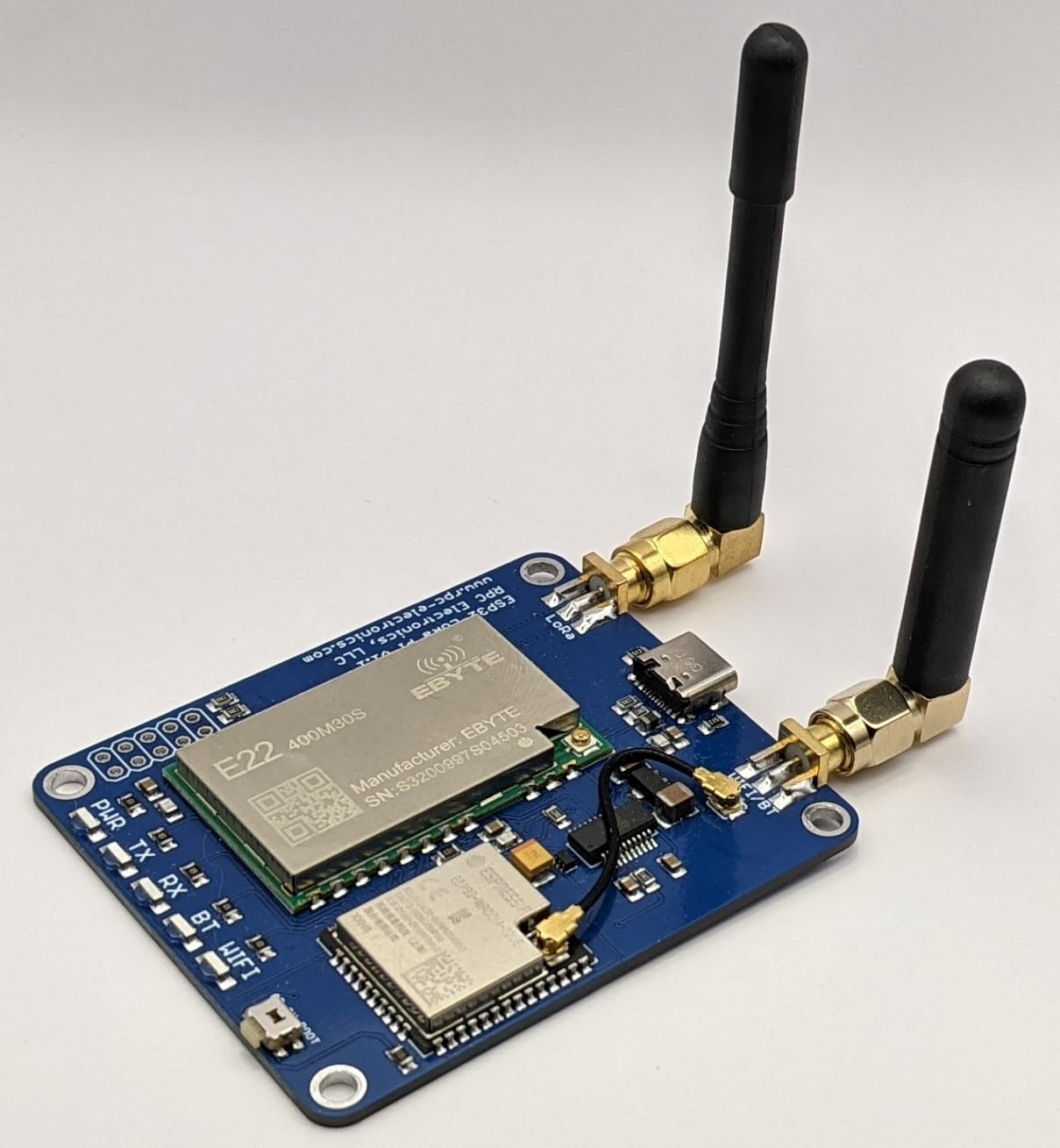
The ESP32 LoRA-Pi is a KISS LoRA modem and 1W UHF transceiver all on one module. Its physical size and form-factor is designed to sit on top of a Raspberry Pi. However, its USB interface allows it to be used with virtually any device that has a USB port and can run software that can speak the KISS protocol.
Key Features:
Native KISS protocol
Use it for APRS, WinLink, WinTNC and so much more
1 Watt UHF Transceiver on-board (Antenna NOT INCLUDED)
USB-C, Bluetooth and direct UART interface for Raspberry Pi options
Web Config via Wifi (future feature)
Bluetooth/Wifi antenna included
Comes pre-configured for KISS operation via USB out of the box
Connect directly to computer, phone and/or tablet via USB
Optional 3D printed case (see below)
Optional UART connector and stand-offs kit for use with Raspberry Pi (see below)
This is a remarkable combination of features! Let's unpack this a bit.
- This... is the radio! No big, power hungry radio module.
- LoRa - a remarkably capable modulation for long range reliable communications at low power. I'll have to do my homework better about the specifics of LoRa, but I think all of the modulation, error correction, etc. is all handled within the LoRa protocol, thus you only need to worry about your applications data to be transmitted.
- LoRa implemented on Amateur Radio 420-450 MHz (70 cm) band - at 1 watt! Not the very low power LoRa radios suitable for use in Europe on the 433 MHz unlicensed band at very low power. The unit uses standard SMA antenna ports for the Wi-Fi / Bluetooth radio and the UHF radio to be able to use external antennas.
- KISS interface. Meaning nearly any Amateur Radio application that can "talk KISS" - Bulletin Board Systems, APRS, etc. can be used with this, with the benefit of the LoRa modulation rather than 1200 bps Audio Frequency Shift Keying modulation (and its many limitations).
- USB-C data interface for data and power. Thus it can be connected to a desktop or laptop via USB-C (including powering it), or any Wi-Fi / Bluetooth device (standalone). It can also be integrated onto a Raspberry Pi computer.
- Very reasonable price including optional case of < $100.
It's early days to understand how capable this will be (for example, over the air data rate not specified), but with the right application of proven technologies for packet radio (such as Net/ROM mesh networking, or JNOS for AX.25 / TCP/IP / Net/ROM) and perhaps even being able to specify different channels and cluster several of these as a relay node... wow, this looks really capable and Zero Retries Interesting!
Kudos to Jason Rausch WB4APR and Remi Bilodeau VE2YAG for shipping this really innovative product into Amateur Radio! Another demonstration of Technological Innovation in Amateur Radio!
What if I told you that you could do Ethernet over LoRA?
Check out a thing I'm working on: https://github.com/datapartyjs/lorapipe
We have a roadmap here: https://github.com/orgs/datapartyjs/pr
Speaking of doing more interesting things via LoRa...
My thanks to Jeff Davis KE9V for mention of this.
Michigan Radio Amateurs Technological Society (MIRATS)

Welcome to the Michigan Radio Amateurs Technological Society! Our callsign is WE8CHZ. We are an FCC-registered amateur radio club.
While we focus on Michigan residents, anyone can join us. We enjoy exploring radio tech, using it in real-life ways, and diving into other parts of the radio hobby—whatever sounds fun.
We are an online club, so we don’t have a physical meeting spot. Most of our chats happen on Discord, but you can also reach us on Facebook.
Our members often hang out on the IRA Linked Repeater System (w8ira.org), the W8BCI repeater in Lansing (w8bci.org), and others like West Michigan Connect on Wires-X.
This Zero Retries Interesting Amateur Radio group was spotted in passing while researching something else. Gotta love an organization with a sense of humor enough to have a humorous club callsign like that.
They're also a Zero Retries Interesting group for featuring articles such as Running a Full Windows Packet and Vara Station on Linux. Their articles can be followed with RSS, and I'm now doing so.
ARDC is Hiring (Contract Roles)
ARDC is Hiring: Software Developer (PT Contract):
ARDC seeks a mid-to-senior-level Software Developer to work with our staff on a contract basis. The role will support ongoing development of our 44Net program services, and potentially other related Free Software projects. An ideal candidate will be active in Free and Open technology communities – particularly those related to amateur radio, digital communications science, F/OSS development, and DIY culture.
ARDC is Hiring: Technical Writer (PT Contract):
ARDC seeks a Technical Writer to work with our staff on a contract basis. The role will support ongoing development of our 44Net program, and potentially other technical publishing activities. An ideal candidate will be active in Free and Open technology communities – particularly those related to amateur radio, digital communications science, F/OSS development, and DIY culture.
I've been involved previously, and currently, as a volunteer for ARDC. In my experience, they're good folks to work with, and for, doing important and relevant work in Amateur Radio and adjacent areas such as open source development.
Thus I endorse and recommend these positions and ARDC as a whole.
GRCon26 Key Dates
Email from GNU Radio Conference 2026:
We’re excited to announce that GNU Radio Conference 2026 (GRCon26) will take place September 21–24 in Raleigh, North Carolina, at the Talley Student Union.
GRCon26 is generously hosted by NC State, which is home to one of the four NSF PAWR platforms, the AERPAW wireless research platform.
Key Dates
April 3 - Call for Participation Opens
April 6 - Registration Opens
June 13 - Call for Participation Closes
July 24 - (Initial) Main Track Schedule Posted
September 21 - Conference Begins
We invite you to submit talks, papers, workshops, tutorials, and demos for GRCon26. Whether you're advancing research, deploying SDR systems in the field, building open-source tools, or experimenting at home, we want to hear from you.
Like HamSCI, GNU Radio Conference is another high-energy conference. Tina and I won't be able to attend this year (September will be a busy month for us), but GRCon is recommended!
Using M17 Without a Radio
Great article in Random Wire 174 by Tom Salzer KJ7T:
How many ways are there to connect to an M17 reflector without owning an M17-capable radio? It turns out there are several software options for getting on M17 reflectors using just a computer, phone, or tablet. Here’s the rundown of what I’ve uncovered.
DroidStar — This is, perhaps, the most popular option. DroidStar is a multimode digital voice client that runs on Windows, Linux, MacOS, Android, and by jumping through a few hoops, probably iOS. (I say probably because I’ve not tried this and most of the advice I found is no more recent than 2023.) It connects directly to reflectors over the internet using just your microphone and speaker(s). For iOS, DroidStar-DMR is a fork of DroidStar that adds some features and is reportedly easier to install on iOS. DroidStar is the go-to solution for most operators and works well on a phone while driving.
M17 Web Client — Listening via the M17 Web Client is probably the easiest way to get started as there is nothing to install. The M17 Web Client is a beta application that enables receiving and transmitting M17 over reflectors from your web browser, making it very easy to get on the air without having to have any special equipment or software installed. Find it at https://m17project.org. Check out the streaming examples at https://stream.m17.app/ (and I note that the Kansas City Wide network is also available if you scroll down the streaming page a bit).
mvoice — The Linux desktop client mvoice is the original M17 client for Linux, featuring Ham-DHT support and direct routing. This is more of a power-user tool but it does have full TX/RX capability.
SDRangel — If you are an SDR hardware user, SDRangel supports both transmission and reception of M17 and runs on both Windows and Linux, working with PlutoSDR, HackRF, and other SDRs. This requires SDR hardware but not a traditional radio.
Practical recommendation: DroidStar on Android is the easiest full TX/RX option and takes about five minutes to set up. The reflector used by the M17 team is M17-M17, module C — there is a net every Friday at 17:00 UTC (10:00 am where I live) where you can ask questions and test your setup.
If you are an iOS user, the easiest path forward without a radio is the MSeven app from the Apple App Store. (I run this on an iPad Mini and it works very well.)
In this brief summary, I did not include information about M17 hotspots since these generally also require a radio.
NEWSDR 2026
16th New England Workshop on Software-Defined Radio
Worcester Polytechnic Institute, 100 Institute Road, Worcester, MA, USA
Main Event: Friday 5 June 2026, 8:00 AM (US Eastern) – 5:00 PM (US Eastern)
Tutorials: Thursday 4 June 2026, 5:00 PM (US Eastern) – 9:00 PM (US Eastern)
The 2026 New England Workshop on Software-Defined Radio (NEWSDR 2026) is the sixteenth installment of an annual workshop series organized by the Boston SDR User Group (SDR-Boston). We are very excited about this year’s NEWSDR event being hosted in-person in the beautiful and historic Atwater Kent Laboratories Building of Worcester Polytechnic Institute (WPI) in Worcester, MA, USA. The primary goal of this workshop is to provide a forum that enables SDR enthusiasts to get together, collaborate, and introduce SDR concepts to those interested in furthering their knowledge of SDR capabilities and available resources. NEWSDR 2026 welcomes both experienced SDR enthusiasts as well as individuals who are interested in getting started with SDR.
...
Workshop Registration
Attendance at NEWSDR 2026 is free, but advance registration is required to ensure access to on-campus parking, guest Wi-Fi, and meals. Click here to register. The deadline to register is 25 May 2026.
Community Spotlight Talks & Posters: Abstract Submission
Interested in giving a 2-3 minute spotlight talk and a poster presentation about your SDR-related activities at NEWSDR 2026? If so, click here to submit your talk/poster abstract information. Deadline for abstract submission is 25 May 2026. Acceptance notifications will be sent out by COB 29 May 2026.
Another Zero Retries Interesting event found when researching something else.
Ground Station: An Open Source SDR Orchestration Platform for Satellite Tracking And Decoding
RTL-SDR.com:
Over on GitHub, we've seen the release of a new program simply called "Ground Station", described as a full-featured, open-source software solution for satellite tracking and radio communication.
The software presents as a web-based UI that allows users to manage satellite passes, view SDR waterfall data, decode basic signals such as GMSK telemetry, view telemetry packets, synchronize TLEs, manage multiple SDR devices, browse downloaded weather imagery, monitor DSP performance, and interface with antenna rotators.
Unlike tools such as SatDump, which focus primarily on signal processing and decoding, Ground Station acts as a higher-level orchestration platform. It automates the full workflow, handling pass prediction, SDR control, recording, and decoding, and integrates with SatDump for more complex protocols like weather satellite image decoding.
While SatDump does include some tracking and automation features, Ground Station takes this further with support for multiple SDRs, coordination across multiple stations, and a centralized management interface. It also includes an interesting AI-based speech-to-text feature for transcribing amateur satellite voice communications.
This... sounds like a great combination of features to get all of that into one console / system.
Automatic Signal Recognition With AI Machine Learning And RTL-SDR
RTL-SDR.com (lots of Zero Retries Interesting content of late):
Thank you to Trevor Unland for submitting his AI machine learning project called "RTL-ML" which automatically recognizes and classifies eight different signal types on low-power ARM processors running an RTL-SDR.
Trevor's blog post explains the machine learning architecture in detail, the accuracy he obtained, and how to try it yourself. If you try it for yourself, you can either run the pre-trained model or train your own model if you have sufficient training data.
The code is entirely open source on GitHub, and the training set data has been shared on HuggingFace.
RTL-ML is an open-source Python toolkit for automatic radio signal classification using machine learning. It runs on ARM single-board computers like the Raspberry Pi 5 or Indiedroid Nova paired with an RTL-SDR Blog V4, achieving 87.5% accuracy across 8 real-world signal types including ADS-B aircraft transponders, NOAA weather satellites, ISM sensors, FM broadcast, NOAA weather radio, pagers, and APRS.
The project provides a complete pipeline from signal capture to trained classifier. Unlike academic approaches that rely on synthetic data or expensive GPU hardware, RTL-ML uses real signals captured from actual antennas and runs entirely on edge hardware with no cloud dependency. The Random Forest model is 186KB and processes signals in around 120ms on a Pi 5.
The GitHub repository includes the full capture and training scripts, a pre-trained model, 8 validated spectrograms, and documentation for adding new signal types. It works out of the box on both Raspberry Pi 5 and Indiedroid Nova with identical code and accuracy.
I have been waiting for something like this to appear (and those earlier systems to improve with better AI). Systems such as this are inevitable and inexorable - it's just going to be the way radio systems work in the near future. They'll use an appropriate system (with, or without a header / Protocol Identification to give a hint of what the modulation, etc. is) to transmit - short, robust packets for voice / video, longer packets with FEC for data, etc.) and the receiving station(s) will figure out what it is being transmitted, load the appropriate decoder, and decode / display / play it. It's mostly a matter of larger data sets being loaded into an AI, and having enough cheap compute / AI power to bring to bear on the challenge.
Video - Andy's Ham Radio Linux ~ 03/11/2026
Spotted this (but haven't yet watched it) as one of the algorithmic selections on the Zero Retries YouTube channel. Of late, RATPAC is doing a good job of highlighting Zero Retries Interesting topics like this.
Video - Pluto+ Clone SDR Review
TheGmr140 YouTube channel:
Another Zero Retries Interesting video I just learned of, thus haven't yet had time to watch. I was amused to learn that these units are referred to as "Fishballs". The reviewer mentioned that these are < $100. My thanks to RTL-SDR for alerting me to this video.
Please offer comments / feedback about ZR > BEACON on the Zero Retries email list with the #ZR0243 hashtag.
Request To Send
I decided to relocate Request to Send to the end of each issue of Zero Retries. One time mention - from the recently updated Zero Retries About page:
Request to Send (RTS) is the Editorial section of Zero Retries, and is derived from the RS-232 data communications standard where one of the signals in RS-232 is “Request to Send” so that Data Terminal Equipment (DTE) (terminals / computers) and Data Communication Equipment (DCE) (modems / TNCs) stay in synch because DTEs typically had small buffers. So, Request to Send is a playful way of saying “May I please have your attention?”. Prior to Universal Serial Bus (USB), RS-232 was the primary serial communications standard, including on Packet Radio Terminal Node Controllers (TNCs). As of Zero Retries 0243, I relocated RTS towards the end of each issue of Zero Retries in response to a number of readers providing feedback that I sometimes / often discuss too much of the mechanics of publishing Zero Retries in RTS at the beginning of each issue. Moving RTS towards the end of Zero Retries makes reading my commentary more optional for readers that don't care to read it.
Post Publication Update - I had some of the technical detail about DTE / DCE wrong, now corrected. My thanks to Brian O Connor KA2CGB for pointing out the incorrect detail.
Zero Retries Photo Essay Page Coming Soon
I took a lot of photos at HamSCI 2026 and the visit to ARRL Headquarters. Given that Zero Retries is an email newsletter, I attempt to minimize the photos included in Zero Retries to keep the file size reasonable for an email. I will soon update the (new) Photo Essays page on www.zeroretries.radio with some of the photos from this past weekend. I wasn't able to do so in time for publication of this issue given my preparation time was compressed because of travel.
(Yet Another) Future Project - Zero Retries Fiction Series
I'm seeing so many Zero Retries Interesting developments... some of which I can't (yet) explain here in Zero Retries (non-disclosure).
The way my mind works now, after decades of steeping in all of the amazing things that radio technology can do, especially in this era of "easy" manufacturing of radio devices (Crowd Supply is amazing...), Software Defined Radio, Artificial Intelligence enabling vibe coding, I can imagine some fun possibilities in Amateur Radio.
I have some projects to finish in the first half of this year, including being fully ready for the first ever Zero Retries booth at Hamvention, so this is yet another deferred project. But imagine an Amateur Radio club... with a big budget... with a membership requirement that you must be willing to get involved in Zero Retries interesting activities / projects... and a core part of this club is to get youth involved in the fun (and lucrative career prospects) of radio technology / electrical engineering / software development... combined.
This project is partially inspired by Jeff Davis KE9V's excellent Amateur Radio (as a well integrated plot device) fiction set in the 21st century such as Cornbread Road, The Zombie Apocalypse, and Late Night Radio (link via Internet Archive Wayback Machine).
Finally Scored a Raspberry Pi 500 Plus
Since its debut a few months ago, I've been curious about the Raspberry Pi 500 Plus. This is the downtown and deluxe Raspberry Pi unit with the cool mechanical keyboard, 16GB RAM and 256GB NVMe storage (replaceable for even more storage capacity). It even has "... bright, crisp LEDs set beneath the mechanical switches. Cycle through the preset patterns or individually program the LEDs for a truly custom look."
Since we were in one of those lucky metropolitan areas where Micro Center has deigned to place a store (they haven't made it North of California, or West of Kansas), I stopped in to peruse the Micro Center in Paterson, New Jersey. I asked if they had the Raspberry Pi 500 Plus in stock, and they did. They're hard to get mail order (almost always sold out), so this was a good opportunity.
My favorite reviewer of all things Raspberry Pi is Jeff Geerling (KF0MYB) and if you're curious about the RPi 500+, see his review - Raspberry Pi 500+: NOW we're gaming!
While at Micro Center, I also picked up a cool, more compact podcast microphone... for... soon.
Sad Hams - Route Around Them
My experiences at HamSCI 2026 crystalized a thought I've had for some time.
Much is made (at great length, and great angst, and no small amount of resulting damage) about Sad Hams - those who are generally negative about the (perceived, by them, but not real) decline in skills, modes, on-air participation, low attendance at clubs and Amateur Radio events, etc. in Amateur Radio.
The "cure" for not letting Sad Hams get to you and discourage you from having fun and doing interesting things in Amateur Radio is to go where, or tune into where the action is (virtual participation). There is Zero Retries Interesting activity happening all over the place... but not everywhere. Believe me... I know this / live this.
If you're a Zero Retries reader that wants to be doing more Zero Retries Interesting things in (and adjacent to) Amateur Radio, but you're "outstanding in your field" hoping for local interaction, but not finding it, then I suggest traveling to events like HamSCI 2026 or GNU Radio Conference 2026, or DEF CON 2026, or Zero Retries Digital Conference 2026 and you'll be certain to find folks with interest and energy.
Post Publication Update 1 - In recommending the above conferences, don't be deterred by the stated focus of the conference, such as GNU Radio for GRCon. The reason to attend is to interact with people doing interesting things, with energy and enthusiasm. Even if you're not (yet) active in (for example) GNU Radio, you'll find ample energy and enthusiasm for Zero Retries Interesting projects and activities there.
If you're just not having fun with your local Amateur Radio Operators, I suggest checking out Meshtastic... or rather, now the momentum seems to have shifted significantly to MeshCore. That is where the cool, hip, happenin' data communications over Amateur Radio folks are hanging out. I just got pinged about that this past week by a group in my region that I had not heard of, and a friend gifted me with the loan of some MeshCore gear that is set up for me to just "put it on the air".
For social interaction out of area, I suggest following the lead of Tom Salzer KJ7T and what he's explaining about EtherHams (Amateur Radio over Internet) such as his article Using M17 Without a Radio (see above). You can also join the fun on AREDN even with no local folks to participate with by connecting to a nearby AREDN tunnel server. Or even Hams Over IP - VOIP telephony with an Amateur Radio focus.
Post Publication Update 2 - There are many Zero Retries Interesting activities one can participate in that can connect you to other Zero Retries Interesting folks / projects that aren't dependent on finding other Zero Retries Interesting folks / projects that are local to you. Some examples are participating in HamSCI, participating in SatNOGS and TinyGS, operating a WSPR receive station, connecting with remote others with Amateur Radio Over Internet, etc.
I'm trying to take my own advice. I'm no longer hoping for better things out of two Amateur Radio clubs that I used to (try) to be active in with some Zero Retries energy. Both clubs just don't want to hear it - they want to keep doing their Sad Hams same old, same... old... low energy, and thus low participation, activities. Ditto two US national organizations that I've tried to be helpful to, and hopeful about, but now watching both organizations coast slowly down with no real energy or useful activity. I've also decided not to attend a regional conference that I used to enjoy attending because last year's event was so low energy Sad Ham'ish, that I no longer have any enthusiasm for it.
I'm so much happier that instead of that same old, same old event, I traveled to HamSCI 2026 and picked up some energy, motivation and some new ideas.
I'm looking forward to doing three in person presentations in the next couple of months to high energy fun organizations (two of them not Amateur Radio... but I'll be talking up Amateur Radio there). And then, of course...
Hamvention Ho!
10 weeks until Hamvention 2026
in Xenia, Ohio, USA...
Zero Retries / DLARC booth 1506
in Building 1 / Maxim
Weekends Are For Amateur Radio!
Lots of catching up to do this weekend from Amateur Radio activities of the past month that I haven't had time to sort out in N8GNJ / Zero Retries Labs. Despite my best intentions, I acquired a bit more schtuff including a pair of TNCs (I forget what...) that were $3/each. (They needed a good home.)
Have a great weekend, all of you co-conspirators in Zero Retries Interesting Amateur Radio activities!
Please offer comments / feedback about Request To Send on the Zero Retries email list with the #ZR0243 hashtag.
73,
Steve N8GNJ
Closing Thanks
My ongoing Thanks to:
Tina Stroh KD7WSF for, well, everything!
Jack Stroh, Late Night Assistant Editor Emeritus
Fiona and Shreky Stroh, Late Night Assistant Editors In Training
Founding Members who generously support Zero Retries financially:
Founding Member 0000 - Steven Davidson K3FZT (Renewed 2025, 3rd year!)
Founding Member 0001 - Randy Smith WU2S (Renewed 2025, 3rd year!)
Founding Member 0002 - Chris Osburn KD7DVD (Renewed 2025, 3rd year!)
Founding Member 0003 - Don Rotolo N2IRZ (Renewed 2025, 3rd year!)
Founding Member 0004 - William Arcand W1WRA (Renewed 2025, 3rd year!)
Founding Member 0005 - Ben Kuhn KU0HN (Renewed 2025, 3rd year!)
Founding Member 0006 - Todd Willey KQ4FID (Renewed 2025, 3rd year!)
Founding Member 0007 and 0010 - Merik Karman VK1DF / VK2MKZ (Renewed 2025 x2, 3rd year!)
Founding Member 0008 - Prefers to Remain Anonymous 08 (Renewed 2025, 3rd year!)
Founding Member 0009 - Prefers to Remain Anonymous 19 (Renewed 2025, 2nd year!)
Founding Member 0011 - Rick Prelinger W6XBE (Renewed 2025, 2nd year!)
Founding Member 0012 - Ryan Tolboom N2BP (Renewed 2025, 2nd year!)
Founding Member 0013 - Newton White N4EWT (Renewed 2026, 2nd year!)
Founding Member 0014 - Joe Hamelin W7COM (Renewed 2026, 2nd year!)
Founding Member 0015 - Rich Stocking N7OP (New 2025)
Founding Member 0016 - Prefers to Remain Anonymous 77 (New 2025)
Founding Member 0017 - Phil Karn KA9Q (New 2025)
Founding Member 0018 - Prefers to Remain Anonymous 95 (New 2025)
Founding Member 0019 - Prefers to Remain Anonymous 0108 (New 2025)
Founding Member 0020 - Prefers to Remain Anonymous 110 (New 2025)
Founding Member 0021 - Prefers to Remain Anonymous 111 (New 2025)
Founding Member 0022 - Prefers to Remain Anonymous 112 (New 2025)
Founding Member 0023 - Prefers to Remain Anonymous 116 (New 2026)
Founding Member 0024 - Rob Bowser (SPOOLTENNA) (New 2026)
Numerous Annual and Monthly subscribers who also generously support Zero Retries financially!
You thousands of readers of Zero Retries without which there would be little point in publishing this newsletter.
The Usual Administrivia
- Zero Retries About - https://www.zeroretries.radio/about/
- Zero Retries Digital Conference - https://www.zeroretries.radio/conference/
- Zero Retries Privacy Policy - https://www.zeroretries.radio/privacy/
- Zero Retries Reprint / Reuse Policy - https://www.zeroretries.radio/reprint/
- Fair Use - All excerpts from other authors or organizations, including images, are intended to be fair use. and are fully attributed generally by author and link (URL).
- Paid Promotional Content - Unless otherwise noted in the article or item, advertisement, or sponsorship notice, Zero Retries does not include paid promotional content. Exceptions:
- Advertisements in Zero Retries,
- Sponsorships in Zero Retries,
- Zero Retries products,
- Zero Retries events
- Features and content exclusive to paid subscribers.
⬅️⬅️⬅️ Previous Issue of ZR | Next Issue of ZR ➡️➡️➡️
This issue released on 2026-03-20
(end)