Zero Retries 0241
2026-03-06
Zero Retries is an independent newsletter promoting technological innovation in and adjacent to Amateur Radio, and Amateur Radio as (literally) a license to experiment with and learn about radio technology. Radios are computers - with antennas! Now in its fifth year of publication, with nearly 3500 subscribers.
Steve Stroh N8GNJ, Editor
Ghost says this issue is too big for email clients? YES
Thus it might be easier to read this in a web browser -
https://www.zeroretries.radio/zero-retries-0241
In This Issue...
- Request To Send
- Paid Subscribers Update
- Administrivia - Imports Into Ghost (Finally), Welcome to Zero Retries on Ghost
- Administrivia - Progress on "Security Issues"
- Hamvention 2026 Ho!
- Attending HamSCI 2026 Next Weekend
- Weekends Are For Amateur Radio!
- Publication Note - Likely No Zero Retries Next Week
- LinHT Revision B Making Great Progress
- LinHT boards have arrived!
- LinHT Rev B update
- LinHT rev B – first boot
- Mercury HF Modem v2
- Multi-Instance (Cross Band / Multi Radio) Cluster in VarAC
- ZR > BEACON
- A Look Back at 2025: ARDC’s Annual Report is Now Available
- SARC Communicator Journal: March-April 2026
- Simple D-Star Transceiver Uses Inexpensive Hardware
- Discovery Drive Campaign Launching Soon
- Inovato, N0LSR Design Endorse Open HamClock Backend Public Server
- Apple's New MacBook Neo
- Closing Thanks
- Permission to Reuse Zero Retries Content
Request To Send
Paid Subscribers Update
My thanks to Thom Proehl K7FZO for renewing as an Annual Paid Subscriber to Zero Retries this past week!
Financial support from Zero Retries readers is a significant vote of support for the continued publication of Zero Retries.
Administrivia - Imports Into Ghost (Finally), Welcome to Zero Retries on Ghost
What follows is why I labeled this Administrivia. If your eyes glaze over about administrivia, feel free to skip ahead.
In this item:
References to "Substack" is content currently on www.zeroretries.org. References to "Ghost" is content currently on www.zeroretries.radio.
On Wednesday, 2026-03-04:
- Exported posts and pages from Substack
- Exported subscriber info from Substack
- Imported posts and pages into Ghost
- Imported subscribers into Ghost
I should have paid attention to the actual numbers pre and post import, but in round numbers, there are now nearly 3500 email subscribers on Ghost. There were between 200 and 250 new subscribers that signed up on Ghost prior to the import, so 3300+ subscribers are new to receiving email from Ghost.
That worked. Mostly. Kind-of. The email import into Ghost seems to have been a non-event. As I write this, only one person signed up for email manually in Ghost from Substack.
At a glance, all the Posts published on Substack are now present in Ghost. For example, Zero Retries 0000 is now available on Ghost - https://www.zeroretries.radio/zero-retries-newsletter-0000/
Good news is that the photos I embedded in Substack posts seem to have also migrated - I wasn't sure that would be the case since Substack embeds photos. Bad news is that there was no translation of URLs, etc., so every URL within a post or page referencing Substack still points to Substack. I don't think that Ghost offers linking within posts, so that's another fix that will need to be applied manually. Finally, In Substack, I never correctly, or fully utilized tagging, and didn't understand how useful tags are (Thanks Tom Salzer KJ7T!) Since I'll eventually "touch" every post originally published on Substack, I'll be applying consistent tags (which were also apparently imported from Substack).
The Pages published on Substack such as those under Zero Retries Guides also seem to have been imported and now present in Ghost, but I haven't done any work to provide linkage to those pages within Ghost... so they're not yet visible.
Thus there's a lot of cleanup to do to make everything internally consistent in Ghost, so Substack will remain online for the foreseeable future. Good news is that none of this is hard or inscrutable. Bad news is, it will be time consuming.
But, good news, it was already in my plans to reread / touch every post and page as I write my forthcoming book Zero Retries Guide to Amateur Radio in the 21st Century. So all of this boils down to a systematic application of butt-in-chair time, and all of that work will eventually get done.
Another thing I'm going to do as part of my "touch every post now in Ghost" process is to create navigation links for Previous Issue and Next Issue.
The (soon to be) plan for the Paid Subscribers and Founding Members (as I write this on Wednesday, after the initial import process), is:
- ✅ In Ghost, import all paid subscriptions email addresses manually as free subscribers so they'll now receive Zero Retries issues via emails from Ghost.
- In Substack, generate a post and email for paid subscribers explaining this issue / process. (I think that will be the first, and last, paid-subscribers-only post and email that I've ever sent in Substack.)
- In Substack, turn off paid subscription renewals (monthly, annual, Founding Members).
- In Ghost, connect the Zero Retries Stripe account (payment back end).
- In Ghost, set up paid subscription options.
- ✅ Founding Members will continue to be listed in every issue of Zero Retries.
I decided upon the process above because I set up Zero Retries paid subscriptions and Founding Members as entirely optional. I didn't want to presume anything of Paid Subscribers and Founding Members by attempting to import their info into Ghost as anything other than as free subscribers.
Administrivia - Progress on "Security Issues"
On 2026-03-04, I posted this on the Zero Retries email list:
Something has changed for the positive!
My personal indicators that there was an issue with using zeroretries.radio were:
• Wouldn’t display in iPhone Safari
• Wouldn’t display in iPad Safari (older OS - it’s an older iPad no longer [receiving updates])
• Wouldn’t display in MacOS Chrome
• Wouldn’t display in MacOS Brave (understood that Brave is warmed over Chrome)
As of today… all of those work.
As suggested, I’ve tried to “light a fire” under Ghost Support. At best, their responses were pleasant, but tepid.
At this point, I’m going to declare “good enough” and offer apologies for anyone who reports issues. I think I’ve done as much as I can, working through Ghost Support.
In response, Jason McCormick N8EI noted:
zeroretries.radio and www.zeroretries.radio are no longer blocked in Cloudflare. So that's a massive win for your domain move.
Indeed that is the case - see the report for zeroretries.radio in Cloudflare Radar - no mention of phishing, which had been mentioned in every previous Cloudflare Radar report I've run. So...
'Nuff said on this issue. I'm moving forward on "full migration" to Ghost, as discussed above.
Hamvention 2026 Ho!
12 weeks until Hamvention 2026
in Xenia, Ohio, USA...
I won't breathlessly report out every week on the preparations for Zero Retries exhibiting at Hamvention 2026 (other than the countdown, which just seems fun to do, and a weekly, visceral reminder to me that preparation time is short), but there was a significant development this week.
The Zero Retries / DLARC booth will now be in Building 1 / Maxim, in Booth 1506. We're paid up and in discussion with the indoor booth folks, but Zero Retries isn't currently on the official, public list, but we're assured that's an oversight.
This development means that Zero Retries and DLARC will be in a high profile location with lots of traffic. Both Kay Savetz K6KJN and I look forward to being at a stable location where we can meet up with Zero Retries and DLARC fans.
I'll have a dedicated page for Zero Retries at Hamvention 2026 up soon. And we'll get busy on one of those more eye-catching line ads in the official Hamvention listing.
Attending HamSCI 2026 Next Weekend
Tina KD7WSF and I will be attending HamSCI 2026 next weekend in New Britain, Connecticut, USA.
This year's theme, "Discovering Science Through Ham Radio", celebrates the community's achievements, including Personal Space Weather Station deployments, meteor scatter propagation studies and the promotion of WSPR as a propagation sensing tool. The workshop is expected to feature more than 50 poster and oral presentations, plus invited tutorials, and a banquet with a keynote address by a prominent member of the community.
The program will focus on the latest findings, strategies, and best practices in ionospheric science. It has been designed to bring together the amateur radio and professional science communities.
Thus HamSCI (not just the annual conference, but the ongoing program) is one of the most prominent examples of technological innovation (research) in Amateur Radio. HamSCI is particularly noteworthy for its direct, deliberate involvement in collegiate student researchers (and presenters at HamSCI conferences).
One of the highlights for me will be a tour of ARRL Headquarters in nearby Newington, Connecticut.
I hope to have "Zero Retries Interesting" conversations with other HamSCI 2026 attendees.
Weekends Are For Amateur Radio!
This week a friend said that they cringe a bit every time they read this section of Request To Send because their weekends are consumed with activities revolving around their children. I sympathize and remember what it was like during that phase of our lives. But eventually, perhaps, Amateur Radio and the kids can be the same activity, such as activating a Parks On The Air, or foxhunting, or launching a pico balloon.
For our household...
- Saturday will be consumed by "Mike & Key Flea" and travel to / from. A long day, but fun.
- Sunday will be consumed by packing for travel beginning early Monday. Next week we're looking forward to lots of sightseeing, shopping, and visiting relatives around Northern New Jersey and Connecticut, then attending HamSCI 2026 next weekend.
Publication Note - Likely No Zero Retries Next Week
As noted above, next week will be a heavy (but fun) travel week for Tina and I. From experience, it will likely be tough to carve out enough blocks of time that I require to publish a typical issue of Zero Retries.
Thus, please don't be alarmed if Friday 2026-03-13 passes without Zero Retries 0242. Or, perhaps time will permit. We'll just have to play it by ear.
Please direct comments / feedback about Request To Send to the Zero Retries email list with the #ZR0241 hashtag.
Steve N8GNJ
LinHT Revision B Making Great Progress
By Steve Stroh N8GNJ
LinHT is the most important hardware project in Amateur Radio today. Bruce Perens K6BP 2025-08-12
LinHT is Linux Handheld Transceiver, an open source project by the M17 Foundation and M17 Project and a very talented team of developers to develop a handheld Software Designed Radio (SDR) (user-changeable). The primary differentiation of LinHT is that it runs Linux as its operating system - no inscrutable, proprietary, unchangeable embedded OS, and it runs GNU Radio flowgraph SDR modules. Within its limitations (such as currently only operating on the Amateur Radio 70cm - 420-450 MHz band), it can run any mode. Modes already implemented include supported FM with CTCSS, SSB, M17, TETRA receive, and an experimental 64-QAM data mode operating at 2 Mbps.
In the LinHT v2 prototypes and perhaps early production runs, the LinHT circuit board is a (mostly) drop-in replacement for the circuit board of the Retevis C62 handheld radio (some components on C62 circuit board are salvaged and reused.
Most information in this article is from the LinHT Development Team:
Andreas Schmidberger OE3ANC
Vlastimil Slintak OK5VAS
Wojciech Kaczmarski SP5WWP
LinHT boards have arrived!
Wojciech Kaczmarski SP5WWP:
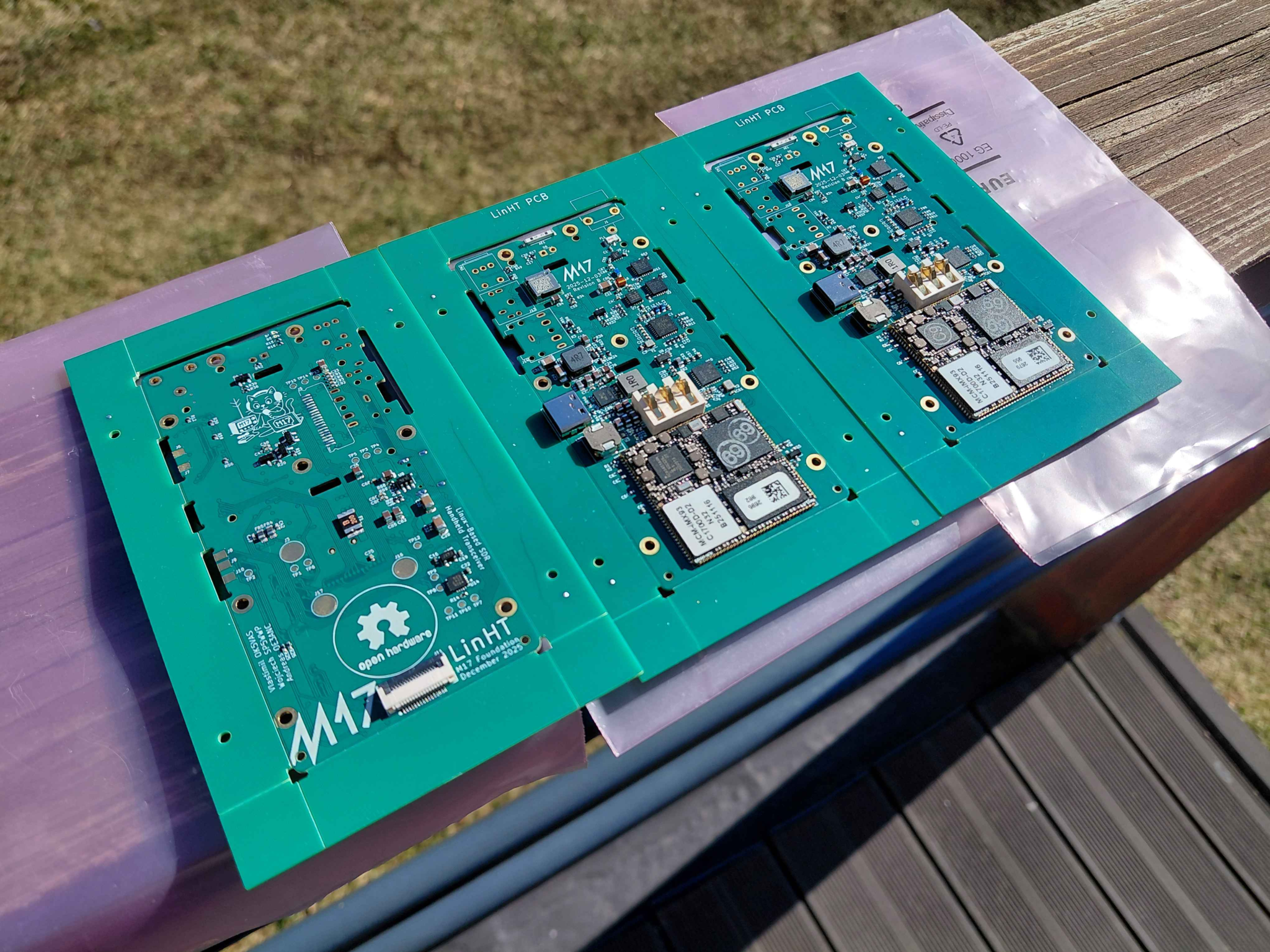
Today, we have received a set of three Rev B boards. They will be tested in the coming days. Stay tuned!
What’s new in Rev B:
– redesigned power supply
– internal RF power amplifier (~5W at 435MHz, CW)
– improved RF receiver path (added variable attenuation)
– GNSS receiver
– battery charging through USB-C
– cleaner layout and grounding
LinHT Rev B update
Vlastimil Slintak OK5VAS:
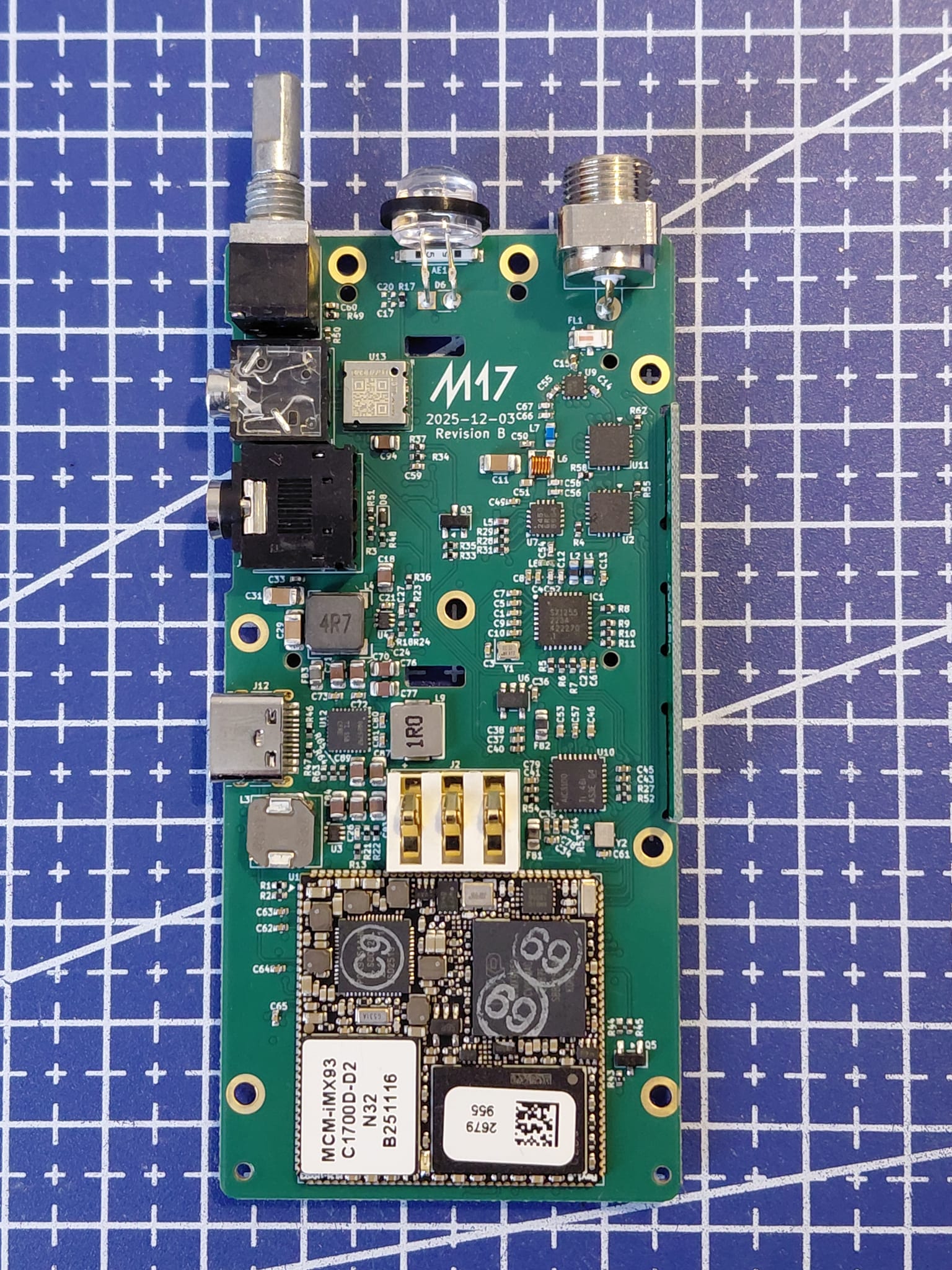
The board powers up correctly, the ATTiny power-management firmware is working, and the PMU logic now controls the startup/shutdown sequence as intended.
USB-C charging is also working as expected, and the whole device can be powered on with the rotary ON/OFF switch.
We also confirmed debug UART from the SoM is available on the Kenwood connector and works with common Baofeng-style USB serial adapters.
There is still a lot of work ahead: update the Linux device tree for the new Rev B pinout, validate all new peripherals, and fully test GNSS, the RF power amplifier stage, and the rest of the hardware.
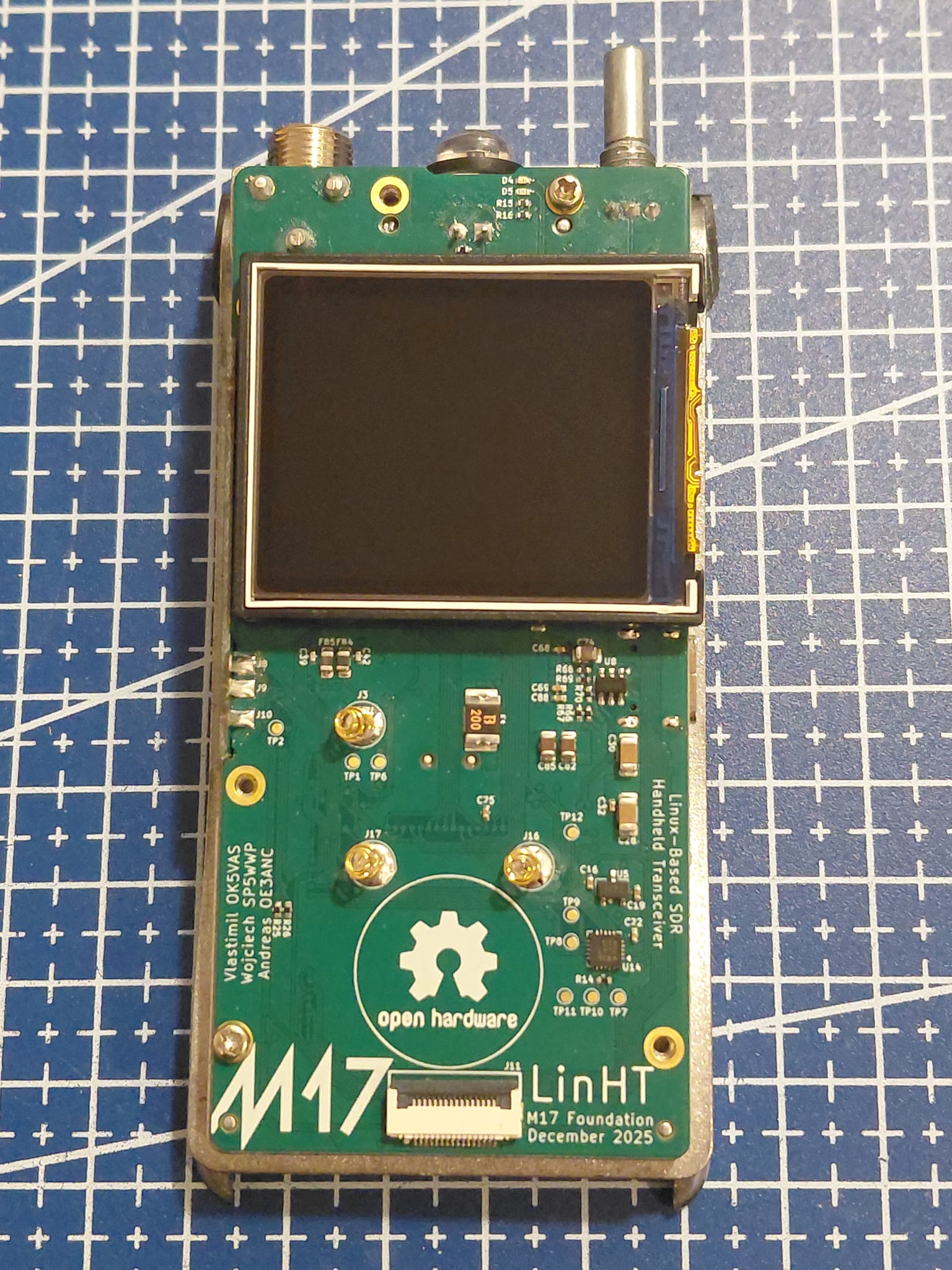
LinHT rev B – first boot
Wojciech Kaczmarski SP5WWP:
Sharing great news from Andreas OE3ANC. Good work, team!
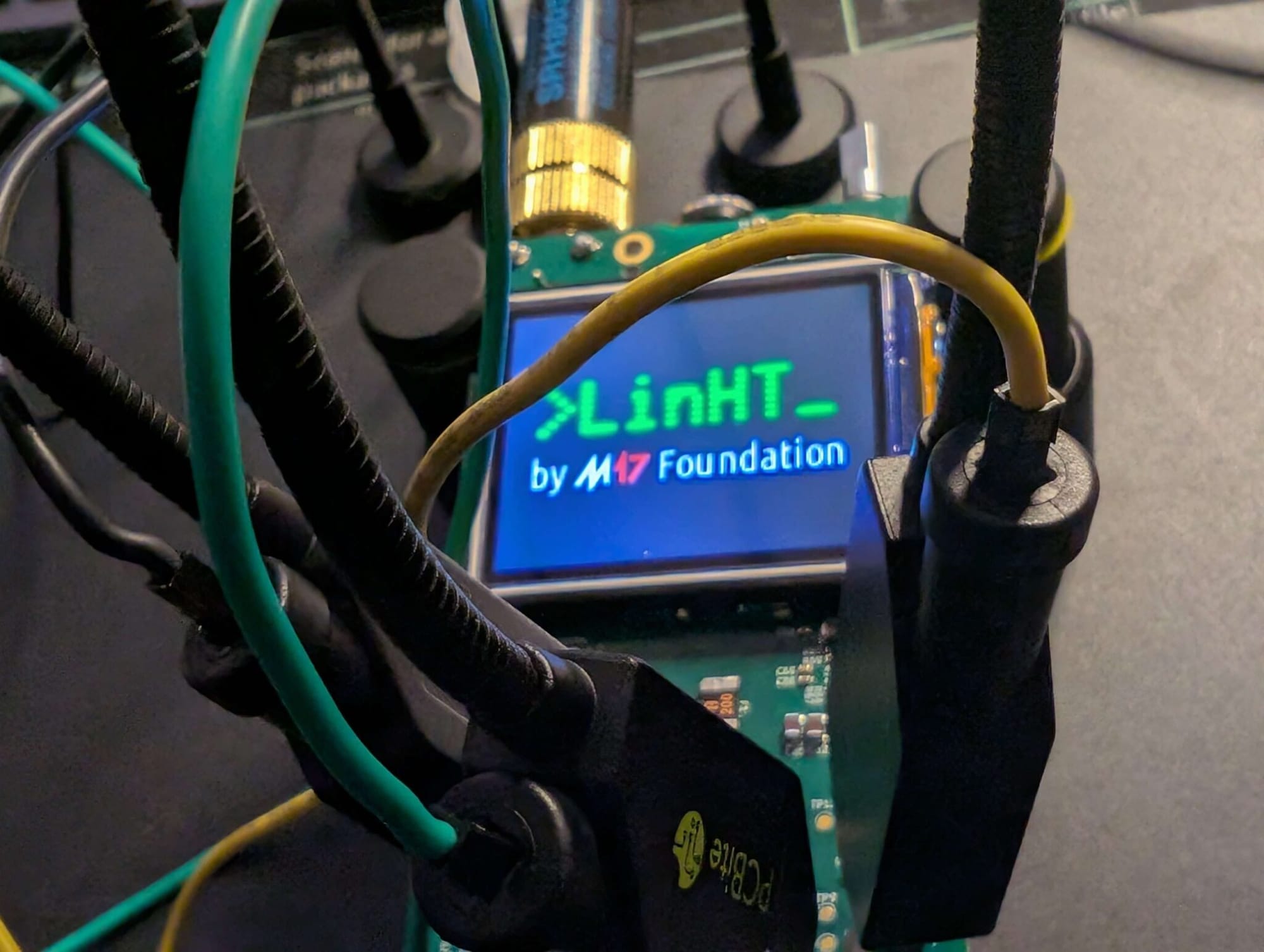
The big feature, to me, in the LinHT Rev B is the integrated 5 watt power amplifier. 5 watts transmit power in a portable device operating on the 70cm / 420-450 MHz band is quite usable. Another feature I wasn't aware that was being developed for Rev B was a GNSS receiver. That's another great feature for the LinHT - that's a cheap way to have a real time clock (time stamping logs, for example) as well as location data for a future APRS-like mode.
It's taking longer than we fans of the LinHT had expected for Amateur Radio manufacturers to get the concept of LinHT and to start getting seriously interested in manufacturing a commercial, turnkey LinHT.
It's also possible, given that LinHT is an open source project with all of the details of the LinHT being developed and reported out in public, perhaps there is a (or multiple) manufacturers quietly developing their own version of LinHT.
When I've written about LinHT and no committed commercial developers - yet, I invoke the mental image of a group of penguins clustering around a hole in the ice. No penguin wants to go first, because there might be a hungry predator waiting under the ice for a tasty penguin meal. But once one goes, they all go. None of the Amateur Radio manufacturers, given consumer price points for Amateur Radio equipment, "want to go first" with a LinHT.
I've also written that manufacturers that are vested in perpetuating their proprietary / current digital modes such as Yaesu (SF / C4FM), Icom (D-Star, NXDN), Kenwood (9600 APRS, D-Star, NXDN), Anytone (DMR) aren't likely to be (initially) interested in manufacturing a LinHT as that will likely cannibalize their lucrative radios.
But I'm convinced it's going to be like a rush of penguins into the hole in the ice - when the first manufacturer comes out with a LinHT - there will be a fast cascade from other manufacturers that don't want to miss out on the vast market for the LinHT.
At the Zero Retries booth at Hamvention 2026, I'll have some handouts about LinHT Rev B as handouts for potential (seriously interested) radio manufacturers that are also at Hamvention.
Kudos to OE3ANC, OK5VAS, and SP5WWP. Developing LinHT has been a lonely quest to date, but I'm in violent agreement with K6BP that LinHT is the most important hardware project in Amateur Radio today.
Please direct comments / feedback about this article to the Zero Retries email list with the #ZR0241 hashtag.
Mercury HF Modem v2
By Steve Stroh N8GNJ
Mercury is a software implementation of high performance, high reliability modem for data communications on the HF bands. Mercury is being developed as a workalike of VARA HF, with equivalent performance and reliability. Unlike VARA HF, Mercury is being developed as open source, and thus no cost. Development of Mercury has been funded by grants (1, 2, 3) from Amateur Radio Digital Communications.
Most information in this article is from the referenced email list message by Rafael Diniz.
Rafael Diniz on the hermes-general email list:
Dear HF radio friends,
After some quiet times, Mercury is back full gas!
The Mercury repository (https://github.com/Rhizomatica/mercury) has been reorganized, and we have some great news!
The main branch has been replaced by two branches:
--
Mercury v1 (mercuryv1 branch): https://github.com/Rhizomatica/mercury/tree/mercuryv1
AGPL v3
This is the original Mercury modem written in C++, with the MFSK weak-signal modes, cross-platform GUI, and the existing ARQ implementation. Broadcast mode is present. It contains the same code that was previously on main. No changes were made to the code — it was simply moved to its own branch.
Kameron is working on Mercury v1 and it has many new features!
--
Mercury v2 (mercuryv2 branch, now the default) https://github.com/Rhizomatica/mercury/tree/mercuryv2
GPL-3.0, LGPL-2.1
This is a complete rewrite of the modem in C, using David Rowe's OFDM modem at the modem (more modems to be added in a later moment). Key changes from v1:
- Modular reactor architecture replacing the monolithic state machine
- Per-direction mode selection — each path (A→B and B→A) negotiates its mode independently based on local SNR
- Hybrid SNR + delivery-feedback adaptive gear-shifting (DATAC4/DATAC3/DATAC1 for payload, DATAC13 for control signaling)
- Persistent FreeDV mode pool eliminating codec re-initialization overhead
- Arithmetic-coded callsign compression with overflow protection
- Async structured logging system with optional JSONL output
- VARA-compatible TCP TNC interface (ARQ and Broadcast)
- Raspberry Pi 4/5 optimized build support
Mercury v2 is what will be deployed on the HERMES stations for store-and-forward email and file transfer over HF. Broadcast mode is also present and working fine.
--
There are no plans to retire Mercury v1 and both versions will co-exist and have new (binary) releases soon!
There was some additional back and forth on the email list, including:
Why not a GUI for mercury as in Vara with only soundcard setup, waterfall and a scope of received signal constellation?
We are working on it:
https://github.com/Rhizomatica/mercury-qt
The Vara command "CHAT ON" or "CHAT OFF" are not implemented and, testing mercury with varim, give a "WRONG" answer.
Good catch. I forgot about CHAT command. I'll install varim here to test.
What's really cool about Mercury, beyond that it's a high performance data communications mode for HF operation, is that it's open source. Thus Mercury can be embedded, adapted / extended / improved / forked infinitely.
As an example of this embedded functionality model, this has already happened in many packet radio systems having integrated Dire Wolf Software TNC. Often Dire Wolf's functionality is embedded so far in the background of the system, it's practically invisible.
Part of that embedded functionality model is becoming "just another mode" in new generations of HF radios, similar to other built-in modes in HF radio, such as RTTY, CW, SSB, etc. This is beginning to happen with FreeDV RADE being supported as a selectable mode in FlexRadio units.
Another cool aspect of Mercury is that a parallel project is to integrate it with an open source HF radio (HF Signals sBitx v3), into a system called HERMES. The combination will be essentially an HF band data communications appliance / modem.
Of course, Mercury and HERMES are just the modem (data transport). The ultimate utility of HF data communications modes are the applications. One of my favorite HF data communications applications is VarAC which integrates a number of data communications "sub applications", including email, messaging, bulletins, file transfers, etc. in a very well developed user interface. I hope that data communications systems and networks such as Winlink, The Packet Radio Forwarding Network (TPRFN), and perhaps DigiPi will eventually integrate Mercury as just another data transport mode.
Please direct comments / feedback about this article to the Zero Retries email list with the #ZR0241 hashtag.
Multi-Instance (Cross Band / Multi Radio) Cluster in VarAC
By Steve Stroh N8GNJ
I've gushed enough in this issue, and previous issues of Zero Retries about the very capable and very polished VarAC application for data communications on Amateur Radio HF and VHF / UHF bands. VarAC uses VARA HF and VARA FM as the "transport layer" and seamlessly integrates email, short messages, bulletins, file transfers, and other modes. It's really a fantastic application, and it's amazing that Irad Deutsch 4Z1AC and Larin Deutsch make VarAC available at no cost for use on Amateur Radio spectrum by Amateur Radio Operators.
But one nagging feature seemed to be lacking in VarAC - the ability to use multiple bands or even a combined HF and VHF / UHF VarAC node. My imagined application is that some users in an area might want to operate a VARA FM / VarAC network on 2m / 144-148 MHz. Others might want to operate VARA FM / VarAC on 70cm / 420-450 MHz. Others might want to use 6m / 50-54 MHz or 1.25m / 222-225 MHz. I thought that would require completely separate computers / radios / modems with no integration or ability to "gateway" between bands.
But I was very incorrect in my understanding / assumption that such a feature was missing in VarAC.
I had a brief email exchange with 4Z1AC where I asked if such a feature could be added to VarAC (similar to that capability already present in the commercial version of VarAC - SafecomLink). To my delight, 4Z1AC replied:
As for multi-instance cluster - this is available already in VarAC. Many already operate a cluster:
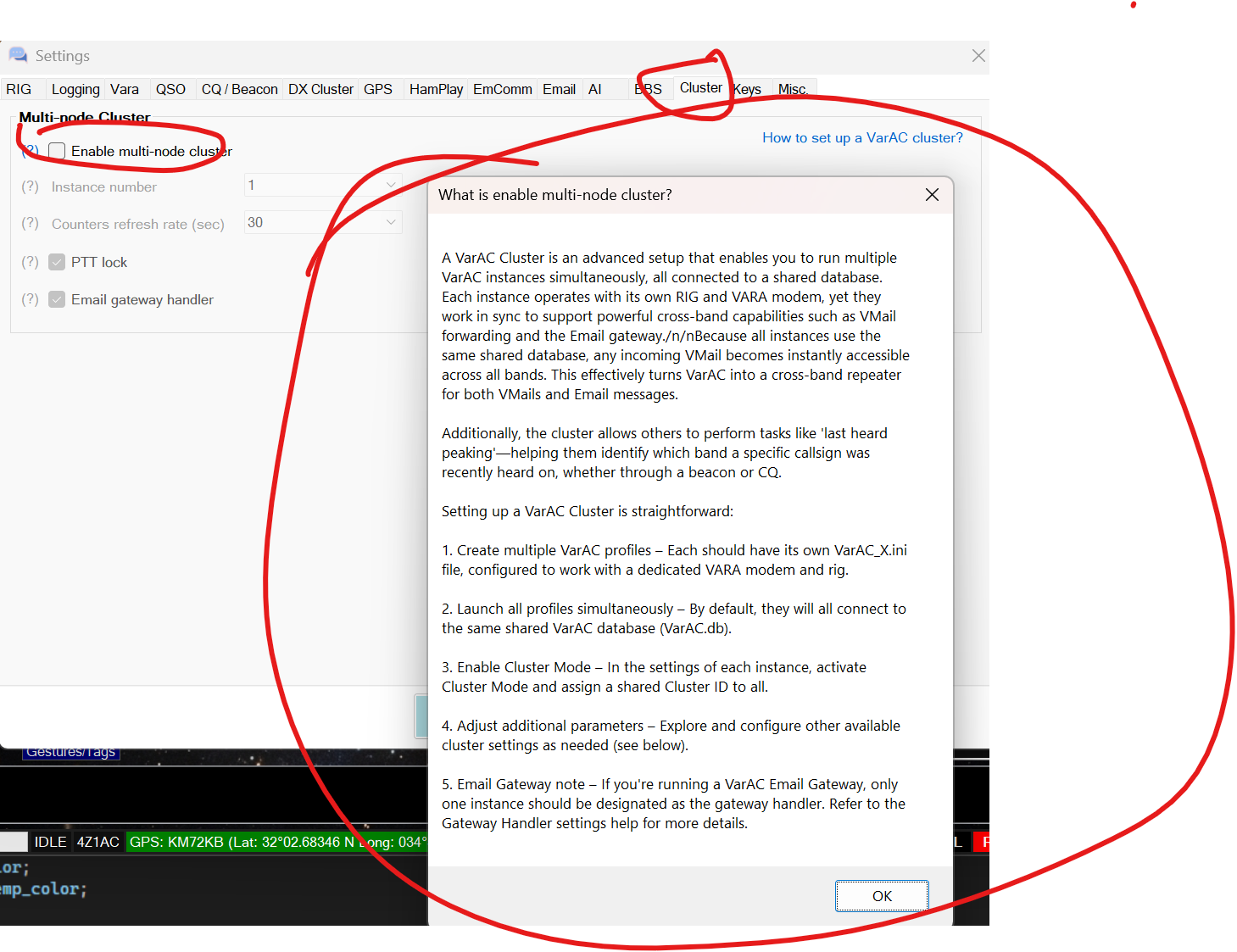
Oh... this rocks my world!
Perhaps even before Hamvention, all three elements of my 2m / 1.25m / 70cm omni antenna are about to get a workout from having three VARA FM radios + modems, and now a VarAC multi-node-cluster connected. I need to fire up one of my Software Defined Receivers and start scouting for quiet frequencies for operating VARA FM on 2m, 1.25m, and 70cm in my area.
Massive kudos to 4Z1AC for this feature!
Please direct comments / feedback about this article to the Zero Retries email list with the #ZR0241 hashtag.
ZR > BEACON
By Steve Stroh N8GNJ
Short mentions of Zero Retries Interesting items.
A Look Back at 2025: ARDC’s Annual Report is Now Available
Rebecca Key KO4KVG on the ARDC website:
Our 2025 Annual Report is now available, highlighting a year of progress as we rolled out new initiatives, shared a clearer strategic direction, and continued supporting innovation across our community. Highlights include:
• Rolling out our vision, strategy, and priority areas for funding
• Approving 79 grants, totaling about $3.4 million, supporting projects across amateur radio and digital communications
• A financial summary highlighting ARDC’s funding and operations
• Launching 44Net Connect, lowering barriers to accessing 44Net address space
• Welcoming Harald Welte to our Board of Directors
• Sharing findings and insights from the Grants Evaluation Team (GET)
• Launching our YouTube channel with the 44Net Origin Story, celebrating 44 years of 44Net
• A look ahead at what’s next for 2026
If you have questions or comments, feel free to reach out at contact@ardc.net.
ARDC's annual reports are, to me, always a fascinating read. An entire year of ARDC's activities, especially the stories about some ARDC grants, condensed into a single engaging document. In my opinion, 2025 was an unusually formative year with ARDC adding their first director who isn't an Amateur Radio Operator, and the 44Net Connect transitioning from beta testing to fully available and operational. I think that ARDC publicly stating their Priority Areas For Funding (and the prominent role of space communications there) was incredibly helpful for Amateur Radio.
ARDC is one of Amateur Radio's secret weapons for creating new technological innovations in radio technology.
SARC Communicator Journal: March-April 2026
Speaking of secret weapons for creating new technological innovation in radio technology, Surrey Amateur Radio Communications' newsletterzine The Communicator is another. The Communicator is an engaging look at modern Amateur Radio, and it helps a lot for it to be approachable to a world audience that it's published in Canada. The Communicator is published online, for free.
I've been so impressed by The Communicator, its subject matter mix, its high production values (kudos to Editor John Schouten VE7TI), and just the overall "tone" of The Communicator that Amateur Radio is cool, fun, and relevant that I asked to become a contributor, and joined SARC as a member. I'll be presenting to an in-person SARC meeting in April. My article in this issue is Rational Optimism About the Future of Amateur Radio, beginning on Page 76:
I’ve been asked why I’m so optimistic about Amateur Radio?
Why can I see a future for revitalized Amateur Radio… and the
“sad hams” cannot?
I’m inspired and energized… and given a bit of vision… by a
number of factors.
One of the biggest factors of my optimism is that Amateur Radio
is a unique microcosm of the technology industry. We have access
to spectrum that isn’t rigidly defined (well, the repeater
operators beg to differ). We have reasonably flexible rules (more
flexible in Canada, but we’ll be working on that factor in the US).
In the US there’s a flexible definition that “undefined codes”
must be “publicly documented”. That’s all it says.
...
Again, there are (always!) a number of Zero Retries Interesting articles in every issue of The Communicator, such as in this issue:
- Chameleon Project: Digital Radio (Page 16) by Kevin McQuiggin VE7ZD / KN7Q,
- High Above The Noise: What’s New in Amateur Satellite Radio (Page 40) by (author unstated),
- The North Fraser Club Balloon Project: High-Altitude Amateur Radio on 925 MHz (Page 54) by Adrian Stimpson VE7NZ,
Radio is the same as in 1920… Really? (Page 114) by John Schouten VE7TI was a great article about ongoing technological innovation in Amateur Radio:
There is a controversial article at https://www.radioworld.com/news-and-business/business-and-law/financial-traders-seek-permanency-for-shortwave-data with the quote: “A radio engineer from the 1920s could take a shortwave radio from the 1920s and transmit and receive voice signals today,” the SMC wrote in a cost-benefit analysis filed to the FCC after a December meeting with the commission.
“It is remarkable how little innovation has occurred in this band.”
This claim by the Shortwave Modernization Coalition (SMC), a proponent of gaining HF bandwidth to trade financial transactions, because it is faster than the Internet...
overlooks a century of profound advancements in amateur radio on the high-frequency (HF) shortwave bands (roughly 3-30 MHz).
...
These digital modes represent profound innovation:
• Spectrum efficiency — Modes like FT8 and PSK31 use fractions of SSB bandwidth, allowing far more activity in crowded HF
bands.
• Power efficiency — Contacts at milliwatts or watts succeed where voice fails, enabling QRP (low-power) enthusiasts to span continents.
• Weak-signal performance — Advanced error correction and digital signal processing overcome noise, fading, and propagation
challenges.
• Accessibility — Free software (WSJT-X, FLdigi) and sound-card interfaces turn everyday computers into sophisticated transceivers.
The Communicator is published bimonthly on the odd months - highly recommended!
Simple D-Star Transceiver Uses Inexpensive Hardware
Donald Papp on Hackaday:
[Yeckel] recently put the finishing touches on an ambitious implementation of a simple D-STAR (Digital Smart Technologies for Amateur Radio) transceiver using some very accessible and affordable hardware. The project is D-StarBeacon, and [Yeckel] shows it working on a LilyGO TTGO T-Beam, an ESP32-based development board that includes a SX1278 radio module and GPS receiver. It even serves a web interface for easy configuration.
...
So far as [Yeckel] is aware, D-StarBeacon is currently the only open-source implementation of a D-STAR radio available on the internet, which is pretty interesting. We’ve seen projects that touch indirectly on D-STAR, but nothing like this.
I'm normally a fan of Amateur Radio articles on Hackaday, but this one has a glaring lack, not mentioning that a D-Star radio (receive and transmit) has been implemented in open source, as one of the modes in Multi Mode Digital Voice Modem (MMDVM), including radio "hotspots". Papp's reference to "touch indirectly" is a very old reference to MMDVM, predating the development of radio hotspots.
The comments on this article are the usual humorous "Hackaday mix" of informed and relevant, uninformed, and inflammatory. None of the commenters made mention that there have been experimental implementations of D-Star that replace the AMBE vocoder with another non-proprietary vocoder. (Obviously, that didn't get wide adoption... but it was proven feasible.) Also not mentioned was that despite that the patent for the particular implementation of AMBE used by D-Star has expired, DVSI is very litigious. Thus, while open source implementations of that version of AMBE are feasible... it's generally been concluded that it's not worth getting into the crosshairs of DVSI's legal team with a workalike implementation of AMBE.
Discovery Drive Campaign Launching Soon
RTL-SDR.com:
Our Discovery Drive campaign will be launching soon, so make sure to sign up for updates on the pre-launch page!
Discovery Drive is an automatic antenna rotator that is designed to be used with our Discovery Dish product, as well as similarly sized antennas such as Wi-Fi grid and Yagi antennas.
A motorized rotator, such as Discovery Drive, enables precise tracking of fast-moving polar orbiting satellites using a satellite dish or directional antenna. Examples of polar orbiting weather satellites include METEOR-M2, METOP, and FENGYUN. Depending on your location, you may also have access to other interesting satellites that dump data over specific regions.
Apart from public weather data, operators and enthusiasts might be interested in using Discovery Drive to track CubeSats, and amateur radio operators may wish to track amateur radio satellites.
Amateur radio astronomy hobbyists can map the galaxy in the hydrogen line spectrum using Stellarium, or custom software to aim a Discovery Dish with H-Line feed, allowing you to scan multiple parts of the sky in one night.
Please check out our promo video below!
There's an unmet market segment with radio experimenters and Amateur Radio Operators for an (more) reasonable cost outdoor rated antenna rotor for use with smaller, lightweight antennas. But what the verbiage above doesn't (explicitly) state, but is quickly obvious from the video, is that this unit isn't (as stated) a mere "motorized rotator", it's an azimuth and elevation rotator, capable of changing two-dimensional antenna orientation for tracking a pass of a Low Earth Orbit satellite with a directional (high gain) antenna or dish.
The price of this unit isn't yet stated, but the closest competition is the Yaesu G-5500DC which is $760 at Ham Radio Outlet. If the Discovery Drive is perhaps half that price, I think it will find a big market for those of us who are increasingly interested in participating in (automated) LEO satellite activity, such as participating in SatNOGS, TinyGS, the Packet Radio and video systems on the International Space Station, and the (I hope, I hop, I hope) a new Packet Radio Store and forward mailbox / BBS / digipeater Packet Radio satellite (PACSAT) in discussion by AMSAT-US (unfortunately, no public facing link for this project).
Inovato, N0LSR Design Endorse Open HamClock Backend Public Server
Amateur Radio Daily:
Editor's Note: Amateur Radio Daily is a contributor to the Open HamClock Backend project and recommends their public server. Amateur Radio Daily headlines have appeared on HamClock since 2023.
Open HamClock Backend (OHB) is now providing a central server for any HamClock user to use with their existing HamClock application. With the original HamClock application scheduled to be sunset in June, the central server provided by OHB will extend the life of existing HamClock installations indefinitely. Previously, OHB users were required to host the server locally. This update allows any HamClock user to utilize OHB's central server through a small configuration change.
When the creator of HamClock became a silent key earlier this year, the HamClock project was expected to be sunset in June 2026. While the HamClock application is open source, the backend server that powers many HamClock features was closed. OHB provides a replacement for that backend service.
Open HamClock Backend (OHB) is a community project by a team of developers with Brian Wilkins (KO4AQF) as the main contributor. It is fully open source, and it runs on servers in a commercial data center. Another example of what the ham radio community is capable of. The hosting in the data center is donated. This provides very high availability with no costs for anyone.
With the stability of the OHB project making its way to a centralized public server, Inovato and N9LSR Design recently announced that they would endorse OHB for their HamClock appliances.
There has been much angst, opinionating, and sparring, and outright bloviating (insert canonical quote about three Hams in discussion arriving at five different opinions) about which "HamClock successor" project is "most legitimate".
In my very, very minor opinion on this matter (with no "standing" whatsoever)...
The presence of Amateur Radio Daily's content on Open HamClock Backend (OHB), and Inovato's endorsement of OHB, combine to make OHB my preferred solution for continuing to use HamClock.
I think very highly of the content of Amateur Radio Daily (and the incredible amount of work Cale Mooth K4HCK puts into Amateur Radio Daily and Amateur Radio Weekly) so it counts a lot that ARD content is on the OHB "fork" of HamClock.
Similarly, Inovato with their inexpensive and capable Quadra / Quadra4K units, in my opinion, made HamClock widely known, widely used, and highly popular in Amateur Radio.
Thus all of my Quadra / Quadra4K units running HamClock will be redirected to Open HamClock Backend... displaying the headlines of ARD among other information.
Apple's New MacBook Neo
(Yeah, there Steve goes again in Apple Fanboy mode. Guilty! But I think it's relevant here - read on.)
In its early 2026 new product introductions this week, Apple debuted the MacBook Neo laptop. This new unit (and new category for Apple) is a cost reduced laptop - base cost direct from Apple is $599. There is some reduction in functionality from the other MacBooks because the Neo uses their A18 processor originally designed for iPhones, 8 GB RAM, and 256 GB storage. For the most common tasks - email, web browsing, etc. the Neo works fine.
Here's why I think that the Neo is applicable to Amateur Radio - increasingly, what we do is done via a web browser. For anything related to that, the Neo would be a great choice. Even if you don't care for Apple's native Safari web browser, all of the other web browsers are available for MacOS on the Neo, including Chrome (or "de-Googled" Brave or Chromium) and Firefox. The number of Mac applications for Amateur Radio is steadily increasing - see Mac Ham Radio for a great overview.
There are two differentiating features of the Neo versus new Windows laptops or Chromebooks in this price class:
- The build quality is superior. Apple didn't "cheapen" the construction of the Neo versus the other MacBooks. Like every MacBook, the lower piece of the Neo is solid aluminum. There's no fan on the Neo (the aluminum body is an adequate heatsink, and the processor is very power efficient).
- Apple has dialed in the battery life of MacBooks with Apple's (again, very power efficient) processors - more than 8 hours of typical use.
There's another subtle issue to recommend MacBooks in general in Amateur Radio - a lot of "command line" applications, utilities, etc. Linux or BSD users require "just work" in MacOS (or are easily added). I know folks that have bought MacBooks that fire up the Command window, make it full screen, and ignore the MacOS graphical user interface completely.
Thus, in my opinion, for typical usage, the price performance of a MacBook Neo has a lot to recommend it. I will be investing in one that I can devote to Amateur Radio use such as remotely accessing my DigiPi station (web browser), my VARA FM / VarAC station (screen sharing into a Windows system), my (eventual) HF station, etc. that all live in N8GNJ / Zero Retries Labs. That a MacBook Neo will be a new, rugged, reliable, inexpensive (enough) laptop that I can dedicate to Amateur Radio is to me a distinct improvement over Winbooks, Netbooks, Chromebooks, or used Windows laptops.
Likely I'll have my new Amateur Radio MacBook Neo with me at the Zero Retries booth at Hamvention where it will be a great way to have new Zero Retries subscribers sign up right there in the booth.
Please direct comments / feedback about ZR > BEACON to the Zero Retries email list with the #ZR0241 hashtag.
Closing Thanks
My ongoing Thanks to:
Tina Stroh KD7WSF for, well, everything!
Jack Stroh, Late Night Assistant Editor Emeritus
Fiona and Shreky Stroh, Late Night Assistant Editors In Training
Founding Members who generously support Zero Retries financially:
Founding Member 0000 - Steven Davidson K3FZT (Renewed 2025, 3rd year!)
Founding Member 0001 - Randy Smith WU2S (Renewed 2025, 3rd year!)
Founding Member 0002 - Chris Osburn KD7DVD (Renewed 2025, 3rd year!)
Founding Member 0003 - Don Rotolo N2IRZ (Renewed 2025, 3rd year!)
Founding Member 0004 - William Arcand W1WRA (Renewed 2025, 3rd year!)
Founding Member 0005 - Ben Kuhn KU0HN (Renewed 2025, 3rd year!)
Founding Member 0006 - Todd Willey KQ4FID (Renewed 2025, 3rd year!)
Founding Member 0007 and 0010 - Merik Karman VK1DF / VK2MKZ (Renewed 2025 x2, 3rd year!)
Founding Member 0008 - Prefers to Remain Anonymous 08 (Renewed 2025, 3rd year!)
Founding Member 0009 - Prefers to Remain Anonymous 19 (Renewed 2025, 2nd year!)
Founding Member 0011 - Rick Prelinger W6XBE (Renewed 2025, 2nd year!)
Founding Member 0012 - Ryan Tolboom N2BP (Renewed 2025, 2nd year!)
Founding Member 0013 - Newton White N4EWT (Renewed 2026, 2nd year!)
Founding Member 0014 - Joe Hamelin W7COM (Renewed 2026, 2nd year!)
Founding Member 0015 - Rich Stocking N7OP (New 2025)
Founding Member 0016 - Prefers to Remain Anonymous 77 (New 2025)
Founding Member 0017 - Phil Karn KA9Q (New 2025)
Founding Member 0018 - Prefers to Remain Anonymous 95 (New 2025)
Founding Member 0019 - Prefers to Remain Anonymous 0108 (New 2025)
Founding Member 0020 - Prefers to Remain Anonymous 110 (New 2025)
Founding Member 0021 - Prefers to Remain Anonymous 111 (New 2025)
Founding Member 0022 - Prefers to Remain Anonymous 112 (New 2025)
Founding Member 0023 - Prefers to Remain Anonymous 116 (New 2026)
Founding Member 0024 - Rob Bowser (SPOOLTENNA) (New 2026)
Numerous Annual and Monthly subscribers who also generously support Zero Retries financially!
You thousands of readers of Zero Retries without which there would be little point in publishing this newsletter.
Permission to Reuse Zero Retries Content
Blanket permission is granted for Amateur Radio use of any Steve Stroh content in Zero Retries for Amateur Radio newsletters and distribution via Amateur Radio such as (but not limited to) Packet Radio Networks, Packet Radio Bulletin Board Systems, Repeater Nets, etc.
In such usage, please provide appropriate authorship credit for the content (especially for guest authors) and mention that it was first published in Zero Retries newsletter, preferably in this format:
This article is reprinted with permission. It was first published in Zero Retries newsletter, issue Zero Retries (number), (date) - (include full web link of the specific issue).
It’s appreciated (a courtesy, but not required) to notify Zero Retries Editor Steve Stroh N8GNJ of any reuse of Zero Retries content - editor@zeroretries.net.
If you’d like to republish an article in this issue for other uses, just ask.
All excerpts from other authors or organizations, including images, are intended to be fair use. Unless otherwise noted in the article, there are no paid promotional items in any Zero Retries articles.
Portions Copyright © 2021, 2022, 2023, 2024, 2025, 2026 by Steven K. Stroh.
This issue released on 2026-03-06
(end)