Zero Retries 0235
2026-01-23
Zero Retries is an independent newsletter promoting technological innovation in and adjacent to Amateur Radio, and Amateur Radio as (literally) a license to experiment with and learn about radio technology. Radios are computers - with antennas! Now in its fifth year of publication, with 3400+ subscribers.
Steve Stroh N8GNJ, Editor
Ghost says this issue is too big for email clients? YES
Thus, it might be easier to read this in a web browser -https://www/zeroretries.radio/zero-retries-0235/
In This Issue...
- Request To Send
- The Saga of the Conversion to Ghost - Part 2
- Paid Subscribers Update Next Issue
- Apologies for Too Much Technological Innovation in Amateur Radio
- Collision(s) with the Future of Amateur Radio
- Collision 1 - The CW Gray Zone
- Collision 2 - Digital Voice Modes Versus Software Defined Radio
- Collision 3 - The Largely Unnoticed Rise of NewTechHams
- Conclusion
- What Would A Future Mesh Networking Broadcast Include?
- ZR > BEACON
- Announcements of IP400 Developments - January 2026
- Two Tech Minds Videos
- AMSAT CubeSatSim Kit - Heathkit Edition Educator Pack
- MeshCom - a New "Meshxxx" Variant Specifically for Hams
- A Latent Interest In Amateur Radio Paging
- SafecomLink
- Closing Thanks
- Permission for Reuse of Zero Retries Content
Request To Send
It will take me a while to figure out formatting (and Markdown). Thus the form and formatting of these next few issues of Zero Retries will be pretty rough in deference to pushing out Zero Retries on schedule(ish).
The Saga of the Conversion to Ghost - Part 2
As you probably see, getting Ghost and the new zeroretries.radio domain hasn't gone smoothly. I won't fault Ghost, or dotRadio domains specifically, but from my experience this week, they're unable to "play nice together" to allow me to use just, plain zeroretries.radio as a domain name for a Ghost newsletter.
Ghost has their requirements, and dotRadio domains (owner of the .radio top level domain) domains has their requirements. Both have pointed out that they each "play nicely with others". Ghost supports many domain registrars to allow root domains as a domain name for a Ghost newsletter... but not the dotRadio domain registrar. Similarly, there many other uses of a .radio domain that are able to use .radio as a root domain... but not Ghost.
After multiple rounds of emails with both Ghost and dotRadio domains technical support, the best accommodation that could be reached this week is to use:
www.zeroretries.radio
Yeah, I hear you - in 2026 (heck, probably in 2006...) it shouldn't be necessary to use a subdomain as a website URL. But, apparently, my choice of the combination of Ghost and a .radio domain just can't quite gell together to allow use of zeroretries.radio without a www (or other) subdomain.
I don't consider this ultimately acceptable in the long term. It's cumbersome to constantly specify www (I've been doing it for more than four years now and it's grown tedious). I plan to do one last plea to the Ghost and dotRadio domains support folks that while www.zeroretries.radio works with Ghost and dotRadio domains, that isn't really what I want to be using, and is there some way that the two orgs could work it out that I could use Ghost and a domain of zeroretries.radio?
In the likely event that doesn't work, I'm going to consider a number of alternatives such as using a different domain that I can get working as a root domain with Ghost.
I will get that working and stable before pulling the triggers of deeper usage of Ghost, such as importing the nearly 3500 email subscriber email addresses currently on (Substack) www.zeroretries.org, and turning on payment options. I really want a stable domain name in place before doing any of that.
Thus this is why you're viewing this on www.zeroretries.radio (Ghost) from a email likely received from www.zeroretries.org (Substack).
For the DNS experts out there, here's the DNS settings that work between Ghost and dotRadio domains for www.zeroretries.radio:
@ 18000 IN A 178.128.137.126
www 18000 CNAME zeroretries.ghost.io
These are the DNS settings Ghost says are required to use Ghost with a root domain such as zeroretries.radio:
CNAME @ [subdomain].ghost.io
A www 178.128.137.126
Oh, and kudos to you brave few who found their way to www.zeroretries.radio and signed up for email already. Special Kudos to Tom Salzer KJ7T who was the very first email subscriber on www.zeroretries.radio / Ghost.
Paid Subscribers Update Next Issue
(Post publication Update)
Apologies to the new and renewing Paid Subscribers. I will include those updates from the previous week and next week in Zero Retries 0236.
Please offer comments / feedback about Request To Send on the Zero Retries email list with the #ZR0235 hashtag.
Apologies for Too Much Technological Innovation in Amateur Radio
By Steve Stroh N8GNJ
A friend who's more knowledgable than I about most of the topics presented here in Zero Retries (they're wicked smart, very highly placed in a core Internet organization, and has much more actual hands-on experience with data modes in the last decade than I do) unsubscribed from Zero Retries last week.
Besides this friend, I've only ever reached out to one other "unsubscribe" because I was curious why they did so. The turnover of "unsubscribes" to Zero Retries is perhaps 3-5% of the new subscribes, so I figure I'm generally doing a fair amount right for the email subscriber count to have ticked up to nearly 3500 despite the unsubscribes. My friend said, basically, that while they like Zero Retries...
it's just too much to read.
That's not the first time I've heard that plaint, though most who say that confess that they don't read much of Zero Retries, but they stay subscribed because I sometimes mention something that they may be specifically interested in.
The problem is... I don't know how to rein it in. The entire point of Zero Retries is to highlight the incredible technological innovation that's occurring now in Amateur Radio. I guess it's a good problem to have that there is so much technological innovation occurring in Amateur Radio.
Maybe I could shorten up the weekly issues of Zero Retries. I've toyed with the idea of Zero Retries Magazine... with monthly issues running at a length of probably more than 50 pages in PDF format (not distributed via email) much like The Communicator. The weekly Zero Retries newsletter would perhaps be a terse editorial with mostly ZR > BEACON short mentions. Or much simpler blog format with each individual story a blog post like what Random Wire has decided to do with EtherHam. But then, some of the value of Zero Retries is lost - you don't really see the total amount of technological innovation happening in Amateur Radio, at least in weekly increments.
Nothing will change in the short term; I still have lots to do with the changeover to Ghost, the Zero Retries Guides, and the book. But clearly, if I'm losing knowledgeable folks like my friend out of the Zero Retries readership, I could, and should, be doing something better to address that issue.
Please offer comments / feedback about this article on the Zero Retries email list with the #ZR0235 hashtag.
Collision(s) with the Future of Amateur Radio
By Steve Stroh N8GNJ
I had three distinct "collisions" with the past (or present) of Amateur Radio and what I'm observing as the future of Amateur Radio... all the in same number of days. I'll call them:
- The CW Gray Zone
- Digital Voice Modes Versus Software Defined Radio
- The Largely Unnoticed Rise of NewTechHams
Collision 1 - The CW Gray Zone
The first collision was CW (Continuous Wave), more formally known as On / Off Keying (OOK)... usually known as Morse Code operation. I had a email exchange with two people who got kind of bent when I offered a comparison between the craft or skill of CW / Morse Code with the craft or skill of woodworking.
CNC Woodworking
I had a blinding analogy about CW in the 21st century in having watched a video about a woodworker who had obvious skill in hand crafting various projects with wood, but was delighted with the addition of a Computer Numerically Controlled (CNC) router table to their wood shop. Now they could design more intricate wood projects by modeling what they wanted to see in the wood in software, and send that model to the CNC router table to reproduce the model more accurately, and much faster, than they could do so by hand.
Computer Assisted CW Radio
Then in space of a day after I watched the CNC router table video, I had a reason to visit the PreppComm Amateur Radio site and saw their newest product Nomad. Nomad is a clamshell device which opens to a keyboard, and a small screen. Nomad is a 80m / 40m / 20m HF radio... solely for computer assisted CW. It doesn't even have an input for a microphone. You type your inputs to be transmitted, and what you type is transmitted in CW. When you tune the radio to a CW transmission, the received CW is displayed on the screen.
The CW Gray Zone
In Amateur Radio, CW is kind of a litmus test, or dividing line... actually, more of a gray zone. On one side of the gray zone are who think CW is fun, and it's the vital soul of Amateur Radio. On the other side are those who think CW is an anachronism... outdated... irrelevant.
My two friends are mostly on the CW is fun / vital side and extending into the gray zone. They both enjoy CW and continue to think it's highly relevant in Amateur Radio.
The NewTechHams (and OldTechHams) that are mostly the readers of Zero Retries, in my experience, mostly consider CW to be uninteresting other than mild curiosity that it's still in use... though it is occasionally still useful as a simple mode of transmitting required identification that's universally recognized as valid, such as on a repeater system.
The Nomad and its use case lives exactly in the middle of the CW Gray Zone. The CW gray zone is populated by folks like me who see CW as both fun and an anachronism. When I get back to operating on the HF bands, hopefully in the next few months, as with nearly every radio I put on the air, there will be an audio interface and computer connected for doing data modes. One of the modes I'll definitely be checking out is CW activity, and I may encounter my two friends on the bands - them doing CW by hand (and ear) and me letting the computer enhance my CW abilities to do a better job transmitting and receiving CW than I can do by hand.
Just like that woodworker who uses their CNC router to do better, faster work than they could solely by hand.
Collision 2 - Digital Voice Modes Versus Software Defined Radio
The second collision was the future of digital voice modes. I was having an email discussion about a particular digital voice mode. I was trying to explain how the Linux Handheld Transceiver (LinHT) Project fits into the paradigm of multiple Digital Voice modes used on Amateur Radio.
My correspondent didn't seem to grasp the true nature of the LinHT and Software Defined Radio (SDR) technology in general (of which the LinHT is just one implementation). That is that Software Defined Radio renders the "partisanship" of specific modes irrelevant - it can do them all. Radios that are "hardware defined" for a specific mode or modes - such as Digital Mobile Radio / Frequency Modulation (DMR / FM) exist because:
- Particular implementations of Digital Voice technology was the best that the technology of a decade or so ago could do.
- The manufacturer of a radio has a vested interest in perpetuating a specific digital voice mode that best perpetuates their business model. (This is most pronounced in the competition between Icom and Kenwood to support D-Star but not DMR or System Fusion, and Yaesu supporting System Fusion but not D-Star or DMR. Not to mention no support from a China manufacturer for D-Star or System Fusion despite both being "open" standards.)
- The network effect of numerous radios on the market at varying price points, the radios that your friends have, and repeaters that are fixed function with one digital voice mode.
Now we can do better with the vastly improved technology of this era - Software Defined Radio. SDR technology has been dribbling into Amateur Radio, but largely hasn't been a factor in VHF / UHF operations other than inexpensive Software Defined Receivers. But as exemplified by the LinHT project, that's about to change.
With the LinHT, and its technological successors, we'll have radios that are Any Mode... it's just software. Different digital voice modes won't be any more distinctive or advantageous than different speeds of CW.
But what my email correspondent really didn't grasp was that the current digital voice modes aren't the best we can do, even at this moment.
As in soon enough, there won't be any (radios dedicated to specific voice modes). Such radios will be functionally as antiquated as the original cellular "brick" phones. These new generations of radios will be truly software based radios, and the software will be under the control of the user. FM, no sweat. DMR yep. And new variations of voice modes like M17 and BBFM (both entirely Open Source) no sweat either. Etc. These new software based radios will handshake to find the best common mode they're both capable of.
Data modes... of course (I'll spare you that speech). With a bit more processing power (that you know is coming in the next couple of years... such progression is inexorable...) we'll have Machine Learning on device so the radio will just figure it out.
The leap of... not faith... but vision... required to make these new radios will probably require a new generation of manufacturers. The Packet Radio era created PacComm, DRSI, Kantronics, hugely enlarged AEA's and MFJ's volume of business. It could... and I think will... happen again in this era of incredible capabilities in radio technology, combined with highly automated electronics manufacturing. That's because there's a gaping void in the middle of the two way radio market (not just Amateur Radio) between...
- Low end, simple commodity two way radios as currently being manufactured in China - typically FM / DMR, and
- Higher End / High End / Commercial / Government fixed function two way radios as currently being manufactured by vendors like Icom, Kenwood, Yaesu, Motorola Solutions, L3Harris, Thales, Tait, etc.
Someone is going to figure this out. Similar to those Packet Radio vendors leveraging the equivalent of Open Source in that era (TAPR offering a reasonably priced license to clone the TAPR TNC 2), someone's going to figure out how to leverage the Open Source technology of the LinHT to make better radios and exploit that gaping void in the middle of the two way radio market.
Collision 3 - The Largely Unnoticed Rise of NewTechHams
The third collision was in a conversation with a Zero Retries reader about their experiences with new, young hams coming into Amateur Radio getting somewhat interested in operating Morse Code. They offered this feedback in response to my mentions of the rise of NewTechHams.
Admittedly I probably have some situational bias with publishing Zero Retries, but while I have seen some small amounts of interest in Morse Code (hey, secret language, kind of cool...), I'm seeing far more NewTechHams quietly coming into Amateur Radio, pretty much unnoticed by Amateur Radio at large - with litter or no interest in Morse Code. Because the nature of their specific interests in Amateur Radio, NewTechHams tend not to get noticed such as by this Zero Retries reader. Typically NewTechHams don't join clubs, they don't join organizations like ARRL, they don't talk on repeaters, (though they own and experiment with the requisite inexpensive portable radio), etc. They're learning about Amateur Radio from YouTube and TikTok, and exchanging questions and info on Discord and Reddit. Thus they go largely unnoticed except by their peers, and more often than they get active on Amateur Radio, they get active on Meshtastic / Meshcore on unlicensed spectrum.
I posit that NewTechHams are coming into Amateur Radio in surprising numbers, and they're just not being noticed because they're not "showing up" in conventional metrics of Amateur Radio "growth". To answer a plaint in advance, no the numbers of NewTechHams certainly aren't offsetting the numbers of Amateur Radio licenses that are not being renewed, for whatever reason...
Here's a thought experiment with regard to NewTechHams... reach out to all of them. The only contact info we positively have access to is their postal address (at least in the US; in some other countries, even that info is considered non-public). Thus what if a NewTechHams organization did a postal (as in postcard) mail campaign to all of the new Amateur Radio licensees in the past five years, perhaps even a decade? The postcard would be simple, but interesting (like a photo postcard, maybe even interesting enough to put on the fridge) with some compelling message to get them to check out the website of a new Amateur Radio organization that catered specifically to the interests of NewTechHams? The trick is that you'd get one shot to make a good impression in specifically addressing the interests of NewTechHams.
Conclusion
In offering my observations about these three distinct "collisions" with the past (or present) of Amateur Radio, I'm not trying to present myself, or Zero Retries as some specially privileged observer, or an oracle, or a Grand Poobah of anything. All I'm doing here in Zero Retries in general, and in this article, is trying to be transparent about the trends I'm observing happening now in Amateur Radio.
Your observations of Amateur Radio and its future will undoubtedly vary.
Please offer comments / feedback about this article on the Zero Retries email list with the #ZR0235 hashtag.
What Would A Future Mesh Networking Broadcast Include?
By Steve Stroh N8GNJ
In my earlier writing career about Broadband Wireless Internet Access, a vendor of microwave communications equipment reached out to me to explain their new mesh networking microwave nodes. If memory serves, these units were intended to operate on the 28 GHz or so licensed microwave bands. What was interesting about that vendor was how they intended for their units to cooperatively share the use of the 28 GHz band. Keep in mind that this is a band where every use is coordinated, licensed, and operated as individual point-to-point links. For every link, there was a pair of radios. Every hardware vendor loved this model. Every user of that band hated that model. This vendor (whose name I've long since forgotten) had a better idea using the (then) new technology of phased array microwave antennas (for communications).
The vendor's basic idea was that they could implement point to multipoint "within the rules" by combining three distinct techniques:
- Frequency separation (generally a 100 MHz channel, if memory serves),
- For each transmission, the phased array antenna would focus the beam in a specific direction (thus "within the rules" of a "point to point" pair of antennas),
- Separating transmissions to various receivers on a synchronized time schedule (down to the milliseconds).
The differentiation of this system from pairs of radios was that every transmission from every unit included all of the above information - frequency, direction (path of beam), and specific time slot and did so in a way that every other unit in the area could passively receive all of this information, even from units not belonging to the same organization.
Thus if both "Telecom A" and "Telecom B" both deployed these units in the same area, the units were aware of what all the other units operating in the area were doing. If memory serves, another piece of information was whether there was interference on a particular path, frequency, or timeslot and thus, that one needed to be avoided.
Beyond the utility of increasing the overall capacity of links operating on the 28 GHz band in a particular area, one (attempted) selling point was that there was a cost savings because an individual radio installed on one corner of a building could operate "dynamic" point-to-point links to any other radio in a 90° arc. Thus the one unit could do the work of multiple radios required in traditional pairs.
In the end, this technique was innovative, but the company didn't really get much traction in the market and, like so many other radio technology companies in the early Internet boom, quietly went out of business.
One funny moment was when they were describing their new technology to me, that I immediately grasped the utility of the "broadcast to all nodes" idea. They told me usually, "press" like you doesn't usually get the concept. But, my background included Amateur Radio, and a little known 1995 Ph.D. thesis - Decentralized Channel Management in Scalable Multihop Spread-Spectrum Packet Radio Networks by Tim Shepard KD1KY.
In his thesis, KD1KY did a thought experiment about being able to scale packet radio transmissions on the same frequency, but collisions increased with the number of transmissions. The "conventional" approach was to implement a control unit which "parceled out" transmission time slots to each unit, but what if the control unit fails? KD1KY figured out that if each unit transmitted its preferred time slot for transmitting, and then listened to all the other transmissions, each broadcasting their preferred time slots, eventually each unit would adjust their time slots to accommodate everyone, as much as possible, without requiring a control node. You can hear KD1KY describe his theory in a presentation at the Digital Communications Conference 2017 - HRN 358: Tim Shepard KD1KY 'Thoughts on Regulation' 2017 DCC. (My thanks to Gary Pearce K4AAQ for recording this at DCC 2017 and making it widely available on YouTube.)
A unit's preferred / adjusted time slot is just one of many parameters that would be useful to broadcast for other units to be aware of in a decentralized, dynamic network. I thought of a few other such useful parameters:
- Transmit on a specific beacon / hailing channel
- Use a simple modulation (not OFDM)
- On 144.39 use typical 1200 bps AFSK (not very often)
- On 222-225 MHz or 420-450 MHz use faster modulation methods like MMDVM-TNC or OFDM
- General Info
- What date I think it is
- What time I think it is
- What is my general transmission time (what minute on the hour)
- Software Version
- Funny Stuff
- Finger file
- What is my public key (for authentication)
- Am I on emergency power?
- If yes, time remaining
- ID Info
- Who I Am (callsign)
- My preferred map icon (from APRS)
- My IP address (unique in network)
- Location Info
- Stationary or Mobile?
- Location
- Grid Square
- Lat/Long
- Transmission / Radio Info
- TX power
- Changes to low if I’m on battery power
- TX frequency
- Gridsquare coverage (what I reliably cover)
- EIRP - TX power - feedline +/- antenna
- Height of antenna
- Antenna is directional or omni
- If directional, beamwidth
- Polarization
- TX power
- Operational Characteristics
- OK to relay my transmissions (Yes / No)
- I am OK to relay other’s transmissions (Yes / No)
- Am I a Repeater (Yes / No)
- If yes, Input Frequency and any other access info (CTCSS, etc.)
- Am I operating on a repeater
- If yes, repeater info
- Do I have (digital) voice capability (Yes / No)
- If yes, which digital voice mode(s) I'm capable of
- Network Neighborhood
- Channels that I hear that are heavily used (% occupied)
- Channels that I hear that aren’t heavily used
- Once per day, channel statistics that I hear
- Channel / which seconds of the day I hear occupied
- Bulletin stations I hear and receive from
- Bulletin stations I send to
- Winlink stations I can reach
- Do I receive APRS on 144.39
- Repeaters I know about and can use
- Nodes I know about and can connect to
Obviously this is a though experiment and wish list, nothing like a serious proposal. We in Amateur Radio didn't ever (that I'm aware of) ever do anything close to this degree of information transmission within Amateur Radio data networks. But in the mid 2020s and beyond, with the compute power we have available, with a properly formatted specification, it seems feasible to me that we could create a very compact "hash" of all of these parameters (and many more reserved for future use) so that when each node transmitted, the "network neighborhood" would know a heckuva lot of information about each node, and work cooperatively in the network to maximize network utilization and reliability.
Just as one example...
- Node B has good connectivity with Nodes A and C,
- Node E has good connectivity with Nodes C and F
Then Node C would be aware that if Node A and Node F want to communicate, it can automatically relay between Node A and Node F.
This is an example of the kind of technological innovation and experimentation that any one, any group, could now implement using Amateur Radio spectrum.
Please offer comments / feedback about this article on the Zero Retries email list with the #ZR0235 hashtag.
ZR > BEACON
By Steve Stroh N8GNJ
Short mentions of Zero Retries Interesting items.
Announcements of IP400 Developments - January 2026
From Alberta Digital Radio Communications Society (ADRCS) News page:
Calgary, Alberta, January 13th, 2026. Following the presentation at the ZRDC the society is pleased to announce that its power node is now in development and that the specification for the supernode is now available for developers. Copies may be obtained by requesting one from the contact form, and it is also available on the developer GitHub repository.
Calgary, Alberta, January 20th, 2026. The society is pleased to announce that the IP400 supernode is now entering its development phase. This node provides a data upgrade with two native modes: a compatible 4FSK mode on 400MHz a high speed OFDM mode on the 2.9GHz band for backbone data network implementations, combined into a single RF modem. The hardware will be a HAT module for an existing raspberry Pi system, which can operate either in a standalone mode or as a simple upgrade to an existing AllstarLink system. A third data mode is currently in the design phase, which will enable IP400 traffic on conventional FM radios. Copies of the specification are available on the developer GitHub site, or to members upon request. The OFDM mode development is being sponsored by a grant from ARDC.
Calgary, Alberta, January 23rd, 2026. The Alberta Digital Radio Society is pleased to announce that it has chosen to extend its Orthogonal Frequency Division Multiplexing (OFDM) development to include an audio band version that will be the basis for the third data mode of its IP400 Supernode. “This mode will enable conventional analog FM Radios and repeaters in either the 2M, 220MHz, 440MHz and 900MHz bands to join data networks at higher data rates than have been previously been utilized”, says Martin Alcock, VE6VH, founder of the IP400 project, who goes on to say “the data capability not only breathes new life into existing repeaters that are falling into disuse, but can be also be used in peer to peer applications. The higher data rate will enable not only data-oriented communications such as telemetry and messaging, but also digital voice coders that are more intelligible than those that are currently in use in existing digital modes”.
These announcements reflect that there's apparently a lot of development work underway on the IP400 Network Project. I'm recently back in touch with Martin Alcock VE6VH who alerted me to these announcements. There's a lot of detail to unpack and understand in more depth from these announcements, especially the newly announced 4FSK and "OFDM in audio" modulations.
Two Tech Minds Videos
Intercept Radio Signals For Intelligence Gathering With An RTL SDR
Matthew Miller M0DQW on his Tech Minds YouTube channel:
Here we take a look at a new software for RF Signal Intelligence. Intercept is a free download and can be installed on OSX and Linux based machines, providing a quick and easy solution to using the most popular RTLSDR decoding packages.
My thanks to Amateur Radio Weekly Issue 404, and Zero Retries Pseudostaffer Cale Mooth K4HCK, for the first mention that I saw of this video. Amateur Radio Weekly is an excellent Zero Retries Interesting "read it right now" publication.
This is NOT a normal Radio! But it can do amazing things!
Matthew Miller M0DQW on his Tech Minds YouTube channel:
In this video we take a look at a B210 clone and use GBU Radio to test its features. Is this the perfect setup for RF Hacking and Cracking or is it just an extreme learning tool?
My thanks to longtime friend of Zero Retries Joe Hamelin W7COM for the first mention that I saw of this video.
One of the things that I find most encouraging and interesting about the Tech Minds YouTube channel is that every video released there is consistently Zero Retries Interesting. (Not to mention that the content and production values are very high quality.) The former video, released 2026-01-01, as of today has 74,500 views to date. The latter video released 2026-01-11 has 43,202 views to date. YouTube states that Tech Minds has 152K subscribers. Thus I don't feel quite so "lonely" in publishing Zero Retries Interesting content after seeing numbers like that. Given the very technical material that M0DQW publishes, and the intense "Amateur Radio" competition on YouTube, obviously there is a much larger audience for Zero Retries Interesting information out there... I just need to be doing (a lot) more information dissemination on video.
AMSAT CubeSatSim Kit - Heathkit Edition Educator Pack
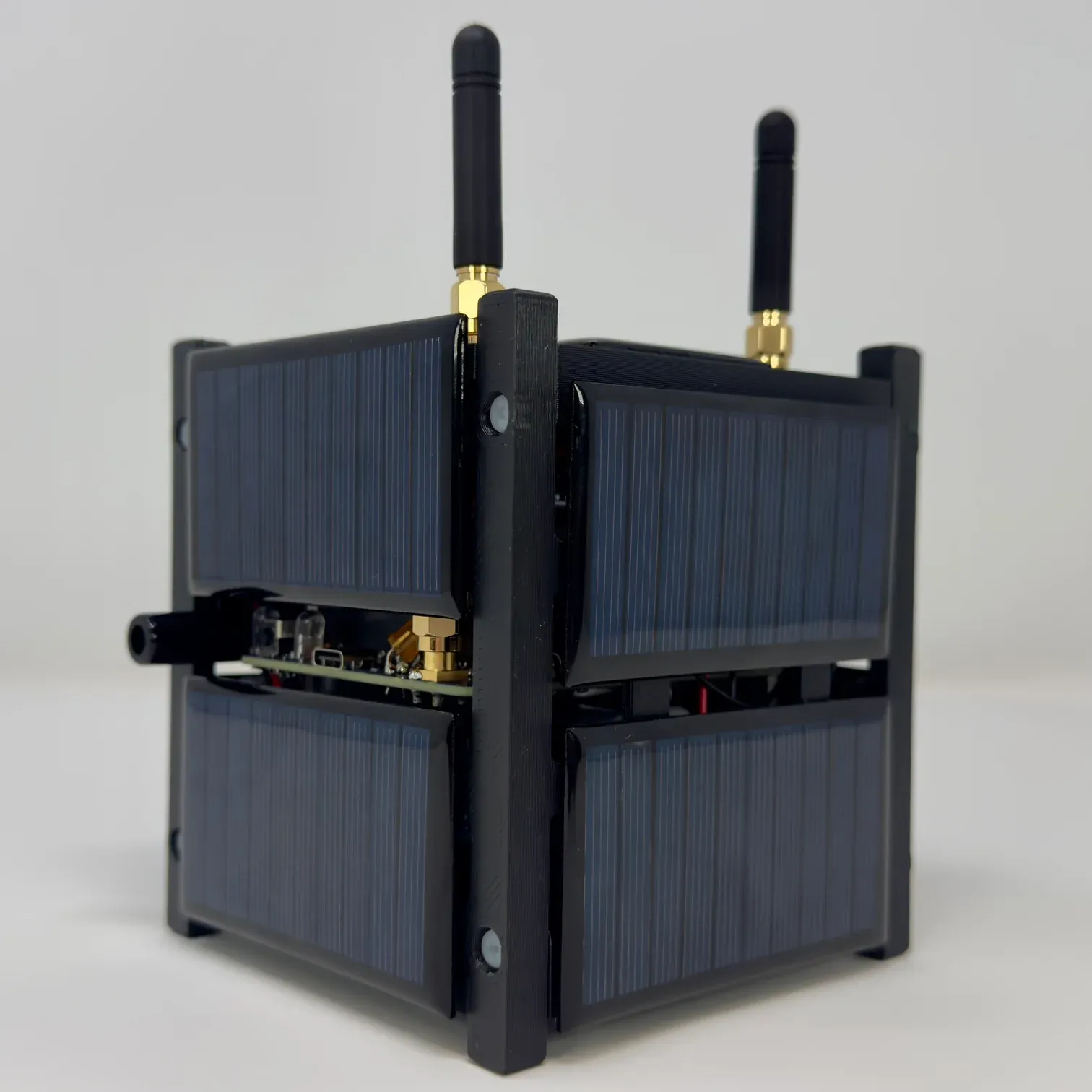
Heathkit is thrilled to make our return to the Amateur Radio sector in partnership with AMSAT and Kirkwall through a special Heathkit edition of the AMSAT CubeSatSim.
Designed by KU2Y, KI6ZUM, and WD6DRI; with help from a team at AMSAT, the CubeSatSim is a low cost satellite emulator that runs on solar panels and batteries, transmits UHF radio telemetry, has a 3D printed frame, and can be extended by additional sensors and modules. Through integration with the Kirkwall IoT monitoring software, this CubeSatSim educator pack builds on the opportunity to learn about satellite communications and Command & Control (C2) with the addition of the comprehensive Kirkwall monitoring platform for any sensors connected to the CubeSatSim through the QWIIC connect system. With applications ranging from university research to space enthusiast and hobbyist builds, users will enjoy the ultimate hands-on educational experience in CubeSat engineering, satellite communications through Amateur Radio, and satellite IoT sensor monitoring.
...
The CubeSatSim has the following features:
• Working solar panels and rechargeable batteries
• Multi-channel voltage, current, and temperature telemetry transmitted in the Amateur Radio UHF band
• Telemetry decoding using FoxTelem software or APRS software
• Payload microcontroller Raspberry Pi Pico and sensors
• Integrated Low Pass Filter
• 3D printed frame and solar panels
I remembered reading that a CubeSatSim full kit would be made available, but I'm surprised that I had not heard about this. I haven't yet rejoined AMSAT so they may have publicized this to AMSAT members through its newsletter or other materials, but until a Zero Retries reader told me about this, I had no idea it was available on Heathkit, which as far as I can tell, has no marketing capabilities at all.
MeshCom - a New "Meshxxx" Variant Specifically for Hams
Informative email from Robert Walker HB9XBO:
There's another LoRa mesh system that you might not be aware of another - MeshCom. Similar to Meshtastic, there is an Austrian development called MeshCom (separate from Meshcore) which started a few years ago and which has gained a lot of traction recently from Spain to Finland on 433MHz, notably OE, DL and I, with HB9 now coming to the party.
See site: https://icssw.org/en/meshcom/ see map: https://mcmap.oevsv.at/ So what's the difference? As I gather so far, Meshtastic is for anyone, Meshcore has its focus on off grid mesh (e.g. preppers) and is popular in the UK, but MeshCom is specifically for Hams: it combines LoRa on 433MHz, gateways which attach themselves to the MeshCom server via WiFi (thus enabling a dashboard, see https://meshcom.oevsv.at/ ) and feeding the APRS network. Yes, MeshCom nodes show up on aprs.fi.
I'm currently running a T-Beam as a gateway, and trying out a T-Deck Plus as a portable terminal, range is modest at present, so I must try a better antenna setup for my 20mW.
Small excerpt from the referenced MeshCom 4.0 page:
MeshCom 4.0
MeshCom is a project to exchange text messages via LORA radio modules. The primary goal is to realize networked off-grid messaging with low power and low cost hardware.
The technical approach is based on the use of LORA radio modules which transmit messages, positions, measured values, telecontrol and much more with low transmission power over long distances. MeshCom modules can be combined to form a mesh network, but can also be connected to a message network via MeshCom gateways, which are ideally connected via HAMNET. This enables MeshCom radio networks, which are not connected to each other via radio, to communicate with each other.
Wow... HAMNET is quite a heterogeneous network, integrating with everything from legacy Packet Radio, to New Packet Radio, I'm sure some connectivity via QO-100, and now adding LoRa-based MeshCom. Impressive!
A Latent Interest In Amateur Radio Paging
During my SysAdmin career, I was given an alphanumeric pager so that my boss could easily summon me when some irate user of our systems showed up in his office. One of the very first web apps I saw on my employer's internal web was a web form to send an alphanumeric page - just fill out the pager phone number and the text message. Fortunately my boss was very reasonable and didn't require me to take my pager home as our department operated on typical weekday office hours. But sometimes I did, especially if I was doing something overnight like a quarterly backup.
Since it was a corporate device, one of the options I had was that I could subscribe to notifications of corporate network problems. Being a curious techie, I asked to be added. Boy, that was a mistake! My employer had operations all over the world, and every time there was a corporate network hiccup (literally...) anywhere in the world, there was a notification to anyone subscribed to network outages. I think I lasted two weeks before asking to be removed from those notifications.
Last week, I was watching a movie where one of the characters was wearing an alphanumeric pager. With a bit of nostalgia, and thinking ahead to a much busier N8GNJ / Zero Retries Labs, with lots of computers, I thought "wouldn't it be fun to have one of the radios send me pages" if there was an issue with one of the lab systems.
I quickly found my way to Dan Srebnick K2IE's blog page Amateur Radio Paging which gave some quick pointers to get up to speed on the subject. I'd forgotten that in Europe there is the Decentralized Amateur Paging Network (DAPNET). At the moment, my "pager itch" doesn't run deep enough to become a DAPNET node. In my noodling around, I found this interesting article Ham Radio Paging Putting POCSAG On Packet and a book PAGER HANDBOOK for the Radio Amateur, both by Phil Anderson W0XI (Silent Keyboard).
The latter two publications reminded me that it was a native capability of the Kantronics KPC-9612, KPC-9612+, and the new (?) 9612XE all can transmit POCSAG pager data with any radio with a flat audio connection. I happen to have a KPC-9612 that probably won't be doing much 9600 bps data given I have two KPC-9612+ units, so that might be a great fit for a pager interface.
Sigh... I'm overcommitted with too many projects to realistically tackle this in the near future. But it was a fun hour or so of relearning that yeah, Amateur Radio groups, and individual Amateur Radio Operators could be doing their own alphanumeric paging.
SafecomLink
World’s best long-range radio-based (HF, VHF, UHF) data communication software platform; When everything fails, SafecomLink delivers.
SafecomLink distinguishes itself as the singular software platform that comprehensively addresses the full spectrum of operational requirements. Its multifaceted suite of features, solidifies its status as the premier choice for HF/V/U base data management on a global scale. With a commitment to excellence and innovation, SafecomLink offers unparalleled versatility, reliability, and performance to organizations across various sectors worldwide.
I saw one brief mention of this, on Facebook, I think, and I was intrigued. As I began to read through the features, it felt more and more familiar, until it dawned on me that this was a very polished, more advanced version of the very well developed (Amateur Radio) application VarAC. Apparently I'm years late to this realization - SafecomLink has existed for more than two years (or probably more - v8.4.4 was mentioned on 2023-11-11. Now the incredible polish and continuing feature improvements that go into VarAC make a bit more sense.
One feature of SafeComLink, that I don't think is available in VarAC is:
SafecomLink Cluster
Operate multiple SafecomLink instances concurrently, all linked to a shared database, enabling your presence across multiple frequencies with various transceivers. Facilitate message relay and delivery between different frequencies.
The detailed web page for the Cluster feature doesn't elaborate on the "across multiple frequencies" capability.
But that's a feature that I would really love to have in VarAC, so that I could operate multiple VarAC instances on multiple bands such as 2m, 1.25m, and 70cm, and have all of those emails, bulletins, etc. and potentially cross band relay (though the Digipeating feature doesn't mention that capability).
SafecomLink is yet another of technological innovation (and development) in Amateur Radio, and then applying that work to (much more lucrative) commercial markets. Some other examples are
- Winlink Global Radio Email for Amateur Radio, and SailMail Association for boat owners to send and receive email via Marine HF radio.
- Kantronics (mentioned previously in this issue) makes it clear that most of their products are intended for commercial use.
- FlexRadio's entry page offers the option for the Amateur Radio products or the Government products.
- And many, many more such examples, including Kenwood, Icom, and Yaesu.
Please offer comments / feedback about ZR > BEACON on the Zero Retries email list with the #ZR0235 hashtag.
Closing Thanks
My ongoing Thanks to:
Tina Stroh KD7WSF for, well, everything!
Jack Stroh, Late Night Assistant Editor Emeritus
Fiona and Shreky Stroh, Late Night Assistant Editors In Training
Annual Founding Members who generously support Zero Retries financially:
Founding Member 0000 - Steven Davidson K3FZT (Renewed 2025, 3rd year!)
Founding Member 0001 - Randy Smith WU2S (Renewed 2025, 3rd year!)
Founding Member 0002 - Chris Osburn KD7DVD (Renewed 2025, 3rd year!)
Founding Member 0003 - Don Rotolo N2IRZ (Renewed 2025, 3rd year!)
Founding Member 0004 - William Arcand W1WRA (Renewed 2025, 3rd year!)
Founding Member 0005 - Ben Kuhn KU0HN (Renewed 2025, 3rd year!)
Founding Member 0006 - Todd Willey KQ4FID (Renewed 2025, 3rd year!)
Founding Member 0007 and 0010 - Merik Karman VK1DF / VK2MKZ (Renewed 2025 x2, 3rd year!)
Founding Member 0008 - Prefers to Remain Anonymous 08 (Renewed 2025, 3rd year!)
Founding Member 0009 - Prefers to Remain Anonymous 19 (Renewed 2025, 2nd year!)
Founding Member 0011 - Rick Prelinger W6XBE (Renewed 2025, 2nd year!)
Founding Member 0012 - Ryan Tolboom N2BP (Renewed 2025, 2nd year!)
Founding Member 0013 - Newton White N4EWT (New 2025)
Founding Member 0014 - Joe Hamelin W7COM (New 2025)
Founding Member 0015 - Rich Stocking N7OP (New 2025)
Founding Member 0016 - Prefers to Remain Anonymous 77 (New 2025)
Founding Member 0017 - Phil Karn KA9Q (New 2025)
Founding Member 0018 - Prefers to Remain Anonymous 95 (New 2025)
Founding Member 0019 - Prefers to Remain Anonymous 0108 (New 2025)
Founding Member 0020 - Prefers to Remain Anonymous 110 (New 2025)
Founding Member 0021 - Prefers to Remain Anonymous 111 (New 2025)
Founding Member 0022 - Prefers to Remain Anonymous 112 (New 2025)
Founding Member 0023 - Prefers to Remain Anonymous 116 (New 2026)
Numerous Annual and Monthly subscribers who also generously support Zero Retries financially!
You thousands of readers of Zero Retries without which there would be little point in publishing this newsletter.
Permission for Reuse of Zero Retries Content
Blanket permission is granted for Amateur Radio use of any Steve Stroh content in Zero Retries for Amateur Radio newsletters and distribution via Amateur Radio such as (but not limited to) Packet Radio Networks, Packet Radio Bulletin Board Systems, Repeater Nets, etc.
In such usage, please provide appropriate authorship credit for the content (especially for guest authors) and mention that it was first published in Zero Retries newsletter, preferably in this format:
This article is reprinted with permission. It was first published in Zero Retries newsletter, issue Zero Retries (number), (date) - (include full web link of the specific issue).
It’s appreciated (a courtesy, but not required) to notify Zero Retries Editor Steve Stroh N8GNJ of any reuse of Zero Retries content - editor@zeroretries.net.
If you’d like to republish an article in this issue for other uses, just ask.
All excerpts from other authors or organizations, including images, are intended to be fair use. Unless otherwise noted in the article, there are no paid promotional items in any Zero Retries articles.
Portions Copyright © 2021, 2022, 2023, 2024, 2025, 2026 by Steven K. Stroh.
This issue released on 2026-01-23
(end)