Zero Retries 0209
2025-07-04 — VARA FM - 12.5 kHz Bandwidth Versus 25 kHz Bandwidth, Jim Boddie NG2J - Silent Keyboard, ADRCS (IP400) Press Release, Radio Module 2 and DreamHAT+ - Unusual Radio Modules, HydraSDR RFOne
Zero Retries is an independent newsletter promoting technological innovation in and adjacent to Amateur Radio, and Amateur Radio as (literally) a license to experiment with and learn about radio technology. Radios are computers - with antennas! Now in its fourth year of publication, with 2800+ subscribers.
About Zero Retries
Steve Stroh N8GNJ, Editor
Email - editor@zeroretries.net
On the web: https://www.zeroretries.org/p/zero-retries-0209
Substack says “Too long for email”? YES
In this issue:
Request To Send
- Paid Subscribers Update
- Next Week, Zero Retries 0210 Begins Zero Retries Fifth Year
- Updated Directory of Independent Open Amateur Radio Technical Media
- Happy Independence Day USA
- Happy Canada Day
- Weekends Are For Amateur Radio!
VARA FM - 12.5 kHz Bandwidth Versus 25 kHz Bandwidth
- My query to NS7C
- NS7C’s Response
- N7SC’s Test Platform
- N7SC’s Test Results - Two Tait TM8200s
- N7SC’s Test Results - TM8200 and TH-F6A
- NS7C’s Conclusions
- N8GNJ’s Response
- Conclusions
Jim Boddie NG2J - Silent Keyboard
ZR > BEACON
Alberta Digital Radio Communications Society (ADRCS) Press Release re: IP400
Surrey Amateur Radio Communications (SARC) The Communicator, July / August 2025
Comments Summary From Previous Issue
Zero Retries Boilerplate
Permission for Reuse of Zero Retries Content
Keywords for this Issue
Footnotes for this Issue
Comments for This Issue (redirect to Comments page)
Request To Send
Commentary by Editor Steve Stroh N8GNJ
Paid Subscribers Update
My thanks to Steven Davidson K3FZT for renewing as Founding Member Subscriber 0000, to Zero Retries this past week (for a third year)!
My thanks to Chris Osburn KD7DVD for renewing as Founding Member Subscriber 0002, to Zero Retries this past week (for a second year)!
My thanks to Don Rotolo N2IRZ for renewing as Founding Member Subscriber 0003, to Zero Retries this past week (for a second year)!
Founding members are listed in every issue of Zero Retries!
My thanks to Hugh Vance KW5X for renewing as an Annual Paid Subscriber to Zero Retries, for a second year, this past week (for a second year)!
My thanks to John Simmons NK0K for renewing as an Annual Paid Subscriber to Zero Retries as of this past week (for a second year)!
My thanks to Orv Beach W6BI for renewing as an Annual Paid Subscriber to Zero Retries as of this past week (for a second year)!
My thanks to Paul Elliott WB6CXC for renewing as an Annual Paid Subscriber to Zero Retries as of this past week (for a second year)!
My thanks to Prefers to Remain Anonymous 03 for renewing as an Annual Paid Subscriber to Zero Retries this past week (for a second year)!
My thanks to Prefers to Remain Anonymous 3A being a Paid Subscriber to Zero Retries as of this past week (for a second year)!
My thanks to Prefers to Remain Anonymous 35 for renewing as an Annual Paid Subscriber to Zero Retries this past week!
My thanks to Prefers to Remain Anonymous 76 for upgrading from a free subscriber to Zero Retries to a Paid Subscriber this past week!
Financial support from Zero Retries readers is a significant vote of support for the continued publication of Zero Retries.
# # #
Next Week, Zero Retries 0210 Begins Zero Retries’ Fifth Year
Next week will be the 2nd Friday of July, which I consider the anniversary of Zero Retries. Zero Retries 0000 was published 2021-07-09 beginning the experiment-in-progress that is Zero Retries.
The focus of that issue will be to look ahead one year, and perhaps a bit more, about Amateur Radio from the Zero Retries perspective. It’s going to be interesting to write, and hopefully at least entertaining, and perhaps thought provoking and/or informative.
Teaser - there will also be some improvements in Zero Retries announced.
# # #
Updated Directory of Independent Open Amateur Radio Technical Media
Added: RTL-SDR Blog
# # #
Happy Independence Day USA
The timing of this issue is that it will publish on the US Independence Day holiday. The concept that began as the United States of America has been an experiment in progress for 249 years now.
I hope that the USA will forever remain an experiment in progress. From my perspective, we humans, including us Americans, can never really get it completely right. Thus the best we can do is keep trying different things. The unique challenges of every era require different approaches.
Earlier this week I had a fascinating conversation with a friend about Artificial Intelligence (AI) and it struck me that my friend’s children will grow into adulthood with AI as a given… much the same way I grew up with electricity and took it for granted. The impact of AI in our societies is only beginning to be felt. Such new challenges dictate that the experiment be continually in progress.
To fully enjoy Independence Day and the long weekend (more time in N8GNJ / Zero Retries Labs!), I’m going to try to have this issue ready to autopublish a day or two early so Tina and I can enjoy a relaxed holiday without time on the keyboard on Friday as has been the case lately.
Happy Canada Day
Happy belated Canada Day to the US’s national neighbors, and literally my neighbors within a day’s walk to my North. Canada is also a longstanding experiment in progress.
# # #
Weekends Are For Amateur Radio!
Have a great weekend, all of you co-conspirators in Zero Retries Interesting Amateur Radio activities!
Steve N8GNJ
VARA FM - 12.5 kHz Bandwidth Versus 25 kHz Bandwidth
By Steve Stroh N8GNJ and Scott Currie NS7C
I’m not enthusiastic about “narrowbanding” - the movement to reorganize the repeater pairs on Amateur Radio VHF / UHF bands to use 12.5 kHz bandwidth (channels) versus 25 kHz. I discussed my perspective on this in Zero Retries 0207 - Amateur Radio’s Lack of Imagination About Repeater Technology. My main objection to such a change is (was…) that I thought it likely that using 12.5 kHz would impact on potential data speeds in adaptive data communications systems such as VARA FM.
I’ve learned to question my assumptions and, when I can find them, consult subject matter experts. In my initial email to Scott Currie NS7C, because of his vast experience with VARA FM, I made a joking reference to NS7C as “VARA FM Obi-Wan”. Turns out, that reference was surprisingly apt. I was not aware that NS7C was one of a number of advocates for the development VARA FM out of VARA HF to take full advantage of the wider, and quieter spectrum available on Amateur Radio VHF and UHF bands.
VARA FM is a good reference platform for this question because VARA FM is adaptive to conditions and equipment. VARA FM’s “WIDE” setting is for optimal systems such as described below. VARA FM’s “NARROW” setting is for systems with more typical modems that use microphone and speaker audio connections.
My query to NS7C
In a “high performance” VARA FM system, such as:
- VARA FM software set up optimally (volume levels, etc.)
- VARA FM is set to WIDE
- Radio’s channel width is set to 25 kHz
- Radio connection is flat audio (data jack aka “9600” connection)
- Modem is a high performance unit designed for uses such as VARA FM
- Known to be working @ 25210 bps (VARA FM maximum speed - Level 13, Symbol Rate 42, Carriers 116, Modulation 256 QAM)…
Q1. What happens when, in the above system, the radio channel size is changed from 25 kHz to 12.5 kHz?
My guess is that max data speed drops in half (or more, since VARA is struggling to use more subcarriers than it the channel is capable of (remember, still set to WIDE).
Q2. If my guess is correct, when using a 12.5 kHz channel, the maximum data rate is half of the maximum 25210 bps data rate, you might as well set VARA FM to NARROW… correct?
NS7C’s Response
There are some unknowns that make this hard to answer. It seems in theory, 12.5k should be enough, but we have trouble with some radios getting enough deviation to get full bandwidth without distortion. Some radios just won't do full speed Wide on a 25k channel, so I know they won't on a 12.5k channel.
Then there is the question on ham grade radios as to what is actually happening when you put them in 12.5k mode. Are they really switching in narrow filters, or just changing the deviation and receive audio level? If one user is on a commercial radio that IS changing filters, and the other end is using a ham radio that isn't, what's the result?
When I get a few minutes, I will set up two Tait TM8200's in the lab here and run them on both 25k and 12.5k channels and see what level I can get on Vara FM Wide and Narrow. It won't answer the question on ham radios, which will vary from model to model and manufacturer to manufacturer, but at least we will have some baseline.
The significance of “Tait TM8200” is that Tait radios in general are excellent for use with data communications because they have a flat audio connection and being designed for commercial use their characteristics are consistent. Thus NS7C’s “lab radios” are perfect for such a test.
N7SC’s Test Platform
Radios: Tait TM8200 UHF, running low power into dummy loads. RF path was full quieting. Kenwood TH-F6A (connected using 9k6 packet input) used with one Tait TM8200 for “reality check”.
Sound card interface: Masters Communications DRA-50, both ends.
TX/RX levels: RX set to -11dBFS according to Vara FM VU meter on clear channel (static only).
TX set to recommended auto-tune setting of -3dB (Vara 1500Hz test tone was measured at 2.29kHz on an HP service monitor at this setting)
Test message: Winlink Express P2P message with 98k attachment (compresses to 84438 bytes by Winlink B2F protocol)
N7SC’s Test Results - Two Tait TM8200s
VARA FM Narrow:
Channel | Vara | Transfer | Notes
Bandwidth | Level | Time |
| Achieved |
25k | 11 | 01:06 | Ramped up to Level 11 within 3
| blocks
12.5k | 11 | 01:05 | Ramped up to Level 11 within 3
| blocks
Vara FM Wide:
Channel | Vara | Transfer | Notes
Bandwidth | Level | Time |
| Achieved |
25k | 13 | 00:39 | Started xfer at 13 and stayed
| there
12.5k | 13 | 00:40 | Ramped up to Level 13 within 2
| blocks
N7SC’s Test Results - TM8200 and TH-F6A
TH-F6A sending to TM8200
Vara FM Wide Test:
Channel | Vara | Transfer | Notes
Bandwidth | Level | Time |
| Achieved |
25k | 12 | 00:44 | Ramped up to Level 12 within
| 2 blocks
12.5k | 12 | 00:47 | Ramped up to Level 11 within 3
| blocks, last 3 blocks went to
| Level 12
TM8200 sending to TH-F6A
Vara FM Wide Test:
Channel | Vara | Transfer | Notes
Bandwidth | Level | Time |
| Achieved |
12.5k | 13 | 00:47 | Ramped up to Level 12 within 3
| blocks, last 3 blocks went to
| Level 13
NS7C’s Conclusions
12.5k narrow bandwidth channels can support Vara FM Wide at full speed using good radios in the lab environment with no significant difference in performance. Further testing should be done over-the-air on a RF path of several miles to see how narrow bandwidth affects distance and transfer speed.
I have no reason to believe the TH-F6A in Narrow Bandwidth mode changes any filtering in either the TX or RX chain. I'm sure it is just setting lower TX deviation and increasing the RX audio level, but is using 25k filters. The Tait TM8200 is a true narrow band radio with both 25k and 12.5k filters.
We went through many beta versions of VARA FM to get to a stable system with repeatable performance.
In other news, a new repeater that we’ve been testing that we plan to dedicate to VARA FM use has been working well and we plan to move forward to get it installed on a nearby mountain.
N8GNJ’s Response
Wow… I did not expect that using radio set to 12.5 kHz channel size would have essentially no impact on VARA FM’s performance. Point taken that real world performance may vary given how different radios implement their 12.5 kHz channel size, but I don’t consider that a major concern given VARA FM’s adaptive modulation.
Thus I’ll guess that VARA FM was optimized for 12.5 kHz channels (the norm in Europe, given the smaller bands, with VARA’s author Jose Alberto Nieto Ros EA5HVK being based in Spain).
But, perhaps there’s a point of diminishing returns when the average file being transmitted is a typical spreadsheet, or there are wide variations in radio characteristics, so “optimize for the mean”, thus there’s little point in having better performance than 25 kbps. I’d further guess that (typical Windows) computer performance might become a factor trying to go faster than 25 kbps, perhaps struggling to generate 2x (?) the current 116 subcarriers. This might be especially a consideration given that the primary use case for VARA FM is EMCOM and Winlink file transfers using Go Kits with compact, inexpensive computers or laptops.
NS7C replied to that point:
That's pretty much what we ran into in the original testing. We could not improve past 25k, in fact, things dropped off quickly after that. We are running into the limits of a typical voice grade radio, not the channel bandwidth.
Conclusions
NS7C’s testing confirms my view that VARA FM as of July, 2025 and version 4.3.9 is well optimized for its primary use case of Winlink file transfers. (My favorite use case with VARA FM is the excellent VarAC chat / email / broadcast / file transfer app.)
VARA FM provides very good data speeds (10 - 25x conventional 1200 bps AX.25 Packet Radio) on VHF / UHF FM and , and its excellent reliability and adaptive performance, and now, confirmation that it works well on 12.5 kHz channels.
And… it’s cool that NS7C’s group is developing a repeater that will be dedicated for VARA FM use. Data repeaters are Zero Retries Interesting!
My thanks to “VARA FM Obi-Wan” Scott Currie NS7C for taking the time and trouble to set up and perform this test. The use of 12.5 kHz channels versus 25 kHz channels was one variable I had not been able to find an answer to in various presentations about using VARA FM, such as this presentation on VARA FM by Mark Breakey KB7RHI at SEA-PAC 2025.
And, of course, credit and kudos to ose Alberto Nieto Ros EA5HVK for developing VARA FM and proving that even with conventional radios, and modems, and typical computers (such as Windows PCs), we can do better… a lot better… than conventional 1200 bps and even 9600 bps Packet Radio on typical “voice” channels on VHF / UHF FM.
Jim Boddie NG2J - Silent Keyboard
By Steve Stroh N8GNJ
Steve Walters and Pat Hays in IEEE Spectrum:
Digital Signal Processing Pioneer Jim Boddie Remembered
He dedicated his career to advancing DSP technology
James R. “Jim” Boddie, a pioneer of the programmable, single-chip digital signal processor, died on 2 December at his home in Canton, Ga., following a long illness. The IEEE senior member was 74.
While working as an architect and designer at AT&T Bell Laboratories in Holmdel, N.J., Boddie applied his expertise in signal processing algorithms to develop a new type of semiconductor: the DSP. The integrated circuit, which Bell Labs called DSP1, was announced at the 1980 International Solid-State Circuits Conference(ISSCC). DSP1 became one of the industry’s first successful DSPs.
Jim led the development of five subsequent DSP generations, economically enabling numerous applications, many for the first time, from AT&T’s gigantic telephone switching systems to tiny digital hearing aids.
For his contributions as a team leader as well as his technical innovations, Jim was elevated to Bell Labs Fellow. In 1988 he and IEEE Senior Member Richard A. Pedersen, a codeveloper of the DSP, received the IEEE Liebmann Award.
Zero Retries Silent Keyboard mentions are usually reserved for Amateur Radio Operators were involved in Amateur Radio digital / data communications or other areas that are Zero Retries Interesting. That’s not the case for NG2J, except that in his career, he largely enabled an entirely new capability in Amateur Radio that flowed from the invention of the DSP chip.
I didn’t know the history of DSP chips, but per the IEEE Spectrum article, it makes perfect sense that the first useful, integrated DSP came out of Bell Labs. DSP chips quickly became ubiquitous, highly capable, and cost effective.
NG2J was modest. He summarized his career on his QRZ page as:
Retired. Was a developer, manager, executive at Bell Labs, Lucent Technologies and Agere Systems. Developed DSP integrated circuits for telecommunications.
In Amateur Radio, I remember the impact that affordable, capable DSP chips made in Amateur Radio such as the TAPR / AMSAT DSP-93 built around a TI DSP chip. Commercially, there was the AEA DSP-2232 with its plethora of selectable modems, including:
(Plus two user uploaded DSP modems)
But that DSP chip era in Amateur Radio eventually gave way to using simpler and cheaper high speed Analog to Digital Converters as “modems” (still called “sound cards” to this day), and then pushing the digital signal processing functions into increasingly capable and cost effective host computers such as a Raspberry Pi 5 with 16 GB RAM for a mere $120. And if the digital signal processing gets really complex, there’s increasingly capable and affordable Field Programmable Gate Arrays (FPGAs) to throw at the challenge.
Thank you for your contributions to society, technology, and Amateur Radio, NG2J.
73 and QRT.
ZR > BEACON
By Steve Stroh N8GNJ
Short mentions of Zero Retries Interesting items.
Alberta Digital Radio Communications Society (ADRCS) Press Release re: IP400
Disclaimer: As of 2025-06-09, I’m no longer directly involved with the IP400 Network Project, other than that I currently host and manage the IP400 Network Project email list and I’m currently a participant on the ip400Developers email list. I am currently building up two prototype IP400 units for development testing in N8GNJ / Zero Retries Labs. What I write about IP400 is solely from publicly sourced information.
Calgary, Alberta June 27th 2025. The society is pleased to announce a contractual agreement with Praebius Communications Inc. of Calgary to provide professional services to carry out the development of the next phase of the IP400 project, and to provide fulfillment services for hardware modules developed by the Society, in conjunction with ZUM Radio of San Diego.
“This contract provides the full spectrum of services required to assure that we will be able to provide for the amateur community in general and stay within bounds of our operational parameters as a non-profit society”, says Garvin Cole, President.
For context, Praebius Communications (Wayback Machine link) is Martin Alcock VE6VH’s consulting company, so this announcement makes public the business arrangement between ADRCS and VE6VH for the ongoing development of IP400.
The announcement that ZUMRadio will be involved in the IP400 Network Project (specific arrangements unstated) is a welcome development. ZUMRadio currently offers products similar to the IP400 Mini Node (aka Ichiban). ZUMRadio’s products are popular and well-respected in Amateur Radio, and ZUMRadio has distribution arrangements with Ham Radio Outlet and Martin Lynch & Sons.
Related: Project Status as of June 30th, 2025
Node Hardware. The first batch of the mini-node hardware was sold out, a second build is under way. After this we will be switching to a new mini-node design, which will be announced soon.
Development of a new high speed transceiver is slated to begin in the fall. This will be fully backwards compatible with the mini-node, and will implement more complex orders of modulation for higher speeds.
The Nucleo CC2 board is also still fully supported. Using external jumpers it can be connected to a Pi, and the same software for the Pi Zero will run on it, as will the user interface.
Node Firmware. Firmware is currently at release 1.3. Recent additions are the generation of a local VPN address from an internal unique ID register in the processor, and an echo mode that can be used for verifying operation of a remote node.
User Interface. A user interface is in development that uses a web browser to view discovered nodes on the network and facilities at remote nodes. Included in this development is a method of using an IP400 node as a Virtual Private Network tunnel to enable IP traffic to be passed through it. A preliminary specification is available and a prototype is running on the AREDN mesh, for more information please use the contact form on the ADRCS main website.
Other Software. A packet dissector for Wireshark, written as a script using the Wireshark Generic Dissector, can interpret IP400 packets and do some rudimentary packet dissecting. This can be found on the Pi Disc image.
Related: Hardware
The first version of the hardware is a ‘mini-node’ (aka ‘Ichiban’, from the Japanese for ‘first one’) realized on a Pi Zero platform, it is shipped as an assembled and tested Pi HAT (hardware attached on top), pre-programmed with the current firmware, and with or without a Pi Zero. A remote power connector can be added as an option, to locate it on a masthead or tower. As it has very few components, it is distributed as a kit, which takes less than an hour to assemble.
The first batch has been sold out, the next batch is in progress, anticipated delivery is the end of July. Our process it to build to order, so we have cut-off dates near the end of each month, we ship when we receive orders from our manufacturers. You will not be invoiced until we are ready to ship.
We are investigating a power amplifier option that will increase the output to 25W. More details should be available by the end of July.
A power amplifier option that would be known to work with IP400 radios would be a very welcome development and would undoubtedly accelerate deployments of IP400.
# # #
Surrey Amateur Radio Communications (SARC) The Communicator, July / August 2025
Since encountering it several years ago and now mentioning it every chance I get in Zero Retries, I have jokingly, but semi-seriously referred to SARC’s The Communicator as a newsletterzine. The intent of The Communicator was originally to be the newsletter of Surrey Amateur Radio Communications (now 50 years old!) to keep members informed about club activities and offer tutorials, technical articles and other useful information.
In the last few years, The Communicator has, in my opinion, now fully morphed into what most people would consider a bimonthly magazine, not a newsletter. For example, this latest issue is 130 pages, and it reads like a magazine, thanks to the skillful editing of The Communicator’s Editor (of 15 years now…) John Schouten VE7TI. This issue, like most in the past several years, is parked in my PDF reader for several re-reads in the next week.
But even better than its length is The Communicator’s excellent production values including liberal use of photographs, graphics, tables, etc.). The Communicator is distributed electronically, and SARC makes The Communicator available for free. There are other nice, and long, and electronically distributed magazines, but because The Communicator is free, it’s now my “Go To” recommendation for new or prospective Amateur Radio Operators to “read up” on Amateur Radio. Previously to discovering The Communicator, for such “reading up”, I previously had recommended 73 Magazine, whose entire run is available for free from the Internet Archive’s Digital Library of Amateur Radio & Communications (DLARC).
But there’s one subtle aspect of The Communicator which endears it, and SARC, to me personally, and from as one of the missions of Zero Retries - portray Amateur Radio in a more positive, relevant perspective to the public and especially to techies that might be interested in becoming involved in Amateur Radio.
The Communicator is SARC’s club newsletter, and as such it documents the activities of Surrey Amateur Radio Communications, which is an active, engaged Amateur Radio club offering many different activities and facets of Amateur Radio. In my research for Zero Retries, my experience from researching Amateur Radio clubs online is that most aren’t nearly as active or nearly as comprehensive as SARC. Worse, the vast majority of Amateur Radio clubs seem to have given up publishing even the most basic information about their club’s activities in text form, even to the point where many Amateur Radio club websites offer information that is out of date by years.
In short, The Communicator is wonderful evidence of some of the best aspects of Amateur Radio and Amateur Radio clubs. In reading The Communicator, the fun, supportive, interesting, and informational nature of SARC comes through, and thus I’m very impressed with SARC.
I’ve grown so impressed with SARC that I recently became a member to support SARC financially (their annual dues are very reasonable). Surrey, British Columbia (a suburb of Vancouver) is a little more than one hour North of Bellingham. It looks a bit busy for Tina and I this summer to attend SARC’s meetings, but perhaps after things settle down after GRCon 2025 and ZRDC 2025 in September (and the busy Summer Washington / British Columbia tourist season abates) we’ll attempt to attend some of SARC’s meetings.
In this issue, my second Zero Retries column - Repeaters Are For Voice, Digipeaters Are For Data - NOT!, I inadvertently tested the “maximum length” of a column in The Communicator. To my relief, VE7TI ran it as submitted, and the column / article appears on pages 78-83. Basically, I make my case that we should be building more repeaters dedicated to data.
As one example of the Zero Retries Interesting content that regularly appears in The Communicator, this was an interesting bit of information in the column Radio Ramblings - The Grab Bag by Kevin McQuiggin VE7ZD / KN7Q, page 24:
B) The Waterfall was a “Classified” Military Technology:
Waterfall displays were originally developed in the military services (particularly those of NATO) in the 1980s to improve situational awareness and provide tactical advantage to armies and navies engaged in cold war military operations (https://www.pbs.org/wgbh/nova/subsecrets/sprisonlortsds.html).
The functionality (and the very existence) of these displays was classified, and military members were forbidden from discussing them with those outside their services.
DSP was in its infancy, and only governments could afford the advanced computing hardware that was necessary to support waterfall displays. DFT techniques were brand new, and one could say that these classified military projects drove the development of better and faster CPUs, A/D computing hardware, and advanced DSP software libraries.
Research and development (R&D) in this area was eventually spun off into mainstream computing and computer hardware designs, and we are reaping the benefits of this early DSP research in our ham shacks today.
I had always assumed that spectrum waterfall displays were a natural outgrowth of wide spectrum receivers. But I can certainly see the utility of it in military use.
Because of the very reasonable amount of Zero Retries Interesting content, I recently added The Communicator to my Directory of Independent Open Amateur Radio Technical Media.
# # #
Radio Module 2 and DreamHAT+ - Unusual Radio Modules
Jean-Luc Aufranc in the CNX Software - Embedded Systems News blog:
Raspberry Pi Radio Module 2 (RM2) is officially available for $4
Raspberry Pi has just announced the general availability of the Radio Module 2 (RM2) wireless module with WiFi 4 and Bluetooth LE connectivity for $4.
The Raspberry Pi RM2 wireless module was already available to some select partners, which explains why the Raspberry Pi RM2 was found in the Pimoroni Pico Plus 2 W and SparkFun Thing Plus – RP2350 since the end of last year. The latest announcement just means it’s available to anybody, and documentation like the datasheet has been released publicly.
…
Lucy Hattersley, in the Raspberry Pi Official Magazine website:
DreamHAT+ Review
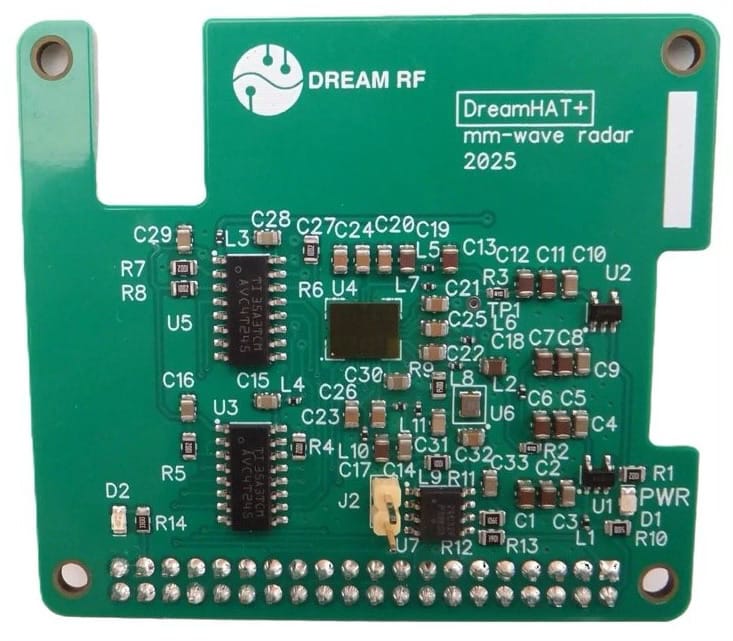
DreamHAT+ (£100 / $135) is a Hardware Attached on Top (HAT) kit that gives Raspberry Pi a 60GHz millimetre-wave radar for you to play with.
The full-size HAT packs an Infineon BGT60TR13C chip featuring a single transmitter antenna and three receivers (TX/RX), connecting to Raspberry Pi 4 or 5 via GPIO pins and SPI.
The Raspberry Pi Radio Module 2 is “2.4 GHz only”… but it’s $4.00! That’s great cost versus performance to be able to add basic Wi-Fi or Bluetooth to just about any computing device.
The DreamHAT+ is $135… but it gets you experimenting with 60 GHz… that’s great performance versus cost. 60 GHz is a very curious portion of spectrum. In the US, the band runs from 57-71 GHz. Yep - 14 GHz of unlicensed spectrum. The range of this band is generally limited to about one mile in terrestrial applications because it’s attenuated by oxygen molecules in the atmosphere, and thus requires highly directional antennas to achieve the maximum range.
I just thought it was interesting that these two modules, designed for easy experimentation in unlicensed bands, were announced the same week.
# # #
HydraSDR RFOne - New Software Defined Receiver
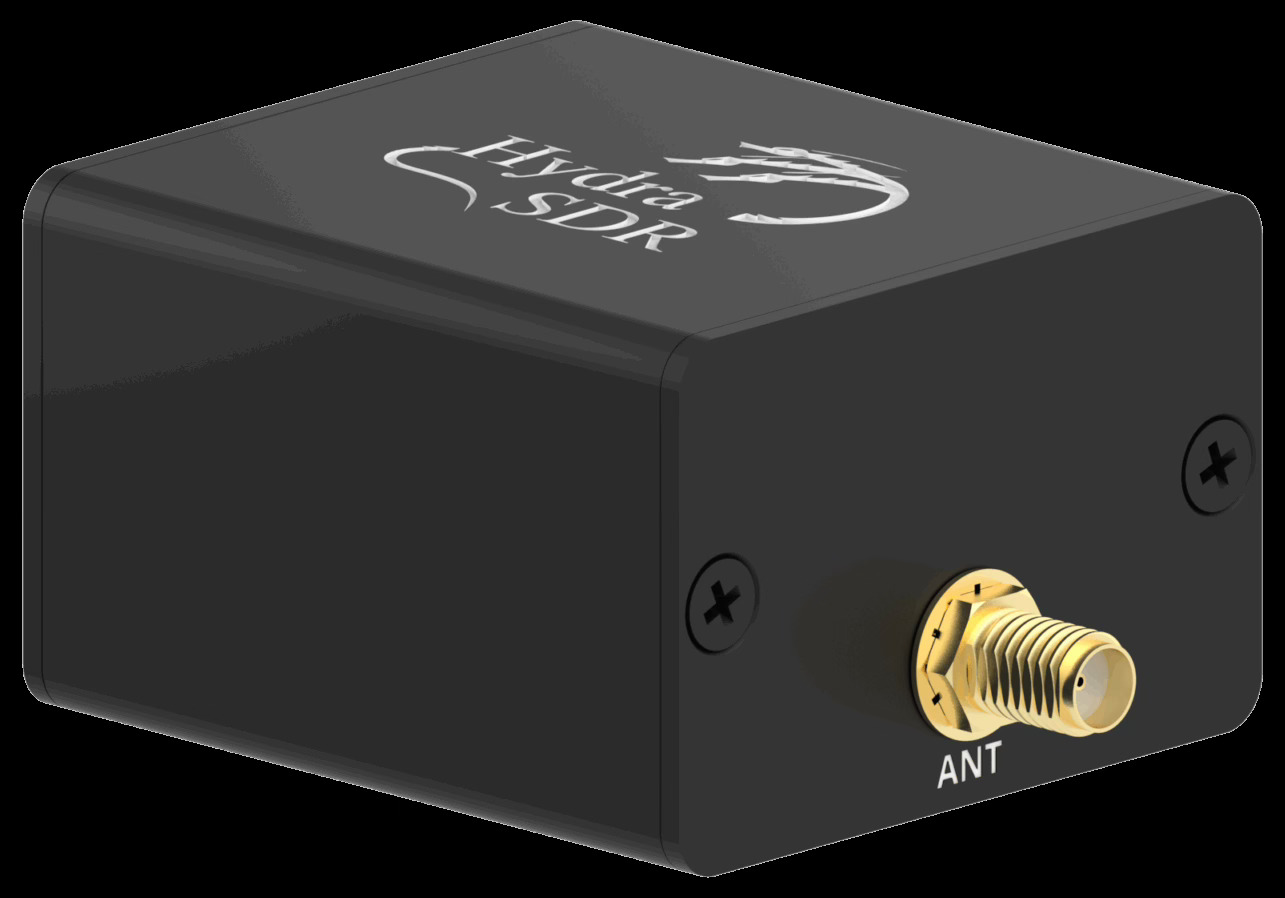
The HydraSDR RFOne is an advanced Software Defined Radio receiver featuring 10MHz instantaneous bandwidth sampling capability across 24MHz to 1800MHz, with expandable features / frequency coverage through extension modules.
At a quick glance, the RFOne could be overlooked from other SD Receivers in this price class ($190). But there are some interesting, subtle features that differentiate it and make it Zero Retries Interesting.
This is not a review - I have not seen this unit in person, thus have not evaluated it. This story is written from publicly available information provided by HydraSDR.
Meets my minimum requirements for a Software Defined Receiver to be Zero Retries Interesting to cover all Amateur Radio VHF / UHF bands and ideally 10 MHz bandwidth to cover 440-450 MHz:
Continuous 24 to 1800 MHz native RX range
… capable of sampling 10MHz of spectrum
The biggest differentiation of the RFOne is that the manufacturer claims that it will be made in the USA, so no hassles with tariffs, etc. It may be that this also qualifies this unit to be used in projects that require made-in-USA electronics, such as government or military or ???1
It includes a metal enclosure, and a custom USB-A to USB-C cable with integrated toroid filters to keep stray radio signals out of the USB data and power. These two “features” suggest significant attention to detail regarding the overall performance of the unit.
Instead of a proprietary Software Defined Receiver app (the approach of many SD Receiver manufacturers) with perhaps secondary attention to making their unit usable with open source software, HydraRF has provided a driver, and qualified the unit for use with an an open source, cross platform Software Defined Receiver application - SDR++2.
These subtle mentions were bullet points in the data sheet:
Ultra extensible : Same case can contains up to 3 Boards for a unique ultra compact Phase-Coherent Receivers for Radar, Scanner
Multiple external clock output (via extension) - Ideal to chain multiple Boards
… with a custom made aluminum case which can contains
multiple extensions)
Even the company name suggests such future products - Hydra (many heads).
Despite the “Made in USA” claim, there’s no mention of where HydraRF is located (in the US?), or where it’s manufactured, other than
Designed and Engineered in France and Made in the USA
Post publication update: The HydraRF / RFOne website has been updated to:
Designed in France and precision-manufactured in Colorado, USA, it represents the perfect fusion of European RF engineering expertise and American manufacturing excellence.
There’s no specific mention that the RFOne is applicable to Amateur Radio use, other than the passing mention of “enthusiasts” in the RFOne Data Sheet.
Post publication update: The HydraRF / RFOne website has been updated to:
Perfect for professionals, researchers, radio enthusiasts and ideal for Ham Radio use…
Curiously, there’s no specific mention of GNU Radio support, other than perhaps
Works with popular software defined radio applications like SDR++
Post publication update: The HydraRF / RFOne website has been updated to:
Open source Firmware / Host Tools + Shared Lib / DLL (Windows/Linux/MacOS), SDR++, SatDump, GNU Radio(gr-osmosdr), SoapyHydraSDR (Support GQRX...), urh, luaradio ... https://github.com/hydrasdr
That paragraph links to the HydraSDR Github repository:
…
The “bullet point mentions” are somewhat confusing teasers of potential extensions of the RFOne, or different products from HydraRF. They’re curious mentions for this specific product - the RFOne in which there’s one board, in this (tall) enclosure. Apparently HydraRF wants to “project” that there will be additional products offered in conjunction with an RFOne, the most obvious would be the ability to integrate multiple RFOne boards into the same enclosure, using a single (?) USB-C connection. But that’s pure speculation on my part.
It’s cool that there’s going to be another reasonable cost, reasonable performance Software Defined Receiver option which will be manufactured in the US. The RFOne would be a good unit for my goal of monitoring Amateur Radio VHF / UHF bands, even as low as the 10 meter band around 28 MHz, which some Software Defined Receivers cannot do without using a transverter stage.
I sent an email via the contact form asking for clarification as to whether the RFOne is actually available as the DigiKey page shows “out of stock”. Benjamin Vernoux of HydraSDR responded promptly that DigiKey has received a quantity of RFOne units, but it takes DigiKey some time to get a new item into its stock and make them available for sale.
Benjamin also offered to send me an RFOne unit for review (despite my confession that I’m a very novice user of SD Receivers and SDR software) and I accepted that offer.
My thanks to RTL-SDR Blog for alerting me to the existence of the RFOne.
# # #
My Portable Packet Radio Test Box (video)
Jason Rausch K4APR on YouTube:
In this video I am showing off a portable packet radio test box that I've been building over the last 6 months. I go over the entire construction of how it's put together in some details on some of the custom modules that I built to make the unit unique to my needs.