Zero Retries 0238
2026-02-13
Zero Retries is an independent newsletter promoting technological innovation in and adjacent to Amateur Radio, and Amateur Radio as (literally) a license to experiment with and learn about radio technology. Radios are computers - with antennas! Now in its fifth year of publication, with 3400+ subscribers.
Steve Stroh N8GNJ, Editor
Ghost says this issue is too big for email clients? YES
Thus, it might be easier to read this in a web browser -
https://www.zeroretries.radio/zero-retries-0238
In This Issue...
- Request To Send
- Substack Data Breach
- (Invalid) Security Warnings for zeroretries.radio
- Paid Subscribers Update
- The Saga of Conversion to Ghost and zeroretries.radio - Part 5
- Zero Retries Digital Conference 2026 Page
- Weekends Are For Amateur Radio!
- What’s New at Digital Library of Amateur Radio & Communications — February 2026
- Thought Experiment - Top Three Priorities for Zero Retries Interesting Amateur Radio In the Next Three Years; Part 2 of 3 - Consolidation / Synthesis of Ideas
- Amateur Radio Standards Organization (ARSO)
- Commercial Interest in Amateur Radio Spectrum
- Data Communications Emphasis, Mesh Networking, Newer Digital Voice Systems
- Emergency Communications (EMCOM)
- GEO Payload / Satellite for Western Hemisphere
- High Frequency (HF) Operation
- New Amateur Radio Organizations
- Primary References - Books, Web Page, Wiki for "I'm a Ham - Now What?"
- Regulatory Reform (Mostly, US)
- ZR > BEACON
- Breaking - ARRL Begins to Consider Encryption in Amateur Radio
- MMDVM and MQTT
- We’re excited to announce the launch of our crowdfunding campaign for xSDR
- Offline Electronic Maps
- Headless APRS Appliance
- Some Interesting (New?) Vendors at Hamcation 2026
- Silent Keyboard - Professor David J. Farber
- Closing Thanks
- Permission to Reuse Zero Retries Content
Request To Send
Substack Data Breach
Email from Substack:
I’m reaching out to let you know about a security incident that resulted in the email address and phone number from your Substack account being shared without your permission.
I’m incredibly sorry this happened. We take our responsibility to protect your data and your privacy seriously, and we came up short here.
What happened. On February 3rd, we identified evidence of a problem with our systems that allowed an unauthorized third party to access limited user data without permission, including email addresses, phone numbers, and other internal metadata. This data was accessed in October 2025. Importantly, credit card numbers, passwords, and financial information were not accessed.
What we are doing. We have fixed the problem with our system that allowed this to happen. We are conducting a full investigation, and are taking steps to improve our systems and processes to prevent this type of issue from happening in the future.
What you can do. We do not have evidence that this information is being misused, but we encourage you to take extra caution with any emails or text messages you receive that may be suspicious.
This sucks. I'm sorry. We will work very hard to make sure it does not happen again.
- Chris Best, CEO of Substack
It's not clear whether this email was sent to me as a publisher of a Substack newsletter, or as a subscriber of Substack newsletter(s).
This email is all I know (personally) know about the situation.
My colleague Tom Salzer KJ7T in his Random Wire 169 newsletter (also published on Substack) found some other articles / mentions online, thus see his article Notice: Newsletter Platform Substack Notifies Users of Data Breach for a bit more info.
(Invalid) Security Warnings for zeroretries.radio
Last week after publishing Zero Retries 0237, I received some reports about https://www.zeroretries.radio being a "suspicious" website (or similar wording). Some of the warnings were just incorrect, such as stating that encryption wasn't being used (provably, it is - see https://...)
The issue seems to have (mostly?) settled down, perhaps after I enabled DNSSEC on my domain management configuration at dotRadio domains. But it also seemed to help that a number of people "clicked through" despite the warnings.
Please advise, via the Zero Retries email list, if this issue persists.
Paid Subscribers Update
My thanks to Rob Bowser (SPOOLTENNA) for upgrading from a free subscriber to Zero Retries to a Founding Member Subscriber 0024 this past week!
Founding members are listed in every issue of Zero Retries!
My thanks to Prefers to Remain Anonymous 21 for renewing as an Annual Paid Subscriber (3rd year!) to Zero Retries this past week!
My thanks to Prefers to Remain Anonymous 122 for upgrading from a free subscriber to Zero Retries to an Annual Paid Subscriber this past week!
My thanks to Prefers to Remain Anonymous 121 for upgrading from a free subscriber to Zero Retries to a Paid Subscriber this past week!
Financial support from Zero Retries readers is a significant vote of support for the continued publication of Zero Retries.
The Saga of Conversion to Ghost and zeroretries.radio - Part 5
Apologies to Zero Retries readers who find this discussion tedious and irrelevant, but some readers do want to know what's going on in this process.
Exporting data from Substack is easy and non-disruptive. It's a snapshot in time of the posts and other data on Substack, and especially the total list of 3400+ email subscribers. But importing that data into Ghost is potentially disruptive, and this week had a number of disruptions to the point where I ran out of "comfortable" days early in the week to attempt the import. So I didn't do so.
I also haven't yet linked Ghost and the Zero Retries Stripe account for setting up the optional paid subscriber capability in Ghost. I'll try again next week.
Zero Retries Digital Conference 2026 Page
There is now a basic ZRDC page on www.zeroretries.radio, with early information on ZRDC 2026. The "Conference" top bar link on the page now directs to that page. We will flesh out that page with new information as it is developed.
The primary takeaway about ZRDC 2026 at the moment is that it will be held on the same Friday as the first day of Pacificon 2026, at a venue within walking distance of the Pacificon hotel.
We expect that the combination of ZRDC on Friday, and Pacificon on Saturday will make for a very Zero Retries Interesting weekend, worth traveling to and attending. For my impressions of Pacificon 2025, and the Zero Retries Interesting aspects, see Zero Retries 0224 - Pacificon 2025 - Great Conference!
If possible, please reserve Thursday afternoon to join a number of ZRDC 2026 attendees at the Computer History Museum, which is a fascinating place with many engaging exhibits (recommended).
Weekends Are For Amateur Radio!
Discussions about potentially getting involved in KMRE 88.3 - a low power, community FM broadcast station here in Bellingham have unexpectedly restarted. There might be some interesting crossovers between community broadcasting in Bellingham and Zero Retries.
Tomorrow (Saturday) I'll be visiting KMRE's transmitter site (and actually seeing the transmitter). When I first reached out with some interest in volunteering to KMRE, and I mentioned that I'd love to see the transmitter, that was received with some puzzlement. "You want to see... the transmitter? Um... why?"
Have a great weekend, all of you co-conspirators in Zero Retries Interesting Amateur Radio activities!
Steve N8GNJ
Please direct comments / feedback about Request To Send to the Zero Retries email list with the #zr0238 hashtag.
What’s New at Digital Library of Amateur Radio & Communications — February 2026
By Kay Savetz K6KJN
In 1974, hams debated whether the autopatch was a friend or foe. In 1983, they wondered whether personal computers and amateur radio were “married or just living together.” More than four decades later, the discussions continue — and thanks to DLARC, we can see where they started.
DLARC has scanned 133 issues of Repeater Journal, the quarterly newsletter of the Southeastern Repeater Association — from 1974 through 2008. These newsletters came from the estate of Wayne Williams, K4MOB. SERA is the largest amateur radio repeater coordinating organization in the United States. These vintage journals include club business, lists of repeaters, and articles like in ’74: “Autopatch: Friend or Foe?” and in 1983: “Personal Computers and Amateur Radio: are they married or just living together?” (I don’t know the answer, but 43 years later, the relationship is still going strong.) We’re missing a handful of issues, they’re now in the DLARC Wantlist.
Last month I noted that we had scanned a collection of 40 issues of "Call Letter", the newsletter of Northwest Vintage Radio Society. This month, the group sent more issues that they had in digital format. The data was a little tricky — for instance, some had the covers and back covers in one PDF and the newsletter innards in another PDF. After some careful massaging of the files, DLARC’s collection of Call Letter has nearly doubled, now up to 76 issues of this newsletter dedicated to the preservation and enjoyment of vintage radio and antique wireless equipment.
We also added 30+ newsletters from the North Shore Radio Association, an amateur radio group in Massachusetts, USA. (Not to be confused, as I did in a moment of panic, with the North Shore Amateur Radio Club in Oshawa, Ontario, Canada. We’ve archived their newsletters, too.)
I discovered in the back alleys of the Internet a few lost issues of Fidonet HAM-PACKET Digest, a newsletter published by Brian Murrey KB9BVN from 1989 through the early 1990s. DLARC now has 20 issues. Written in the heyday of 1200 bits per second amateur packet radio, and distributed via landline BBSes, the newly added issues include receiving and interpreting satellite comms on the 440 band, and SAREX2 — packet on the space shuttle. Sorry, the formatting of the PDF came out a little weird — I couldn’t figure out how many lines per printed page they expected. We’re still missing issues — v2n7, v2n8, v2n9, and v2n11 — so I’ve added the Digest to the DLARC Wantlist. Did it continue into volume 3? I reached out to KB9BVN but he doesn’t have the original files after all this time.
Internet Archive patron Curtis Philips has been uploading beautiful scans that he made of Electrical Experimenter magazine. Published in the 1910s and 1920s by Hugo Gernsback, the famous science fiction and science fact publisher, the magazine features plenty of radio-related articles and advertisements. Check out this two-page “Radio Department” spread published April 1918, just after the U.S. government shut down amateur radio stations due to World War I. And this 1919 article about a device that let you “see” wireless signals. Nikola Tesla wrote five articles for the magazine over the years. I created a new collection for these wonderful Electrical Experimenter scans — there’s 70 issues so far. In 1920 the publication’s name was changed to Science and Invention and they published an article about electrocuting sharks, and the management of DLARC definitely does not advocate doing that.
Tom Perera W1TP asked me to add his Perera's Telegraph Collector's Guide to DLARC, which I was thrilled to do. After selling “many thousands of copies,” he decided to make the guide available online for free. Originally published by the Radio Society of Great Britain, the guide has sections on Pre-Morse Land-Line Telegraph (1830-1844); Spark and Wireless Keys (1910-1921); American, German, Japanese, and Russian military keys; and many other topics. Check it out, it’s a fascinating read.
It’s been a long minute since I had any update on the Packet Radio Temporary Notes collection. As a reminder, these were informal technical docs distributed by the organizations developing packet radio from the ground up, from 1972 through 1983. These documents are hard to find, but I’ve found two more: PRTN 111: Packet Radio Link-Related Measurements Test Plan by R. C. Kunzelman, and PRTN 245: JANUS Interface Specifications for a symmetrical, 1822-like Interface. (“A need arose in the Packet Radio project for specification of an interface between Packet Radio units and other equipment. This paper is to meet BBN's responsibility to supply that specification.”) That brings DLARC to 133 PRTN files, with dozens and dozens still out there, somewhere, waiting to be rediscovered.
For some lighter reading material, check out “Radio Boys Cronies, or Bill Brown's Radio” by Wayne Whipple and S. F. Aaron, a 1922 (public domain!) juvenile fiction book about resourceful boys who explore radio technology and solve mysteries.
Turning to conferences: I’ve added 11 talks from the M17 Project’s 2025 conference which was held in September in Poland, archived from their YouTube channel. Unfortunately, the audio wasn’t captured that well, but if you listen carefully (or read the automated transcripts, which are pretty good) you can learn about TETRA and its use in amateur radio, and e-Czas Radio: long-wave radio distribution of legal time signals in Poland.
I received a request from a DLARC user to preserve everything from the Trenton (New Jersey) Computer Festival’s web site and YouTube page. This annual festival has been held for 49 years and has amateur computer and radio significance. The last founder, Professor Al Katz K2UYH, passed away in 2024 and this patron is worried about the future of the show. So I dug through the organization's site history in the WayBack machine to find programs, schedules, press releases and even some slide decks from talks, going back to the year 2000. Also, I got more than 200 videos from the group’s YouTube channel. All of this is in DLARC’s new Trenton Computer Festival collection. Ham radio talks at the show have included last year’s Building a 26 MHz to 1.7 GHz RF Spectrum Monitor on a Raspberry Pi Zero — and in 2023, Getting Started on EME (Earth-Moon-Earth) Communication. Older schedules hint at unrecorded talks like in 2011on APRS, Radio Amateur Civil Emergency Service, and radio history. (Here’s the program for that year.)
Taaaa daaa, that’s some of what’s new in February 2026. If you’d like to revisit past What’s New at DLARC columns, now you can: here’s a compilation from the first column in October 2023 through December 2024, and a roundup of the 2025 columns. As always, if you have material to contribute or suggestions for the library, please email me at the address below.
Digital Library of Amateur Radio & Communications is funded by a generous grant from Amateur Radio Digital Communications (ARDC) to create a free digital library for the radio community, researchers, educators, and students. If you have questions about the project or material to contribute, contact me at kay@archive.org. No sharks were harmed in the writing of this column.
Editor's Postscript - On 2026-01-28, Kay did a presentation to RATPAC about DLARC. That presentation is now available on YouTube - DLARC: updates from your favorite free online ham radio library.
Please direct comments / feedback about this article to the Zero Retries email list with the #zr0238 hashtag.
Thought Experiment - Top Three Priorities for Zero Retries Interesting Amateur Radio In the Next Three Years; Part 2 of 3 - Consolidation / Synthesis of Ideas
By Steve Stroh N8GNJ
To keep issue length (more) reasonable, I've divided this long article into three consecutive installments.
- Part 1, in Zero Retries 0237 was summations of the inputs provided.
- Part 2 , below, is a consolidation and synthesis of ideas into some broader themes for consideration of the Top Three Priorities for Zero Retries Interesting Amateur Radio in the Next Three Years.
- Part 3, planned for Zero Retries 0239 will be my opinions and my perspective of what should be the Top Three Priorities for Zero Retries Interesting Amateur Radio in the Next Three Years.
The following was developed with considerable editorial discretion... with some creative license... of what ideas expressed by the responding individuals could be combined into broader themes.
Amateur Radio Standards Organization (ARSO)
Amateur Radio continues to create new modes and implement existing modes on new hardware and software with varying degrees of compatibility. The resulting lack of interoperability has resulted in Amateur Radio communications becoming fragmented into silos such as DMR radios not being able to interoperate with D-Star radios.
This situation is similar to use of many different network standards prior to the widespread adoption of TCP/IP as the universal networking protocol. Thus it seems past time for Amateur Radio to have its own wide-ranging standards body for technologies used in Amateur Radio, similar in scope to the Internet Engineering Task Force (IETF).
Another activity of ARSO might be reference implementations of open source radio technology including DSP libraries and GNU Radio flowgraphs applicable to Amateur Radio. Hardware reference implementations could include simple (as possible) hardware examples for VHF / UHF / microwave, polar modulation (for high efficiency), etc.
Perhaps the first "big project" that ARSO should consider is building an open Public Key Infrastructure (PKI) for Amateur Radio as a precursor towards some use of encryption in Amateur Radio. Another near term project for ARSO could be developing a distributed database for contact logging. It should be lightweight enough to not require a "big" computer. Once this is established, create a distributed realtime contact dashboard.
Commercial Interest in Amateur Radio Spectrum
In this era, Amateur Radio must be on the alert and prepared to respond quickly and at scale to potential use of Amateur Radio spectrum by commercial (or other) users. Amateur Radio needs to be to credibly provide solid reasons to justify Amateur Radio use in of its allocated spectrum, especially with examples of technological innovation being implemented within Amateur Radio. Recent issues have shown a need for a "quick response" capability. Examples include building coalitions of credible organizations in advance (and regularly communicate and coordinate) to be able to quickly co-sign formal comments.
Develop a notification system that would quickly alert NewTechHams (and related actives such as Meshtastic, GMRS, and CB experimenters) via channels that are relevant to them, such as Discord groups.
Data Communications Emphasis, Mesh Networking, Newer Digital Voice Systems
Emphasize data communications and data networking as a primary mode - HF (see HF item for more detail) and VHF / UHF / Microwave. Mesh networking has traditionally been problematic in Amateur Radio and unlicensed bands, but has proven useful and scalable in some military applications when enough (expensive, in earlier eras) technology and adequate spectrum could be applied. In the 2020s, to support mesh networking technology in Amateur Radio, we now have flexible (Software Defined) wideband (multiple band) radios, ample computer power, and many reference examples of good ideas for mesh networking... and many reference examples of what not to do. Also, develop a (generic) Chirp Spread Spectrum (CSS) implementation for all Amateur Radio VHF / UHF bands that works as well as LoRa.
A new type of digital voice should be developed as "just another data type" that can be transported over data communication networks. Also, develop (or implement existing) an open source, higher quality (than current bandwidth / technology constrained implementations) digital voice mode.
Emergency Communications (EMCOM)
Acknowledge Amateur Radio's declining role in "served agency" scenarios in recognition that there is now ample commercial / Government EMCOM capabilities, such as Starlink.
Continue to encourage personal EMCOM capabilities such as non-grid power, local radio communications, HF communications, etc.
GEO Payload / Satellite for Western Hemisphere
Few other Amateur Radio capabilities excite NewTechHams as much as satellite communications. Connectivity between widely separated Amateur Radio Operators using Low Earth Orbit (LEO) Amateur Radio satellites is fleeting, and the majority of Amateur Radio satellites are designed for voice / "radiosport" casual contacts. The QO-100 Amateur Radio payload in GEO over the Eastern hemisphere has proven to be useful for regular communications (including some networking) with simpler equipment and modest fixed antennas.
Possibilities for GEO satellite usage include potentially leasing dedicated transponders on existing GEOs, contracting for engineering / build / launch / place into orbit services of a "Micro GEO", and (unlikely, but possible) Amateur Radio (or perhaps "MARS") use of US Department of Defense Fleet Satcom satellites operating in the UHF band.
High Frequency (HF) Operation
Emphasize ways HF can be used other than "expensive radio, powerful transmitter, big antenna on suburban lot. Examples - Build it yourself magnetic loop antennas, data modes, fun modes such as WSJT-X and FT8, digital voice such as FreeDV RADE, and inexpensive radios such as QMX+, sBitx v3, Radioberry, and Hermes-Lite. Also, develop or improve an automated message origination and delivery system - for Health and Welfare traffic.
New Amateur Radio Organizations
ARRL is frequently cited as not very relevant with NewTechHams / OldTechHams and the younger demographic in general and 21st century media. Examples - monthly magazines, paywall, high membership dues. The outlines of a what a new organization should be to address this issue aren't well defined, but some examples are emerging, such as Online Amateur Radio Community (OARC).
Sub-elements of a new organization are emerging such as numerous Discord chat groups on specific Amateur Radio topics, focused publications such as Zero Retries, and general publications made available at no cost such as SARC The Communicator.
Primary References - Books, Web Page, Wiki for "I'm a Ham - Now What?"
Provide guidance and directory of a collection of simple, inexpensive Zero Retries Interesting projects or activities for new or prospective NewTechHams... especially those that are fun. This would also serve to improve engagement with the perception of Amateur Radio as relevant, interesting, and developing useful skills.
Emphasize digital technologies, data communications, and networking. Video tutorials should be an outgrowth once these references are developed. This is tightly paired with an emphasis on modern media relevant to potential and current NewTechHams. Modern media includes wikis / websites, videoconferences / YouTube / TikTok video, Discord channels, and Digital Library of Amateur Radio & Communications (an enormous amount of information, available for free). Dedicated, tightly focused technical in-person conferences are "modern" - example, DEF CON and GNU Radio Conference.
De-emphasize use of legacy media including magazines, periodic publication (monthly), newsletters, email lists. Unfocused, casual attendance in-person events such as Amateur Radio club meetings and presentations at hamfests are "legacy". Implicit in modern media is that it's almost always accessible at no cost (no paywall).
Regulatory Reform (Mostly, US)
In the US, existing symbol rate limitations, bandwidth limitations, emission restrictions on VHF / UHF bands are inhibiting technological innovation in Amateur Radio. Example - New Packet Radio is only marginally legal on 420-450 MHz, and not legal on 144-148 MHz. Other countries don't have such restrictions and thus US Amateur Radio is an outlier, and at a technological disadvantage, with these restrictions in place.
Prohibitions against use of encryption in Amateur Radio (especially in the US) is another issue that is coming to the forefront. Canada has allowed some encryption on Amateur Radio spectrum with placing encryption keys in escrow.
Please direct comments / feedback about this article to the Zero Retries email list with the #zr0238 hashtag.
ZR > BEACON
By Steve Stroh N8GNJ
Short mentions of Zero Retries Interesting items.
Breaking - ARRL Begins to Consider Encryption in Amateur Radio
This just in from the ARRL 2026 Annual Board Of Directors Meeting Minutes (held 2026-01-16 and 17):
[Item 22]
Director Frenaye removed the Communication Counsel’s Report and began his comments by asking Counsel Siddall to elaborate on Canada's use of encryption codes, particularly if those codes are made public, and the possibility of establishing a nationwide repository for these codes. Counsel Siddall provided a detailed explanation of Canada's approach, and a discussion ensued between him and Director Frenaye about how to initiate a similar process in the United States. Counsel Siddall emphasized the need for developing consensus on any such proposal.
[Item 44]
Director Frenaye moved, seconded by Director Yonally that Communications Counsel and the Executive Committee explore options for reducing the FCC workload by changing to a lifetime Amateur Radio license, and by allowing secure forwarding of health and welfare messaging, especially for use in the Amateur Radio Emergency Service.
I trust there's ample evidence that discussion and consideration of encryption in Amateur Radio, here in Zero Retries and the Zero Retries email list, predated the ARRL Board of Directors meeting.
"... secure forwarding..." for use in ARES. Note that while ARES is an emergency communications (EMCOM) activity, ARES is an exclusive program of ARRL.
There are many other EMCOM groups and activities that are independent from ARES and ARRL. Exploration of the possibility of "secure forwarding of health and welfare messaging, especially for use in ARES" is an unfortunate myopia on the part of ARRL, which promotes itself as The National Association for Amateur Radio"... not the "National Association for ARRL Members". I expect that a "secure forwarding" capability that's proposed as exclusive to ARES... will be poorly received by the > 80% of US Amateur Radio Operators that are not ARRL members.
Post Publication Update:
I received some thoughtful feedback on this article from a Zero Retries reader, resulting in this update. I'm leaving the above verbiage with some incorrect points in place for comparison, since (in Ghost) I don't seem to be able to use strikethrough formatting.
First... I mistakenly thought that participation in ARES was linked to ARRL membership, and thus ARES was exclusive to ARRL members.
ARES Membership Requirements
Every licensed amateur, regardless of membership in ARRL or any other local or national organization is eligible to apply for membership in ARES.
Second, I'm perhaps guilty of parsing Item 44 too pessimistically and saying:
I expect that a "secure forwarding" capability that's proposed as exclusive to ARES...
A less pessimistic parsing of Item 44 might translate to:
... by allowing secure forwarding of health and welfare messaging, especially for use in Amateur Radio emergency communications.
... of which the ARES program of ARRL is one of many entities that provide emergency communications training, and services, within Amateur Radio.
Given the context of an ARRL meeting in which all the participants have longstanding participation in ARRL, it may be that, in their minds, saying "ARES" is equivalent to saying "Amateur Radio emergency communications".
My thanks to the Zero Retries reader that provided their candid feedback on this item. I truly appreciate such detailed and candid feedback to what I write in Zero Retries.
MMDVM and MQTT
Jonathan Naylor G4KLX on the OpenDV email list:
In the near future, the whole of the MMDVM suite of programs will be moving over to using MQTT to disseminate information to other programs and people. Let me explain, MQTT is middleware that allows multiple programs to read and write data to each other using named "topics" that can be subscribed to. In terms of the MMDVM programs, it will be used to make status information available to other programs that desire it, for example, a display driver program, a file logging program, or a GUI.
This move to MQTT means that none of the existing programs will write log files, but will make that information available via MQTT instead. It would be trivial to write a program to write this program to a file if needed. In addition some programs will make more detailed status information via other topics in JSON format which is better structured than the existing log format.
Existing digital voice data streams between the MMDVM Host and the gateways will remain as UDP links as MQTT isn't designed for the level of service that this traffic requires.
This means that the master/main branches of each of these programs will become MQTT enabled, and it is possible that other bugs will be introduced into the programs initially. The last non MQTT enabled versions of each program will have a Git tag added to it so that it can easily be found.
MQTT is Message Queuing Telemetry Transport, and it operates over TCP/IP. For those like me that need a bit more explanation about the benefits using MQTT, see MQTT.org. Once you understand how efficient and lightweight it is, it's easy to imagine many more scenarios in Amateur Radio systems where MQTT would be useful.
G4KLX's work to migrate MMDVM to using MQTT has been in progress for some time, so kudos to G4KLX for reaching this milestone!
We’re excited to announce the launch of our crowdfunding campaign for xSDR
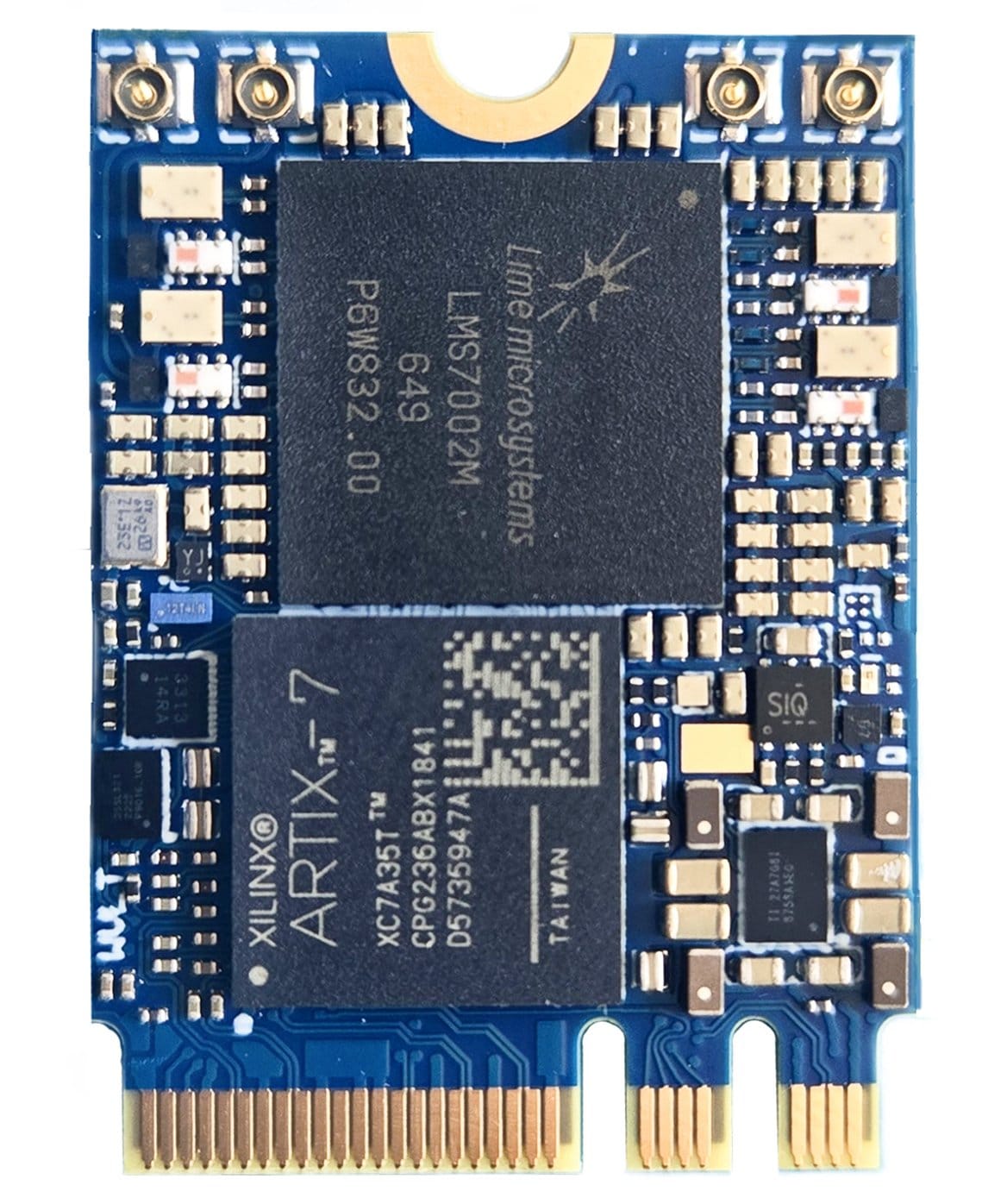
Andrew Avtushenko via Crowd Supply:
... the next evolution of embedded software-defined radio.
xSDR is a compact, single-sided M.2 software-defined radio designed for seamless integration into modern computing platforms. The “x” stands for extended, delivering extended bandwidth and multi-channel operation in the same minimal footprint that defined uSDR.
You can configure and operate xSDR directly from a browser, and collaborate through cloud-based workflows using the wsdr.io platform. Build, control, and share RF applications without complex setup or driver overhead.
Details of the capabilities of xSDR are on the campaign page, But a few basics are:
- Two transmit / receive channels (MIMO),
- Frequency range is 30 MHz to 3.8 GHz,
- Bandwidth up to 90 MHz,
- Price of a single xSDR is $549
The capabilities we can bring to bear on radio systems with new radio technology such as this... is just amazing. Imagine a ka9q-radio receiver (or, as periodically hinted... transmitter) with a 90 MHz bandwidth. Or perhaps this one unit can do all of 420-450 MHz on one channel, and both 144-148 MHz and 219-225 MHz on the second channel.
Offline Electronic Maps
In the ARRL Letter for February 12, 2026, there was this story:
Digital or Paper?
In a digital world, everything works correctly. But what happens when it doesn’t?
Tina Milenovic, K8RBQ, a member of the All Things Amateur Radio Association (ATARA) in Lancaster, Ohio, said her club began asking that question a couple of years ago. “What happens in a grid down situation, when the internet, tablets, laptops, and GPS are not available? In an emergency, how can first responders quickly navigate and travel to their intended destinations?” Milenovic said that after some thought and discussion, the answer was, well, old school ... use paper maps!
In 2023, members of ATARA began contacting the county engineer offices of Fairfield and contiguous counties to acquire fold-out, paper county maps for their Off Grid team members. The Off Grid team trains to be able to respond and provide mission-essential emergency communications in a natural or human-made disaster situation in which amateur radio operators are needed to assist first responders or other emergency officials. The intent of having the paper maps was to ensure that team members could travel to an incident scene if the power grid or internet were down and no GPS was available.
Yes, it's a prudent precaution to foresee that in a significant communications emergency, online map services such as Apple Maps and Google Maps might not be available. But resorting to paper maps isn't the only alternative in such a scenario. Another alternative, but with the capabilities of electronic maps, is offline (downloaded, stored locally) electronic maps, such as OpenStreetMap (use the Export option). That seems a more likely scenario to me, unless there has been a Carrington / Electro Magnetic Pulse (EMP) event, in which case, almost nothing will be working - modern vehicles, laptops, GPS receivers, two way radios, Starlink, etc.
Headless APRS Appliance
Ev Tupos W2EV on the Aprsfoundation email list:
Does the APRS ecosystem have a product that allows me to connect my cell phone to an APRS network appliance (TNC/Transceiver) via Bluetooth; with the cell phone having a UI that is designed for both configuring the appliance and using it for situational awareness communication with other APRS users?
In effect, the APRS appliance is "headless", accessed via a Bluetooth connection to a cell phone.
Don Rolph AB1PH replied:
The APRS Appliance:
https://github.com/APRSFoundation/aprsappliance
supports bluetooth connections over serial interface protocol. This is supported on android devices and LINUX/Windows devices.
IOS devices cannot connect via Bluetooth.
The APRS Appliance acts as a hotspot and can be connected via WIFI which is the more tested approach.
And terminal application can login over WIFI and be used to configure the device. An Xterm applications should work fine. I use Mobaxterm on my PC.
Jason Rausch K4APR also replied:
https://www.rpc-electronics.com/esp32-aprs-tracker.php
A quick glance at that page shows:
KISS over Bluetooth (Tested with APRSDroid Android and APRS.fi iOS applications
I just love learning factoids about amazing new capabilities in Amateur Radio like these two solutions, and sharing them in Zero Retries. From my perspective, the former is a great solution for a fixed installation, especially given that it's based on a Raspberry Pi, which can easily host an Ethernet connection (Raspberry Pi 3B+ is $40'ish) and the latter, as an integrated appliance, is ideal for mobile or go kit usage.
Some Interesting (New?) Vendors at Hamcation 2026
I had reason to look at the vendor list of Hamcation 2026, and the vast majority are same old, same old vendors. But there were some new (to me, at least) vendors:
- Frontline Gadgets
- LowMesh LLC
- MakerNova
- MorseNexus (formerly PreppComm)
- Rocket Machine Worx - This caught my interest as great-looking, apparently well-built coax wall penetration units. We've really needed something better than "drill through wall, fish coax through, goop up with silicone seal".
- Rokland - I'm a future customer of Rokland to purchase several ALFA Network Tube units for 802.11ah.
- Seeed Studio
- Sol-Tac
- SpecFive
- SPOOLTENNA - I haven't gotten out into the field with a small HF radio in some time, but this looks like a great easy to deploy wire antenna option.
- TN07 Engineering
One emerging theme leaped out - Meshtastic / Meshcore, enabled by LoRa, is either finding a large emerging market, or the cost of starting a business in this new business segment is low (risk) enough for a number of vendors to enter.
It looks like new vendors can get space at Hamcation, unlike Hamvention where new vendors are placed on a waiting list that (reportedly) can stretch to years. I applied for a future Zero Retries table (no placement preference) while attending Hamvention 2025, and I haven't heard from Hamvention for 2026.
Silent Keyboard - Professor David J. Farber
From (Farber's) Interesting People email list (which has run for decades):
IP Asia Announcement
We are heartbroken to report that our colleague – our mentor, friend, and conscience – David J. Farber passed away suddenly at his home in Roppongi, Tokyo. He left us on Saturday, Feb. 7, 2026, at the too-young age of 91.
To his son Manny, he was simply “Dad”, his bedrock whom he will miss immeasurably. They spoke almost daily by video throughout his time in Japan, and shared special times on numerous visits. He is survived by son Manny Farber and daughter-in-law Mei Xu, daughter-in-law Carol Hagan and grandsons Nate Farber and Sam Farber. He was preceded in death by his wife Gloria (G.G.) and son Joe Farber.
Dave’s career began with his education at Stevens Institute of Technology, which he loved deeply and served as a Trustee. He joined the legendary Bell Labs during its heyday, and worked at the Rand Corporation. Along the way, among countless other activities, he served as Chief Technologist of the U.S. Federal Communications Commission; became a proficient (instrument-rated) pilot; and was an active board member of the Electronic Frontier Foundation, a digital civil-liberties organization.
His professional accomplishments and impact are almost endless, but often captured by one moniker: “grandfather of the Internet,” acknowledging the foundational contributions made by his many students at the University of California, Irvine; the University of Delaware; the University of Pennsylvania; and Carnegie Mellon University.
In 2018, at the age of 83, Dave moved to Japan to become Distinguished Professor at Keio University and Co-Director of the Keio Cyber Civilization Research Center (CCRC). He loved teaching, and taught his final class on January 22, 2026.
At CCRC, one of his most enjoyable activities was co-hosting the IP-Asia online gathering, which has met every Monday for more than five years and has addressed many aspects of the impact of technology on civilization. Dave thrived in Japan in every way.
We, the IP-Asia community, will gather for an online remembrance of Dave at the usual time and place, 2100 JST on Monday, February 9, 2026.
It’s impossible to summarize a life and career as rich and long as Dave’s in our few words here. And each of us, even those who knew him for decades, represent just one facet of his life. But because we are here at its end, we have the sad duty of sharing this news. Further information and a more formal obituary are forthcoming.
Farber was at least briefly an Amateur Radio Operator, though as I write this story, I cannot find a record of his lapsed callsign. I found that Farber made at least a few fleeting references to Amateur Radio, and he knew (pretty well, if memory serves) my friend and mentor, Dewayne Hendricks WA8DZP (also now a Silent Keyboard). Farber also gave an influential talk about emerging radio technology (flexible spectrum usage I think) to an Amateur Radio audience... though I cannot find a reference to the PDF of his speech (which I remember I downloaded from the FCC website). Both lapses are very frustrating.
Not mentioned in the above brief announcement was that Farber curated an email list called Interesting People (IP) for decades. To be added to it, you had to "plead your case" directly to Farber, and I was thrilled when I applied, and "made the cut". Farber gave early notice of many breaking technological developments on IP. It wasn't solely a broadcast (announcement) email list. It was always a thrill when something I said on another email list was picked up by Farber and reposted onto IP.
I think I met Farber briefly at a conference or a private gathering as I have a memory of his very distinctive voice. What I found most remarkable about Farber was that he was recruited to serve briefly at the FCC as "Chief Technologist" which, at least as I recall, was a position created for him to advise the Commission without being bogged down in the legalese administrivia that characterized the Commission's activities. His brief tenure at the FCC was, at least for a time, formative in bringing a technological focus about Internet and spectrum policy, to the FCC, explaining that spectrum usage was fungible and a creation of technology... not fixed property equivalent to "land" that can only be allocated to exclusive use instead of being sharable with the use of steadily improving technology.
What I found most admirable about Farber was that he figured out how to continue to be productive and contributing to technological society, as a teacher, to the very end of his life. We should all aspire to make our own "dent in the universe" and contribute to the future of humanity like Farber did.
Please offer comments / feedback about ZR > BEACON on the Zero Retries email list with the #ZR0238 hashtag.
Closing Thanks
My ongoing Thanks to:
Tina Stroh KD7WSF for, well, everything!
Jack Stroh, Late Night Assistant Editor Emeritus
Fiona and Shreky Stroh, Late Night Assistant Editors In Training
Founding Members who generously support Zero Retries financially:
Founding Member 0000 - Steven Davidson K3FZT (Renewed 2025, 3rd year!)
Founding Member 0001 - Randy Smith WU2S (Renewed 2025, 3rd year!)
Founding Member 0002 - Chris Osburn KD7DVD (Renewed 2025, 3rd year!)
Founding Member 0003 - Don Rotolo N2IRZ (Renewed 2025, 3rd year!)
Founding Member 0004 - William Arcand W1WRA (Renewed 2025, 3rd year!)
Founding Member 0005 - Ben Kuhn KU0HN (Renewed 2025, 3rd year!)
Founding Member 0006 - Todd Willey KQ4FID (Renewed 2025, 3rd year!)
Founding Member 0007 and 0010 - Merik Karman VK1DF / VK2MKZ (Renewed 2025 x2, 3rd year!)
Founding Member 0008 - Prefers to Remain Anonymous 08 (Renewed 2025, 3rd year!)
Founding Member 0009 - Prefers to Remain Anonymous 19 (Renewed 2025, 2nd year!)
Founding Member 0011 - Rick Prelinger W6XBE (Renewed 2025, 2nd year!)
Founding Member 0012 - Ryan Tolboom N2BP (Renewed 2025, 2nd year!)
Founding Member 0013 - Newton White N4EWT (Renewed 2026, 2nd year!)
Founding Member 0014 - Joe Hamelin W7COM (New 2025)
Founding Member 0015 - Rich Stocking N7OP (New 2025)
Founding Member 0016 - Prefers to Remain Anonymous 77 (New 2025)
Founding Member 0017 - Phil Karn KA9Q (New 2025)
Founding Member 0018 - Prefers to Remain Anonymous 95 (New 2025)
Founding Member 0019 - Prefers to Remain Anonymous 0108 (New 2025)
Founding Member 0020 - Prefers to Remain Anonymous 110 (New 2025)
Founding Member 0021 - Prefers to Remain Anonymous 111 (New 2025)
Founding Member 0022 - Prefers to Remain Anonymous 112 (New 2025)
Founding Member 0023 - Prefers to Remain Anonymous 116 (New 2026)
Founding Member 0024 - Rob Bowser (SPOOLTENNA) (New 2026)
Numerous Annual and Monthly subscribers who also generously support Zero Retries financially!
You thousands of readers of Zero Retries without which there would be little point in publishing this newsletter.
Permission to Reuse Zero Retries Content
Blanket permission is granted for Amateur Radio use of any Steve Stroh content in Zero Retries for Amateur Radio newsletters and distribution via Amateur Radio such as (but not limited to) Packet Radio Networks, Packet Radio Bulletin Board Systems, Repeater Nets, etc.
In such usage, please provide appropriate authorship credit for the content (especially for guest authors) and mention that it was first published in Zero Retries newsletter, preferably in this format:
This article is reprinted with permission. It was first published in Zero Retries newsletter, issue Zero Retries (number), (date) - (include full web link of the specific issue).
It’s appreciated (a courtesy, but not required) to notify Zero Retries Editor Steve Stroh N8GNJ of any reuse of Zero Retries content - editor@zeroretries.net.
If you’d like to republish an article in this issue for other uses, just ask.
All excerpts from other authors or organizations, including images, are intended to be fair use. Unless otherwise noted in the article, there are no paid promotional items in any Zero Retries articles.
Portions Copyright © 2021, 2022, 2023, 2024, 2025, 2026 by Steven K. Stroh.
This issue released on 2026-02-13
(end)