Zero Retries 0229
2025-11-21 — Plug and Play New Packet Radio Units, Including 2m!, The Piling On and Misinformation About ARDC Continues, The 44Net Story Interview, LinHT – a Complete M17 Transceiver, futureGEO
Zero Retries is an independent newsletter promoting technological innovation in and adjacent to Amateur Radio, and Amateur Radio as (literally) a license to experiment with and learn about radio technology. Radios are computers - with antennas! Now in its fifth year of publication, with 3300+ subscribers.
About Zero Retries
Steve Stroh N8GNJ, Editor
Email - editor@zeroretries.net
On the web: https://www.zeroretries.org/p/zero-retries-0229
Substack says “Too long for email”? YES
⬅️⬅️⬅️ Previous Issue of Zero Retries \ Next Issue of Zero Retries ➡️➡️➡️
In this issue:
- Paid Subscribers Update
- Zero Retries is the only ham radio periodical I read
- Presentation to Mount Diablo Amateur Radio Club tonight (2025-11-21) at 19:00
- Wayne Technical Fanatics
- Evangelism for Amateur Radio of the 21st Century
- Starlink Mini - Wow!
- Penguins and LinHT Manufacturers - No One Wants to go First
- Another Hilariously… Ridiculously Long “Newsletter” This Week
- Credit Where Due - Guillaume F4HDK Patiently Created and Nurtured a
GoodGreat Idea - With Open Source - Credit Where Due - ARDC Grants Can Really Work
- Weekends Are For Amateur Radio!
(Breaking!) Plug and Play New Packet Radio Units Available from Localino… Including for 2 Meters!
- OK5VAS - The New Packet Radio
- Other New Packet Radio Variants
- Then It Really Got Interesting
- These are built-for-purpose higher speed data radios!
- Pushing the Boundaries of US Part 97
The Piling On and Misinformation About ARDC Continues
- Bdale’s ham radio background
- The beginnings of ARDC
- The early hams
- The evolution of ARDC
- Grant review vetting approval process
- Grant categories
- Success and failure
- Shifting priorities
- The future of ham radio
- Visionaries
- Scaling
N8GNJ’s Takeaways from the W1DED / KB0G Interview - DreamNet and GEO
- DreamNet
- Arguably, DreamNet is Operating in Europe
- DreamNet in North America - Work in Progress / Recovery
- GEO Capability for Western Hemisphere
Thought Experiment on the Linux Mobile Transceiver
- (Breaking!) LinHT – a Complete M17 Transceiver (Finally!)
- Opinion: futureGEO is the Most Important Amateur Radio Initiative of this Decade. Why is no one Talking About it?
- ARDC 2024 Audited 990-PF (Tax Return) & Financial Statements
- FreeDV v2.1.0 Released
- Update on HF Signals zBitx HF Software Defined Radio
- VGC BHM-88 Firmware Update
- HaLow_Scanner: An RTL-SDR Based 802.11Ah HaLow Channel Scanner
- The Final Fate of the TAPR Tangerine SDR Project
- Origin Story of Phased Array Antenna Technology (video)
Permission for Reuse of Zero Retries Content
Comments for This Issue (Redirect to This Issue’s Comments page)
Request To Send
Commentary by Editor Steve Stroh N8GNJ
Paid Subscribers Update
My thanks to Prefers to Remain Anonymous 0108 for upgrading from a free subscriber to Zero Retries to a Founding Member Subscriber 0019 this past week!
Founding members are listed in every issue of Zero Retries!
My thanks to Marvin Motsenbocker “Mots” AK4VO for renewing as an Annual Paid Subscriber to Zero Retries this past week!
My thanks to Prefers to Remain Anonymous 107 for upgrading from a free subscriber to Zero Retries to an Annual Paid Subscriber this past week!
My thanks to Jason McCormick N8EI for upgrading from a free subscriber to Zero Retries to a Paid Subscriber this past week!
My thanks to Mitchell Boyce W8DOD for becoming an Annual Paid Subscriber to Zero Retries this past week! PTRA 110 included this nice message:
I think it’s important that ideas and information are shared freely through the ham radio community and I appreciate the work that you put in to do this.
My thanks to Prefers to Remain Anonymous 109 for becoming a Paid Subscriber to Zero Retries this past week!
Financial support from Zero Retries readers is a significant vote of support for the continued publication of Zero Retries.
Zero Retries is the only ham radio periodical I read
I mentioned in Zero Retries 0228:
My thanks to Florian Lengyel WM2D for renewing as an Annual Paid Subscriber to Zero Retries this past week (3rd year)!
As is my habit, I replied with a personal email thanking WM2D for renewing their subscription, and WM2D replied by saying:
Zero Retries is the only ham radio periodical I read.
Wow. That is humbling.
In another email message:
Thanks to Zero Retries, I’m back on the air (D-Star via the m1ke), aside from Chirp Spread Spectrum on 900MHz.
That is what I strive for in Zero Retries, to present the interesting, technical, and relevant aspects of Amateur Radio in the 21st century, that you probably won’t hear about from any other Amateur Radio media. Hopefully Zero Retries inspires folks, as happened with WM2D, to get involved or re-involved with Amateur Radio with these amazing new technologies.
Thank you very much WM2D! Your support, and the other paid subscribers helps me keep going on Zero Retries.
Presentation to Mount Diablo Amateur Radio Club tonight (2025-11-21) at 19:00
Tina and I have been impressed with the Pacificon conference (2024 and 2025), sponsored by Mount Diablo Amateur Radio Club. We were invited to be the presenting speakers at MDARC’s November 2025 General virtual meeting, which will be held on Friday 2025-11-21 at 19:00 Pacific (Saturday 2025-11-22 at 03:00 UTC) via Zoom:
https://us06web.zoom.us/j/87314224901pwd=0swnc2UTtucJnd8wHZ28Zcpcp2cC3e.1
Meeting ID: 873 1422 4901
Passcode: 049211
Our topic will be:
ZRDC 2025, a Zero Retries view of Pacificon 2025, M17 - an Open-Source Digital Voice mode, the LinHT, and SuperPeaters
(That title was a tad ambitious for a one hour speaking slot, but we will try to fit all that in.)
I don’t see an indication on MDARC’s Speakers page that they make archived recordings of their online meetings available. I plan to make my slide deck available after the presentation.
Wayne Technical Fanatics
One of the new Zero Retries Paid Subscribers in the past week, Jason McCormick N8EI is a member of Wayne Technical Fanatics, a not-formally-organized club in Wayne County, Ohio, USA (near Wooster, Ohio). When callsigns are provided in a paid subscription, I look them up on QRZ.com and often learn about new things, like the existence of Wayne Technical Fanatics.
In my opinion, Wayne Technical Fanatics are doing a number of things right:
- Cool name - Technical, and Fanatics! The name gets the point across quickly that the group isn’t a same old, same old Amateur Radio group. Also… cool acronym - WTF!
- They have an informative website that folks can find and learn about the group.
- They do ambitious projects and build useful infrastructure for the common good such as multi-mode (yay!) repeaters and digipeaters.
- When things don’t work out, they don’t continue to invest time and resources in them, such as their decision to shut down “Megalink”. Their priority seems to be doing interesting and relevant and fun activities and infrastructure.
- They decided to “keep it loose” - no officers, no dues, no formal affiliations… Wayne Technical Fanatics seems to have formed up to do interesting things and have technically interesting fun relating to Amateur Radio.
Gosh I wish there had been some group like Wayne Technical Fanatics in Ottawa County, Ohio when I was growing up there in the mid-1960s and 1970s.
We need more groups like Wayne Technical Fanatics to form up and promote themselves as co-conspirators in Zero Retries Interesting Amateur Radio activities.
Evangelism for Amateur Radio of the 21st Century
This storylet is a good accompaniment to the above story about the WTF group.
I was exchanging emails with a person who has tried to do outreach into their local Amateur Radio community to make Digital Amateur Radio Television (DATV) more widely known. The results… in that Amateur Radio community… weren’t great. I replied:
With respect, I don’t think that same old, same old Amateur Radio Operators are the right audience to target your outreach of DATV.
Reluctantly, sadly, I’ve come to the conclusion that the majority of Amateur Radio is the worst enemy of what Amateur Radio can be… arguably, is, in the 21st century.
As evidence, I offer Zero Retries. It’s now 3300+ email subscribers, perhaps as many as 500-1000 more, that view it via RSS or pass along or social media.
That’s a tiny fraction of the US Amateur Radio population, and Zero Retries will apparently stay that way because ZR discusses subjects that just don’t interest the vast majority of Amateur Radio Operators. That’s OK - I’m not trying to write for the masses, I’m trying to write for the folks like me that are interested in the more technical and future-forward aspects of Amateur Radio, beyond HF operation, contesting, yakking, CW, DXing on HF, etc. - basically Amateur Radio grounded in the operations and technologies of the 1950s.
Not to diss those aspects of Amateur Radio - it’s a big hobby, and obviously those aspects are very popular - there are entire clubs and organizations devoted to DX, etc.
If Zero Retries was going to “catch on” with Amateur Radio, it would have much greater circulation by now (it’s free!) after 4.5 years of weekly publication.
Thus, from my observations from Zero Retries, I think that you may find your outreach to be more effective by not targeting the same old, same old Amateur Radio audiences at hamfests, etc. Instead target audiences of techies in the 21st century, such as:MakerspacesMaker FairesSTEM classes at high schoolsMeetups of Meshtastic usersLinux user groupsLocal IEEE meetingsLocal college / university Amateur Radio clubsMeetings of “techies” Amateur Radio clubs
My personal experience is that some geographic areas just don’t have the critical mass of enough curious techies that’s necessary for “Zero Retries Interesting” aspects of Amateur Radio to catch on. Count your blessings that your group had the resources and the critical mass to put up a (D)ATV repeater. Most areas do not, and that’s to the detriment of Amateur Radio.
Starlink Mini - Wow!
I received my Starlink Mini a week or so ago and wow, it is amazing.
The setup process only works if you follow the process exactly as outlined on the lid of the Starlink Mini box, which specifies to first place the Starlink Mini outdoors with a clear view of the sky. Only once the Starlink Mini has connected with the Starlink constellation can you proceed with the setup process (see “Starlink” as one of the Wi-Fi options). Then you can do the Wi-Fi setup (renaming the SSID, establishing a password).
But once you’re past that, wow, Starlink Mini works great. Even the “minimal speed” 500 kbps works surprisingly well. I was able to watch (grainy) YouTube, and do all my normal activities quite well, including editing Zero Retries via Substack, which is entirely web-based. (I noted that the transition in the upper left corner status from “Saving changes…” to “Draft” took a few seconds longer, but that was the only difference I could see. Email, looking at web pages, etc. all worked normally.
Here’s one photo of just how trivial it is to “set up” Starlink Mini:
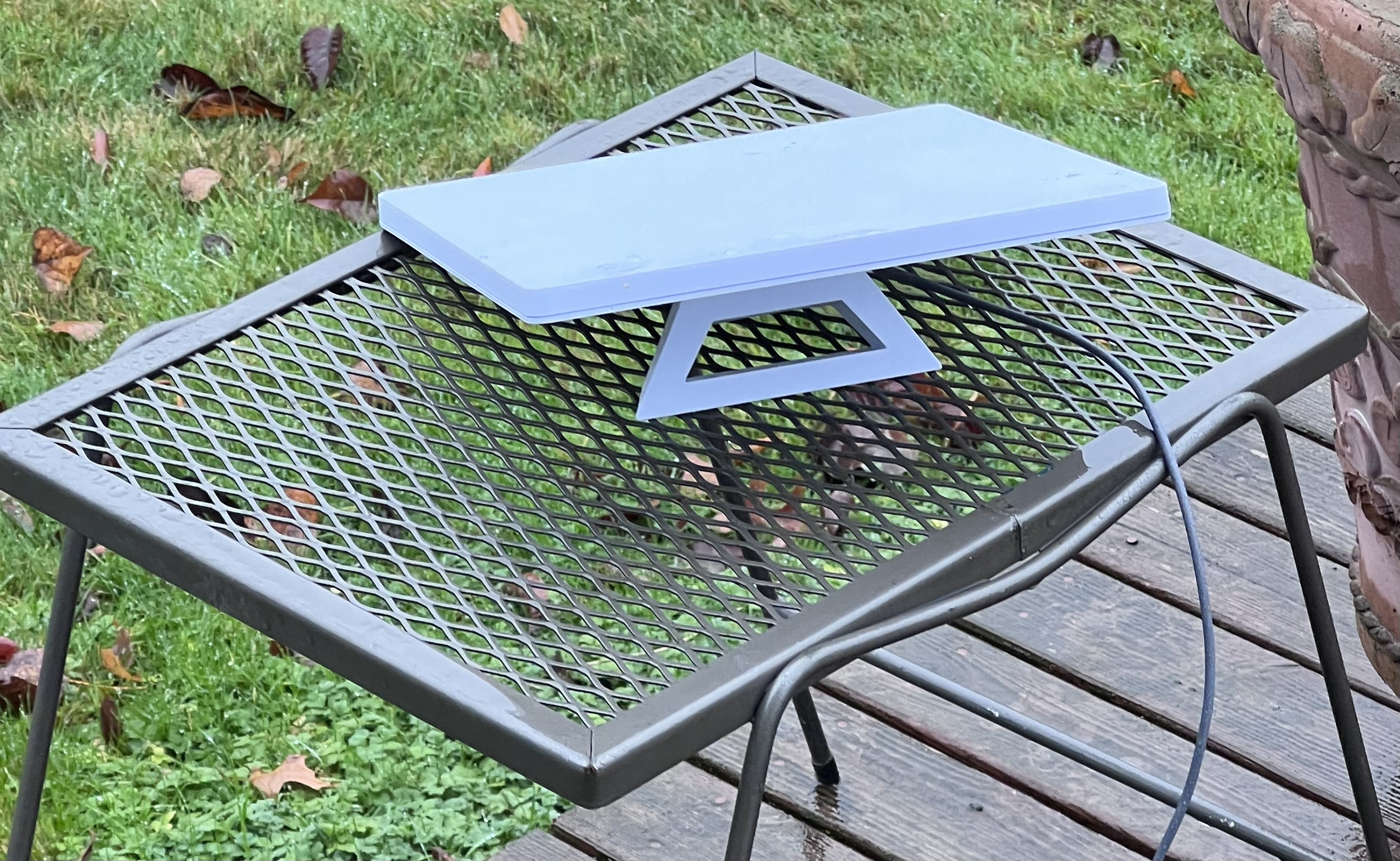
The orientation of Starlink is NNE and the Starlink app was interactive in saying that was the most optimum orientation.
Here’s the result of the speed test:
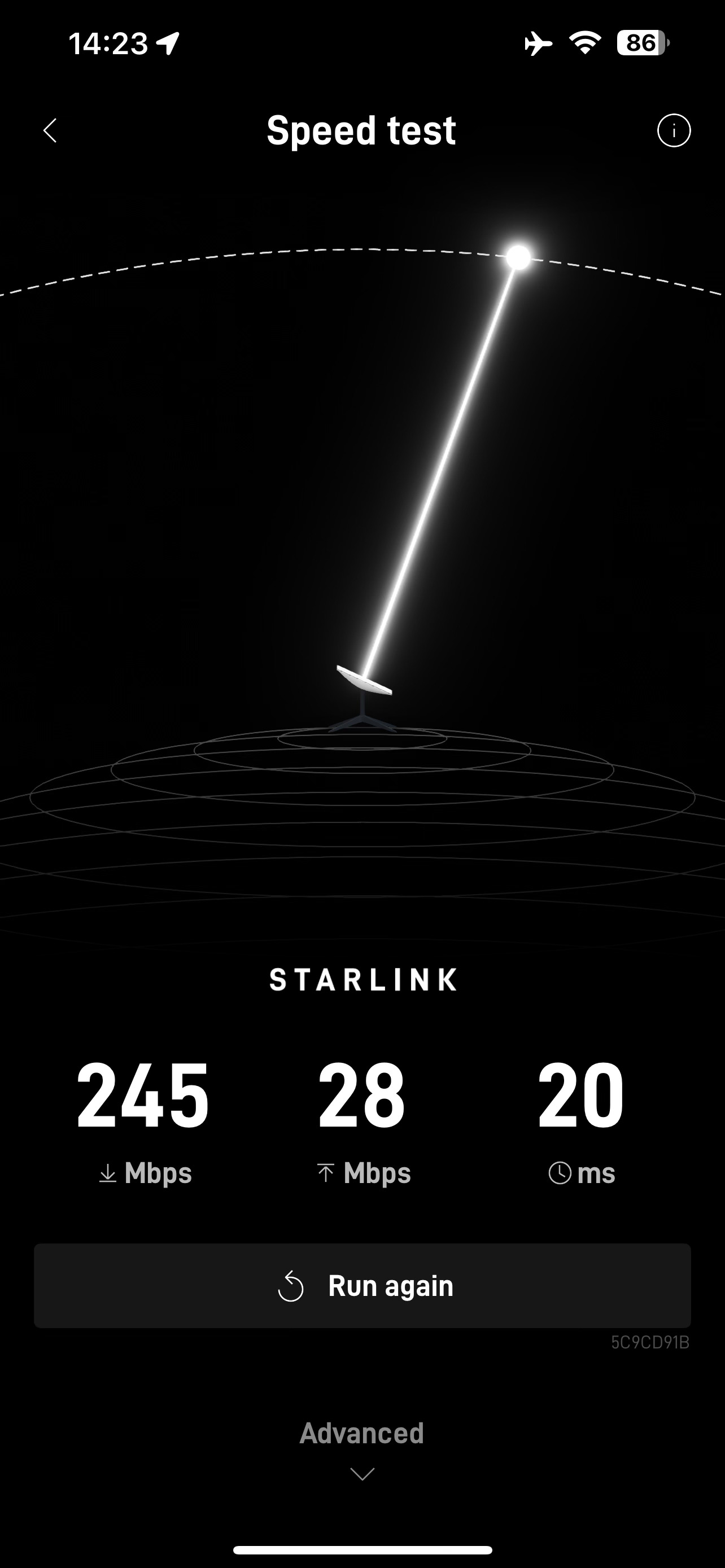
Look at that casual “installation” photo again - 245 Mbps down, 28 Mbps up (if I was paying for one of the “normal broadband” tiers of service which, again, is $25 / month for me as an existing Starlink user for my home service.
I suspect that Starlink Mini communications will quickly become another network for techie hobbyist communications, with peer-to-peer encrypted links, audio, VOIP telephony, video streaming (including full time cameras), native IPv6 support, web servers, etc. similar to the techie hobbyists that have embraced Meshtastic and MeshCore and perhaps soon 802.11ah / Wi-Fi HaLow.
The SharkRF m1ke (see below) is an absolute natural for a “Starlink techies network”.
Penguins and LinHT Manufacturers - No One Wants to go First
Even though it’s early days with the LinHT project (see first article in ZR > BEACON section), various folks have been reaching out to portable radio manufacturers in China, with no real results. Each manufacturer that’s been contacted is “carefully studying” LinHT, but are totally noncommittal.
Short reason, no radio manufacturer in China wants to spend the money and work to be first with a LinHT unit, only to have their unit quickly cloned by other radio manufacturers in China. That’s just the normal business model in China, little or no legal or other protection of technology, only some unique brand names (and sometimes, not even that’s can be protected).
In emails over the past couple of weeks, I’ve offered the analogy for this situation of penguins1 queueing up to go dive into an opening in the ice, knowing that there might be a shark or orca waiting for the first penguin to jump in. The penguins start crowding around the opening in the ice, waiting for one penguin to get hungry enough, or brave enough, or get pushed into the opening in the ice.
The point being, once one penguin goes, they all quickly follow. I was able to find a nice YouTube video to humorously illustrate this point. Thus, like the penguins crowding around a hole in the ice, there will eventually be one radio manufacturer, probably in China, that’s hungry enough, or brave enough, to make a LinHT.
And, once one manufacturer starts making a LinHT (and lots of money)… lots of other radio manufacturers “will all go” - just like the penguins do.
We will eventually get a plug and play, turnkey LinHT from a significant manufacturer, likely in China. LinHT is too powerful a concept for it not to happen.
Another Hilariously… Ridiculously Long “Newsletter” This Week
My editorial composition process for Zero Retries is still (regrettably to me) chaotic. I put in equal parts items that I find interesting, useful, or important. I can’t remember the last time the Substack “caution” didn’t pop up warning me that an issue was “too long for email”. That’s when I started adding:
On the web: https://www.zeroretries.org/p/zero-retries-0229
Substack says “Too long for email”? YES
Mentions at the very top of each issue.
The Substack editor has a useful icon labeled Post info in the lower left corner, that I almost always never look at. But I was spending so much time paging up and down in composing this issue, I thought “wow, this one’s really long”. So I looked at Post info…
Reading Time ~ 1H 22M - 1H 39M (as I finally cease to add things to this issue).
You’ve been warned 🤣
Update - Even more hilariously, that reading estimate was before I accidentally stumbled onto the information about the new lead article in this issue, which was so Zero Retries Interesting, I couldn’t not include it in this already way too big issue.
Credit Where Due - Guillaume F4HDK Patiently Created and Nurtured a Good Great Idea - With Open Source
In 2019, Guillaume F4HDK unveiled his New Packet Radio (NPR) system (Reference 1, Reference 2). F4HDK developed NPR as a “clean sheet of paper” design and despite including “Packet Radio” it had no backwards compatibility with legacy Amateur Radio Packet Radio, other than “packets” were used, over “radio”. No AX.25, no narrow bandwidths, no TNCs, no legacy FM (or other) radios, etc. NPR used TCP/IP, Ethernet as a radio interface, reasonable data speeds (100 kbps - 1 Mbps), on the 420-450 MHz / 70cm band. NPR even had a built-in networking capability for making efficient use of high profile nodes.
But the biggest innovation of New Packet Radio that F4HDK used was that he released NPR as open source, hardware, software, and well-designed protocol. His good designs that could be replicated, and then improved upon, the growing need for such a higher speed data radio for use on VHF / UHF, and his decision to use the open source model, has now resulted, in 2025, of a version of NPR for the 2m band (currently, 146-148 MHz). That one radio could conceivably be the “magic bullet” that helps recreate Amateur Radio data networks suitable for use (and NewTechHams) of the 21st century.
Kudos to F4HDK for his prescient creation of New Packet Radio!
Credit Where Due - ARDC Grants Can Really Work
This issue of Zero Retries has become laughably long and disjointed with a several inter-related and overlapping story threads, but early in this issue, I wanted to make one clear connection about ARDC grants.
This ARDC Grant:
Grant: New Packet Radio Version 3.0 / Seeding UK and Ireland Usage
Resulted in these two (and perhaps eventually three) new high speed data radios specifically designed for Amateur Radio operation on Amateur Radio VHF / UHF bands:
New Packet Radio NPR-H 3.0 (2m)
New Packet Radio NPR-H 3.0 (70cm)
Going back as far as the TAPR packetRADIO (concept) 30 years ago, Amateur Radio has needed such higher speed, designed-for-data radios, designed specifically for Amateur Radio requirements, especially Amateur Radio VHF / UHF spectrum, for decades now.
What finally created these new radios was an ARDC grant to fund the non-recurring engineering costs, routed to folks that were capable and willing to do the work of creating these unique radios for Amateur Radio. Finding such folks to do such work was the marvel - the grant wasn’t very lucrative, but it was apparently sufficient for Localino to do the work in creating these new, unique Amateur Radio data radios.
Thus, kudos to:
- Online Amateur Radio Community (OARC) for the vision to request the grant,
- ARDC for funding the grant,
- Localino for creating these two new radios.
ARDC grants for research and development can work. Sometimes ARDC’s research and development grants don’t work out2. That’s the nature of Research and Development.
But when a Research and Development grant does work, like this grant, it can really make a profound difference in Amateur Radio.
Weekends Are For Amateur Radio!
This weekend’s primary Amateur Radio activity will be devoted to playing with the m1ke that SharkRF has sent me for review. I first mentioned the m1ke in a (admittedly gushing) article in Zero Retries 0179 - SharkRF M1KE. That was a full year ago, so SharkRF has had plenty of time to work out the bugs from this unit, and I’m looking forward to easily participating in some Internet talk groups, as long as they’re ones that the m1ke supports (the list is long). One demerit I’ll be offering is that M17 isn’t on SharkRF’s list of compatible networks - bummer. Although… maybe… Brandmeister is a supported network, and (I think) Brandmeister supports M17?
Minor disclaimer - The multiplicity of options of Internet talk groups is a bewildering array of choices that I’ve not previously dived into. It’s going to take me at least a couple of days to really wrap my head around all of this. Fortunately, Tom Salzer KJ7T in Random Wire Newsletter 157 saved me a great deal of fumbling with the m1ke in his storylet Beginners guide video from M0FXB.
While I didn’t come out and say it in my initial mention of the m1ke, it is an interesting and potentially useful device that it went on my “buy one, someday” queue, but to date, I had not yet done so. Thus I was delighted when Norbert Varga HA2NON of SharkRF offered to send me a m1ke for review.
I have to get it working in time for the US Thanksgiving holiday on Thursday 2025-11-27 when there will be some additional Amateur Radio Operators in our household that I’m sure would be interested in playing with it.
Things I’m very interested in exploring with the m1ke beyond the usual Internet talk groups are:
Direct communication with other M1KE devices (no internet connection or wireless infrastructure needed).Multicast communication with other M1KE devices over the connected wireless network.Custom private networks (built-in support for broadcast/multicast gateway operation and site linking over the internet).Custom private servers (SharkRF IP Connector).
And, hopefully, communicate via Amateur Radio Over Internet with my buddy Tom Salzer KJ7T who also has a shiny new m1ke for review. I’ll definitely be using it over the new Starlink Mini. The m1ke is really cool - likely a full review in Zero Retries 0230 next week.
Have a great weekend, all of you co-conspirators in Zero Retries Interesting Amateur Radio activities!
Next week, Happy Thanksgiving to all you Zero Retries readers in the US. Tina and I are thankful to all of you for subscribing, reading, commenting, and especially supporting (financial, and otherwise) the Zero Retries newsletter, the Zero Retries Digital Conference, and all the other Zero Retries activities.
Steve N8GNJ
(Breaking!) Plug and Play New Packet Radio Units Available from Localino… Including for 2 Meters!
By Steve Stroh N8GNJ
OK5VAS - The New Packet Radio
As part of my article on the updates for the LinHT Project (see ZR > BEACON section), I found a mention of an interesting project to develop a new version of the New Packet Radio modem by (LinHT hardware developer) Vlastimil Slinták OK5VAS called The New Packet Radio. This article is dated 2025-06-25, but despite looking at OK5VAS’ website in the past couple of months, I hadn’t seen that specific article because that article is only in Czech, and I had been clicking the UK/US button to see articles in English. But, as I was putting the finishing touches on this issue, I saw it and was impressed. Probably because the page is partially in English (the sidebar), my primary browser (Apple Safari) didn’t offer an automatic translation. But Firefox did, and I read with interest.
In this text, I would like to introduce the New Packet Radio project to the Czech-Slovak amateur radio community (and also the Hamnet network a little marginally) and why I was so interested that after years I decided to get a license, design my own PCB and start experimenting with NPR.
In the text we will look at the history, technical parameters and practical use of NPR and hopefully I will be able to motivate you so much that together we will expand the NPR in the Czech Republic/SR. Well, let’s do this.
When I finally started thinking about a radio amateur license this year, it was mainly because of digital modes and HAM data networks. I was never very attracted to talking to strangers on short waves as an introvert (even if this changes over time, I recently discovered the M17 mode).
I like that instead of a voice connection, modern radio amateurs use digital/data transmissions, often with admirable efficiency in limited bandwidth. But most of the available modes (AX.25, APRS, FT8, ...) are built to very low bitrate, often only to transmit a few bytes of text per minute.
Then there is the (so far little-known and widespread) NPR project, which aims to create an open, IP-compatible and high-speed radio network for radio amateurs. It is not a black box full of patents – it is a fully open-source solution built on commonly available components and open firmware, authored by the French radio amateur F4HDK. I was very interested in this and as someone who studied telecommunications at BUT FEKT and professionally deals with the development for IoT, I was really interested in the combination of simplicity, openness and the chosen technical solution.
For a moment I read about NPR and watched all available Youtube videos, went through the original documentation, clicked on the firmware, and then put it aside for a few months. It was not until I was provoked by Twitter in February this year by a post from OK2AWO, which boasted the first planned Hamnet connection in the Czech Republic.
We started talking and there was a mention of NPR. This time I didn’t hesitate, launched KiCAD and started designing my own version of the album. I wanted to get everything on one compact printed circuit board, without unnecessary cables and purchased PCB modules, ready for use. I used the radio module from NiceRF (as well as the original author), but I composed the rest of the circuit from separate components, liabilities of size SMD 0402 and everything as compact as possible.
Other New Packet Radio Variants
Since OK5VAS was new to New Packet Radio (at the time of that article), and I had corresponded with him lately about the LinHT project, I thought he might like to know about some other New Packet Radio development to improve the original NPR hardware design, including:
- NPR-70 v05 Modem by F4HDK | New Packet Radio over 70cm Band | Amateur Radio Packet Radio | Factory-Assembled
- New Packet Radio Modem Version 2, NPR-H 2.0
- TACNPR - Another Independent Implementation of New Packet Radio
- Grant: New Packet Radio Version 3.0 / Seeding UK and Ireland Usage
Then It Really Got Interesting
As I was web searching to find that first link in the previous paragraph (I couldn’t remember the name of the “storefront” site Tindie)…
I found the Localino Ham Radio page.
And, there were two new New Packet Radio variants mentioned in the ARDC grant linked in the previous paragraph:
New Packet Radio NPR-H 3.0 (2m)
New Packet Radio NPR-H 3.0 (70cm)
There will be a third radio unit - New Packet Radio NPR-H 3.0 (23cm) but that won’t be available until mid-December at the earliest.
What’s brilliant about these three radios is that they have a common “compute” motherboard, and the individual radio boards just plug in to the motherboard. Thus they have a common enclosure, end panels, etc.
What is new in Version 3.0?Modular design for 70cm, 2m and 23cm RF NPR-H 3.0 boards (baseband board + selectable RF board)New Microcontroller STM32F4 with more powerPorted and updated firmware with bugfixes and improvements (USB bootloader for [firmware] updates, watchdog, listen before talk feature, interrupt handling, fixed race conditions)Compatible with F4HDK firmware/master/client nodes
These are built-for-purpose higher speed data radios!
Just in case the point is lost with this development, perhaps the lede got buried in my excited verbiage… these are new data radios that can do, natively, up to 1 Mbps on the 2m and 70cm (and probably, eventually, the 23cm) band.
Ethernet (and USB-C?) data in, RF out, and unlike the original New Packet Radio (that was only available for 70cm), the output power is a very usable 7 watts.
To address the but, but, but factors…
- The use case for New Packet Radio, and these units, is a lower speed (but still reasonably fast), longer range connection into the European HAMNET high speed microwave network using VHF / UHF bands. (But there’s nothing restricting these radios to that usage.)
- Yes, the 2m unit is designed for the Europe 2m band (146-148 MHz, but I confirmed with Steffen Heuel DO5DSH of Localino that it will work over the full 144-148 MHz 2m band available in North America.
- There will likely be issues using the 2m unit in the US with the current FCC Part 97 bandwidth limit for 2m of 20 kHz. (More on this in a bit.)
- Despite the ongoing tariff issues with the US, Localino will happily sell and ship these units to the US.
- The units are sold as boards, but can be supplied with enclosures (German Fischer AKG series) for an additional €19 including front and back plates.
What’s really encouraging is that New Packet Radio was developed entirely with an Amateur Radio use case:
NPR uses Amateur Radio callsigns for node identifiers.
NPR uses IPv4 TCP/IP addresses. Fortunately, there’s no need for using IPv4 Network Address Translation (NAT) - 10.x.x.x, 192.168.x.x, etc. We in Amateur Radio have a pool of routable, unique IPv4 addresses to work with - 44Net so we can build “clean” networks using these units using IPv43 TCP/IP.
NPR uses native TCP/IP - it’s basically Ethernet / RF bridges. Just use your usual TCP/IP apps - email, web server and browser, file transfers, etc.
NPR has provisions for high profile nodes to efficiently manage contention for multiple stations accessing a high profile node.
I’ll guess there’s some easy way to bridge or route multiple NPR LANs - different 2m or 70cm channels, cross-band, etc.
For North America, the (not quite homogenous) equivalent role of Europe’s HAMNET is networks based on AREDN. While HAMNET has the advantage of population density (and thus infrastructure is more supportable), AREDN has the advantage of being able to easily form local networks with mesh networking (or static networking), with tunneling between AREDN LANs via Internet. These new NPR radios could easily (I hope) fit into AREDN networks in the same way that 802.11ah / Wi-Fi HaLow units have been integrated into AREDN.
Suffice it to say, for now, that these new New Packet Radio units are a very big, very exciting, very promising deal for Amateur Radio data communications and may well be the building blocks of a new Amateur Radio high speed data communications network in the 21st century.
I will be reporting on these new radios very regularly from how on here in Zero Retries. It seems quite likely that if these new radios are actually able to be delivered to the US, I’m going to get a pair of each on order for testing in N8GNJ / Zero Retries Labs.
Pushing the Boundaries of US Part 97
These new Localino radios are hardware refinements that don’t change one fundamental aspect of New Packet Radio - the minimum bandwidth is 100 kHz.
In the US, a 100 kHz bandwidth is incompatible with the current Part 97 maximum bandwidth limit for data modes in the 144-148 MHz 2 meter band of 20 kHz.
In the US, a 100 kHz bandwidth is barely compatible (slowest setting) with the current Part 97 maximum bandwidth limit for data modes in the 420-450 MHz 70cm band of 100 kHz.
In the US, there are no bandwidth limits on the 1240-1300 MHz 23 cm band so the NPR-H 3.0 (23cm) can be used in the US with no restrictions.
To use an NPR-H 3.0 (2m) / (70cm) to its full potential of 1 Mbps, requires a bandwidth of 1 MHz. Thus to use the New Packet Radio NPR-H 3.0 (2m) at all in the US, or to use either unit to their full potential, requires regulatory change.
We have three potential solutions:
Petition the FCC to delete data communications bandwidth limits on the US Amateur Radio VHF / UHF bands per the recommendations of the ARRL and others (including me). (I’ll put together a full re-hash of the comments filed with the FCC to date for future reference and new filings with the FCC.)
There are ample “protections” available in other parts of Part 97 to ensure that interference is minimized. For example, the NPR-H 3.0 (2m) probably isn’t a good fit for operation in US urban areas where there are numerous 2m voice repeaters, thus not “Good Amateur Practice”.
This is the long term solution, but will require a significant, coordinated effort.
This comment / observation by Justin Overfelt AB3E from Zero Retries 0223 is now completely applicable:
… Interesting statement fromCommissioner[actually, Chairman] Carr:https://docs.fcc.gov/public/attachments/FCC-25-68A1.pdf
He says that soon they’ll move to “more substantiative whacks at the FCC rulebook”. I think these will take the form of NPRMs rather than direct final rules and in fact one has already come out regarding Internet labeling regulations that is generating some new comments. Some things to realize here:
* They are very obviously only doing deletions. I felt this was clear from the jump, but that didn’t stop people from requesting all sorts of massive new regulations.
* With that in mind, it might be worthwhile to comment again emphasizing the changes for Part 97 that can be accomplished with only deletions (symbol rate, 219, etc).
* The takeaway is they are tracking (to the word level) how many regs they delete so adding to the pile of removals will get consideration.
Thus, perhaps now, with the use case of these new NPR radios to illustrate the need and utility, carefully craft and submit a new Notice of Proposed Rulemaking to the FCC to surgically delete the bandwidth limitation statements (and of course, the inane symbol rate limitations) for the Amateur Radio VHF / UHF bands. That approach would seem to stand a reasonable chance of being paid attention to by the current FCC administration.File an application with the FCC for a Special Temporary Authority (STA) to prove out the potential utility and full potential (1 Mbps links / networks) on VHF / UHF bands) of the NPR-H 3.0 (2m) and NPR-H 3.0 (70cm). The problem with an STA is that it’s temporary… of limited duration. However, this might be expedient and necessary precursor to requesting removal of bandwidth limits for VHF / UHF in Part 97. Elements of an STA:
Manage the STA carefully, with a central Point of Contact (POC), who can easily contact all participants.
An STA will require a plan on what is to be tested / demonstrated, a viable number of participants (willing to invest in the equipment to be tested / demonstrated).
Ideally there will be some geographic diversity of the STA activity, especially use in rural areas where Amateur Radio spectrum usage is lower.
At the end of the STA period, compose and submit a final report to the FCC on the results of the STA.
Also document in that final report that there are no bandwidth limits imposed on Amateur Radio VHF / UHF bands in other countries (notably, Canada) without detrimental effect to Amateur Radio operations in those other countries. Also note that Amateur Radio bands are smaller in those countries, most notably in Europe, only 2 MHz on 2m, and 10 MHz on 70cm is available for use by Amateur Radio.Demonstrate use cases for the faster data rate and unique applicability of high speed data communications on the VHF / UHF bands such as longer and not necessarily optical line of sight paths, easier antennas (than microwave - 5 GHz).
Demonstrate that with careful planning (such as point to point) there are not significant interference issues resulting from 100 kHz - 1 MHz bandwidth usage on 2m and 70cm, especially in rural areas.
Demonstrate that Amateur Radio with the use of VHF / UHF high speed data radios is improving the state of the radio art, when data communications have largely been moved to microwave networks and commercial mobile networks, Amateur Radio can do high speed data communications in VHF / UHF bands.
In lieu of an STA, file an application with the FCC for a Part 5 Experimental License to prove out the potential utility and full potential (1 Mbps links / networks) on VHF / UHF bands) of the NPR-H 3.0 (2m) and NPR-H 3.0 (70cm). Note that while the FCC states that the usage for Part 5 licenses are “… for space and earth station licenses…”, the FCC has issued a number of Part 5 Experimental Licenses for experiments with HF systems, so this statement doesn’t seem like a “hard” rule for Part 5 Experimental Licenses. The same elements of an STA apply to a Part 5 Experimental License, with the desired result to demonstrate the feasibility of removal of bandwidth limits on the US Amateur Radio VHF / UHF bands.
Thanks to the pioneering work of F4HDK in 2019, then OARC and ARDC in 2024, and Localino in 2025, we finally have high speed data radios created for the unique aspects of Amateur Radio for the VHF / UHF bands… that we have wanted for literally three decades now.
What remains now is to persuade the FCC to minimally update the Part 97 rules to eliminate the arcane bandwidth restrictions on the US Amateur Radio VHF UHF bands… for groups to buy and deploy the radios, and start finally having fun with fast data communications over radio. DreamNet indeed!
The Piling On and Misinformation About ARDC Continues
By Steve Stroh N8GNJ
I now feel a bit prescient about my article in Zero Retries 0228 - In Defense of ARDC and its Grant Funding / Process.
In a Forums post on QRZ.com by Kevin Thomas W1DED - Call for Volunteers: Help ARDC Shape Ham Radio’s Future, a video on the YouTube channel, Q5 Worldwide Ham Radio: