Zero Retries 0226
2025-10-31 — LinHT Article (by the developers), MESHCON 2025 is a Wakeup Call, Test Bench in a Hand, N8GNJ Standby Battery System, direwolf 1.8, New AllScan USB Radio Interfaces, MMDVM Update
Zero Retries is an independent newsletter promoting technological innovation in and adjacent to Amateur Radio, and Amateur Radio as (literally) a license to experiment with and learn about radio technology. Radios are computers - with antennas! Now in its fifth year of publication, with 3200+ subscribers.
About Zero Retries
Steve Stroh N8GNJ, Editor
Email - editor@zeroretries.net
On the web: https://www.zeroretries.org/p/zero-retries
Substack says “Too long for email”? YES
⬅️⬅️⬅️ Previous Issue of Zero Retries \ Next Issue of Zero Retries ➡️➡️➡️
In this issue:
Request To Send
- Paid Subscribers Update
- Radio Technology is Evolving Fast, Especially Open Source
- FreeDV “Oughta” Have a Data Option
- Happy Halloween (Treat!) - ZRDC 2025 Material Now Available
- Weekends Are For Amateur Radio!
Full Article by the LinHT Developers:
LinHT: An Open-source SDR Handheld Radio for Amateur Radio Operators
MESHCON 2025 is a Wakeup Call to Amateur Radio for Relevance With Techies Interested in Radio Technology
Test Bench In A (Handheld) Box
My New 2025 Standby Battery Power System
- Background on my 12 Volt Power System
- The Bioenno Power BLF-1240A
- West Mountain Radio Epic PWRgate
- The Most Puzzling, Frustrating Aspect - the Two Connectors on the BLF-1240A Aren’t Documented
- Power Budgeting
- Add a West Mountain Radio PWRcheck+?
- Don’t Charge LiFePO4 Batteries < 0° C
- Wrapping Up…
ZR > BEACON
- direwolf Release 1.8 Now Available
- IP400 (and More) News from ADRCS 2025-10 Newsletter
- Thought Experiment - Could OpenGD77 or MMDVM Be Configured for Single Channel or Four Timeslots DMR?
- 44Net VPN Status Update
- Introducing the Next Generation of AllScan USB Radio Interfaces
- Surrey Amateur Radio Communications The Communicator Newsletterzine - November December 2025 Issue
- FutureGEO Workshop Memo
- SDR-Hub: A New RTL-SDR Scanner and Audio Recorder with Web Interface
- Trials & Errors #67 (10/10/25): Defending the Spectrum
- Pacificon 2025 Overview
- MMDVM 2025-10 Update
- Announcing The 2025 Hackaday Superconference Communicator Badge
- Explaining the Mesh! - MESHCON 2025: Daniel Susca Opening
Comments Summary From Previous Issue
Zero Retries Boilerplate
Permission for Reuse of Zero Retries Content
Keywords for this Issue
Footnotes for this Issue
Comments for This Issue (Redirect to This Issue’s Comments page)
Request To Send
Commentary by Editor Steve Stroh N8GNJ
Paid Subscribers Update
My thanks to Peter Neubauer KD0QXJ for renewing as an Annual Paid Subscriber (3rd year!) to Zero Retries this past week!
My thanks to Prefers to Remain Anonymous 104 for becoming a Paid Subscriber to Zero Retries this past week!
Financial support from Zero Retries readers is a significant vote of support for the continued publication of Zero Retries.
Radio Technology is Evolving Fast, Especially Open Source
I was “surfing” the YouTube videos from the recently concluded AMSAT-US 43rd AMSAT Space Symposium and Annual General Meeting - Day 1, Day 2. One discussion got my attention - the planned use of a 10 GHz downlink on a Low Earth Orbit (LEO) microsat. A big challenge in using (Amateur Radio) 10 GHz from LEO is for an Amateur Radio ground station to keep a 10 GHz antenna aimed at the fast moving satellite. It’s (I think…) inherent that a directional antenna for 10 GHz has a much more narrow beam width than a directional antenna for lower Amateur Radio bands such as 420-450 MHz. Thus the aiming mechanism must be more precise and responsive than for lower frequency antennas.
I immediately thought of the open.space phased array antenna system that I saw at Pacificon 2025. That particular unit / system is designed for C-band - 4.9–6 GHz, but otherwise it’s exactly what AMSAT described as needed for a microwave downlink from LEO - an electronically steered (with perhaps some assistance from azimuth / elevation rotors) phased array antenna.
Thus with the “ground segment handled” by the open.space system, perhaps it’s appropriate to adjust the plans of the AMSAT microsat to use 5 GHz for the downlink instead of 10 GHz? The argument for doing so is that a 10 GHz phased array antenna array for a ground station is currently unobtainium, especially at Amateur Radio price points. In contrast, open.space recognized that radio chipsets for 5 GHz are commodity items (even available on very inexpensive microcontrollers).
I wasn’t surprised to learn that open.space was founded by a former Space X Starlink engineer familiar with the phased array antenna systems used on Starlink satellites and consumer ground terminals.
FreeDV “Oughta” Have a Data Option
One of the highlights of Pacificon 2025 for me was Bruce Perens K6BP inviting me out to lunch, along with David Rowe VK5DGR and Mooneer Salem K6AQ. VK5DGR and K6AQ are the primary developers on the FreeDV Project, and most recently, the new Radio Autoencoder (RADE) in the newest versions of FreeDV. RADE uses Machine Learning (as opposed to previous versions of FreeDV that used algorithms for digitizing speech).
The four of us had a delightful, casual lunch (Thanks Again, Bruce!), but I wasn’t going to miss the opportunity to make one of my primary “pitches” for future features of FreeDV - an option to use FreeDV for data, not just voice.
I cited the example of FreeDATA which uses (pre-RADE) FreeDV’s OFDM modulation but adapted for data rather than digitized voice. VK5DGR works with FreeDATA’s developer to assist the development of FreeDATA.
But FreeDATA and FreeDV are completely separate applications, despite the common framework of the FreeDV modulation.
I tried to make the case that these two separate apps don’t make sense to me. To me, choice of transmitting data, or voice, should simply be whether you press the Enter key on your keyboard, or press the Push To Talk button on your microphone.
Given that there has continued to be the separation of FreeDV and FreeDATA, even with the “enablement” of a 2023 ARDC grant to continue development of FreeDV, I expected to have to press my case with VK5DGR and K6AQ.
However, VK5DGR agreed with me that such a combination of voice and data in FreeDV is feasible, and perhaps desirable. But, a “tight integration” of data into FreeDV / RADE isn’t currently in the development plan submitted for the current ARDC grant. Further, neither he (VK5DGR) nor K6AQ had the skills, or the available development bandwidth, to integrate a data capability into FreeDV / RADE.
That… is a reasonable explanation of why there won’t be an integrated data option in FreeDV / RADE in the near future. Perhaps a future ARDC grant can add such a capability / integrate the capabilities of FreeDATA directly into FreeDV / RADE. This seems reasonable and feasible given that the current work on FreeDV is well documented and open source.
Happy Halloween (Treat!) - ZRDC 2025 Material Now Available
Most of the material from ZRDC 2025 is now publicly accessible on the Zero Retries Digital Conference 2025 Archive page. There are many rough edges on this page, and a number of lingering to-dos (such as photos), and I didn’t get the videos uploaded to the (to be created) Zero Retries YouTube page. But it’s good enough to make public now.
What is there are the videos, the slide decks, the full Proceedings, and the three papers that were submitted.
Weekends Are For Amateur Radio!
Have a great weekend, all of you co-conspirators in Zero Retries Interesting Amateur Radio activities!
I have a new 12 volt standby battery power system to install!
Steve N8GNJ
Full Article by the LinHT Developers:
LinHT: An Open-source SDR Handheld Radio for Amateur Radio Operators
By Andreas Schmidberger OE3ANC, Wojciech Kaczmarski SP5WWP, and Vlastimil Slinták OK5VAS
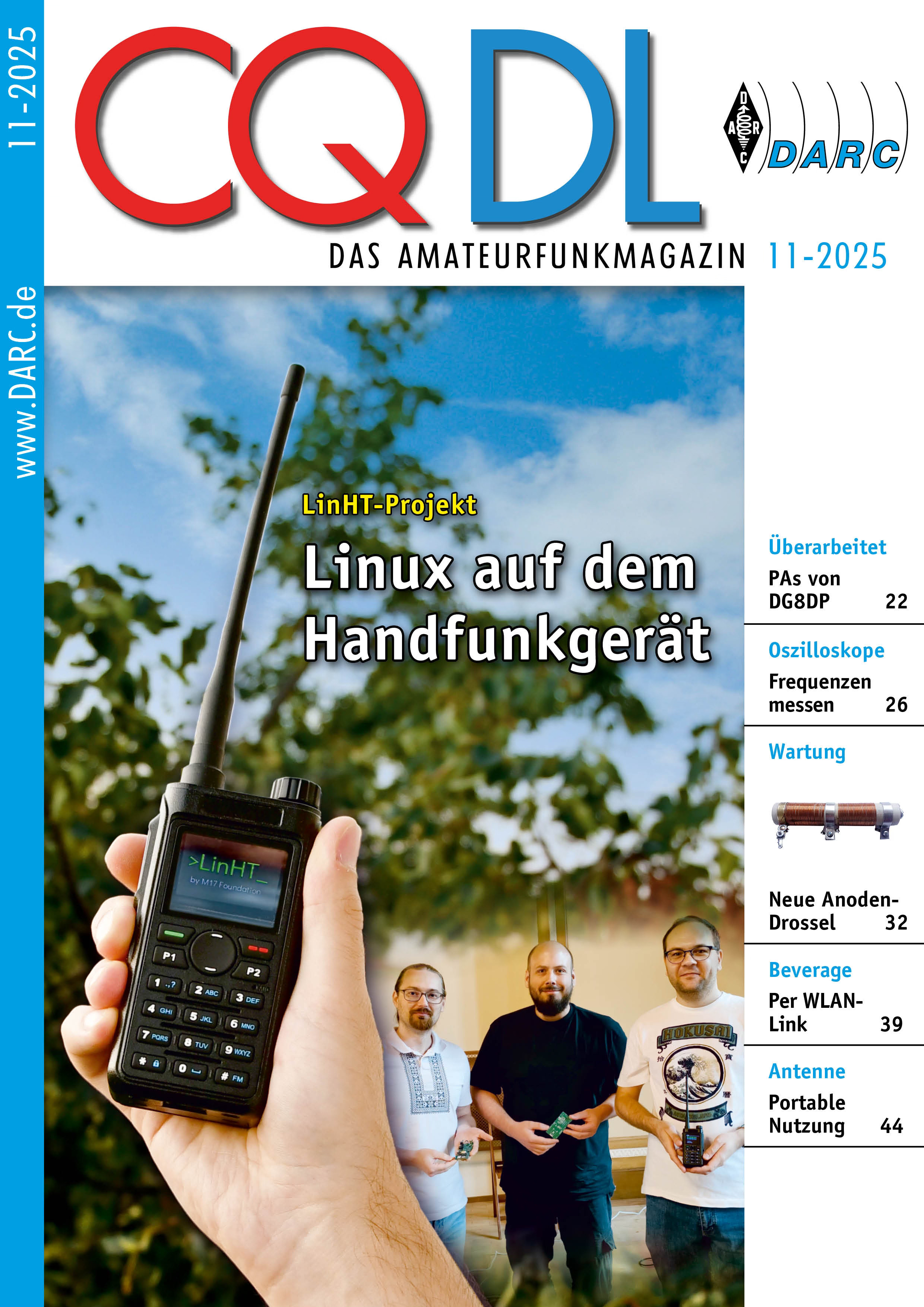
Editor’s Note: Until very recently, I have been referring to the expansion of “LinHT” as Linux Handie Talkie, which is incorrect. The correct expansion of LinHT is:
Linux Handheld Transceiver.
Below is the article - LinHT: An Open-Source SDR Handheld Radio for Amateur Radio Operators previously referenced in Zero Retries 0225, as submitted CQ-DL magazine by the three authors, and published in the November, 2025 issue. Note the article, as submitted, was written in German - this version is a translation to English.
This republication is not an excerpt from the pages of CQ-DL 2025-11.
This article is republished in Zero Retries with the permission of the three authors of the article to promote the LinHT project, which is one of the projects undertaken by volunteers of the M17 Project, sponsored by M17 Foundation.
While the article is a good explanation of the current state of the LinHT project, some additional detail is offered in SP5WWP’s slide deck for his LinHT presentation - LinHT – a GNU Radio configurable handheld transceiver at M17 Conference 2025 on 2025-09-06 (PDF version):
The video of SP5WWP’s presentation on LinHT at M17 Conference 2025 is now available: