Zero Retries 0223
2025-10-10 — Why Manufacturers May Be Reluctant About VHF / UHF / Microwave SDR “Real Radios”, VARA FM Via FM (Analog) Repeater, Help Track Our Light Sail!, Jesse Alexander WB2IFS GRCon 2025 Keynote
Zero Retries is an independent newsletter promoting technological innovation in and adjacent to Amateur Radio, and Amateur Radio as (literally) a license to experiment with and learn about radio technology. Radios are computers - with antennas! Now in its fifth year of publication, with 3200+ subscribers.
About Zero Retries
Steve Stroh N8GNJ, Editor
Email - editor@zeroretries.net
On the web: https://www.zeroretries.org/p/zero-retries-0223
Substack says “Too long for email”? YES
⬅️⬅️⬅️ Previous Issue of Zero Retries \ Next Issue of Zero Retries ➡️➡️➡️
In this issue:
Request To Send
- Paid Subscribers Update
- The Serenity Prayer for Amateur Radio
- Weekends Are For Amateur Radio! Conferences - Like Pacificon 2025
Why Manufacturers May Be Reluctant About VHF / UHF / Microwave SDR “Real Radios”
VARA FM Via FM (Analog) Repeater
- Testing A Dedicated VARA FM Repeater
- Terrain Challenges
- Summary
ZR > BEACON
- University of Pennsylvania Amateur Radio Club Wireless Luncheon
- FCC FACT SHEET In re: Delete, Delete, Delete - Direct Final Rule – GN Docket No. 25-133
- Help Track Our Light Sail! - Setting Up a Ground Station for the Cornell Alpha Mission
- Video - HackRF Portapack Evolved? This is PortaRF
- Dire Wolf Version 1.8 Beta Test
- Jesse Alexander WB2IFS - Keynote at GNU Radio Conference 2025
- OpenRTX 0.4.2 Released
- PocketPD Update: Announcing a New Version for Drone & Ham Radio Operators
- open.space
- Documentary Explores Collins Radio’s Role in Creation of the Internet
- Hush - An Open Source Alternative to VARA-HF
- Video - MeshCore Presentation by Liam Cottle
- Video - Ukraine’s New Jam-resistant Battlefield Radios Signal Soldier-led Revolution
Comments Summary From Previous Issue
Zero Retries Boilerplate
Permission for Reuse of Zero Retries Content
Keywords for this Issue
Footnotes for this Issue
Comments for This Issue (Redirect to This Issue’s Comments page)
Request To Send
Commentary by Editor Steve Stroh N8GNJ
Paid Subscribers Update
My thanks to Prefers to Remain Anonymous 54 for renewing as an Annual Paid Subscriber to Zero Retries this past week!
Financial support from Zero Retries readers is a significant vote of support for the continued publication of Zero Retries.
The Serenity Prayer for Amateur Radio
In a private discussion group I’m a member of, the “regulars” include a number of very intelligent, accomplished folks from many countries. A recent item of discussion was a particular intellectual activity. The discussion soon changed from the activity, to discussion that the activity was futile, given “so much is going wrong these days… surely there are bigger, more important issues to focus one’s energy and attention on”.
Perhaps. But then there are times when “issues” can be so overwhelming as to be paralyzing. At times, I’m guided by the essential wisdom of the Serenity Prayer:
The serenity to accept the things I cannot change,
The courage to change the things I can,
And the wisdom to know the difference.
So maybe focus on things that one can personally affect. In my case, diving deep to report out and advocate for technological innovation in Amateur Radio here in Zero Retries. Maybe, just maybe, such actions can change the world for the better, at least a little bit.
Weekends Are For Amateur Radio! Conferences - Like Pacificon 2025
Welcome to the new Zero Retries subscribers / readers discovering Zero Retries at Pacificon 2025!
Pacificon has become my second (only to Zero Retries Digital Conference) favorite Amateur Radio conference because of its proximity to Silicon Valley, California. I’m routinely overhearing Zero Retries Interesting conversations that I just don’t hear at other conferences (again, other than ZRDC). Of course, there were similar ZRI conversations overheard at GRCon 2025, but that wasn’t specifically an Amateur Radio conference.
open.space (see ZR > BEACON article) will, I predict, be a showstopper at Pacificon 2025, but there’s plenty of Zero Retries Interesting exhibitors (FreeDV is next to us) and presentations.
I’m looking forward to a lot of ZRI conversations at the Zero Retries booth.
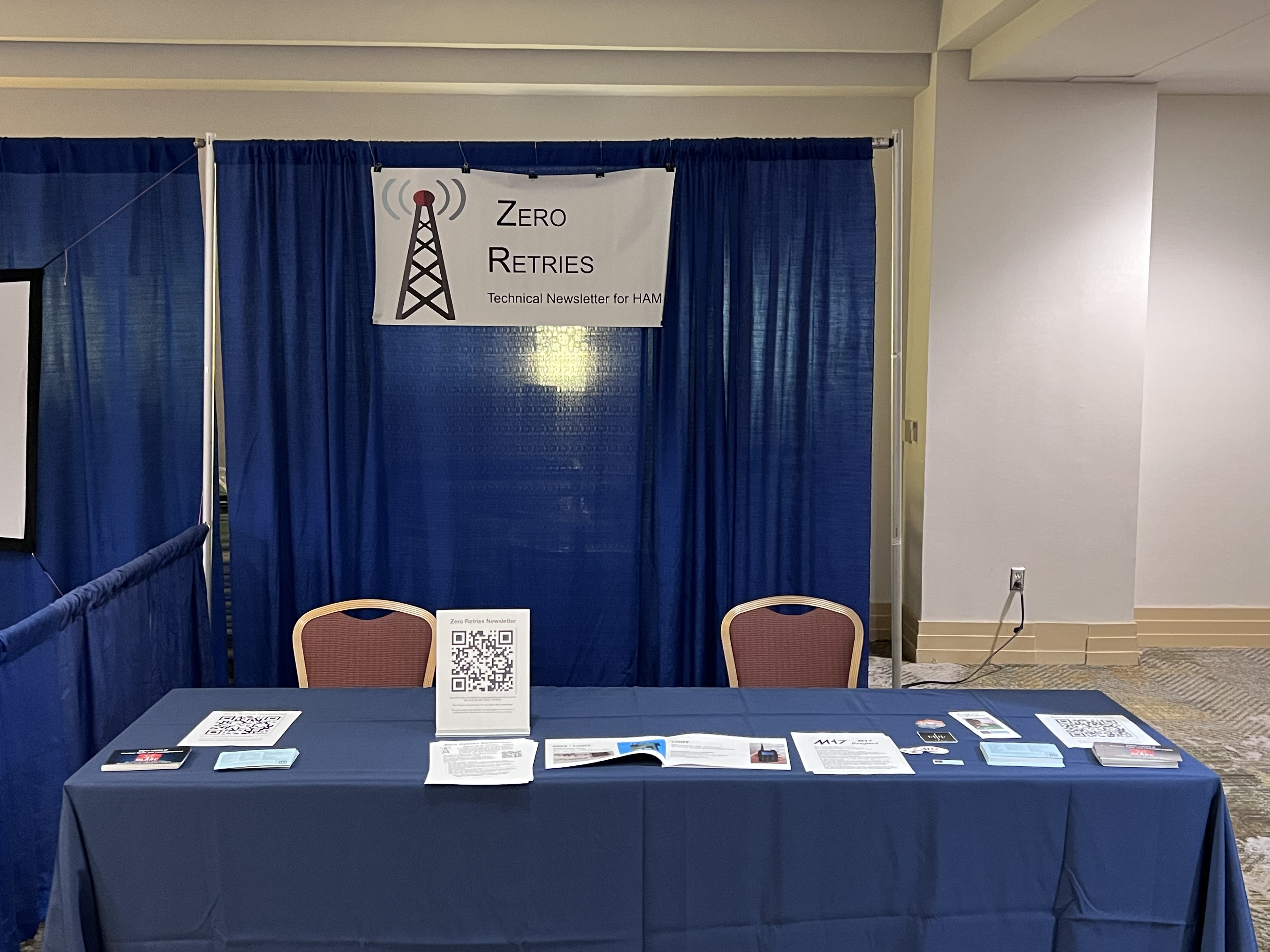
As I lead off with to passers-by who have no idea what Zero Retries is:
We’re selling free subscriptions to an Amateur Radio newsletter.
I developed a one-page handout about Zero Retries:
which increases the interest in Zero Retries considerably.
I also developed a one-page handout about M17:
And we have the double sided postcards about DLARC. I need to make a new sign for those, like Kay Savetz K6KJN had to do to grab attention at Pacificon 2024:
Free online Ham Radio library!
Have a great weekend, all of you co-conspirators in Zero Retries Interesting Amateur Radio activities!
Steve N8GNJ
Why Manufacturers May Be Reluctant About VHF / UHF / Microwave SDR “Real Radios”
By Steve Stroh N8GNJ
Here in Zero Retries, I’ve often bemoaned that there is not (yet) a “real radio” Software Defined Radio (SDR) for VHF / UHF / microwave operation, as a “turnkey” product, available for use in Amateur Radio. In my description, “real” denotes that a user can load whatever SDR software they want to on such a unit. “Real” also denotes having a transmit power output that is usable for typical Amateur Radio communications on VHF / UHF / microwave, such as at least 5 watts, preferable 25 or 50 watts.
I also brazenly predict that “someone” (an individual, or small business) will spot this unmet need for the Amateur Radio market and offer such a product.
A few weeks ago, Ismo Väänänen OH2FTG (ftg on Mastodon) wrote to me on Mastodon:
I think one of the major reasons why there are no ready made, out of the box usable open source 100W or even 5W class SDR’s is regulations.
In USA it is 47 CFR § 2.944
https://www.ecfr.gov/current/title-47/chapter-I/subchapter-A/part-2/subpart-J/subject-group-ECFRd5ad3b739dbf27a/section-2.944
The line: “Manufacturers must take steps to ensure that only software that has been approved with a software defined radio can be loaded into the radio.”
Makes things very clear cut.
This stuff almost killed openwrt and similar projects around 2015 - 2016 - see https://hackaday.com/2015/09/02/save-w
You might also notice that all retail SDR’s like HackRF are certified as laboratory equipment, not radios.
That’s also why they are exempt from the scanning receiver cellular blocking, as are spectrum analyzers with FM demodulators.
My thanks to OH2FTG for pointing this out, and, at first glance, that issue and adherence to the letter of the regulations, could intimidate potential manufacturers from creating a VHF / UHF SDR “real radio”.
But perhaps not?
The Chinese manufacturers of “Amateur Radio” units don’t seem to be intimidated by “… must take steps to ensure that only software that has been approved with a software defined radio can be loaded into the radio“. I’ve mentioned a number of alternative software loads for various Chinese radios, and there is also the blurring of authorization requirements for multiple radio services such as Part 90 (Private Land Mobile Radio - commercial), Part 95 (General Mobile Radio Service), and Part 97 (Amateur Radio).
Wi-Fi and Wireless Internet Service Providers (WISP) radio units that can be updated with OpenWRT software is a more instructive example… though those are very low power to operate in the unlicensed bands.
Ultimately a workaround to making a usable VHF / UHF / microwave SDR available for Amateur Radio might be the simple expedient of making the power amplifier “optional”, but easy to install. A similar approach is a common workaround for avoiding the necessity of full certification of some Amateur Radio products. That is, offer a unit as a kit that is almost entirely assembled and tested, but leave some “assembly” step, such as soldering on the power connector, or assemble the unit into the case and plug some components into sockets, etc.
Thus I remain optimistic that a real radio (not “test equipment”) VHF / UHF / Microwave SDR unit might become available in the near term (the next couple of years, at most).
A very good first step is the Linux Handie Talkie (LinHT) project by the folks of the M17 Project to develop a fully (user) SDR in a portable radio form factor on the Amateur Radio 420-450 MHz band.
VARA FM Via FM (Analog) Repeater
By Steve Stroh N8GNJ and Scott Currie NS7C
For all the varying digital modes that have been created for Amateur Radio VHF / UHF bands, one of the fastest (with a few exceptions1), and easiest to implement for a wide area data communications system is a basic VHF or UHF FM repeater using some easily set parameters can make an FM repeater perform optimally for use with VARA FM.
Acknowledged that VARA FM is not open source, is designed to be used only on Windows, and there is the cost of $69 for a user license. All of those issues are addressed in the VARA FM chapter of the forthcoming book.
Steve is working on his forthcoming book SuperPacket - the Zero Retries Guide to Amateur Radio in the 21st Century.
As part of his research for the VARA FM chapter, regarding usage of VARA FM via FM repeaters, on the VARA website, in the document VARA FM 4.0 Features, there is this mention:
Operation of VARA FM sessions thru voice repeaters is improved.
To clarify the usage of VARA FM via FM repeaters, Steve contacted Jose Alberto Nieto Ros EA5HVK, the creator of VARA FM.
Jose replied:
VARA FM works best over analog (FM) repeaters when the repeater’s delay parameters are configured properly.
For relaying VARA FM, VARA FM digipeaters work better than analog (FM) repeaters.
Testing A Dedicated VARA FM Repeater
Steve also contacted Scott Currie NS7C who is one of the most experienced users and promoters of VARA FM
Scott replied:
In San Louis Obispo County (SLOC), California we have been testing a full duplex repeater for VARA FM operations for about a year now, with very good success. Although this repeater can still be used for voice operations, we have dedicated this repeater for data only. This repeater was supplied by the county radio shop at their facility on Cuesta Peak in SLOC. In the test configuration it is running a unity gain antenna not very high up on the tower, and is using a mobile duplexer. We are working to make this repeater permanent with a more suitable antenna and duplexer. The repeater is a Tait TB8100 on UHF.
After testing various configurations, we have found that VARA FM performs best with the following repeater configuration:
- CTCSS on receive only, no TX CTCSS,
- Zero drop delay / hang time,
- Flat audio on receive and transmit, no pre/de emphasis,
- Short CW ID, call sign only, with nominal 9 minute timing (no “smart” identification),
- No courtesy tone or any other signaling.
Running with zero drop delay results in Transmit Delay (TXD) well within VARA FM’s range, and has prevented voice users from finding the repeater. They don’t think there is a repeater there since they don’t hear a drop delay. They also don’t know what that weird noise is when a VARA FM user is active.
To use this repeater, as Jose mentioned, users set their VARA FM stations to use VARA FM NARROW mode. VARA FM WIDE mode3 does not work well through the repeater as VARA spends too much time trying to find the best speed, which often ends up being slower than VARA FM NARROW mode. Those who have a good path to the repeater regularly achieve VARA FM NARROW mode Level 11 (12,750 bps), though the average is more typically level 9 (about the same as 9600 packet except with FEC and compression).
In theory, a VARA FM digipeater4 at the same location running VARA FM WIDE mode could provide marginally better performance, assuming most users would be able to achieve level 11 or higher, but there would still be the issue of hidden terminals / hidden node problem.
Keep in mind, using a digipeater drops the overall throughput in half or more since each data block needs to be sent twice. With timing and overhead, it works out to more than a 50% hit on throughput.
With a VARA FM digipeater there is also the issue of running a Windows computer at a remote location with limited access. This would have to be a stripped down Windows install with no network access. With Microsoft’s current direction, building such a system is getting much more complicated and difficult. A regular Win11 machine on a mountain top would likely be very frustrating to maintain and probably not very reliable.
There may be an added benefit to using a voice repeater operationally. During an emergency activation with ARES/RACES users needing to send a lot of digital messages (we have standardized on Winlink, though you could use VarAC or even VARA Chat). This is going to result in contention for use of the frequency / repeater (this has proven to be the case, even when using 1200b packet on a busy frequency. In our experience, Packet Radio’s CSMA/CD (Carrier Sense Multiple Access / Collision Avoidance) on a simplex frequency doesn’t work in most cases.
Our plan would be to establish a “Data Net Control station” on the data repeater using voice to sequence operations. Yes, that does mean people would have to listen to the VARA FM noise, but VARA FM connections are relatively short, so it might not be too annoying. We have not tested this procedure yet.
An interesting side note - we have tested regular AFSK (Audio Frequency Shift Keying) 1200 bps packet through this repeater, and it works well even without doing bit regeneration. This eliminates the hidden terminal problem and CSMA/CD actually works much more efficiently!
Discussing the configuration of the FM repeater to have zero drop delay / hang time, it might seem advantageous to have a non-zero drop time, but apparently VARA FM is capable of sensing carrier drop, faster than the cessation of data traffic, to decide that the channel is clear.
The testing of this test repeater optimized for VARA FM is being done in San Luis Obispo County, CA, among the SLO County Amateur Radio Emergency Services (ARES) teams. To date, usage of the test repeater has been by those involved in ARES. The SLO County ARES teams work with the California Office of Emergency Services (CalOES) at the county level. Teams are spread across the county in 5 general areas:
- South County
- Central County
- North County
- North Coast
- Estero Bay
We also have a liaison to the California Polytechnic State University at San Luis Obispo (Cal Poly) campus and W6BHZ, the Cal Poly Amateur Radio Club, which hosts a Winlink Gateways on campus. See https://www.sloecc.org/ for more information.
Terrain Challenges
The San Lucia Mountains in the Central Coast separate these areas from an RF perspective. The Cuesta Grade separates South and Central county from North county, and the ridge continues along the coast to separate North Coast and Estero Bay. Our hilltop repeaters link these areas, but in the case of data systems, these create the ideal situation for hidden terminals. If you look at our packet network with the terrain map, it is pretty easy to see what we are up against:
https://www.google.com/maps/d/edit?mid=13wao94dYtEVnjIZ38QzoOwEixW9oodE&usp=drive_link
I’m in Paso Robles. Connecting to stations in San Luis Obispo, Arroyo Grande, Cambria or Morro Bay is impossible without the network nodes. The County Emergency Operations Center (EOC) is located in a valley off Highway 1 to the west of San Luis Obispo. There’s no radio paths in or out of at location without repeaters. So, we need the peaks, but the isolation is really good. I can’t hear any stations south of Santa Margarita, and they can’t hear me. We are bound to transmit at the same time. Cuesta Peak and Tassajara Peak link these regions together.
Summary
Scott has performed admirable research (testing various parameters for more than a year) which resulted in a easy-to-replicate, reliable, reasonably fast (~ 10 kbps) wide area data communications system for Amateur Radio use. This is significantly faster than typical Amateur Radio Packet Radio operating at 1200 bps, with no FEC, and if digipeaters are used, half duplex and thus prone to collisions from hidden terminals / nodes.
It’s notable that a “VARA FM” repeater such as NS7C has developed can be “basic” and thus inexpensive (and also, minimal for maximum reliability). With the use of VARA FM “NARROW” the radios can be any VHF or UHF radio (connected via speaker and microphone connections) and any audio interface is capable of the bandwidth required for VARA FM NARROW.
ZR > BEACON
By Steve Stroh N8GNJ
Short mentions of Zero Retries Interesting items.
University of Pennsylvania Amateur Radio Club Wireless Luncheon
Email from John Campbell W3MHZ / W3KZ:
Greetings! On behalf of W3KZ - the University Of Pennsylvania Amateur Radio Club (UOPARC), and the Moore School [of Engineering] at the University of Pennsylvania, I wanted to extend the below invitation for a ZOOM meeting Saturday, October 18, 2025 at 11 a.m.
This may be timely as we too are talking about Meshtastic and Amateur Radio and have bought Seed T1000Es some for W3KZ. Philly Mesh will be presenting.
This is primarily a networking event with Penn Alums, Students and many friends in the broader amateur radio and wireless communities.
A rough agenda is below. We plan on an hour and will leave the ZOOM call open after we finish so our guests can interact for any “meeting after-the-meeting” since we hope to have many of the area ham radio clubs represented.
We have invited the other local universities - Villanova, Drexel, Temple, Ursinus, our not too distant friends at University of Scranton W3USR.
We have invited clubs such as Ham-Sci, MARC, HARC JFDNA, Free Library of Philadelphia Amateur Radio Club, Delaware Valley OMIK, AMSAT, ARRL, etc..
Please join if you can and feel free to invite anyone appropriate to the ZOOM call.
…
The Moore School of Engineering at The University of Pennsylvania, in collaboration with W3KZ - The University of Pennsylvania Amateur Radio Club, invites you to join us for our Penn Wireless Luncheon.
This gathering brings together alumni, faculty, staff, friends, and current Penn students from the amateur radio and wireless communities. Join us for technical discussions, hands-on activities, and engaging conversation with fellow enthusiasts.
We’ll be hearing from students, alumni, WM3PEN, ARES, and Philly Mesh. We also hope to hear from you, our guests!
Event Details
Date: Saturday, October 18, 2025
Schedule:
11:00 AM - 12:00 PM — Meeting in Levine 307 (Zoom available)
https://upenn.zoom.us/j/97296390406?pwd=8t79Jet5ETDAiHBQkrnkmzH4geeNUB.1
Meeting ID: 972 9639 0406
Passcode: 420045
12:00 PM — Lunch and amateur radio activities in Levine Hall rear courtyard
Location:
Levine Hall
3330 Walnut Street
University of Pennsylvania
Philadelphia, PA 19104
Maidenhead Grid: FM29sx
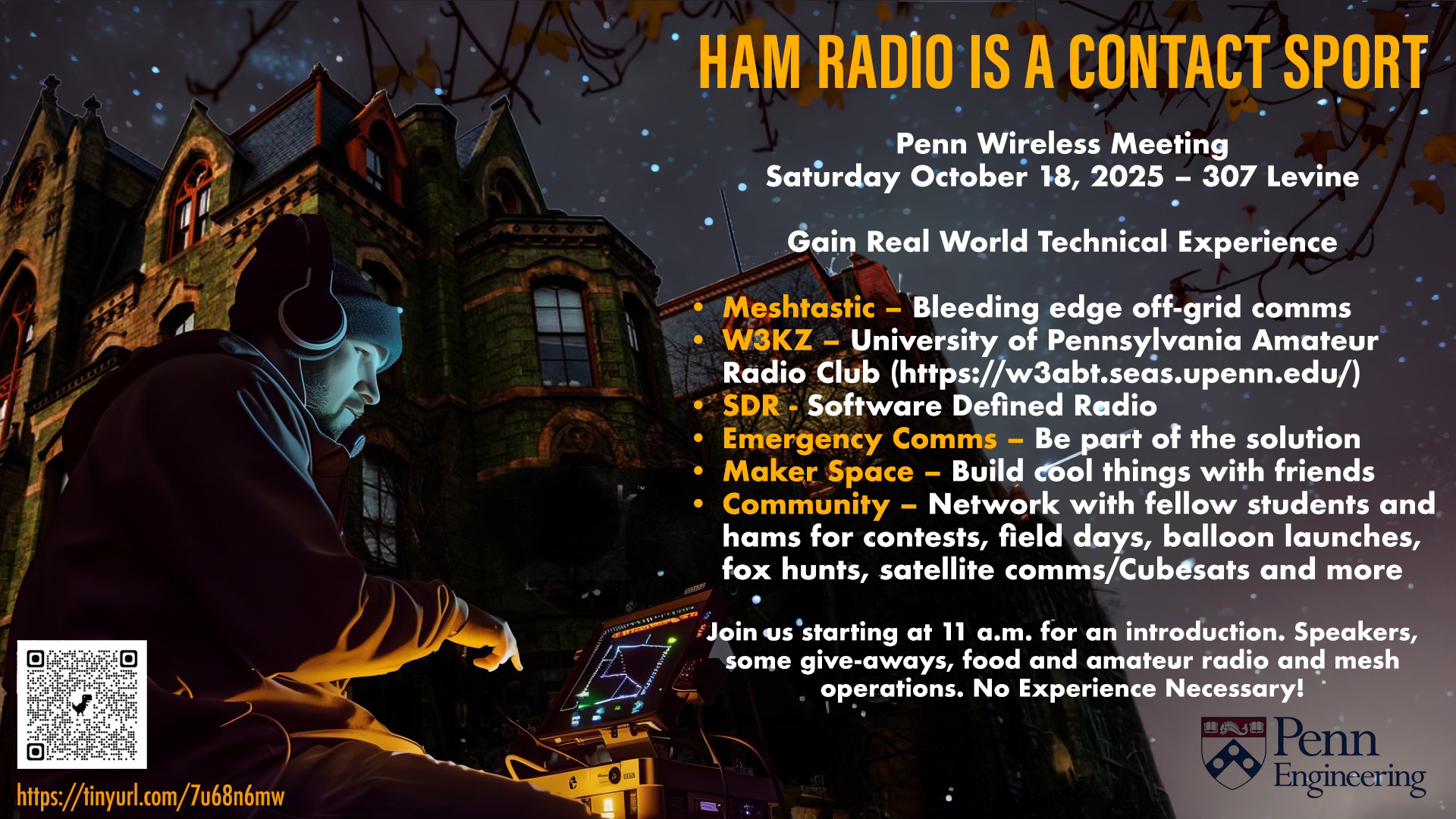
I know that there are a number of Zero Retries readers in the Philadelphia area, but I also included this item because of their specific mention about “radio fun” such as Meshtastic, SDR, and a makerspace. Kudos to UOPARC for reaching out to the University of Pennsylvania community to stoke interest in radio technology and Amateur Radio. The above card is also pretty cool!
FCC FACT SHEET In re: Delete, Delete, Delete - Direct Final Rule – GN Docket No. 25-133
Background: The Direct Final Rule marks the next step in the Commission’s continuing effort to modernize the Commission’s regulatory framework and pave the way for the next generation of innovation. The “In re: Delete, Delete, Delete” proceeding launched a sweeping review aimed at eliminating outdated rules, reducing unnecessary regulatory burdens, accelerating infrastructure deployment, promoting network modernization, and spurring innovation.
Justin Overfelt AB3E via email:
This FCC document dated October 7, 2025 seems Zero Retries Interesting:
https://docs.fcc.gov/public/attachments/DOC-415063A1.pdf
My summary of the Part 97 changes is below:Removes “97.27 FCC modification of station license grant” (This apparently restates 47 USC 316 and is deemed redundant)Removes “97.29 Replacement license grant document.” (Yep, this is the one ARRL and multiple others called out - a slam dunk)Removes 97.315 (b)(2) A carve-out for amplifiers produced or bought before 1978 saying they don’t have to be certified - I actually think this could affect some people still hanging onto old gear, but I don’t disagree with its removal.Remove 97.521(b) Saying you have to be qualified to be a VEC in one of the VEC regions in Appendix 2 (FCC says VECs no longer organized by region and remote testing makes this moot)Remove Appendix 2 (apparently only referenced in 97.521(b)
So all of the “clearing out dead wood” variety. Here’s hoping for some more substantial fixes upcoming.
I concur with AB3E’s assessment that these are minor changes to Amateur Radio regulations. To me, these items related to Amateur Radio (and a few other items in this document that I looked at) seem like “easy wins” - pretty non-controversial and easy to implement by removing small bits of regulatory verbiage.
While I still feel that it was important for Amateur Radio to “show up” and comment in GN Docket 25-133, I don’t think that the comments that Amateur Radio filed - notably by me, Open Research Institute (ORI) and ARRL, however well composed and reasoned, for substantive change in Amateur Radio (such as deleting symbol rates and bandwidth limits on Amateur Radio VHF and UHF bands) will be implemented by the FCC. To effect such changes, some significant “forcing function” will be required, such as “Amateur Radio” filing a Petition for Rulemaking. That’s not an “impossible” barrier for substantive regulatory change, but it’s a substantial one.
I’m grateful to Justin Overfelt AB3E for mentioning this to me. At date of publication, I haven’t seen mention of this anywhere else.
Help Track Our Light Sail! - Setting Up a Ground Station for the Cornell Alpha Mission
Email from Joshua Umansky-Castro, forwarded to me:
Date: October 7, 2025 at 12:26:01 AM CDT
Greetings from Ithaca!
If you’re receiving this message, you expressed interest in setting up a ground station to support Cornell University’s Alpha CubeSat mission. It took a few more years than anticipated, but we’re excited to share that we’ve launched!! Here’s a news article commemorating the milestone.
Our CubeSat along with its ChipSat-sail payload are now stowed onboard the International Space Station. On November 17th, the CubeSat will be released into space. A few days after that (if all goes well), the CubeSat will deploy the sail! At that point we’ll need all the help we can get to collect data from the sail’s ChipSats in the very limited (less than 48hrs) time they are in orbit!
By mid-November we encourage you (and anyone you may know) to set up a small low-cost ground station to help collect data from our sail and to establish a LEO-to-ground link for our next-generation ChipSat spacecraft. I’ve made a guide that provides some background on the mission and walks you through all the steps on how to set up the station.
Link to guide: https://cornell.box.com/s/n4se5ku0ltjb1of2piagfz1y7xa92n47
Please share the guide with as many people as you can! The more people listening for the ChipSats the better, especially if they are geographically widespread. Also if you have any questions, please reach out to both myself and sail-designer Andy Filo. We are more than happy to assist you with your ground station setup!
Contact info:
Joshua Umansky-Castro <jsu4@cornell.edu>
Andrew Filo <43dprinting@gmail.com>
Thanks again for your support of our mission! After so many years of development, it’s admittedly nail-biting that my time to demonstrate the tech in space comes down to just a few hours. Your help has a huge impact on making the most of the sail’s short time in orbit!
Best regards,
Joshua Umansky-Castro
PhD Candidate, Aerospace Engineering
Space Systems Design Studio
Cornell University
(The link to download the ground station document is pretty slow, but it does eventually work.)
Light sails, though theoretically simple, still seem to me like technology straight out of science fiction, though a brief web search showed that there have actually been a few launched.
Having a new ground station online by 2025-11-17 might seem like a tight deadline, but this specific ground station hardware seems like it’s a pretty simple system to build. The ground station they’re requesting to be built is pretty simple and inexpensive. The simplest version is a LoRa board for 433 MHz and a ground plane (omnidirectional) antenna. The software is the same as TinyGS - see the document for full details.
This seems like a cool project that’s pretty easy and inexpensive to build, especially for techie kids / families / makers (and STEM classes, makerspaces, NewTechHams, etc. The light sail aspect really stirs the imagination!