Zero Retries 0216
2025-08-22 — ZRDC 2025 Update, LinHT Progresses, ARRL Tech Awards, patty AX.25 stack, IPv6 /48 Subnets, JNOS 2.0q, KV4P V2, AREDN Plans for 2025, MMDVM Update, Ham DEFCON, AllStarLink Donations

Zero Retries is an independent newsletter promoting technological innovation in and adjacent to Amateur Radio, and Amateur Radio as (literally) a license to experiment with and learn about radio technology. Radios are computers - with antennas! Now in its fifth year of publication, with 3100+ subscribers.
About Zero Retries
Steve Stroh N8GNJ, Editor
Email - editor@zeroretries.net
On the web: https://www.zeroretries.org/p/zero-retries-0216
Substack says “Too long for email”? YES
⬅️⬅️⬅️ Previous Issue of Zero Retries \ Next Issue of Zero Retries ➡️➡️➡️
In this issue:
Request To Send
- Paid Subscribers Update
- Substack Internal Links Aren’t Working
- LinHT Progresses
- Weekends Are For Amateur Radio!
Zero Retries Digital Conference 2025 Update - 8/22/2025
Three Brief Articles on LinHT
- First LinHT Tests
- LinHT – Open SDR Handheld for Radio Amateurs
- Demo LinHT M17 Decode
ZR > BEACON
- ARRL Technical Awards
- PACKRAT - Intro and Five Part Series, and hz.tools - Tutorial on Software Defined Radio by K3XEC
- patty AX.25 stack (for POSIX-like OS)
- July / August 2025 ARDC News
- IPv6 /48 Subnets for Radio Amateurs
- http://amprv6.org
- JNOS 2.0q
- SF-HAB High-Altitude Balloon Launch #5
- Turn Any Android Device Into A Full VHF Radio - KV4P Version 2 - NEW!
- AREDN Development Plans 2025
- MMDVM.com 2025-08 Update
- Does Amateur Radio Need a DEFCON?
- Open Letter from AMSAT-SM Regarding Development of a Full Duplex Handheld
- AllStarLink Appeal For Donations
Comments Summary From Previous Issue
Zero Retries Boilerplate
Permission for Reuse of Zero Retries Content
Keywords for this Issue
Footnotes for this Issue
Comments for This Issue (redirect to Comments page)
Request To Send
Commentary by Editor Steve Stroh N8GNJ
Paid Subscribers Update
My thanks to Rick Prelinger W6XBE for renewing as a Founding Member Subscriber 0011 to Zero Retries this past week!
My thanks to Prefers to Remain Anonymous 47 for upgrading from an Annual Paid Subscriber to Founding Member Subscriber 0018 to Zero Retries this past week!
Founding Member Subscribers are listed in every issue of Zero Retries!
My thanks to Don Coker KM6TRZ for renewing as an Annual Paid Subscriber to Zero Retries this past week - for a 3rd year!
My thanks to Prefers to Remain Anonymous 46 for renewing as an Annual Paid Subscriber to Zero Retries this past week!
My thanks to Prefers to Remain Anonymous 92 for upgrading from a free subscriber to Zero Retries to an Annual Paid Subscriber this past week!
My thanks to Prefers to Remain Anonymous 94 for upgrading from a free subscriber to Zero Retries to an Annual Paid Subscriber this past week! PRTA 94 included this nice message:
I'm not technically savvy, but I support open source technology. I find your newsletters fascinating, learning what's under development. I'm familiar with DMR, and I aspire to learn to use my new CS700-M17 GPS. As an ARES Winlink user, I look forward to the open source substitute for VARA that you report is in development.
PRTA 94 is referring to Mercury, which is the subject of an upcoming story in Zero Retries… if all these pesky 😄 exiting new developments would quit popping up week after week.
Financial support from Zero Retries readers is a significant vote of support for the continued publication of Zero Retries.
Substack Internal Links Aren’t Working
I was told that the internal hyperlinks in the Table of Contents of the last several issues of Zero Retries aren’t working - they redirect to the URL of the issue. I haven’t had time to troubleshoot this issue, thus I won’t feature a hyperlinked Table of Contents until I can resolve that issue with Substack.
LinHT Progresses
The LinHT project, being developed as a project within the larger M17 Project, is some really impressive technological innovation in Amateur Radio. LinHT is really disruptive technology being developed within Amateur Radio that isn’t being attempted anywhere else. My wife Tina is fond of stating “You never know where the next great idea is going to come from” and LinHT is a great example of that. LinHT is a win / win / win scenario:
- Amateur Radio will finally have the “universal radio” that has been needed for more than a decade since Amateur Radio VHF / UHF began fragmenting into non-interoperable digital voice and data modes.
- Amateur Radio and GNU Radio users will finally have a practical, and (probably, soon enough) inexpensive platform to develop and use new types of radio technology, developed in software - write it, run it, use it.
- That LinHT is being developed as an Open Source proof of concept will enable commercial manufacturers to create a VHF / UHF Software Defined Radio. There will be ample opportunities to differentiate different vendor’s products - higher power (can’t come soon enough), mobile radio form factor (and higher power), multiple bands (222-225 MHz hopefully soon), ease of use / better user interfaces, etc.
As I said in a previous issue of Zero Retries, I think LinHT is just going to blow by the major Amateur Radio manufacturers because they just can’t grasp1 the pent up demand for a VHF / UHF Software Defined Radio within Amateur Radio. Whatever commercial vendor delivers the first usable LinHT (including reasonable power levels - probably 5 watts) is going to sell a whole lot of them. The market for LinHT isn’t just Amateur Radio, it’s vastly larger - university students, GNU Radio experimenters, etc. For example, I will be giving a Lightning Talk on the LinHT at GRCon 2025 to explain the LinHT to the GRCon attendees.
I think we’ll quickly see variants of LinHT developed as, for example, a “travel router” form factor2 with power and communications via USB-C, no local display or controls. designed for use with laptops to enable VHF / UHF communications.
And, while the device isn’t quite sufficient (we’re going to need new radio modes to take full advantage of these capabilities)… LinHT is the kind of 21st century technology that is relevant to the NewTechHams that I’ve been writing about in Zero Retries, and I believe it will be interesting enough to attract techies to get their Amateur Radio license to be able to use it.
Consider engineering students - It’s fun and instructional to experiment with GNU Radio and maybe run your GNU Radio experiments on a very low power Software Defined Transceiver such as the ADALM-PLUTO which is (as far as I’m aware) the primary unit for Electrical Engineering students for experimentation with radio.
But how much more fun and instructional would it be run your GNU Radio experiments on a LinHT that you can carry around, self contained, running your own unique radio system on campus, with your friends?
Lastly, I find it humorous that two projects underway - GT-DV and Opulent Voice, both of which the principals of those projects have “dissed” M17… may well see their respective projects most widely used in a LinHT.
Weekends Are For Amateur Radio!
Have a great weekend, all of you co-conspirators in Zero Retries Interesting Amateur Radio activities! We will be entertaining a dear friend as a guest, and more, more, more writing in time for ZRDC 2025 to finish my submitted paper and my keynote presentation (Tina and ZRDC Proceedings Coordinator Don Rotolo N2IRZ are fearsome taskmasters). And, perhaps some fun time in N8GNJ / Zero Retries Labs.
Steve N8GNJ
Zero Retries Digital Conference 2025 Update - 8/22/2025
By Tina Stroh KD7WSF
This is the fifth in a series of weekly updates leading up to Zero Retries Digital Conference 2025. ZRDC 2025 occurs in three weeks!

ONE DAY PASS FOR ZERO RETRIES ATTENDEES AT GRCon 2025!
In our weekly conference call with the folks from GNU Radio, they mentioned they had received some feedback regarding the ticket price for their one day pass. Since Steve and I are the local hosts for GRCon 2025, they graciously offered a one day pass for Zero Retries attendees to GRCon 2025 at a significant savings. A normal one day pass was $350.00 and now it's discounted to $125.00 All inclusive including meals. However, you must be registered for the Zero Retries Digital Conference (ZRDC) to receive the discount. This is an extremely generous offer and I hope many will take advantage of it. GRCon 2025 starts 9/8/2025 through 9/12/2025.

Discount code: ZERORETRIESDISCOUNT
https://tickets.gnuradio.org/grcon25/redeem?voucher=ZERORETRIESDISCOUNT

REGISTRATION
As I mentioned last week, I have added a new ZRDC tickets for clubs to purchase. There are two versions of the club ticket; one for virtual attendance on the day of the conference and one for the early release of the video. It is a one ticket price, regardless of how many are participating.
If you are planning on attending in person, please register by September 5th as I will need to give the venue a head count for meals. Although we can accommodate the day of registrations, IT WILL NOT include meals and we don’t want to turn anyone away. The admission cost also increases. So, please register ASAP.
Conference: Registration for ZRDC 2025
Links
Zero Retries Digital Conference 2025
Please check the Conference page on the Zero Retries Webpage regularly for up to the minute news.
In closing for this week, we would like to thank our sponsors for their gracious donations:
ARDC
ARRL
CentyLab
Connect Systems
GigaParts
HydraSDR
Three Brief Articles on LinHT
Compiled by Steve Stroh N8GNJ
As I’ve been saying, there’s a lot going on with LinHT!
First LinHT Tests
Wojciech Kaczmarski SP5WWP on the M17 Project website:
The future is here: LinHT booted up successfully for the first time. We believe that Software Defined Transceivers will be the next big trend in amateur radio.
LinHT is the most important hardware project in Amateur Radio today.
Bruce Perens, K6BP
https://perens.com/2025/08/12/whats-wrong-with-ardc/
The test device has no RF amplifier (although we will include GRF5604 RF amplifier in the next revision, see this). The output power of this test setup is around 5dBm. Frequency range: 420-450MHz (UHF).
While some doubted that such a design is even viable, we continued our work tirelessly. Big shout out to Vlastimil OK5VAS and Andreas OE3ANC. The project would not be possible without your help, guys.
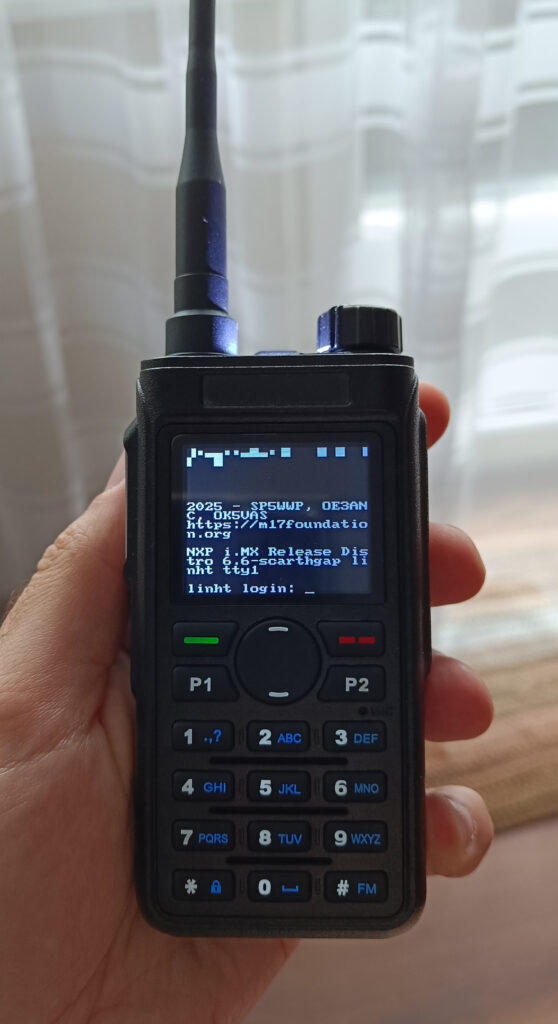
The device is open source hardware. The PCB design is available here.
Total cost for a prototype run:
– $490 for PCB+assembly at PCBWay (5 pcs.)
– Retevis C62 (donor)
– $469 for SoM, 5pcs.
and…
LinHT – Open SDR Handheld for Radio Amateurs
Vlastimil Slinták OK5VAS on his blog:
What is LinHT?
LinHT (Linux Handheld Transceiver) is our attempt to take the flexibility of SDR and bring it into a form factor radio amateurs actually use every day: a handheld. Instead of another black-box HT with proprietary firmware, LinHT runs a full Linux system on an NXP i.MX93 SoM, with GNU Radio as the DSP engine.The RF front-end is based on the Semtech SX1255 – a complete IQ modulator/demodulator, which makes it possible to support “all modes” in software.On the software side, the image is built with Yocto, and already includes Python, GNU Radio, development/debug tools, USB networking (Ethernet with DHCP and SSH), and hardware support (GPIOs, display, codec, SX1255).Images are already available for download at m17project.org/linht/experimental.
In short: it’s a small Linux computer with a radio front-end – and it fits into the enclosure of an off-the-shelf handheld.
The team
Right now, the LinHT core team is just three people:Wojciech, SP5WWP – software and hardware design, testing, first prototypes.Andreas, OE3ANC – software and system integration (Linux image, Yocto, drivers).Myself, Vlastimil, OK5VAS – PCB design.
It’s a small group, so it means we cannot add support for every feature immediately, but we’re making progress. We just received the first prototype PCBs, and Wojciech has already started bringing them up.
Current status
The Linux image is booting, networking works, and most of the hardware is already supported. GNU Radio flowgraphs can run directly on the handheld, which opens the door to a huge range of experiments.
On the RF side, the first prototypes are at the “does it even turn on” stage, but the design already covers the basics: display, codec, SX1255.
The next step is power amplification. The current board runs at milliwatt levels, but we’re already working on adding a PA for around 3–5 W output. That’s where my LinHT-rf-amp project comes in: a proof-of-concept RF amplifier board based on the Guerrilla RF GRF5604. Once we’ve characterized it, the PA will be integrated into the handheld.
Why should hams care?
Because it’s open.
Every major HT on the market today is a locked-down device. You get the features the manufacturer decided you should have, and that’s it. With LinHT, we finally have a path to a fully open handheld where you can:run your own software and protocols,experiment with SDR modes beyond FM/DMR,learn and tinker with GNU Radio on actual RF hardware,contribute to a platform that is community-driven instead of vendor-driven.
Bruce Perens, one of the early open-source pioneers, recently mentioned LinHT in his blog, recognizing it as an example of the kind of important innovation amateur radio needs. In my opinion, that alone is a good sign we’re onto something.
Why these design choices?
A few people have already asked why we picked Guerrilla RF’s GRF5604 as the PA, why the first prototype is “only” UHF, and whether the i.MX93 SoM can actually handle heavy DSP tasks like vocoders. These are all fair questions, so let’s unpack them.
On the PA: We went with the GRF5604 because it’s compact, efficient, and hits the power target we’re aiming for – around 5 W in a handheld. Yes, it’s designed for a 3-5.25 V supply, but that’s not a problem for us. The handheld form factor means a single Li-Ion pack or a 5 V power supply is a good fit. Guerrilla RF might not be as well-known in the ham community as, say, CML Micro, but this IC has all the necessary parameters and documentation we need. For our first step, the balance of availability, size, and performance made sense.
On UHF first: The SX1255 transceiver chip we’re using covers 400-510 MHz, which neatly spans the 430-440 MHz ham allocation in Europe (and 420-450 MHz in the US). That makes UHF the logical starting point: it’s the “universal” handheld band. Could we also do VHF or 900 MHz? Sure, but that would mean different RFICs, and more filters. For this first iteration, it’s better to walk before we run. Once the hardware, software, and mechanics are proven at UHF, we can revisit multiband.
On DSP and vocoders: The SoM (an MCM-iMX93) is more than capable for digital voice. M17’s Codec2 vocoder runs fine. Wojciech and Andreas also tested TETRA reception, and performance was good. More demanding vocoders like IMBE/AMBE (used in P25, DMR, etc.) should be within reach of the dual Cortex-A55 cores and the M33 coprocessor. We haven’t even touched the NPU yet.
So the short version is: the choices we made aren’t the final word, they’re just the most practical path for a first prototype. UHF-only, 5 W PA, Codec2 and M17 working – enough to prove the concept.
and…
Demo LinHT M17 Decode
Wojciech Kaczmarski SP5WWP on the M17 Project website:
I used my USRP B210 to transmit a reference M17 RF signal with the recently updated gr-m17. Here’s how LinHT decoded it. There is no signal parameter or RF front-end config display yet (receive/transmit frequencies, SRC and DST callsigns, etc.). For now, all of that data is available through SSH only.
This post has a couple of very short videos with audio. Considering the stage of development and that this is being done on an embedded Software Defined Radio in a portable device… not bad!
The progress on LinHT is pretty amazing. Goodspeed LinHT development team!
Opulent Voice End-to-End Working
Michelle Thompson W5NYV on the Open Research Institute website:
At DEFCON in RF Village, we had a place to demonstrate work from ORI. We showed off open source synthetic aperture radar with coffee cans and GNU Radio and a PLUTO, and had space to show our “FT8 performance for keyboard chat” RFBitBanger QRP HF kit. We had room for the regulatory work for ITAR/EAR/219 MHz. And, very importantly – we had enough space to show major components of our UHF and up comms Opulent Voice system for amateur terrestrial and satellite fully up and running. At DEFCON, we had the human-radio interface and the modem as separate fully functional demonstrations.
Today, these two components have been combined and are working end-to-end. It’s coughing and sputtering, but it’s a solid first light. This means that microphone/keyboard/data processing from user input to waveforms over the air are happening.
The design goals for Opulent Voice project are to deliver very good voice quality in a modern way. AMBE/CODEC2 honestly sound terrible. Amateur radio deserves better audio quality. Therefore, we baseline Opus 16 kbps. It sounds great. Want more? there’s a path to 32 kbps.
We were very tired of a separate broken packet mode for data in ham digital voice product after ham digital voice product. Opulent Voice has keyboard chat and data in a single prioritized stream. No separate clunky packet mode. No 1980s architecture. It just works. In your browser. Or, at a command line interface. Chat only with transcriptions of all the audio received? With a microphone all in your ears and you never have to look at a screen? Your choice.
I had not been paying attention to the latest work on Opulent Voice. It took some careful reading:
… to waveforms over the air are happening.
and a note from a Zero Retries reader to understand that Opulent Voice is now a radio mode, as in can be transmitted over the air.
In a link in the next item:
It’s easy to try out with a custom firmware build for the PLUTO SDR. Directions on how to install this implementation can be found at https://github.com/OpenResearchInstitute/pluto_msk
Custom hardware is in development right now, with production no earlier than late 2025
That’s the development I had been waiting for with Opulent Voice - being able to try it via RF. Apparently now with an Analog Devices ADALM PLUTO, and perhaps by the end of 2025, dedicated radio hardware. Perhaps it’s time for N8GNJ / Zero Retries Labs to invest in a second ADALM-PLUTO to try out Opulent Voice.
Or perhaps, soon, Opulent Voice will be just another GNU Radio flowgraph that can be loaded onto a LinHT portable Software Defined Radio.
ZR > BEACON
By Steve Stroh N8GNJ
Short mentions of Zero Retries Interesting items.
ARRL Technical Awards
John Ross KD8IDJ in the ARRL Letter for 2025-08-21:
The ARRL Technical Innovation Award is granted annually to individuals who are licensed radio amateurs with accomplishments and contributions which are of the most exemplary nature within the framework of technical research, development, and application of new ideas and future systems in the context of amateur radio activities. The Board bestowed the 2025 ARRL Technical Innovation Award on Matthew Wishek, NBØX, for his work on development of Opulent Voice Minimum Shift Keying transceiver implementation, and “modem module” architecture.
The ARRL Technical Service Award is given annually to individuals who are licensed radio amateurs whose service to the amateur community and/or society at large is of the most exemplary nature within the framework of amateur radio technical activities. The 2025 award was issued to Bill Meara, N2CQR, and Dean Souleles, KK4DAS, who have developed and facilitated the “SolderSmoke Direct Conversion Receiver Challenge” education project, which has enabled high school students and many amateur radio operators to construct a working HF receiver.
I don’t care for the perception of “only one significant technical development” each year nature of the ARRL Technical Awards, but at least ARRL is doing some formal recognition of technological innovation in Amateur Radio.
PACKRAT - Intro and Five Part Series, and hz.tools - Tutorial on Software Defined Radio by K3XEC
With all the recent mentions of Software Defined Radio here in Zero Retries, it was opportune that Zero Retries reader Justin Overfelt AB3E reminded me about the work of Paul Tagliamonte K3XEC who AB3E describes as … exudes NewTechHam. (I agree!)
I first mentioned K3XEC’s work on PACKRAT in Zero Retries 0024 - Intro to PACKRAT Tutorial Series:
I’ve only made time to casually browse this series, but it really does look understandable for a typical techie. Something like this has been needed for a long time - how you go from software defined radio to data modulation / demodulation. With some focused study, I think even I could get this. Kudos K3XEC!
I don’t think I made it clear then that K3XEC’s PACKRAT series is complete:
- 2021-12-02 ※ Intro to PACKRAT (Part 0/5) 🐀
- 2021-12-02 ※ Processing IQ data formats (Part 1/5) 🐀
- 2021-12-03 ※ Transmitting BPSK symbols (Part 2/5) 🐀
- 2021-12-04 ※ Receiving BPSK symbols (Part 3/5) 🐀
- 2021-12-05 ※ Framing data (Part 4/5) 🐀
- 2021-12-06 ※ Proxying Ethernet Frames to PACKRAT (Part 5/5) 🐀
I also mentioned additional work by K3XEC in Zero Retries 0089 - hz.tools - Radio Technology From a Software Perspective:
… K3XEC has been busy fleshing out his vision for a well-documented, understandable “single [person] perspective” Software Defined Radio protocol stack. hz.tools is a teaching tool, and as with his PACKRAT Tutorial Series, K3XEC is “paying it forward” by helping to make Software Defined Radio technology more understandable.
Recommended!
patty AX.25 stack (for POSIX-like OS)
Alex Maheu KZ3ROX:
patty (packet TTY multiplexer) is a portable implementation of the AX.25 2.2 standard, able to run in userland on many POSIX-like operating systems. The software uses the KISS TNC protocol to communicate with hardware.
FeaturesFull support for AX.25 2.2 stateful connectionsBSD sockets-like API for listening for, accepting, establishing, and creating connectionsSeparate BSD sockets-like API for sending/receiving Unnumbered Information (UI) datagramsSupports one separate program per SSID (up to 16) to accept inbound connectionsSupports thousands of concurrent inbound and outbound stateful connectionsAble to multiplex a single KISS TNC to multiple software endpoints via BSD pseudoterminalsAllows APRS-IS connections to be used by software speaking the KISS TNC protocol
Example Use CasesUse off-the-shelf BBS software without modificationAllow logins to a Unix shellUse Xastir with APRS-ISCreate an APRS IGate
patty is another interesting discovery thanks to Justin Overfelt AB3E who noted:
patty is a standalone userspace AX.25 implementation. Would be very neat to use for a variety of use cases where you might not want to trot out Direwolf.
Depending on who I talk to, the “kernel” AX.25 drivers in Linux / *NIXs are:
- Broken, or
- Deprecated, or
- Works fine now.
I can certainly see the utility of patty running in user land of *NIX rather than the kernel.
July / August 2025 ARDC News
Good roundup of ARDC’s activities of late - they’re busy folks!
One of the things that leaped out at me from this ARDC newsletter is that ARDC has a presence at a number of conferences and gatherings that aren’t Amateur Radio, such as:
That is what exactly Amateur Radio needs to be doing - reaching out to techies, makers, Open Source advocates, information technology, software engineers, engineering students, etc. (And promoting Amateur Radio activities, projects, systems, etc. that are relevant to the attendees at those events.)
While ARDC didn’t mention a presence at DEF CON 33, there was definitely a significant Amateur Radio presence there, including the cool stuff that ORI and AREDN are doing.
I look forward to chatting with the ARDC attendees / speakers at GRCon 2025 and ZRDC 2025 in a few weeks.
Kudos ARDC!
IPv6 /48 Subnets for Radio Amateurs
Răzvan Zeceș YO6RZV on the 44net email list:
As part of supporting the amateur radio community, I’d like to share some of my IPv6 resources.
Since IPv6 space is practically endless and I’ll never use it all myself 😅, I’d be happy to provide one free /48 IPv6 subnet to each fellow radio amateur in the ARDC community who wants to test, play, and explore IPv6.
Each /48 comes with RPKI and a registered ROA in RIPE, so you can easily announce it in BGP if you’d like.
If you need a larger subnet size, no problem — just let me know and we can discuss an allocation that fits your needs.
Let’s support the global transition from IPv4 to IPv6 together, especially now with the worldwide IPv4 shortage.
If you’re interested, drop me a message on email and I’ll get you set up.
Let’s put these addresses to good use instead of leaving them idle!
Kudos to YO6RZV for this generous offer to help bootstrap Amateur Radio IPv6 activity!
http://amprv6.org
Related to the above, likely complementary. Seen in passing when checking out JNOS 2.0q - see below.
Amateur Packet Radio and IPV6
Just another way to perhaps consolidate amateur radio sites in IPV6 land ?
* it's just a domain name, nothing more, but still ...
telnet ve4klm.amprv6.org
* yes, believe it or not, JNOS 2.0 has an IPV6 stack (for over a year now) ...
Contact me if you want a subdomain - you must be IPV6 connected.
JNOS 2.0q
Maiko Langelaar VE4KLM mentioned this on the NOS-BBS email list.
JNOS 2.0q is now out, check rsync repo, haven't updated official.txt yet
In early 2023, I added an IPV6 stack to JNOS 2.0 and Michael Ford, WZ0C, has contributed significant enhancements to both the VARA and APRS code, while I simultaneously added support for multiple interfaces to the latter. Then came multiple heard groups per interface, to keep heard lists pristine on frequency or band changes, and more.
Check out my VARA research page, there are older demonstration videos of JNOS forwarding with a Winlink Express client, an IP bridge between two JNOS systems, and an FTP session over IP between two JNOS systems. These were concept projects I did, with some naivety, in 2021 and 2022, but still noteworthy perhaps?
I couldn’t quite parse out what was new, updated, or bug fixed with JNOS 2.0q, but there must have been something significant to justify a new release of JNOS.
SF-HAB High-Altitude Balloon Launch #5
The link above is recommended reading if you’re at all curious about Amateur Radio balloon launches. It’s easily equivalent to a long article in an Amateur Radio magazine.
The link is from an email by Martin Rothfield W6MRR that was a really intriguing, Zero Retries Interesting idea:
One payload Item was the APRS over LoRa. Despite having just a few receiving stations it worked really well.
Our last launch was to include a Meshtastic to Meshtasic link between balloons. Each balloon can have up to a 400 mi range circle. We also fly U/V crossband repeaters to coordinate the chase.
To me, this has huge potential for EmComm. Here in California, the big EmComm threats are wildfire and earthquake. My belief is that repeaters would go down in either. Repeater sites frequently have a limited fuel supply that could be hard to replenish. Having the supplies of balloons and radio payloads on hand at EOC's would allow time release of HAB crossband/data repeaters.
Balloon to ballon, or just balloon-based repeaters (preferably digital / data, from my personal perspective)! That would be really cool, and conceptually as simple as putting up an inexpensive portable radio that can do cross-band repeating. What a cool idea!
Turn Any Android Device Into A Full VHF Radio - KV4P Version 2 - NEW!
Matthew Miller M0DQW on his Tech Minds YouTube channel: