Zero Retries 0214
2025-08-08 — Three New Pseudostaffers, ZRDC 2025 Update, Meshtastic at Open Sauce 2025, 802.11ah Device Support in AREDN, 1.5 New NinoTNC Derivatives, Hams Over IP Invitation to Hamshack Hotline Users
Zero Retries is an independent newsletter promoting technological innovation in and adjacent to Amateur Radio, and Amateur Radio as (literally) a license to experiment with and learn about radio technology. Radios are computers - with antennas! Now in its fifth year of publication, with 3000+ subscribers.
About Zero Retries
Steve Stroh N8GNJ, Editor
Email - editor@zeroretries.net
On the web: https://www.zeroretries.org/p/zero-retries-0214
⬅️⬅️⬅️ Previous Issue \ Next Issue ➡️➡️➡️
Substack says “Too long for email”? YES
In this issue:
Request To Send
Some Weeks, the Technological Innovation in Amateur Radio Just Gobsmacks Me
My Reply Comments to FCC SB Docket No. 25-201 Submitted (On Time!)
ZRDC 2025 Update - 08/08/2025
Meshtastic at Open Sauce 2025
Additional Details on 802.11ah Device Support in Latest AREDN Release Candidate Software
1.5 New NinoTNC Derivatives
ZR > BEACON
- ARDC Has Updated Their 2025 Grants List, and a Report From ARDC Grant Evaluation Team (GET)
- Starlink Beam Switching Upgrade Improves Reliability for Obstructed Dishes
- Decoding Meshtastic with GNURadio on a Raspberry Pi
- Hamshack Hotline Users Invited to Apply for Services at Hams Over IP
- vARIM Messaging Program
Zero Retries Boilerplate
Permission for Reuse of Zero Retries Content
Keywords for this Issue
Comments for This Issue (redirect to Comments page)
Request To Send
Commentary by Editor Steve Stroh N8GNJ
Paid Subscribers Update
My thanks to William Arcand W1WRA for renewing as a Founding Member Subscriber 0004 to Zero Retries this past week!
Founding members are listed in every issue of Zero Retries!
My thanks to Doug Leber KF0PCW for renewing as an Annual Paid Subscriber to Zero Retries this past week, for a third year!
My thanks to Prefers to Remain Anonymous 09 for renewing as an Annual Paid Subscriber to Zero Retries this past week, for a third year!
My thanks to Prefers to Remain Anonymous 86 for upgrading from a free subscriber to Zero Retries to an Annual Paid Subscriber this past week! PTRA 86 also included this nice message:
I find what you report on to be unique and interesting. It's stuff I'm not hearing about unless I stumble upon it on the web. Then it's usually old news. Great job on the HRWB Podcast. I'd love to see pics of the backers racks for projects. Sounds like a great idea.
My thanks to Prefers to Remain Anonymous 87 for upgrading from a free subscriber to Zero Retries to a Paid Subscriber this past week!
My thanks to Harris Butler NN0Y for becoming a new Annual Paid Subscriber to Zero Retries this past week!
My thanks to Prefers to Remain Anonymous 88 for becoming a new Annual Paid Subscriber to Zero Retries this past week!
My thanks to Prefers to Remain Anonymous 89 for becoming a new Annual Paid Subscriber to Zero Retries this past week!
Financial support from Zero Retries readers is a significant vote of support for the continued publication of Zero Retries.
Three New Zero Retries Pseudostaffers Named
For more background on the Zero Retries Pseudostaffers, see About the Zero Retries Pseudostaffers.
- Steve Monsey N0FPF
- Ren Roderick KJ7B
- Don Rotolo N2IRZ
These newest Pseudostaffers were granted the grand and exalted title of Zero Retries Pseudostaffer because each of them regularly contribute Zero Retries Interesting information to me both behind the scenes, and for publication.
In addition, these newest Pseudostaffers regularly provide feedback on Zero Retries, about things I get wrong, or incomplete, or things I perhaps should have mentioned.
Thank you Steve, Ren, and Don!
Their contributions make Zero Retries a better publication, and I’m grateful to them, and the other eight Zero Retries Pseudostaffers.
Zero Retries Gets a Cameo in Ham Radio 2.0 Video
Zero Retries 0211 was mentioned briefly on a recent Ham Radio 2.0 on 2025-08-05 - M17 Foundation Fires Back At MMDVM Decision! (2:13).
In this video, Jason Johnston KC5HWB, provides a reasonable counterpoint to his earlier video (The Surprising Reason M17 was REMOVED from MMDVM) by discussing M17 Foundation’s rebuttal to G4KLX’s stated reasons for removing M17 from his version of MMDVM.
One comment that keeps reoccurring in these videos is the plaint that there are “too many digital (voice) modes” now, and M17 isn’t “mainstream” and “no one cares about M17”.
When I see such comments, stated reasonably enough that it seems that the commenter might be interested in a response, I comment:
Some Amateur Radio Operators wanted to experiment with a fully Open Source system for Amateur Radio VHF / UHF Digital Voice / Data, and so M17 was created.
Some Weeks, the Technological Innovation in Amateur Radio Just Gobsmacks Me
Several developments this week have me more excited about Technological Innovation in Amateur Radio - more than usual, such as:
LinHT (Linux Handie Talkie)
I’ve previously reported on the LinHT in Zero Retries, but it keeps returning to my thoughts and the more I read about it, the more excited I get imagining the potential.
In the M17 Project article by Wojciech Kaczmarski SP5WWP, An update on LinHT (OpenHT v2) development process , the potential of this project is just staggering. It seems quite realistic that this project may well “break through” to become a usable VHF / UHF (Amateur Radio changeable) Software Defined Transceiver available at scale.
In the short term, “all that’s needed” is to build this one board. A LinHT user would purchase the specified “donor” radio, disassemble it, remove the original circuit board, install the LinHT circuit board, and reassemble the radio.
Then flash the new LinHT with the preferred radio software, and voila! You then have an M17 radio. Or an OpenDV radio. Or a DMR radio. Or a Frequency Hopping Spread Spectrum radio. Or a high speed data radio. Or a “whatever you can create in GNU Radio” radio.
In the weekly coordination meeting for GRCon 25 (GNU Radio Conference 2025), I mentioned the LinHT and this key paragraph:
One of the best things of our design is that the System on Module used runs Linux and you can SSH onto it through USB-C connector (it enumerates as an RNDIS/Ethernet Gadget).
You can basically drag-and-drop your [GNU Radio] flowgraph and completely redefine your radio or add new capabilities to it. How cool is that?
If that’s not enough for you – the SoM includes a Neural Processing Unit with TensorFlow Lite support that should be enough to enhance Codec 2 decoding process.
The potential of the LinHT was immediately apparent to the GRCon 25 organizers, and I was asked to do a Lightning Talk (at minimum) on the LinHT at GRCon 25.
AREDN Support for 802.11ah
This idea grew into a separate article - see Additional Details on 802.11ah Device Support in Latest AREDN Release Candidate Software below.
What has changed of late for using 902-928 MHz is that we finally have reasonable devices supported by a durable standard for use in the 902-928 MHz Unlicensed / Amateur Radio band in North America. (There have been previous 902-928 MHz devices supported by AREDN, but they were proprietary standards that didn’t have interoperability between vendors.) Unlike 5 GHz and 2.3 GHz, 902-928 MHz will work, somewhat, through trees and (it’s my guess) that it could be used with omnidirectional antennas.
G4KLX Thought Experiment about OpenDV
If you are not yet subscribed, I recommend joining the OpenDV email list. In the last few weeks (in the aftermath of his dropping support for M17 in his MMDVM software), Jonathan Naylor G4KLX is conducting a fascinating thought experiment about a next generation Open Source Digital Voice system for Amateur Radio. Despite G4KLX’s ongoing open antagonism for M17 and the M17 community (I just read around it like an eccentric, opinionated, otherwise beloved relative), I’m learning a lot about the considerations that would go into such a system.
Example: Let's talk about FEC.
Forward Error Correction is a method used to allow receiving systems to receive data and to be able to "fix" errors that have accrued by the propagation and reception of a data transmission.
There are two main systems for this, convolution codes, and block codes. They share the basic idea that the transmitted data is increased in size by some factor in order to allow for the FEC to work, you don't get something for nothing. The more extra data you send, the more powerful the FEC is. However you need to compromise and choose a system that is good enough for what you are trying to achieve. DV modes aren't particularly weak signal modes, but they can and do suffer from data corruption so some level of FEC is needed to ensure that they work well enough.
Ironically, what may make it possible to realize G4KLX’s flexible, extensible OpenDV concept is the (wait for it…) the LinHT being created by the M17 Project / Foundation and Wojciech Kaczmarski SP5WWP.
And, of course, the IP400 Network Project
Although there hasn’t been any public updates on IP400 since 2025-06-27, ADRCS made their 2025-07 Newsletter publicly available:
IP400 Project Update
Martin Alcock, VE6VH
The IP400 project now has its own website, which can be reached by following the link from the page on the main site.
This site explains the vision, the status, current hardware developments, links to media items, and an order form for hardware. The ordering process starts by placing it on the project website, and at specific cut-off dates orders are placed on our supplier for manufacturing. This time can vary, depending on availability of parts and manufacturing resources.
When they arrive, an invoice is generated using PayPal, and the parts are shipped, usually by UPS.
The project has grown is both and complexity that it can be considered as three different activities, transceiver development, user interface and network development, and finally the so called ‘supernode’ with a focus on repeaters.
Transceiver Development: This has two activities on its own, the first is the ‘mini node’, which is currently in limited production and will be shipped up until July 1st. After that, a new node is being produced in conjunction with ZUM Radio of San Diego, which will be functionally the same, but designed for volume production.
Thanks to the grant from ARDC, development of a higher speed modem using OFDM will begin in the fall. Both modems are intended to operate primarily in the 400MHz band, but a dual band offering with the high speed portion in the 900 band is also being considered.
UI and Network Development: A basic UI is in development, which will have a browser-based interface to view the current network status. Some interoperability with the AREDN network is in discussion, but as a user of it, not interconnected with it.
Supernode: This is still in the design stage and more information will be published at a later date.
IP400 has tremendous potential, especially with the potential for an IP400 network (operating on 420-450 MHz) connect as a network segment with an AREDN network (that was discussed as a future feature), and especially now with the potential of “AREDN-AH” on 902-928 MHz.
Summary - Near Term Potential
While none of these four individual items / projects is “real, right now”, the individual potential of each of these items / project is very evident and very real to me. I can easily see any or all of these becoming real and usable in the very near future, like six months. These are just some of the amazing technological innovation that is happening, now, in Amateur Radio.
My Reply Comments to FCC SB Docket No. 25-201 Submitted (On Time!)
My Reply Comments for SB Docket 25-201 are now submitted and shown as received on 2025-08-05 (the formal cutoff for Reply Comments) and marked DISSEMINATED.
I finally worked up the courage to submit my comments as:
Steven K. Stroh N8GNJ / Zero Retries Newsletter
Some organizations also filing Reply Comments this week around deadline were:
Radio Amateurs of/du Canada (RAC)
As I complete this issue of Zero Retries, the FCC ECFS page for 25-201 states that there were 2,519 Comments and Reply Comments submitted. Other than some comments that were filed by AST SpaceMobile, all comments that I saw (admittedly, only a handful, mostly the organizations) were negative about AST’s use of 430-440 MHz.
This issue is getting attention within “tech media” as evidenced by a pair of articles in PCMag (online). My thanks to friend Bruce Miller KC7IAY for pointing these articles out.
- No Interference? AST SpaceMobile Defends Use of Ham Radio Spectrum on 2025-08-06, and
- Ham Radio Users Explain Why They're Worried About AST SpaceMobile's Satellite Plans on 2025-08-08.
The former article links to an undated letter to the FCC - CONSOLIDATED RESPONSE OF AST & SCIENCE, LLC, which includes some (insert preferred adjective for “bold”) assertions:
Notably, none of the objections offer any basis for denying or delaying an expeditious grant of additional TT&C authority and all fail to raise any new or outstanding claims that the Commission has not previously considered or cannot otherwise address by adopting suitable license conditions consistent with applicable precedent.
Huh? Admittedly most of the Comments and Reply Comments don’t veer into the obtuse legalese of FCC regulations and precedents (including mine), but a number of submissions, such as the ARRL’s submissions, actually do state “basis for delaying an expeditious grant of additional TT&C authority”.
In the same document, AST also states:
The Commission previously found that AST SpaceMobile’s use of these same UHF-, S-, and V-band frequencies for non- routine TT&C serves the public interest and consequently authorized such use to allow deployment of the first five Block 1 Bluebird (“BB1”) satellites in the SpaceMobile System.4 Thus, grant of TT&C authority for the entire 248-satellite constellation is fully consistent with the Commission’s prior grant and public interest findings.
Allow this at face value for the moment… the first five “Block 1 Bluebird” satellites were prototypes / experimental, and the FCC license granted was an Experimental license for those five satellites:
After review of the record, we conclude that a limited grant in part of AST’s application, authorizing AST to deploy and operate five satellites, as conditioned, will serve the public interest.17
Five satellites… not a constellation. Footnote 17 states:
In this document, the term “United States” refers to the contiguous United States, as well as Alaska, Hawaii, Puerto Rico, the U.S. Virgin Islands and all U.S. territories.
So, any transmissions by these five satellites outside these regions do not seem to be authorized… and yet a number of Comments and Reply Comments document that such transmissions occurred in Europe.
It’s kind of funny that AST SpaceMobile apparently doesn’t consider that its activities beyond their Experimental license wouldn’t be noticed by Amateur Radio Operators. We’re… kind of good with radio technology.
In AST’s application for that Part 5 Experimental license, AST said (in Footnote 13, Page 5 and 6):
AST SpaceMobile acknowledges that experimental radiofrequency testing occurs on a sufferance basis and has provided contact information for personnel with kill switch authority in Exhibit B. AST SpaceMobile will take appropriate action to initiate immediate shut down upon request from the Commission.
It seems to me, as an (admittedly interested) observer, that AST has exhibited a lack of integrity in its dealings with the FCC, and the reasonable objections of Amateur Radio for its roughshod use of 430-440 MHz as a unique band for Amateur Radio’s unique contributions to space and satellite communications. Especially the unique role that Amateur Radio on the International Space Station (ARISS) has in exciting interest in space and STEM subjects amongst primary students. AST seems to be “doubling down with a weak hand of cards” in its dealings with the FCC and Amateur Radio as a whole.
Alternative Scenario - AST Space Mobile Hosts an Amateur Radio Payload?
In an alternative scenario, AST SpaceMobile could have approached Amateur Radio via International Amateur Radio Union (IARU), the designated organization for coordinating satellite communications involving Amateur Radio and spectrum used by Amateur Radio such as 430-440 MHz. AST could have proposed to develop an Amateur Radio capability on AST SpaceMobile’s satellites, such as a linear translator in a portion of 430-440 MHz. In return, AST SpaceMobile would request to use that portion of 430-440 MHz for very occasional use, such as launches, commissioning newly orbited satellites, and emergencies. That would endeared AST to Amateur Radio. And yes, let’s call it what it would be - a bribe to Amateur Radio. But in my opinion, that would have been a reasonable exchange and cooperation between a commercial entity and Amateur Radio. But apparently such a win / win scenario simply didn’t occur to AST.
Weekends Are For Amateur Radio!
I got a couple of items off my Amateur Radio To Do list.
ZRDC 2025 looms large for all of August, as well as helping with GRCon 2025 the week prior, so I have to get busy on some demonstration systems for ZRDC 2025 and perhaps one for GRCon 2025.
Have a great weekend, all of you co-conspirators in Zero Retries Interesting Amateur Radio activities!
Steve N8GNJ
ZRDC 2025 Update - 08/08/2025
By Tina Stroh KD7WSF
Zero Retries Digital Conference Manger
This is the third in a series of weekly updates leading up to Zero Retries Digital Conference 2025 on Saturday 2025-09-13 in Everett, Washington, USA..
Registration
Registrations appear to be coming in slowly. There are just five weeks until conference day. If you are planning on attending in person, please do so by September 5th as I will need to give the venue a head count for meals. Although we can accommodate the day of registrations, day-of-registrations will not include meals. We really don’t want to turn anyone away. So, please register ASAP.
I am still receiving some feedback concerning traveling, especially across the Canadian/United States border. As I have written earlier, I have created various ways to attend the conference. For instance, if you prefer not to attend in person, you can purchase a virtual ticket. With an added expense to us, we have asked our AV vendor to set up a live feed so that anyone purchasing this ticket can see AND participate just as if you were in the conference center. Another option is for those who may not be available on 9/13/2025 for the live feed, but within two weeks after the conference, the video will be available to purchase from the Zero Retries store. After January 2026, the video will become open source and free to download.. Although I am encouraging people to attend in-person as nothing can take the place of face to face conversations with fellow Hams, we do respect and honor travel and time constraints. I would greatly appreciate it if all our readers would share this information with fellow hams who might be interested in amateur radio/digital communications.
Hospitality
I will be updating the Conference page today with hotel information and sightseeing places if you have never been to Seattle and have the time to explore. It's still a great time to see the area as the weather remains great this time of year. There are no special deals or room blocks with any of the hotels as we could not commit to a specific number and were not planning on holding any events at the hotels. If you have any questions, please reach out to me either by phone or email. Always happy to help.
Door Prizes
We have received additional door prizes and new sponsors!

GigaParts has graciously donated five (5) Explorer QRZ-1 5 watt VHF/UHF Handheld Transceivers. ((We will open up these units and charge the batteries so they are ready to play at ZRDC 2025.)
In addition to the Connect Systems CS-7000 M17 donated by Connect Systems, an additional Used CS-7000 M17 With GPS has been donated to ZRDC 2025 by Joe Hamelin W7COM. (Steve purchased two of these units for us, and cosmetically they look brand new.) We are grateful to Joe for this individual donation. (We will open up this unit and charge the battery so it’s ready to play at ZRDC 2025.)
These new door prizes join the other door prizes previously announced:
- Connect Systems CS7000 M17 UHF Radio donated by our gracious sponsor Connect Systems. (We will open up this unit and charge the battery so it’s ready to play at ZRDC 2025.)
- 2 each HydraSDR RFOne Software defined Receiver donated by our gracious sponsor HydraSDR.
- Various ARRL gift certificates by our gracious sponsor ARRL.
- AnyTone AT-D578UV PRO donated by Steve Stroh N8GNJ and N8GNJ / Zero Retries Labs.
- 5 each Raspberry Pi Steel Bases donated by Steve Stroh N8GNJ and N8GNJ / Zero Retries Labs.
- Various quality Zero Retries swag, donated by the Zero Retries Store.
Unlike other events, you will not need to purchase additional tickets to be eligible for these door prizes. You will have a door prize ticket in the registration packet that you will receive upon arrival. Door prizes are limited to in-person registration.
In addition, in-person attendees will receive a gift bag. Unfortunately due to postal rates, gift bags cannot be shipped unless purchased from the Zero Retries store after the conference.
Conference Links
Please check the Conference page on the Zero Retries Webpage regularly for up to the minute news.
In closing for this week, we would like to thank our sponsors for their gracious donations:
- ARDC
- ARRL
- Connect Systems
- GigaParts
- HydraSDR
- Joe Hamelin W7COM
Meshtastic at Open Sauce 2025
By Benjamin Faershtein KO6CNT
Editor’s Note: This article submission from K06CNT was a dream come true. This is exactly the kind of reporting I had ultimately hoped for when I began Zero Retries. I’m very grateful to KO6CNT for this excellent reporting from his first person observations.
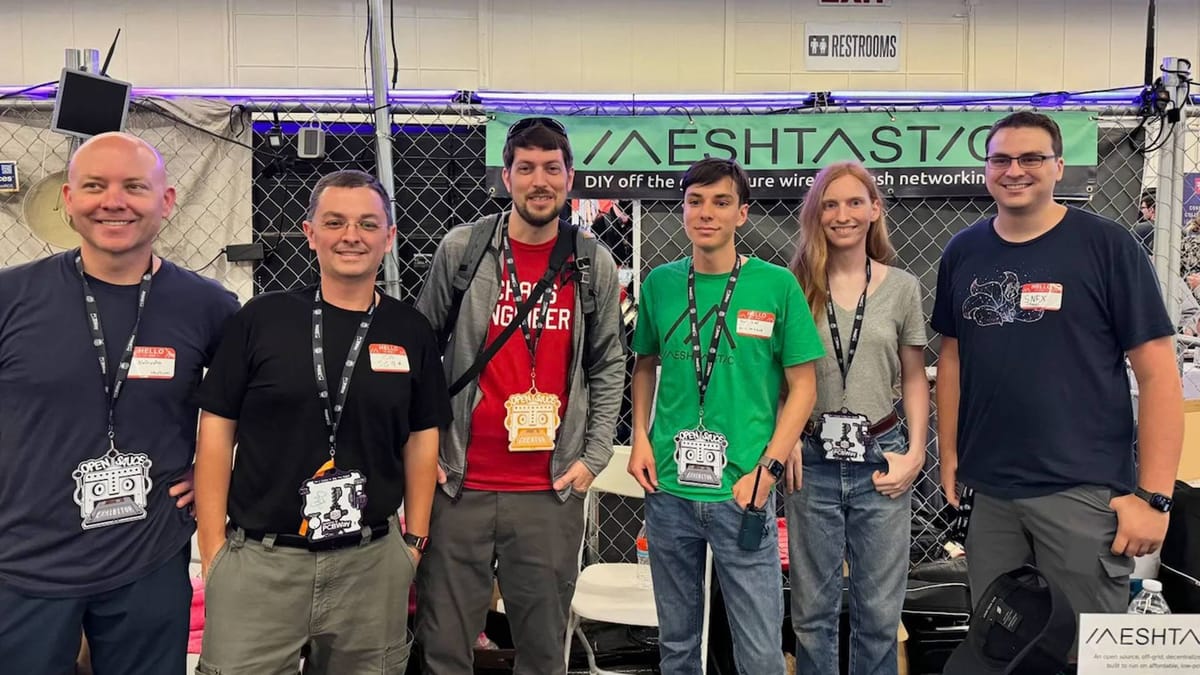
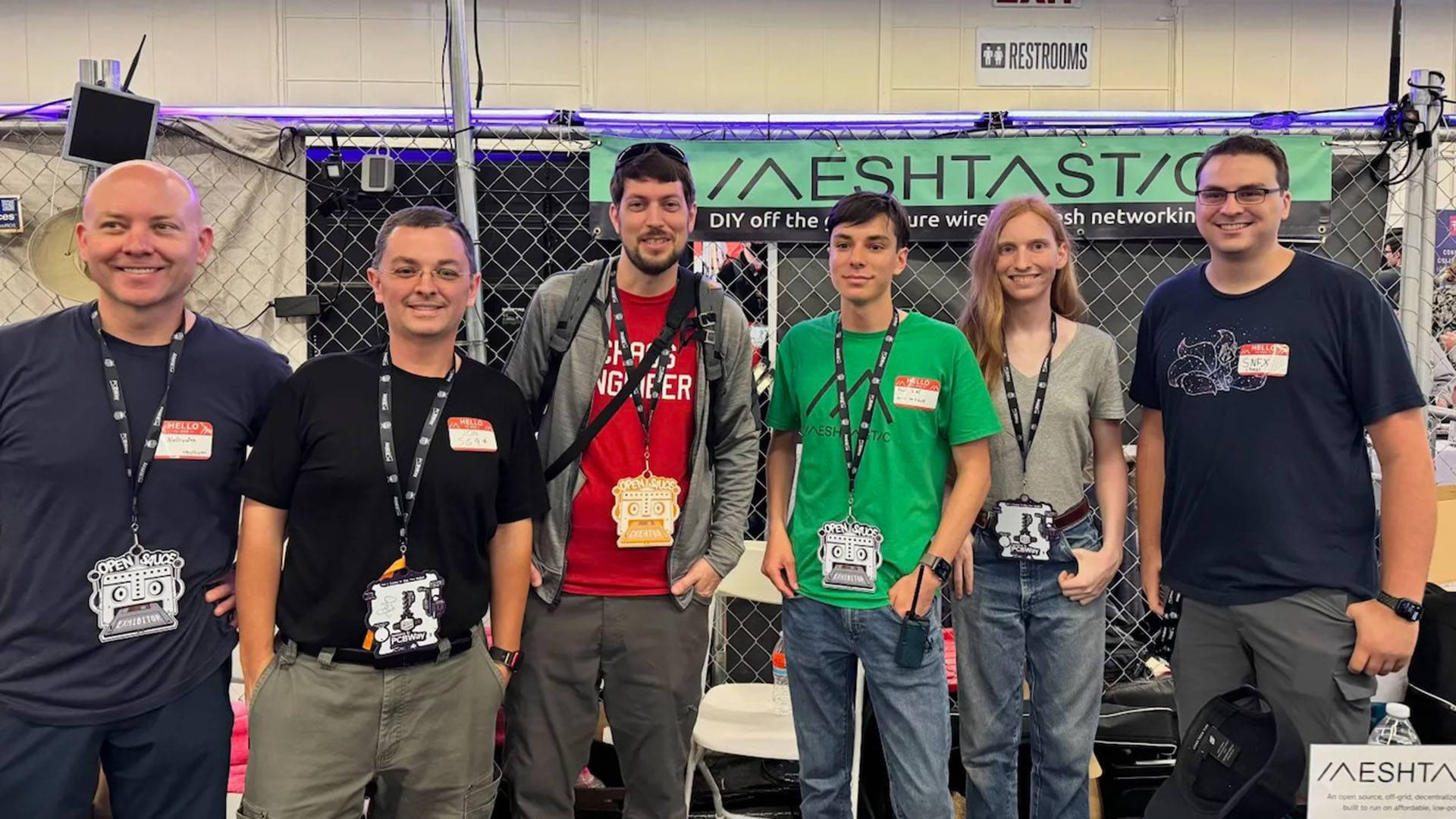
Recently, I attended Open Sauce 2025, a major engineering YouTuber maker faire. I represented the Meshtastic booth this year. Our booth was twice as large as last year's, which I also attended.
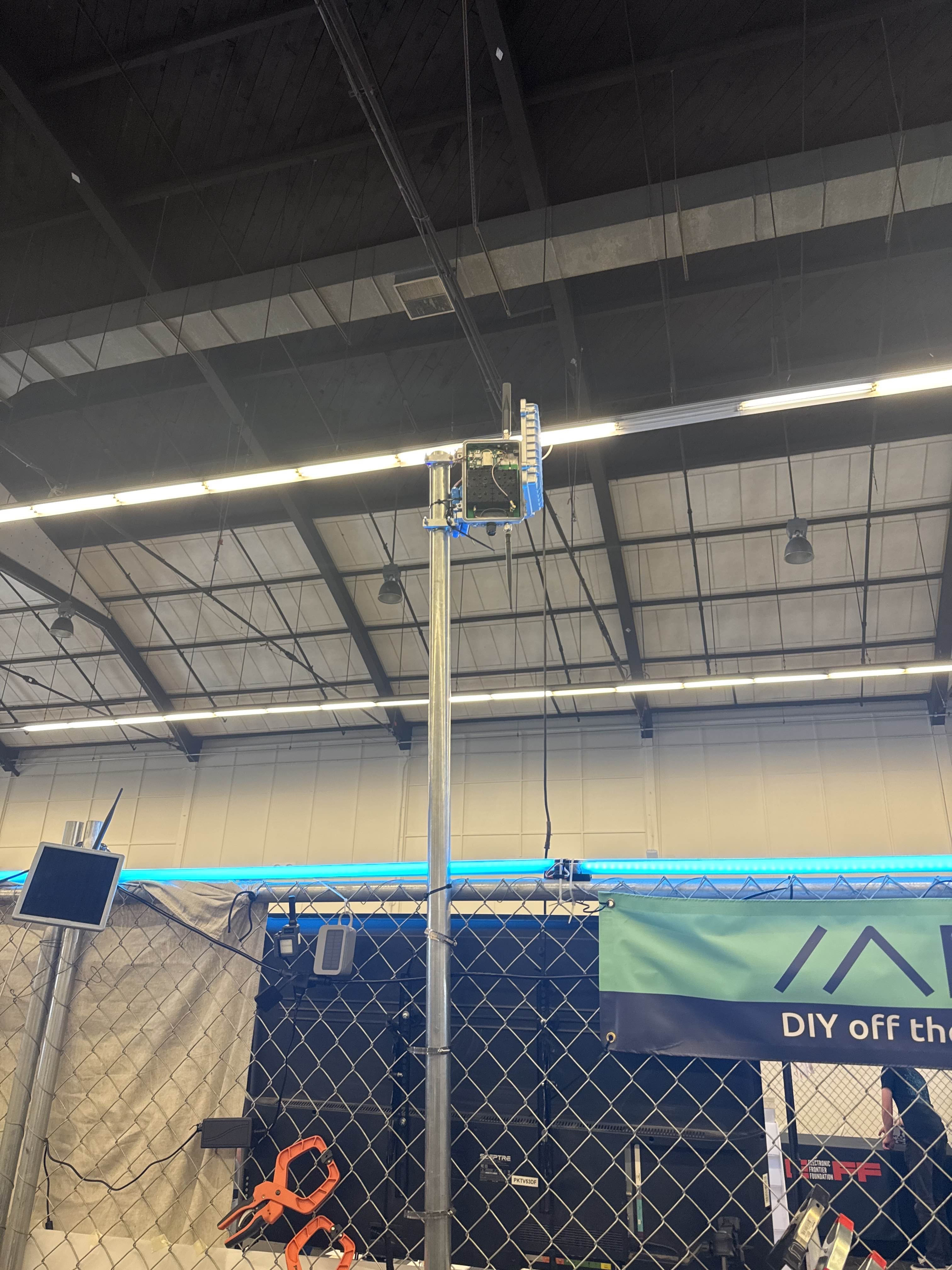
The Meshtastic booth was placed in the center of Hall A (the main hall) and took up two booth spaces. Before the event, we had distributed an event mode Open Sauce-specific Meshtastic firmware. This firmware puts nodes on Short Turbo (The highest bandwidth LoRa preset Meshtastic supports) and puts some harder limits in place to prevent network foot-guns. We set up a crazy mesh router that had two nodes, a Medium-Slow (The network we use in the Bay Area) node and an OpenSauce Short-Turbo node. Both were overkill nodes with 1W of output power and cavity filters; they were housed in a repurposed helium miner case.
We set up the second router, which was a solar-powered Rak node on a giant extended painter’s pole above all the outdoor booths. The Meshtastic network within the event worked extremely great, all messages were received throughout the event center, and we were updated in real-time through other users on where all the YouTubers were. The booth was extremely busy with interested attendees and even some YouTubers like Jeff Geerling and Scotty from Strange Parts. Our table was just a pile of all sorts of Meshtastic nodes that we would let attendees pick up and play with.
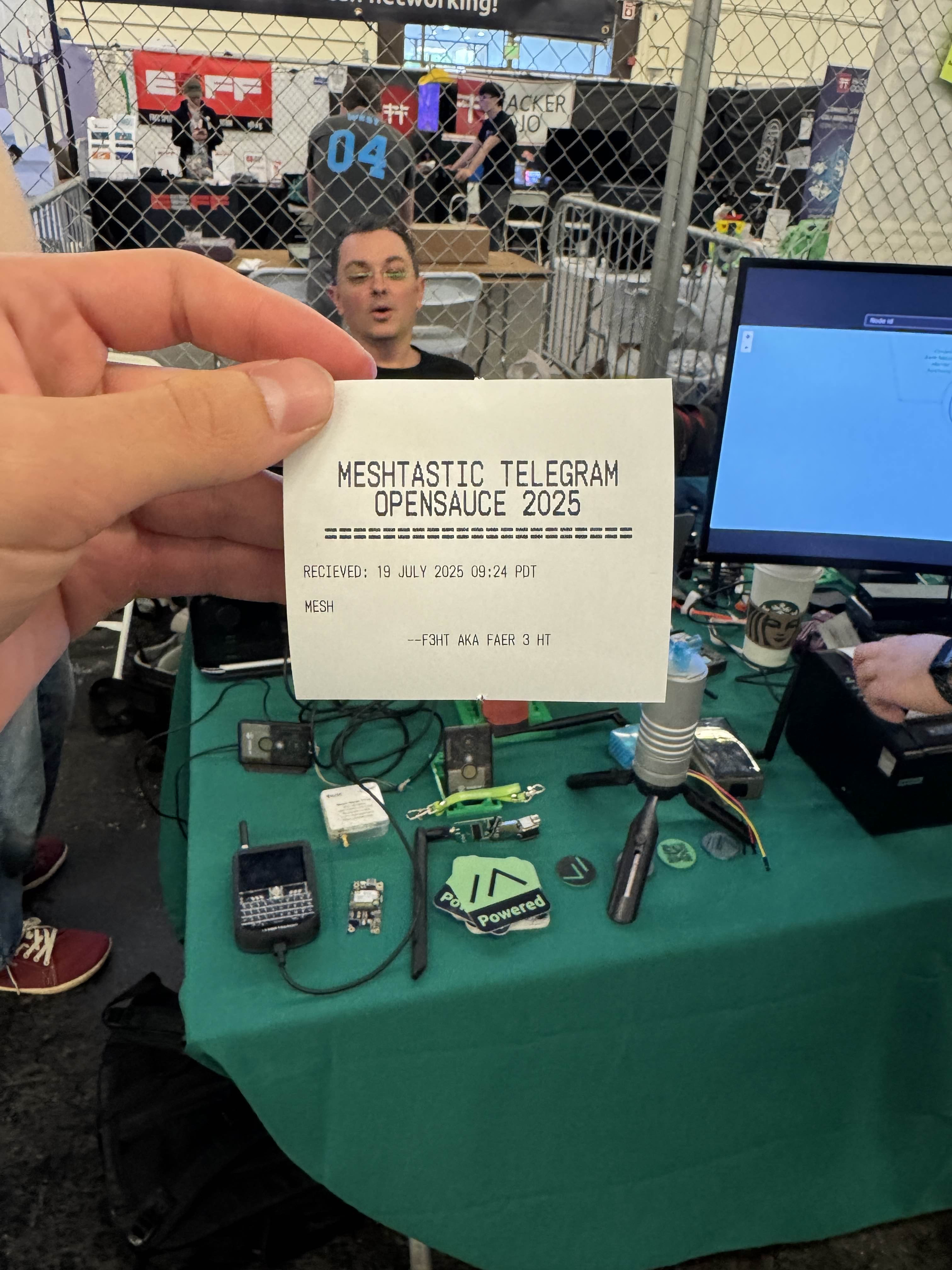
There was also an over-the-mesh receipt printer that would print any direct messages it would receive over the mesh. We had around 100 people on the mesh, with a couple of other booths being hooked up to our mesh. I hope we can bring back this booth next Open Sauce and make next year even better.
Regarding Ham radio: there were a lot of hams carrying around HTs, although I did not get much use out of mine, as the booth was so loud with people around, I could barely hear it. The ARDC CEO even came by the booth and gave me some business cards and stickers. I think if someone set up a ham radio testing booth, it could get some action at Open Sauce next year.
I have included a couple of images from the event and some YouTube videos:
(KO6CNT’s first video suggestion is the Jeff Geerling KF0MYB video mentioned in the ZR > BEACON section.)