Zero Retries 0208
2025-06-27 — ZRDC 2025 Registration Now Open, AST SpaceMobile Lays Claim to 430-440 MHz and 902-928 MHz for Commercial Satellite Comms, Details About Data Over DMR, State of the APRS Foundation
Zero Retries is an independent newsletter promoting technological innovation in and adjacent to Amateur Radio, and Amateur Radio as (literally) a license to experiment with and learn about radio technology. Radios are computers - with antennas! Now in its fourth year of publication, with 2800+ subscribers.
About Zero Retries
Steve Stroh N8GNJ, Editor
Email - editor@zeroretries.net
On the web: https://www.zeroretries.org/p/zero-retries-0208
Substack says “Too long for email”? YES
In this issue:
Request To Send
ZRDC 2025 Registration Now Open
AST SpaceMobile Lays Claim to 430-440 MHz and 902-928 MHz for Commercial Satellite Communications in FCC Filing
- FCC Accepting Comments Through 2025-07-21, Reply Comments Through 2025-08-05
- Additional Coverage of This Story
Details About Data Over DMR
2025 June - State of the APRS Foundation (YouTube)
- Newly “Elected” APRSF Directors (see slide at 7:09)
- Contacting APRS Foundation With Your Input
- Consolidating the Many “Variants” of APRS Specifications
ZR > BEACON
- Update on “Available for Amateur Radio” Power Amplifiers
- QRadioLink - Multimode Software Defined Transceiver Application
- HackRF Pro Announced (Pre-purchase)
- Checking in on the Universal Radio Test Instrument (URTI) Project
- TETRA Supports Single Frequency Repeater Mode
Comments Summary From Previous Issue
Zero Retries Boilerplate
Permission for Reuse of Zero Retries Content
Keywords for this Issue
Footnotes for this Issue
Comments for This Issue (redirect to Comments page)
Request To Send
Commentary by Editor Steve Stroh N8GNJ
Paid Subscribers Update
My thanks to Rick Gilmore W3TM for renewing as an Annual Paid Subscriber to Zero Retries this past week!
My thanks to Eric Stammers M0REQ for renewing as an Annual Paid Subscriber to Zero Retries this past week!
My thanks to Prefers to Remain Anonymous 34 for renewing as an Annual Paid Subscriber to Zero Retries this past week!
My thanks to Stuart Whiting WS7SW for upgrading from a free subscriber to Zero Retries to an Annual Paid Subscriber this past week!
My thanks to Prefers to Remain Anonymous 75 for becoming a Paid Subscriber to Zero Retries this past week!
Financial support from Zero Retries readers is a significant vote of support for the continued publication of Zero Retries.
# # #
Weekends Are For Amateur Radio! Ham Holiday Weekend in Europe and the US
For Amateur Radio Operators in Europe, this weekend is the International Amateur Radio Exhibition, more widely known in Amateur Radio as HAM RADIO Friedrichshafen… or just “Friedrichshafen”.
The motto of this year's HAM RADIO in Friedrichshafen, “REMOTE RADIO - CONNECTING THE WORLD”, demonstrates in a unique way that amateur radio is on the pulse of the times.
Where previously the radio operator needed to be physically present with their equipment, remote operation now allows transmission from anywhere. This is defined in the amateur radio regulations as the “unmanned, remote-controlled operation of a fixed amateur radio station” by a licensed amateur radio operator. The respective station is controlled remotely over the Internet.
One of the advantages of remote operation is that it allows amateur radio operators who are unable to set up a station and, in particular, an antenna at their place of residence, to operate. In the event of a disaster, remote stations can be used as emergency radio stations, replacing destroyed but essential communication structures. In educational settings, they can help to teach amateur radio technology to students, with minimal technical effort required. In addition, many other opportunities for radio experimentation become possible – including radio operation where people cannot or do not wish to stay for an extended period of time.
The “extended radio” therefore has many benefits. You can experience it first hand at HAM RADIO!
I browsed through the exhibitor list of HAM RADIO 2025, and didn’t find much detail. That said, I was surprised at the number of test and measurement equipment vendors that want to showcase their products specifically to Amateur Radio Operators. I don’t recall a similar effort for (US) Hamvention 2025. There also seem to be a number of Amateur Radio organizations from all over Europe exhibiting at HAM RADIO. I look forward to hopefully visiting HAM RADIO in the next few years, and seeing these exhibitors for myself, most of which I would never see represented in the US.
For Amateur Radio Operators in the US, this weekend is ARRL Field Day 2025, the closest thing to an Amateur Radio holiday in the US.
Field Day is ham radio's open house. Every June, more than 31,000 hams throughout North America set up temporary transmitting stations in public places to demonstrate ham radio's science, skill and service to our communities and our nation. It combines public service, emergency preparedness, community outreach, and technical skills all in a single event. Field Day has been an annual event since 1933, and remains the most popular event in ham radio.
Between recent travels and lots of work on the Zero Retries Digital Conference (read below) and of course, Zero Retries, and other personal busyness, I don’t have plans for participating in Field Day 2025… though I was tempted by the impressive coordination that obviously went into Seattle Radio Field Day 2025 which is a joint event by:
Puget Sound Repeater Group, the West Seattle Amateur Radio Club, the Seattle Auxiliary Communications Service, and Cascadia Radio.
The weather oracle on my pocket computer predicts sunshine and moderate temperatures for Bellingham and our temperate corner of the continent.
Thus I plan to spend this weekend doing more work on various projects in N8GNJ / Zero Retries Labs, especially now that all the parts for a planned project have finally arrived and I can finally get stated on that project. And finally unpacking my HF Signals zBitx that arrived just before my trip to Hamvention. Or perhaps I’ll finally fix my antenna pole that was bent this past winter by the Wicked Whatcom Winter Winds.
Next year, after several years of preparation, I hope plan to participate in both Winter Field Day and ARRL Field Day with a modest personal portable (capable) station… my version of a Go Kit… operating on emergency power (solar panel with a battery) operating some data mode on low power (under 50 watts). It sounds like by then ARRL’s Logbook of the World will have received a long overdue update and will probably be easier (and more reliable) to use. Thus any contacts I make during those events won’t be “throwaway” (as has happened with groups I’ve participated with during past years) for not having been uploaded and thus confirmable.
So, whether you’re in Europe at HAM RADIO, or in North America participating in Field Day, or like me working on interesting Amateur Radio projects, have a great weekend, all of you co-conspirators in Zero Retries Interesting Amateur Radio activities!
Steve N8GNJ
ZRDC 2025 Registration Now Open
By Tina Stroh KD7WSF
Zero Retries Digital Conference Manager
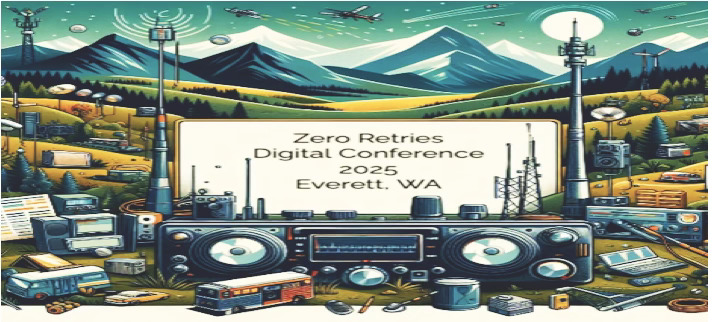
Registration for the inaugural Zero Retries Digital Conference (ZRDC) 2025 is now open!
Click here to register for ZRDC 2025
Registration offers in-person access and virtual attendance options to attend the inaugural Zero Retries Digital Conference 2025. Ticket price descriptions state what is included with each level of participation. Such as, in-person attendance includes access to the conference along with conference proceedings, welcome refreshments, refreshments throughout the day, buffet lunch and a chance to win raffle prizes.
Welcome refreshments will include fresh fruit with a Greek yogurt dip, assorted pastries, muffins, doughnuts and scones, and assorted bagels with butter, cream cheese and preserves. Coffee , hot tea, and juice will be available.
The buffet lunch will consist of a green and Southwest style salad, deli sandwich display of turkey, ham, and roast beef with cheddar, swiss, and provolone cheeses, various condiments, assorted deli breads, deli wraps, roasted veggies, polenta bar, apple crumble and brownies. Beverages choices of coffee, tea, iced tea, and lemonade will be offered.
Throughout the day, coffee service, lemonade and fruit infused water will be available.
Just a reminder…
ZRDC 2025 will be held on Saturday September 13th, 2025 at the same venue as the GNU Radio Conference (GRCon) 2025 - the Edward D. Hansen Conference Center in downtown Everett.
GRCon 2025 will be held Monday September 8th through Friday, September 12th, 2025.
While GRCon 2025 and ZRDC 2025 are being held consecutively at the same venue, the two events are independent of each other.
AST SpaceMobile Lays Claim to 430-440 MHz and 902-928 MHz for Commercial Satellite Communications in FCC Filing
By Steve Stroh N8GNJ
This may well be the most significant challenge to date to one of Amateur Radio’s most popular bands. It’s particularly significant for Amateur Radio space communications, as that usage directly competes with this company’s use case - satellite communications.
In DA 25-532, released 2025-06-20, the FCC Space Bureau has accepted a filing from AST SpaceMobile to conduct Telemetry, Tracking, and Command (TT&C) in both space-to-Earth and Earth-to-space communications modes in 430-440 MHz. In the document, AST SpaceMobile is referenced as AST & Science, LLC (AST).
In the US, this 10 MHz band segment comprises the middle third of US Amateur Radio’s (secondary1) allocation of the very popular and heavily used 420-450 MHz (70 cm) band.
Also of interest, and potentially impacting US Amateur Radio operations in the 902-928 MHz band, AST also requests to use 902-928 MHz for space-to-Earth and 902-915 MHz for Earth-to-space communications.
In the US 902-928 MHz band, Amateur Radio has overlapping allocations with unlicensed operations in this very popular and also very heavily used band.
AST’s request mentions a number of bands other than those in use by Amateur Radio.
AST intends to operate a number of satellites in Low Earth Orbit (LEO) with very large antennas that will allow typical mobile telephones to operate normally in areas where there is no terrestrial network coverage, operating on some of the same frequencies as terrestrial carriers.
AST intends to provide its satellite service worldwide:
We are partnering with some of the largest mobile network operators across the globe to reach the biggest audience and improve connectivity worldwide. AST SpaceMobile’s goal is to eliminate the connectivity gaps faced by today’s 5 billion mobile subscribers and bring broadband to approximately half of the world’s population who remain unconnected.
AST SpaceMobile has entered into agreements and understandings with over 50 mobile network operators which collectively service over 3 billion cellular customers.
In the US, AST’s carrier partners are AT&T and Verizon. T-Mobile has announced a partnership with Starlink with similar technology (use of ordinary mobile phones via satellite) called T-Satellite, which will begin commercial operation on 2025-07-23.
FCC Accepting Comments Through 2025-07-21, Reply Comments Through 2025-08-05
FCC DA 25-532 appears to be notification that the FCC Space Bureau has merely accepted AST’s request to use these bands.
The FCC is now accepting comments:
Filing Requirements: Interested parties may file comments on or before July 21, 2025 and reply comments on or before August 5, 2025. Comments and petitions regarding this application should be filed in both the Commission’s Electronic Comment Filing System (ECFS) and in International Communications Filing System (ICFS) under the appropriate file number. 47 CFR §25.154. All filings must refer to SB Docket No. 25-201 and ICFS File No. SAT-MOD-20250612-00145.
Per this mention by AMSAT-DL from 2022, AST has been operating in 430-440 MHz for some time:
AST SPACEMOBILE CONSTELLATION IN 430-440 MHZ BAND
This seems concerning, per this update in 2024 by DB2OS:
Although FCC confessed that the commercial 435 MHz TT&C operations do not fall within the ITU assigned classification for the amateur satellite service, they granted permission…
Additional Coverage of This Story
ANS-159 AMSAT News Service Weekly Bulletins - 2025-06-08:
Satellite Shorts from All Over+ The FCC has denied AST Space Mobile’s request to use 430 MHz -440 MHz for telemetry operations, noting “There is no space tracking or space telemetering allocation in the 430-440 MHz frequency range.” (Thanks to AMSAT-DL and the FCC for the information)
Unfortunately, AMSAT did not provide a link to their source for the “denied” claim, and I haven’t seen any additional confirmation. Note that FCC DA 25-532 was dated later (2025-06-20) than AMSAT’s mention.
[Peter Guelzow] DB2OS 2025-06-22 - Bad News for the 70cm Amateur Radio Band
Amateur Radio Daily 2025-06-25 - Satellite Communications Company AST SpaceMoble Seeks Use of 70 cm Amateur Band
AMSAT-UK 2025-06-26 - Use of 430-440 MHz by AST SpaceMobile Constellation
Amateur Radio Newsline Report 2487 for Friday, June 27th, 2025 - Mobile Broadband Provider Seeks Amateur Frequencies For Satellites
Details About Data Over DMR
By Adrian Octavian Musceac YO8RZZ
Editor’s Note - What follows is a deep dive down a rabbit hole of obscure Amateur Radio technology. This subject has been mentioned numerous times in Zero Retries, and this article is a satisfying conclusion to my quest to understand this subject.
Introduction by Steve Stroh N8GNJ; some reference info provided by ChatGPT
The raw data rate of Digital Mobile Radio (DMR), in a 12.5 kHz channel, is 9600 bps.
- The 9600 bps data rate is divided into two 4800 bps time slots in a Time Division Multiple Access (TDMA) system.
- Each 4800 bps stream includes voice encoding using AMBE+2 vocoder, which typically consumes around 2.45 kbps. The remaining data of each time slot is used for error correction, synchronization, signaling, and control data.
- Short messages (short text messages similar to Short Message Service - SMS on mobile devices) can be sent on DMR without needing to switch the radio to a "data-only" mode. Texts are transmitted using the control / signaling portion of the DMR protocol. Texts use either time slot, depending on availability and configuration. Texts are usually limited in size — often up to 140–255 characters, depending on implementation. Radios can send or receive texts even when not actively in voice use, or between voice use.
- In data-only use (such as IP data over DMR), the usable data rate is lower due to protocol overhead — approximately 2400 - 3600 bps of actual user data per time slot, depending on the implementation.
I’ve long been interested in the potential of sending data (arbitrary data such as files, not just text messages) via DMR because there are now hundreds, perhaps thousands of DMR repeaters deployed in Amateur Radio. But as I stated in Zero Retries 0093 - Data / Packet Radio via DMR:
It’s frustrated me that the specification for Digital Mobile Radio (DMR) includes the capability for data exchange (and that DMR, by fundamental definition, is data communications), but data interoperability between various manufacturer’s implementations of DMR has not been established. Thus “Data Over DMR” has been a nebulous concept in Amateur Radio (per my research to date) except for (10 key keypad) unit to unit text messaging and some position data transmissions (“APRS” over DMR). Note that the data being exchanged in this video are between two units of the same manufacturer (Motorola). I did some very brief (incomplete) research on the radios mentioned in this video, and they are expensive (intended for professional use). Despite that dis-recommendation for consideration for Amateur Radio use, it’s good to see at least a reference demonstration that data communications are possible with DMR radios.
That article linked to a YouTube video - DMR Packet Radio? which demonstrated that data can be exchanged over Motorola Mototrbo radios.
I can remember complaining in various issues of Zero Retries over the past nearly four years about the “data over DMR” issue, that data over DMR is nebulously defined in the DMR specification. Or rather that was my perception.
My most recent plaint was at the very end of an article in Zero Retries 0207 - Amateur Radio’s Lack of Imagination About Repeater Technology:
Now if we could only figure out how to use DMR for data communications without resorting to proprietary data over DMR systems like Motorola’s and Hytera’s.
…
In response to that statement, Adrian Octavian Musceac YO8RZZ wrote me a detailed email explaining about the potential use of data over DMR, including some questions, and their answers.
(End Introduction)
Hello Steve,
I frequently read your newsletter at Zero Retries, since you publish useful and interesting content. Thank you for that. The number of amateur publications with interesting content is rather small today.
I recently read the newsletter at https://www.zeroretries.org/p/zero-retries-0205.
Inside it, at paragraph "Data Repeaters", there are some statements about the data transfer features of the DMR standard that I consider incorrect, and would rather like they would be amended for the sake of not propagating incorrect information in the amateur community. Specifically, I mean:
DMR has a data option, though it’s never been reasonably defined, that I’ve seen.
In fact, the DMR standard defines very well in TS 102 361-1 and TS 102 361-4
the following data packet protocols:
1. Confirmed data packet transfer (Base Station - BS or Mobile Station - MS acknowledges receipt of specific data blocks, only data blocks lost are re-transmitted by originator)
2. Unconfirmed data packet transfer (self explanatory)
3. Raw short data
4. Defined Data
5. Unified data transport (used by Short Message Service - SMS bearer services and registration / call control services on the Tier III control channel)
These Layer 2 data transfer protocols enable the following:
- SMS services between MS units and between MS units and gateway to other types of services or dispatch consoles
- Internet Protocol - IP bearer services: arbitrary data encapsulated in IP transport (UDP datagrams being the most frequent usage, but TCP and other formats could also be possible)
- Call line information, system messages, talkgroup provisioning for MS units
Technical references:
https://www.etsi.org/deliver/etsi_ts/102300_102399/10236101/02.04.01_60/ts_10236101v020401p.pdf
Sections
- 8.0 DMR Packet Data Protocol (PDP) - Introduction
- 9.2 Data related Protocol Data Unit - PDU description
https://www.etsi.org/deliver/etsi_ts/102300_102399/10236104/01.09.01_60/ts_10236104v010901p.pdf
In fact, most manufacturers implement a proprietary protocol on top of one of these data transfer methods, frequently on top of IP/User Datagram Protocol - UDP, as is the case with popular Anytone radios. The type of data messages sent by these radios are very well described here:
https://github.com/carpaldolor/DMRText
I have written code based on that document and the DMR standards that can parse and convert between various data formats sent by these radios.
The easiest to understand DMR data protocol is Unified Data Transport which is used for Tier III SMS messages as well as other system services. I have written a fully open source implementation of this data protocol inside the DMR Tier III trunking controller:
https://github.com/qradiolink/dmrtc
Furthermore, I am currently working towards an open source implementation of DMR IP bearer services for MS units (using Software Defined Radio - SDR hardware), largely based on Jonathan Naylor's code libraries for DMR. These DMR services allow an IP link to be established either directly between units or via BS infrastructure.
To conclude, the DMR standard defines data transfer protocols rather well, and manufacturers are also free to add their own proprietary features on top of the standard, however these are built on a solid open base.
If you would like further information on this topic, I am at you disposal, having worked on both an open source implementation of the DMR trunking protocol and an open source DMR transceiver using SDR hardware, work which I try to document in open-access articles for the benefit of amateurs everywhere:
https://qradiolink.org/DMR-tier-3-trunked-radio-BTS-software-defined-radio.html
https://qradiolink.org/open-source-DMR-transceiver-implementation.html
…
N8GNJ again:
My questions to YO8RZZ:
If data is so well defined in the DMR specification…
Why don’t we see more data capabilities in DMR radios?
I’ve seen data capability in videos and documentation for Mototrbo and Hytera. Connect a computer to one of their radios, load their respective software, and easily send data and text messages, but only to other stations that are similarly equipped.
Is it just that Motorola and Hytera did a good job, and the other manufacturers of DMR radios just don’t bother?
Is it just that manufacturers of Amateur Radio DMR radios build them too cheaply (don’t implement data capabilities)?
That is what has been puzzling me, bothering me about data over DMR. If data capability is inherent in the specification of DMR, then why don’t we see more data over DMR capability?
YO8RZZ’s Reply:
I think it is a problem of product market fit.
The cheaper radios that are generally popular in the amateur community have as a primary market small businesses and amateurs. These type of customers do not use or demand more advanced features of the standard, and in some cases may not even know they exist in order to demand them (in the case of the more technical amateur market).
On the other hand, more expensive radios from established brands have as customers large businesses and even smaller governmental services. This type of organization does need these features, and manufacturers do market them, perhaps as a cheaper alternative to more expensive options like TETRA.
I think price is also a big factor. Implementing all the advanced features of the [DMR] standard requires more expensive software development and [Quality Assurance - QA] pipelines, probably a more powerful computing platform on the radio itself, so this reflects in the pricing.
DMR became quite popular with amateurs because simple terminals were pretty cheap, and did their simple job fairly well. If DMR radios would have been as expensive as the fanciest D-Star radio, I don't know if it would have gotten that popular.
If the manufacturers of cheaper radios had more demand for more advanced features, perhaps they would be able to add them while keeping the price point down.
N8GNJ for the close:
Finally, from YO8RZZ’s deep knowledge, I now have an understanding of Data over DMR, as in “it’s possible, but not easy, and not built-in to every DMR radio”.
To reiterate, my interest in data over DMR is primarily because there are now hundreds, perhaps thousands of DMR repeaters deployed in Amateur Radio. And, potentially, those Amateur Radio DMR repeaters could be used for data communications.
Per the information in this article, it would seem possible to create (inexpensive?) DMR data (only) radios such as the Maxon SD-670D Series Digital DMR/Analog RF Data Modem that could use one, or both DMR time slots for data communications over a repeater. It remains to be seen if that data can be passed over DMR repeaters without disruption.
My profound Thanks to Adrian Octavian Musceac YO8RZZ for providing such a great response to my request for information about data over DMR.
See the ZR > BEACON article below about YO8RZZ’s QRadioLink project.
2025 June - State of the APRS Foundation (YouTube)
By Steve Stroh N8GNJ
Someone has to report out what is happening in APRS Foundation.