Zero Retries 0206
2025-06-13 — What’s New at DLARC - June 2025, M17 - N8GNJ’s Perspective as of June 2025, Followup On Single Frequency Repeaters, New Packet Commander IOS App, Jeff Geerling in QST, IP400 News

Zero Retries is an independent newsletter promoting technological innovation in and adjacent to Amateur Radio, and Amateur Radio as (literally) a license to experiment with and learn about radio technology. Radios are computers - with antennas! Now in its fourth year of publication, with 2800+ subscribers.
About Zero Retries
Steve Stroh N8GNJ, Editor
Email - editor@zeroretries.net
On the web: https://www.zeroretries.org/p/zero-retries-0206
Substack says “Too long for email”? YES
In this issue:
Request To Send
- Too Long For Email?
- Zero Retries Will Publish on Substack Through Late 2025
- Better, Cheaper, Smaller, More Cost Effective, and More Efficient Ways To Communicate
- Weekends Are For Amateur Radio!
What’s New at Digital Library of Amateur Radio & Communications — June 2025
Kay Savetz K6KJN
M17 - N8GNJ’s Perspective as of June 2025
Steve Stroh N8GNJ
- Bruce Perens K6BP Informal M17 Status Report
- M17 Foundation is Still New
- Cryptographic Signatures of M17 Transmissions
- One Fundamental Difference, Two Potential Vulnerabilities
- M17 in “The Chasm”
- M17’s Bright Future in Amateur Radio
Followup On Single Frequency Repeaters
Steve Stroh N8GNJ
- Perhaps a History of Digital Voice and the Rise of Dual Time Slot DMR Repeaters
- Time Domain Duplex (TDD) Single Frequency Repeaters (SFRs)
- In the Bigger Picture, Why Encourage a Proliferation of Single Frequency Repeaters?
- “Radio Machine Learning”
ZR > BEACON
- Alberta Digital Radio Communications Society Press Release
- Jeff Geerling, Geerling Engineering, and Level 2 Jeff [YouTube Channels]
- APRS Foundation "State of the Foundation" Zoom Call on June 22nd @ 1900 (7PM) EST
- Mention of Raspberry Pi Compute Module 4 (CM4) in FlexRadio Units Wasn’t Meant to Imply “Hackable”
- SteppIR to Discontinue Amateur Radio Sales
- HAM RADIO Job Market Shows Career Opportunities
- Zero Retries Guide to Zero Retries Interesting Events Updated
- New Starlink Performance Kit
- Reasonably Priced Uninterruptible Power Supply, including USB and 12 Volts Outputs
- Sorcerer - Building a Nervous System for the Atmosphere
- Development, the American Way
- Single Pair Ethernet (SPE)
- Packet Commander - The Terminal App for AX.25 Packet Radio on iOS
- VP-Digi - APRS Digipeater Controller with Built-in KISS Modem
- Skyroof: New Ham Satellite Tracking And SDR Receiver Software
- Radio Apocalypse: Meteor Burst Communications
- RTL-SDR Blog V3/V4 USB-C Model Released For Sale
- Detect Radio Jammers with Raspberry Pi 5
- Why [Connect Systems Is] Improving the DMR in the CS7000 M17 PLUS
Comments Summary From Previous Issue
Zero Retries Boilerplate
Permission for Reuse of Zero Retries Content
Keywords for this Issue
Footnotes for this Issue
Comments for This Issue (redirect to Comments page)
Request To Send
Commentary by Editor Steve Stroh N8GNJ
Too Long For Email?
I decided to put a quick indicator under the URL for each issue at the top of the newsletter:
Substack says “Too long for email”? YES
That’s the indicator that if you’re reading this issue of Zero Retries on a tablet or phone, it’s probably best to just go to the web version, as your email app will probably cut off that issue of Zero Retries.
Almost always, the answer will be Yes. 😆 I pack a lot of… probably too much content into most issues.
# # #
Zero Retries Will Publish on Substack Through Late 2025
There are a substantial number of Zero Retries readers that love Zero Retries, but hate that it’s published on the Substack platform.
I first discussed this issue in Zero Retries 0133 in 2024-01-05 - The Substack Problem. At that time I became aware of the issue, but I was undecided on what to do. A few weeks later in Zero Retries 0135 - Update on The Substack Problem I had decided to move Zero Retries off Substack by the end of 2024. That date came and went, and I set, and missed, a few more goal dates. My most recent goal date for moving Zero Retries off Substack was to coincide with the beginning of Zero Retries’ fifth year - Zero Retries 0210 on July 11, 2025.
TL:DR - The “move Zero Retries off Substack” date has been extended into late 2025. Read on for the backstory of why we made that difficult decision.
Much like Zero Retries has grown beyond the simple newsletter I began back in 2021, the various activities that have grown up around Zero Retries have become a micro business, that Tina and I have laughingly taken to calling “Zero Retries Enterprises”. Beyond publishing Zero Retries, there’s the M17 book I mentioned a few issues ago, there’s another major writing project with a hard deadline of mid-August, perhaps even a third major writing project, and most recently my contributions to making the Zero Retries Digital Conference a rousing success.
There are enough hours in the day to get Zero Retries re-platformed… if I were to devote all of them to the re-platforming project and the other elements of “Zero Retries Enterprises”. Or, I perhaps could have availed myself of concierge services that would have handled the migration of Zero Retries from Substack to Ghost (my preferred new platform) for me. But, the funds necessary for that are now committed to the startup expenses of the Zero Retries Digital Conference.
And… the short, and gorgeous (as in makes life worth living) Summer season is now underway here in our wonderful little corner of the Pacific Northwest. Tina and I want to have some balance of quality of life for the next few months - we both claim to be “retired”. 😀 For Tina, besides the intense work of making the Zero Retries Digital Conference an exciting and dynamic event, there is the fun of Summer garden and yard work, and some volunteer work in the community. For me, in addition to the Zero Retries writing work this summer, I have many deferred Amateur Radio projects queued up, including IP400, that I want to enjoy working on in N8GNJ Labs. And I also have a minor commitment for some volunteer work in the community.
Thus Tina and I have decided that devoting the necessary time to “re-platform” Zero Retries… all four plus years of weekly issues… and all the other elements of Zero Retries just isn’t realistic to accomplish in the short term. Just one example is that we’re very actively promoting Zero Retries Digital Conference with the URL of
https://www.zeroretries.org/p/conference
… and we just can’t risk that link not working reliably during a transition when we’ve invested so much time in promoting it.
Nor is a hybrid approach of simply publishing new newsletters on a new platform a realistic option given that I changing the domain name would cause no end of confusion and disruption, etc.
The reasons for moving Zero Retries… all of Zero Retries… off Substack remain valid. Those reasons are still heard, still understood, and I still agree.
But moving Zero Retries off Substack is not doable in the short term. Thus moving Zero Retries, all of Zero Retries (no half measures) off Substack is being deferred, one last time, until late 2025, when there will be time, and funds available to do it right.
Thank you for your understanding.
# # #
Better, Cheaper, Smaller, More Cost Effective, and More Efficient Ways To Communicate
I don’t own any equipment that uses tube electronics, except one legacy Cathode Ray Tube (CRT) monitor for a vintage PC compatible computer I have that I hope to resurrect for posterity in N8GNJ Labs.
My formal instruction in electronics at (the late) Ohio Institute of Electronics (DeVry) in Columbus, Ohio included tube electronics, but I never saw any in my career… with one exception that I can think of. While working offshore in the Bering Sea, our 100 watt marine HF radio proved ineffective, and we were refitted with a 1.5 kW marine HF radio, and we were given a replacement tube as a spare for that unit. There’s a long story (that I’ll spare you readers) about why delicate electronics on our company’s ships were short lived unless extraordinary care was taken with extensive shock mount isolation. With my training with the comparative efficiency (space, power, complexity) of transistors and integrated circuits, when looking at tubes, I could only see the inefficiencies - space, waste heat, more electrical power required, the dangers, the fragility, etc.
Thus I’ve seen the transition of tubes, to transistors, to ICs, and now modules as the radios for commercial and Amateur Radio communications. Motorola’s mobile radios are testament to this trend - they used to weigh 30 pounds or so to put out 100 watts or so and survive for years in a hot car trunk on dirty 12 volt power. Now the same capability (not at 100 watts) is a few pounds and is built into a small unit barely bigger than your hand.
Radio technologists keep developing better, cheaper, smaller, more cost effective, and more efficient ways to communicate. In my writing of Zero Retries, I see such progress very regularly. I’m still in awe of the radio that is at the heart of the early IP400 Network Project units is approximately one inch square, and that is the radio. Thus seeing the potential of a Single Frequency Repeater (SFR) that uses Time Division Duplex (TDD) techniques is to me a major win for Amateur Radio by eliminating the need for two frequencies and the need for a complex, big, expensive duplexer. That’s a huge efficiency gain. Then add the potential of features like Radio Autoencoder (RADE) Machine Learning (ML) techniques for voice digitization, cryptographic signatures as discussed in in the M17 article below, and integral data capabilities… wow, Amateur Radio repeaters could quickly be in the forefront of radio technology experimentation and development.
That is why I spend so much time and space in Zero Retries prattling on about data repeaters.
This summer, there are two ordinary and unsuspecting repeaters in N8GNJ Labs awaiting some experimentation of fitting them with an MMDVM unit, along with radios I can fit with MMDVM units, and start testing all the cool modes available in MMDVM, especially MMDVM-TNC. I hope to develop some interesting results to report.
# # #
Weekends Are For Amateur Radio!
I finally figured out a name for this last section of Request To Send!
In trying to make myself accountable for some personal progress in Zero Retries Interesting Amateur Radio, my “short” list for this weekend includes:
- Unpacking and inspecting my new zBitx HF radio.
- Sorting out my login issues for beta access that I was granted to ARDC’s 44Net VPN.
- Minor modification, setup, and updating to the latest firmware of the two IP400 Ichiban units I was given at Hamvention so that I can begin testing and reporting usability and feature suggestions.
- Set up my new Raspberry Pi 5 and Raspberry Pi 500 in N8GNJ Labs to support… well, at the moment, just rabid curiosity about these powerful new variants of Raspberry Pi computers. Eventually the RPi 5 will get a HAT for using Solid State Drive modules. I need to make room on my workbench for a monitor for one of them.
- Inventory and package up approximately 60 pounds of printed material that I’ve accumulated over the last six months from several conferences and flea markets and ship it to an Internet Archive scanning center for ingestion into DLARC. (Thanks Kay!)
- And… because I won’t be able to resist now that I’ve learned about them, I’ll check out the new issues of the AMRAD Newsletter, and the new Packet Radio History collection in DLARC. (Thanks Kay!)
- (Last minute addition) - Explore the new Packet Commander app on my iPhone - see the ZR > BEACON item below.
The weather Oracle on my phone predicts direct(!) sunshine and moderate temperatures this weekend, so no excuses to not spend the weekend in N8GNJ Labs.
Have a great weekend, all of you co-conspirators in Zero Retries Interesting Amateur Radio activities!
Steve N8GNJ
What’s New at Digital Library of Amateur Radio & Communications — June 2025
By Kay Savetz K6KJN
Internet Archive's Program Manager, Special Collections
One of my favorite things to discover is people whose special interest lies at the intersection of radio and some other — seemingly unrelated — hobby. Until now, my best example of this was the Bicycle Mobile Hams of America, a club for people who love bicycling, ham radio, and doing both together. My new favorite example is Neil Carleton VE3NCE’s “Radio Stamps” radio show, which celebrated the intersection of radio and philately. His specialty was stamps about radio.
The program ran for five years (1990 through 1995) on the DX Partyline show of radio station HCJB in Ecuador. The program aimed to combine the fun of listening to international radio and collecting stamps from around the world. The show included stamp collecting tips, contests, descriptions of radio-related stamps, and discussions of radio subjects that could be found on commemorative stamps and postal cancellations.
For me, this particular rabbit hole appeared when the California Historical Radio Society sent DLARC a cassette tape with a recording of a single episode: a scratchy, off-the-air recording of episode 39. I contacted VE3NCE asking about his program. He had a tape of only the first two episodes. The rest were lost. And that would have been the end of it, except a couple of weeks later I heard from him again: “In preparation for the installation of some new flooring, I've been emptying shelves and moving things to another room. One of my discoveries was a complete set of typed scripts that I prepared for recording my 50 Radio Stamps programs.” So thanks to timely home renovation and the scanning prowess of his daughter, we now have scripts for all 50 episodes of the program (plus the actual recordings of the three episodes I mentioned.)
I learned from episode 8 that the first postage stamp in the world to show a radio receiver was issued by France in December 1938. “This semi-postal issue has a denomination of 90 centimes plus a surtax of 25 centimes. This stamp is special in another way too. The surtax was used to help provide radios for the blind. The design of the stamp shows a blind man listening to a radio.” And from episode 3 I learned that in 1964, “a colourful postage stamp was issued in the United States to commemorate the 50th anniversary of the American Radio Relay League. It's a striking stamp, in red lilac, with a denomination of 5 cents.”
Radio Stamps is endlessly fascinating, two kinds of nerdy at once, and a wonderful addition to DLARC.
Last month I mentioned the addition of 130+ issues of AMSAT Satellite Report/Amateur Satellite Report: the issues were part of collection donated by Hank Magnuski KA6M. We’ve added a whole lot more material from KA6M to DLARC, starting with 51 issues of AMRAD Newsletter, which is the newsletter of the Amateur Radio Research and Development Corporation (AMRAD). It’s unclear to me exactly when that newsletter started, but Hank’s collection starts in May 1980 and ends December 1983. We have a few more issues from the 1990s from another source. AMRAD’s web site has an index of articles from 2001 to the present, but those older issues are hard to find. I’ve added AMRAD Newsletter to the DLARC Wantlist.
The boxes of material from KA6M also included stacks and stacks of papers documenting the early development of packet radio. Magnuski was a mover and shaker in the committees and groups that developed amateur packet radio, and he saved everything! He was involved with the Pacific Packet Radio Society and saved their early newsletters. He wrote a seminal document On the Care and Feeding of Your Packet Repeater. He served on the ARRL Ad Hoc Committee on Amateur Radio Digital Communication, and saved numerous documents about that group’s work from 1982 through at least 1988. There’s so much more, including correspondence, printouts of packet radio BBS discussions, design documents ... an incredible trove of ham packet history, now all digitized, searchable, and downloadable for hobbyists and researchers.
Which leads me to the new Packet Radio History collection of DLARC, which includes Magnuski’s documents plus hundreds more that I’ve collected from the U.S. government Defense Technical Information Center. There’s more on the way — in fact, the best is yet to come — and I hope to tell you about more preserved packet radio history next month.
DLARC has also added 165 issues of the South Bay Amateur Radio Association (based in Fremont, California) Groundplane newsletter; and more than 800 videos by Patrick Stoddard WD9EWK/VA7EWK. His videos primarily focus on working satellites: a few contain activity by astronauts on the International Space Station. He also contributed about 30 magazine articles that he’s written about D-Star, ISS comms, and other digital communication technologies.
The folks at Internet Archive’s scanning center continue working through the vanloads of material that I recovered from Fair Radio Sales last summer. We’ve added several hundred manuals just in the past month, bringing the collection to over 7,000. Also from the Fair Radio stacks: hundreds of new old radio catalogs. Need a 662-page Cramer electrics parts catalog from 1972? Got it. How about a 1960s (maybe? Hard to tell) catalog of nothing but replacement television knobs? Got that too. And we’ve added dozens of books for checkout in the DLARC Lending Library.
Finally, DLARC just added the three-volume set of The Lenkurt Demodulator: selected articles from GTE’s “Lenkurt Demodulator” publication, “an informative technical periodical published without charge to technicians, engineers, and managers of companies or government agencies who operate communications systems, and to educational institutions.” Covering 1955 through 1975, topics include microwave communications, multiplexing, and digital data transmission.
DLARC Want List: https://archive.org/details/dlarc-wantlist
Digital Library of Amateur Radio & Communications is funded by a generous grant from Amateur Radio Digital Communications (ARDC) to create a free digital library for the radio community, researchers, educators, and students. If you have questions about the project or material to contribute, contact me at kay@archive.org.

M17 - N8GNJ’s Perspective as of June 2025
By Steve Stroh N8GNJ
Some thoughts on the state of the M17 Project, and its progress, in mid 2025.
Bruce Perens K6BP Informal M17 Status Report
Bruce Perens K6BP on LinkedIn:
I wanted to give a little informal M17 Status report, just in case you've heard some crazy stuff on the net. The project is just fine, and there are an increasing number of commercial transceivers implementing it. This will continue and M17 will continue to be the portable, implementable, Open Source and zero-royalty protocol for Amateur Radio digital voice, and to gain user-share, for some time.
M17 is not, however, the _last_ digital voice protocol, which is why I continue to push fully-programmable transceivers as I have for, uh-oh, must be 15 years now. David Rowe's work on RADE, a machine-learning digital voice autocoder, shows us that the codec-and-modem architecture that we have followed since the advent of digital voice is not the only possible architecture. RADE goes straight from voice to baseband, combining the functions previously carried out by the codec and modem, and somehow doing it better than codecs and modems purpose-written by programmers, including Rowe himself. This will eventually obsolete our leading open Amateur Digital Voice protocols today: M17 and Opulent Voice, both of which were designed for the older paradigm.
An experimental version of RADE is available on HF today due to the work of David, Mooneer, etc., and a derivative may be available soon on fully-programmable VHF/UHF radios like the Comjot, if I can verify that the one I bought really does implement a sufficient-bandwidth path between the computer and the radio. This will remain experimental for some time, and M17 is still the recommended protocol for operations.
Other than I don’t consider RADE to be “experimental” now that it has crossed the threshold of a full release (v2.0), I agree with K6BP’s assessments of M17.
M17 Foundation is Still New
Absent any substantive news about M17 from M17 Foundation (other than M17 Foundation at the Friedrichshafen exhibition) or M17 Project, it can be worrying to have no regular updates from a project that used to have a lot of activity. But consider:
- M17 has just reorganized into the (new) M17 Foundation, with M17 Project (and the M17 trademark) now formally part of M17 Foundation.
- M17 Foundation is currently thinly funded by personal funds of the M17 Foundation board members and a few donations,
- M17 has not received any significant grant funding in 2025. Thus any progress on M17 will be done with “hobby time” and “hobby funding” unless there are (additional) donations and / or commercial implementations of M17, which have yet to be unveiled.
There’s nothing stopping more widespread deployment of M17 other than inertia. As I posited in Zero Retries 0163 - Why M17 Is Significant - Part 1 and Zero Retries 0164 - Why M17 Is Significant - Part 2, all the pieces are in place for more widespread deployments of M17 - repeaters (using MMDVM), now portable radios with M17 right out of the box, Brandmeister network supports M17 (I think…), etc.
The M17 is cutting edge, alternative to the mainstream, exciting, edgy, not quite ready for prime time science experiment phase is largely complete. Not that the fun of M17 is over, but the suspense of “can it be made to work?” phase is over.
Obviously, the answer is yes, M17 provably works, and is now usable in a variety of forms (and gadgets).
Cryptographic Signatures of M17 Transmissions
Because M17 is so well-specified, flexible, and extensible, there’s even more that could be done to make M17 even more capable and usable, especially compared to the now static nature of other Digital Voice systems in use on Amateur Radio VHF / UHF. One compelling example of M17’s extensibility is public key / private key cryptographic signatures of M17 transmissions. Some preliminary work on this has been done by M17’s creator Wojciech Kaczmarski SP5WWP. This was discussed in a series of posts on X (that seem to be publicly viewable) - @m17_project:
https://x.com/m17_project/status/1802298193817776142:
Finally some good news regarding digital signatures. I've been experimenting with ST's CMOX library and just got 160-bit ECDSA to run on the Module17. It takes around 8.25ms to sign a 16-byte M17 voice stream digest. The signature can be appended to the voice stream.
^SP5WWP
https://x.com/m17_project/status/1803457769107751158
Our protocol implementation has just been updated with experimental ECDSA signature support based on the secp256r1 curve. No signature verification has been added yet.
https://github.com/M17-Project/M17_Implementations/tree/auth
^SP5WWP
(ECSDA - Elliptic Curve Digital Signature Algorithm)
https://x.com/m17_project/status/1803791126639370335
Implementing digital signatures in M17 - part 2. Looks like both encoder and decoder work together and the latter is able to verify stream signatures now.
^SP5WWP
GitHub (`auth` and `crypto` branches are the most interesting):
https://github.com/M17-Project/M17_Implementations
Note that this is cryptographic signing of M17 transmissions, not encryption.
One Fundamental Difference, Two Potential Vulnerabilities
… versus other Amateur Radio Digital Voice systems for VHF / UHF.
Unfortunately, in the bigger picture of Amateur Radio, M17 is not (currently) a significantly better experience or technology for most Amateur Radio Operators versus the significant deployed base of other digital voice system in Amateur Radio, especially Digital Mobile Radio (DMR).
In my opinion, the most significant differentiation between M17 and almost1 every other digital voice systems in use in Amateur Radio VHF / UHF is that M17 is entirely open source - no proprietary elements. While that is a primary qualification for many… it’s not a significant enough differentiation for most Amateur Radio Operators… who continue to happily use DMR, or D-Star, or System Fusion, or P25, or TETRA.
In my opinion, the first significant liability of M17 is the pending emergence… and eventual dominance of RADE techniques (as explained by K6BP above). M17, as currently specified and implemented, isn’t compatible with RADE techniques.
But the dominance of RADE will take a while. RADE (Machine Learning) is compute intensive, but I expect that’s only one new version of Raspberry Pi (RPi 6) to transition from possible to practical to (soon enough) routine.
M17’s second significant liability, in my opinion, is that I recently discovered that a DMR repeater can be reconfigured from the usual “two independent time slots” using a receive channel and a transmit channel (Frequency Division Duplexing - FDD) on a DMR repeater to usage as a DMR Single Frequency Repeater (SFR) with one time slot for receive, and the other time slot for transmit (Time Division Duplexing - TDD).
I think that TDD SFRs are a significant innovation in Amateur Radio that will eventually see significant implementation. M17, as currently specified and implemented, isn’t compatible with TDD SFR.
But like RADE, I expect TDD SFRs will take a while to emerge. I’ll discuss the potential of TDD SFRs in the next article.
M17 in “The Chasm”
In the bigger picture about M17, in my opinion, M17 is currently in the “chasm” stage that inevitably seems to develop in new technologies, between “Early Adopters” and “Early Majority” as described in the great book about product (and technology) development Crossing the Chasm.
Wikipedia:
The most difficult step [of “Crossing the Chasm”] is making the transition between visionaries (early adopters) and pragmatists (early majority). This is the chasm that he refers to. If a successful firm can create a bandwagon effect in which enough momentum builds, then the product becomes a de facto standard, by creating a complete solution for one intractable problem in one business vertical before building out services in adjacent verticals and expanding on from there.
Thus, I think that for M17 to succeed long term and grow “market share” within Amateur Radio, there needs to be a sustained effort to promote M17 implementations, especially promotion of M17 capable repeaters and M17 capable devices. To date, as a “project” rather than a “product”, M17 hasn’t been great at either of those types of promotion.
I will stop short of suggesting the creation of a dedicated M17 newsletter (at least authored by me, which would be great, and fun, but more work than I can handle at the moment), but I do commit to continue to promote significant new developments of M17 here in Zero Retries.
M17’s Bright Future in Amateur Radio
Admittedly I’m speculating with this final observation about M17. Perhaps the biggest impact M17 will ultimately have will for it to be the basis for voice and (interchangeably) short messages (data) communications in other systems. None of the other Amateur Radio digital voice systems for VHF / UHF are suitable for transport across a data network (other than what’s already been done via the Internet) because of their use of a proprietary CODEC. M17 doesn’t have such “baggage”, it’s already supported in MMDVM, and its specification is so well done that independently developed interoperable devices have been created. Thus I could foresee that M17 could “easily” be added to an IP400 node such that you could use an M17 portable radio to chat with another local M17 user but instead of using Radio Hotspots that are connected via Internet, you can use Radio Hotspots connected by IP400.
In summary, I think IP400 has a bright future because:
It was the first digital voice system for Amateur Radio VHF / UHF…
That has a provably well-developed completely open specification…
Developed by Amateur Radio…
That’s open source and…
For which a wide ecosystem of independently created interoperable devices has been developed.
Followup On Single Frequency Repeaters
By Steve Stroh N8GNJ
More thoughts on the efficacy and practicality of Single Frequency Repeaters and why using (Time Division Multiple Access) with one time slot used for receive, and the other time slot for transmit, makes a huge difference in repeater operation.
The topics in this article really didn’t fit into the discussion of M17 in the previous article, but are worth bringing out for discussion. This a continuation of Zero Retries 0205’s article Thorough Explanation of Single Frequency Digital Mobile Radio Repeater.
Perhaps a History of Digital Voice and the Rise of Dual Time Slot DMR Repeaters
I can’t speak from any authority about this, but this is the story I was told in my early Amateur Radio days about the very wide availability of cheap, surplus land mobile radio gear and how the the rise of dual time slot Digital Voice Radios, and repeaters, actually came about. Dual time slots for Digital Voice in a 12.5 kHz channel were a compromise with the US FCC to “kind of accommodate” a roadmap of the FCC to change radio communications from using 25 kHz channels using FM, to 12.5 kHz channels (creating 2x the number of available channels in the same amount of spectrum). Longer term, it was on the FCC’s announced roadmap to eventually require the use of 6.25 kHz channels (creating 4x the number of available channels in the original amount of spectrum) when the available technology could eventually support that.
The requirement to eventually use 6.25 kHz channels caused the land mobile radio industry (and their customer base) to panic about the prospect of replacing every piece of radio equipment yet again to meet the 6.25 kHz channel requirement.
So a compromise was proposed. What if the equivalent of 6.25 kHz channels could be implemented by the use of two independently accessible time slots in a 12.5 kHz channel. That’s equivalent to two 6.25 kHz channels, right? The FCC (and ETSI?) agreed with that compromise, and that’s how we ended up with two independent time slots on every DMR repeater. Note that a typical DMR repeater still requires a transmit channel, and a receive channel.
Time Domain Duplex (TDD) Single Frequency Repeaters (SFRs)
In my opinion, the same “equivalent efficiency” argument applies to a single frequency DMR repeater, with one time slot used for receive, and the other time slot used for transmit. Single frequencies are a lot easier to “find room for” in Amateur Radio spectrum, for example, probably enabling a lot more home-based repeaters for experimentation.
To this mere human, it seems that TDD SFRs offer a significant difference in Amateur Radio operations beyond the prevailing digital (and analog) voice paradigms of using Frequency Division Duplexing. Perhaps TDD SFRs are more efficient overall, or perhaps not. I don’t think we’ve ever tried a side by side comparison.
Imagine a blossoming of hundreds of new repeaters, perhaps highly localized, enabled by the use of a single frequency rather than a (glacially coordinated, highly contested) pair of “allocated to repeater” frequencies and the lack of a need for an expensive, fussy duplexer.
My enthusiasm for TDD SFRs is not specific to Digital Mobile Radio (DMR). DMR is merely the current most popular potential use of TDD SFRs because current DMR radios seem to be able to make use of DMR TDD SFRs for voice.
But just like inexpensive, embeddable compute power will give rise to easy ML techniques, inexpensive Software Defined Radio (SDR) hardware, driven by the imperative that every computing device is rapidly evolving to at least have the option of radio connectivity, will soon enable TDD SFRs for any radio technology, including data, not just DMR. You want Time Domain Duplex Operation in a single frequency? No problem with a Software Defined Radio - just write that new radio.
In the Bigger Picture, Why Encourage a Proliferation of Single Frequency Repeaters?
Because the prevailing paradigm of Amateur Radio in the minds, and the limited experience of new Amateur Radio Operators is to buy an inexpensive portable radio, and with typical existing repeaters located on high places (buildings, mountaintops, towers) there just isn’t sufficient density to support the extensive use of portable radios, at least indoors, with marginal (rubber duck) antennas, low power, etc. Thus these new Amateur Radio Operators using their portable radios in their homes or apartments have a generally poor experience.
This issue isn’t just with use of portable radios. A lot of people, especially new Amateur Radio Operators live in “private communities” or developments that don’t permit exterior antennas.
Thus being able to put simpler SFRs in closer proximity for more effective use of users with portable radio and other low power and constrained antennas will materially help Amateur Radio Operators. An example is an Amateur Radio Operator near a big apartment complex could provide a great experience for new, young Amateur Radio Operators with portable radios in that apartment complex.
Portable Radio “Hotspots” using the Internet are also filling this gap, but providing higher density SFRs may well offer “Let’s communicate over radio” experience rather than “Let’s communicate over the Internet”.
“Radio Machine Learning”
I think that the techniques of translating human voice or data over Amateur Radio spectrum using Machine Learning (ML) techniques, as pioneered by FreeDV RADE, ML will inevitably be the way that communications over radio will be done in the long term. There’s just no longer any point in us mere humans attempting to design CODECs (Coder Decoder for voice) and MODEMs (Modulator Demodulator for data). No, that was not humor or hyperbole. I’m merely doing a straightforward extrapolation that soon enough there will be ample, inexpensive embedded compute capability to make local ML not just possible, but usable, and then desirable, and then “why would you think of doing it any other way?” The same way we now embed very simple and very cheap processors into light bulbs.
Thus ML techniques will be applied to all radio communications (including data) because efficiency is important in radio communications. “Efficiency” should not be confused with minimum bandwidth; channel occupancy is also a measure of efficiency and sometimes a wider bandwidth with shorter channel occupancy is, overall, a more efficient use of spectrum. As for sorting out rapidly evolving new ML techniques for radio interoperability… with a brief instruction from us mere humans, the “Radio MLs” will figure out how to cooperatively create a new “tag” to notify all the other “Radio MLs” that it’s using new techniques for a new type of data, such as (just making up an example here) perhaps high resolution stereo audio voice. Or a new format for images, or videos, or a recording from one’s ka9q-radio receivers of all four (US) VHF / UHF bands - 50 MHz, 144 MHz, 222 MHz, and 420 MHz.
Thus I think that ML techniques will apply an entirely new layer of efficiency in the future of Amateur Radio communications. Imagine a repeater system that instead of requiring 12.5 kHz of spectrum, requiring only 3 kHz? That is 2x the spectrum currently required by FreeDV RADE version 2.0.0:
It combines Machine Learning (ML) with classical DSP to send high quality speech over HF radio at SNRs as low as -2dB in a bandwidth of 1500 Hz.
And before you fire up the comments to remind me that the use of FreeDV RADE requires a SSB radio and a Windows computer, I have two replies for you:
Software Defined Radios will do whatever their programming tells them to do (within their hardware limits), such as SSB.
FreeDV RADE v2.0.0 was demonstrated at Hamvention 2025 running on a Raspberry Pi 5 which costs as little as $502.
We’re in a golden age, fellow Zero Retries fans! We just have to start using and deploying these incredible technologies to demonstrate how useful Amateur Radio is to society as a proving ground for innovation in radio technology.
ZR > BEACON
By Steve Stroh N8GNJ
Short mentions of Zero Retries Interesting items.
Alberta Digital Radio Communications Society Press Release
Calgary, Alberta, June 9th 2025. The society is pleased to announce that it has been approved to receive a grant from Amateur Radio Digital Communications (ARDC) for the development of the high speed IP400 transceiver. Pending completion of due diligence, it expects to begin work in the fall.
“This grant will ensure that we can continue our development activity and bring the project goals to fruition”, says Martin Alcock, VE6VH, Chief Technology Officer of the Society and project founder. “It will enable us to recruit top-notch personnel that would have normally been out of our reach”.
For more information, please send us a message on our contact page.
This is a publication of the new ADRCS Media Committee, which I was briefly a member. As of 2025-06-09, I do not have any formal affiliation with ADRCS, especially in regard to promoting the IP400 Network Project.
Despite this, I continue to have ample enthusiasm for the potential of the IP400 Network Project. I continue to posit that IP400 is the Packet Radio Revolution of the 21st Century, and hope to see IP400 mature to the capabilities and potential that I have been promoting.
I do plan to cover the ongoing development of IP400 when there is news to report, in the same manner as I try to cover many other Zero Retries Interesting technologies, projects, and products in Amateur Radio as news of them evolves.
I hope to contribute technically to the IP400 Network Project as a user, testing and experimenting with IP400 hardware, submitting usability suggestions, identifying bugs, etc.
Tina and I hope to see representatives of the IP400 Network Project as a speaker and exhibitor at the Zero Retries Digital Conference on Saturday 2025-09-13.
# # #
Jeff Geerling, Geerling Engineering, and Level 2 Jeff [YouTube Channels]
Steve Goodgame K5ATA, Ham Media Playlist column in the 2025-06 issue of QST:
Jeff [Geerling KFØMYB] was fascinated by the engineering culture his dad’s group of friends fostered. Growing up, he would often pretend to be a radio broadcaster. He started getting into the two-way radio scene with Family Radio Service radios. Jeff later discovered that radio offered a lot of fun through not only receiving, but also via playing with small transmitters and tinkering with software-defined radio (SDR) and Raspberry Pi computers. It didn’t take long for Jeff to decide to get his amateur radio license and expand his ability to experiment with RF.
Jeff didn’t have a traditional mentor, even though he was friends with many hams. While preparing for his licensing exam, he spoke with Teak Phillips, WØTLP, and some of his dad’s radio engineer friends who were also hams, such as Ken Meacham, KØKYZ. As he grew in his experience, he ended up having great conversations with Kyle Krieg, AAØZ, as well. To Jeff, part of the allure of the amateur radio community is the wide range of niche interests that exist. Many of his friends have interests in POTA, emergency communications, packet radio, nets, and SDR. Each individual makes meaningful contributions to the group and, thus, keeps Jeff plugged in.
In Zero Retries, I rarely cite items that are behind a paywall. This article is only accessible to ARRL members. I’m mentioning it here in Zero Retries because it was a refreshing change from the usual QST profile of individual Amateur Radio Operators that KF0MYB isn’t a contester, doesn’t (currently) do HF or DX, doesn’t do CW (Morse Code), etc. KF0MYB is a gifted communicator first, and enjoys experimenting with computers (especially Raspberry Pi) and his Amateur Radio activity is just one activity of many that he enjoys explaining.
I was glad to read that KF0MYB has a support group to help him in his Amateur Radio activities in the St. Louis, Missouri area.
I’ve been a fan, and a follower of KF0MYB’s excellent YouTube videos. He is often one of the first to announce (and is provided early access) to new developments with Raspberry Pi computers. He is a detailed and impartial reviewer, and more importantly, a very active (and demanding) and capable user of Raspberry Pi computers.
I’ve mentioned KF0MYB and his activities and videos a number of times in Zero Retries because he is an excellent example of NewTechHams that are becoming Amateur Radio Operators in this era, with vastly different expectations of, and contributions to Amateur Radio than legacy Amateur Radio paradigms.
KF0MYB’s YouTube channels:
- Jeff Geerling - https://www.youtube.com/@JeffGeerling
- Geerling Engineering - https://www.youtube.com/@GeerlingEngineering
- Level 2 Jeff - https://www.youtube.com/@Level2Jeff
# # #
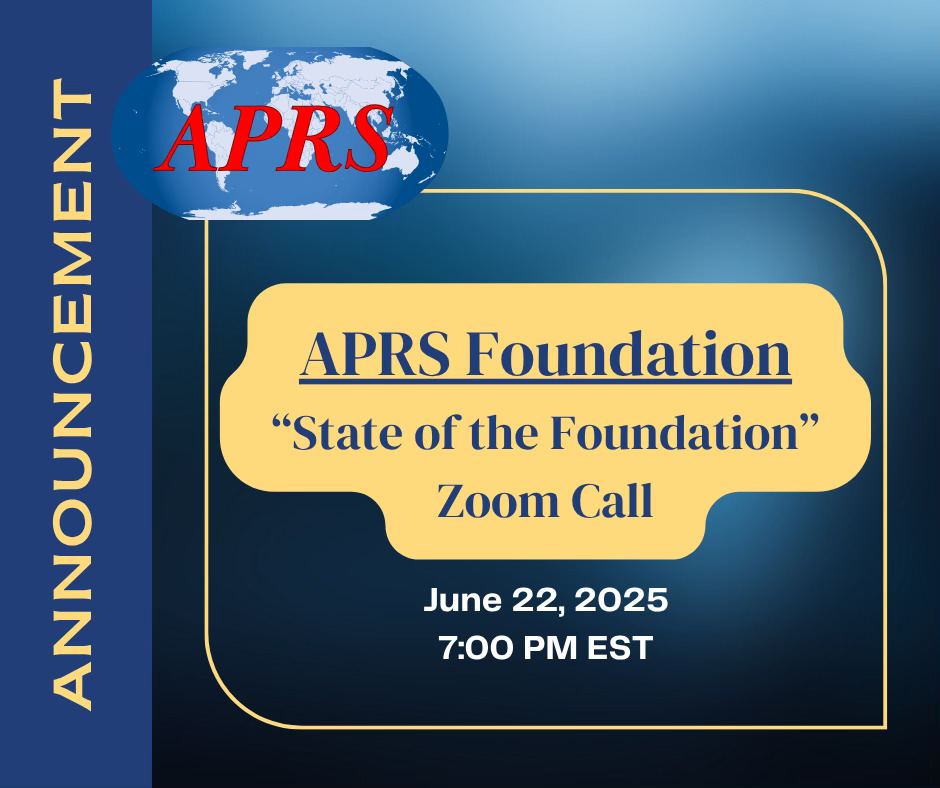
APRS Foundation "State of the Foundation" Zoom Call on June 22nd @ 1900 (7PM) EST
Jason Rausch K4APR on the aprssig email list:
The APRS Foundation will be holding a public Zoom call on June 22nd at 1900 (7PM) EST to present the “State of the Foundation” update. We'll be discussing recent changes in the officer lineup, newly added board directors and paying tribute to Lynn Deffenbaugh, who we lost in the past year and calling for volunteers for several tasks. This call will be limited to one hour and will include a question and answer session after the slides. We'll do our best to make the presentation short and to the point, so we can address as many questions as possible. Please join us at the below Zoom link (link will only be active for the meeting time):
[Corrected link]
https://us06web.zoom.us/j/81634671105?pwd=QEqaSTvJfbRlSEaTxfIwdjl60e3tb0.1
As always, we do our best to keep the foundation's website up to date:
https://www.aprsfoundation.org/
Thank you!
Jason Rausch K4APR (APRSF Director)
There was a seminar at Hamvention 2025 by APRS Foundation (at least one was scheduled):
APRS - State of the Union
Begin: 3:10 PM
End: 4:00 PM
Location: Room 3
Moderator: Jason Rausch, K4APR
Speaker: John Tarbox, WA1KLI
Description:
APRS (Automatic Packet Reporting System) plays a crucial role in real-time tactical digital communications for amateur radio operators worldwide.
We will explore the current state of APRS, including its infrastructure, applications, and ongoing projects.
We will also discuss the future of APRS. Whether you’re a seasoned APRS user or just getting started, this session will provide valuable insights into where APRS is headed and how you can contribute to its evolution.
I had hoped to attend that one, but I got drawn into a very interesting conversation and missed it, thus I don’t know if it happened, or didn’t, or what was said there.
Zero Retries readers - did you attend the APRS - State of the Union Forum at Hamvention 2025? If so, could you drop me an email - steve@zeroretries.net?
That seminar was (apparently?) not recorded (that I’m aware of - it’s not currently on the DARA Hamvention YouTube channel), and APRS Foundation hasn’t posted anything about Hamvention on their website, their email list, or the aprssig email list. That kind of silence after a major conference, and the lack of attention to maintaining their website (for example, posting this announcement there) is… concerning.
Thus I’m glad to see this announcement. After seeing nothing resulting from Hamvention, with a decent interval for folks to catch up, I had pinged APRS Foundation on their email list on 2025-06-08:
Any updates from APRSF?
Last update was dated 2025-02-07:
https://www.aprsfoundation.org/hamcation-2025/
Other than deleting Jeff W4JEW (https://www.aprsfoundation.org/leadership/)… nothing has changed on the website that I can see.
And of course, the stated APRS Summit 2025 scheduled for 2025-05-10 (https://www.aprsfoundation.org/events/) didn’t happen:
What say, APRSF Board of Directors?
John T?
John L?
Jason?
Speaking as a paid member, it seems like there should be an update TO THE MEMBERS of the state of the APRS Foundation. I think that’s the least we’re owed after being patient for months with no communication whatsoever from the APRSF.
I didn’t get an answer to my message on the email list, but this is certainly good enough. I look forward to hearing the updates from APRS Foundation.
# # #
Packet Commander - The Terminal App for AX.25 Packet Radio on iOS
Email from Georges Auberger WH6AZ - Island Magic Co. at 07:30 Pacific today:
Aloha Steven,
I’m excited to share that Packet Commander is now available on the App Store!
I built this app in hopes of bringing a smooth, modern packet radio terminal experience to iPhone and iPad.
And the best part? It’s free to try. You get 5 full connection sessions to explore the features and confirm compatibility with your setup before committing to a purchase.
So what are you waiting for? Command the airwaves!
I had planned to run this article as “discovered this interesting development for Amateur Radio Packet Radio hiding in plain sight on the Island Magic Co. website”, but Packet Commander is now available!
And… confirmed! I just downloaded it from the IOS App Store onto my phone. Great… another thing to add to the list for the (now busy, but interesting) weekend.
Features
Powerful TerminalFull-screen terminal for interacting with packet nodes and BBS over amateur radioClassic color themes inspired by iconic computersAdjustable fonts and layout for readability and screen efficiencyYAPP protocol support for file transfersDictation-ready for composing messages hands-freeSmart filename selection — double tap to highlight and copy
Smarter Packet ConnectionsLocation-aware digipeater routing: automatically recalls the last-used path at each locationSeamless iCloud sync for nodes and digipeaters across all your devicesCompatible with popular packet node software including BPQ32, URONode, and others
Works with the Gear You LoveAuto-discovery of Bluetooth and TCP TNCs, including Dire Wolf on DigiPiAutomatic frequency set/restore on supported radiosBuilt-in, high-performance 1200 baud AFSK software modemOptimized for VHF/UHF packet at both 1200 and 9600 baud
See the web page for additional details.
This is a really cool development (not yet available), from Georges Auberger WH6AZ, the developer of the RadioMail app for IOS and the B.B. Link Adapter for use with the Kenwood TH-D74A and TH-D75A portable radios.
My thanks to Zero Retries reader Bill Arcand W1WRA for pointing out that news of Packet Commander is now public.
# # #
Mention of Raspberry Pi Compute Module 4 (CM4) in FlexRadio Units Wasn’t Meant to Imply “Hackable”
Comment for Zero Retries 0205 by Eric Grumling:
Readers should keep in mind that just because it is using a CM4 doesn't mean it is running Raspbian. It is most likely running VxWorks or Yocto Linux. These are real time operating systems (RTOS) that are optimized for performance and stability. While I'm certain in the longer timeline someone will swap out the installed CM4 with one that has a more hacker friendly OS installed, embedded Linux isn't for the casual user. There's not going to be a package manager, for example. Things will be locked down.
But it is a huge step in the right direction. Kudos to Flex Radio for letting us know what's under the hood!
(The name “Raspbian” for the official Raspberry Pi version of Linux has been deprecated. It’s now called Raspberry Pi OS.)
There was also an email from Bill Diaz KC9XG:
Detailed info on differences and possible incompatibilities between the CM4 and the CM5 [Compute Module 5]:
https://www.raspberrypi.com/news/meet-the-engineer-dominic-plunkett-on-compute-module-5/
Point taken to both Eric and KC9XG. In my article in Zero Retries 0205 - Minor Scoop About FlexRadio’s Impressive Engineering, I didn’t mean to convey that the FlexRadio units using the CM4 should be considered "hackable" by users, or that FlexRadio doing an upgrade from the CM4 to the CM5 in their radios would be “easy”.
What I was trying to convey was my admiration for FlexRadio’s use of the CM4 as (what I consider to be) elegant and cost-effective engineering. Using a Raspberry Pi Compute Module (the CM4 was probably the only choice at the time the 8000 series was designed, much of which was inherited by the Aurora series) was a sound engineering decision. Given Raspberry Pi’s longstanding assurance of long term availability to industrial customers like FlexRadio, using a Compute Module 4 provided not just a reliable supply, but a reasonable expansion path to potentially upgrade those FlexRadio units to a Raspberry Pi CM5 if that is eventually warranted.
# # #
SteppIR to Discontinue Amateur Radio Sales
Pop up notice on SteppIR’s website when Amateur Radio is selected:
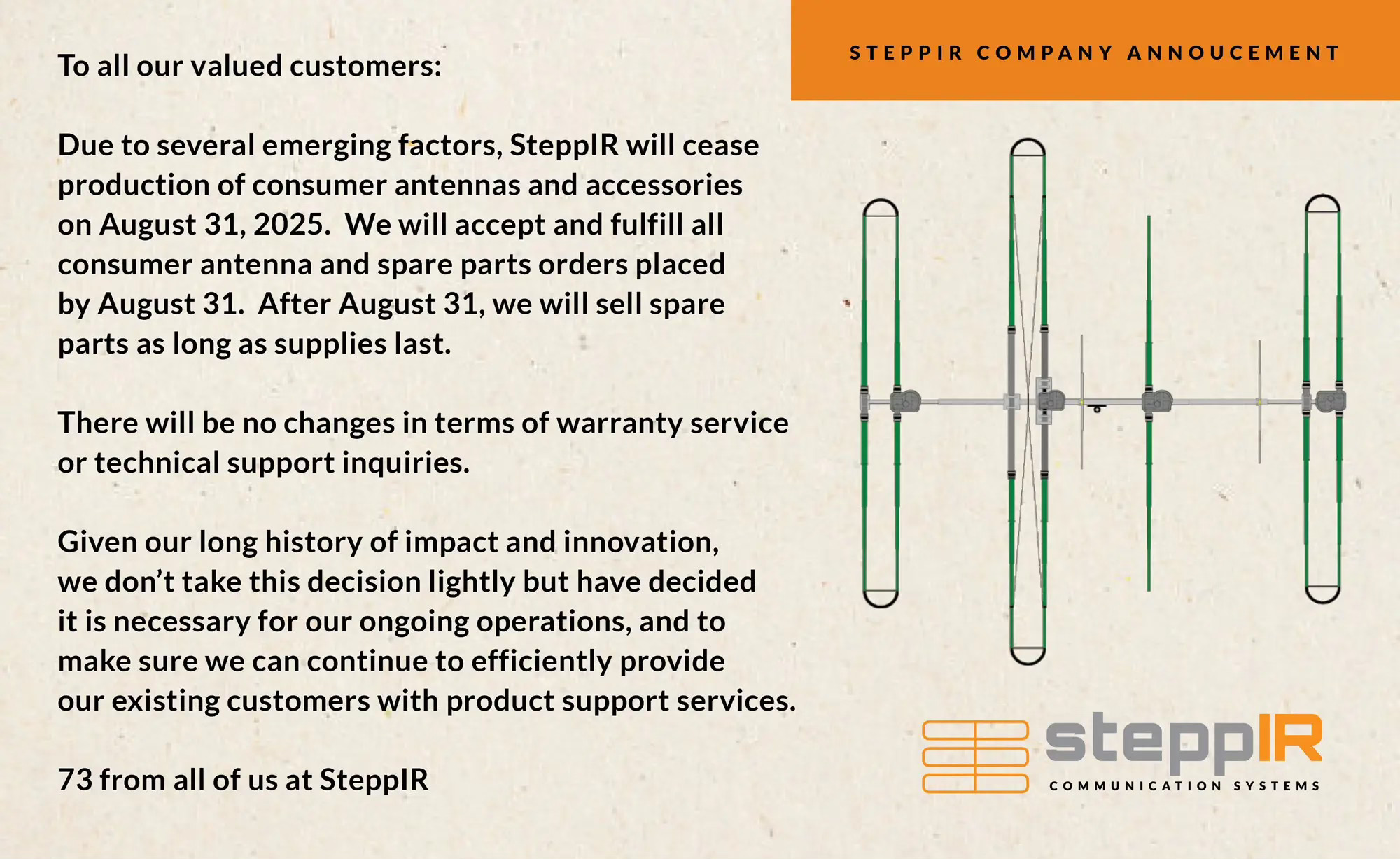
SteppIR is based in the Seattle, Washington USA area and thus they’re one of the few remaining radio related manufacturers in the region. The only other big company in Amateur Radio in our region is one of the offices of Icom America. In fairness to SteppIR’s innovations in Amateur Radio, I should have highlighted them and their innovations… and often.
SteppIR’s technology is (was, I guess now) another example of technological innovation in Amateur Radio that I constantly talk about in Zero Retries. Unfortunately I never got around to mentioning SteppIR’s significant innovation in the unsung area of active HF antennas. In SteppIR’s case, instead of dissipating (wasting) transmit power in an antenna tuner unit between a (matched for 50 ohms) transmitter and a mismatched antenna… SteppIR antennas were capable of being tuned so that there was no mismatch, on any frequency within their tuning range. All the power of the transmitter can then be coupled into the antenna.
But SteppIR antennas are expensive (justifiably, in my opinion, given their technology). Over time, SteppIR found a much more receptive and lucrative market in the re-emergence of HF communications in commercial use, especially some HF applications where the price of SteppIR antennas was of little or no concern.
I don’t blame SteppIR for forgoing the Amateur Radio market. I think this revered advice3 applies:
Don’t Cry Because It’s Over; Smile Because It Happened.
# # #
HAM RADIO Job Market Shows Career Opportunities
In 2025, the HAM RADIO job market will once again offer the ideal platform for training, jobs and careers - for all sectors!
You can easily post your offer online on our homepage. The advertisement will also be presented on the job market pinboard in Foyer WEST during the trade fair. This allows you to reach your target group directly, personally and without wastage.
☛ Our offer: € 150.00 (for up to 3 ads)
Take advantage of this opportunity - whether you are an exhibitor at HAM RADIO or not!
Kudos to the marketing team of HAM RADIO! This was just one item from the most recent informative email(s) that I’ve been getting for the last month or so leading up to the big HAM RADIO conference in Friedrichshafen, Germany on 2025-06-27 thru 29, just a few weeks from now.
This is in contrast to communications from Hamvention (Dayton Amateur Radio Association). Hamvention doesn’t offer individual, direct outreach for Hamvention (that I can find), only links to Twitter (they still use the bird symbol), Facebook, and YouTube.
Offering HAM RADIO Job Market really helps to tie together the commercial uses of radio technology with Amateur Radio and reinforces that…
Ultimately, amateur radio must prove that it is useful for society.
Dr. Karl Meinzer DJ4ZC.
# # #
Zero Retries Guide to Zero Retries Interesting Events Updated
This week I updated the Events page to add a few conferences that I recently learned about. As part of that update, I tried to add all of the ARRL Division conventions that I could find… and I noted an interesting dichotomy.
I didn’t dive too deep into this, but it struck me that some ARRL Division conventions were significant multi-day events, such as SEA-PAC (Northwestern Division) and Pacificon (Pacific Division) that offer a number of forums. They are well-produced, held at nice venues, have informative websites (and unique names, such as SEA-PAC, Pacificon, etc.) that were easy to discover.
Then there are a number of ARRL Division conventions that seem to be held in conjunction with one day Amateur Radio / electronics flea markets (with few or no seminars, other than an ARRL forum).
In the Zero Retries perspective, the significant multi-day events are well-marketed and thus inviting and interesting to potential new Amateur Radio Operators. The variety of forums, and commercial vendors at such events make it a lot easier to “Discover Amateur Radio”.
# # #
New Starlink Performance Kit
Disclaimer - I’m not receiving any revenue from mentions of Starlink in this article.
Marketing email from Starlink:
Starlink Performance offers high-speed connectivity and durability in the most remote and extreme environments, ideal for travel, boating, and all mobile applications.
New features on the Performance Kit include both AC and DC power inputs, an aluminum enclosure and ruggedized connectors for endurance in extreme weather, and an enhanced waterproof rating for the highest level of protection against water, dust, and debris. See Durability Guide here.
The Starlink Performance Kit is capable of download speeds up to 400+ Mbps for high-speed connectivity whenever you need it. Additionally, the Performance Kit will support increased speeds as we make future network enhancements. No hardware changes needed.
Available now for $1,999 on Roam.
What's in the Box
The Starlink Performance Kit arrives with your Starlink, Advanced Power Supply, 25m Starlink Performance Cable, AC Power Cable, DC Power Cable, and 5m Ethernet Cable.
A choice of mount and optional free router is also included with the purchase of a Performance Kit but not included in box.
I’ve seen a number of third party kits that attempt to “ruggedize” the consumer version of Starlink units, but this one seems to answer the issue of “can it handle my challenging situation?” The words of my friend Steven Roberts N4RVE ring in my ears from his era of designing the Microship - “Water corrupts, but saltwater corrupts absolutely.” And now Starlink has answered the “marine usage issue” with the Performance Kit. If N4RVE was doing the Microship in this era, it would undoubtedly have a Starlink Performance Kit. Imagine livestreaming a trip in a small boat down a river like the Mississippi. River Horse, sponsored by streaming video!
Starlink just continues to impress me. Compared to the daily dropouts I experienced with Comcast, and the endless hassles and annoyances with “let’s slip another random charge onto your monthly bill”, Starlink just works, the pricing is consistent, and it’s remarkably no hassle. I haven’t had a service interruption in months.
And Starlink is paying attention to even the small pain points. They just released the Router Mini, priced at only $40. Its primary purpose is to act as a wired or wireless Wi-Fi extender. I have one spot in my house furthest away from the house router in the garage, and so I’ll try putting this unit inside the house and see if it improves the coverage. At $40 it’s a worthwhile experiment.
A fun mention of Starlink… after I got my Starlink working in our household with the primary router in N8GNJ Labs, and a long Ethernet cable in a conduit between the N8GNJ Labs and the house, and a second Starlink router inside the house, Internet in our household Internet has been “it just works” reliable and hassle-free. At an appointment this week, my wife Tina KD7WSF was listening to a receptionist complain that she was having trouble checking Tina out because the office’s Internet was acting up again. Tina gave her my phone number and told her “My husband can could fix your Internet problem - just give him a call”. When I picked her up she said “I pimped you out for tech support. They’re having problems with their Internet again, and told them you could help them. All you have to do is tell them about how reliable Starlink is, and how easy it is to install.” True, that.
As long as I’m gushing about Starlink, two last interesting data points …
- If I were to get into the “Fix your Internet” business, Starlink now has an Authorized Reseller program. Never say never… Not to mention that Starlink now have a wide variety of mounting adapters, and there’s a big third party market for adapters, enclosures, extenders, vehicle mounts, etc.
- I saw this mention as I was scrolling down the Starlink page:
GIGABIT SPEEDS AVAILABLE IN 2026
Starlink is focused on making network enhancements which will enable gigabit speeds starting in the most remote places on Earth with the Performance Kit. Service plan upgrades will be available in 2026. No hardware changes needed.The Starlink Performance Kit is currently capable of download speeds up to 400+ Mbps for fast, reliable connectivity whenever you need it.
There was an old phrase in the computer industry of the 1960s:
IBM isn’t the competition, it’s the environment. The implication was that IBM was so dominant, so ubiquitous, its sales, services, and range of equipment was so comprehensive that it was very hard to compete directly with IBM.
Starlink is quickly becoming the environment of telecommunications worldwide. It’s the only truly worldwide Internet / Telecommunications Service Provider. It’s about to begin providing mobile telephone service. Fiber providers were probably laughing about “Starlink as a competitor” right up to the point where Starlink starts offering Gigabit speeds. Mobile carriers were probably laughing about “Starlink as a competitor” right up to the point where Starlink Mini debuted and people, and truckers, and boaters, and even private pilots starting attaching them to their vehicles for high bandwidth continuous Internet access.
Starlink Mini that fits in a backpack, that can be powered by a USB-C battery pack… still blows me away. See my story about my “Meadow Day” experiment.
# # #