Zero Retries 0204
2025-05-30 — 2800 Email Subscribers, A Few Last Zero Retries Impressions of Hamvention 2025, ARDC Priority Areas for Funding - R&D, The Importance of Internet-connected Systems for Amateur Community

Zero Retries is an independent newsletter promoting technological innovation in and adjacent to Amateur Radio, and Amateur Radio as (literally) a license to experiment with and learn about radio technology. Radios are computers - with antennas! Now in its fourth year of publication, with 2700+ subscribers.
About Zero Retries
Steve Stroh N8GNJ, Editor
Email - editor@zeroretries.net
On the web: https://www.zeroretries.org/p/zero-retries-0204
In this issue:
Comments for This Issue (redirect to Comments page)
Request To Send
Commentary by Editor Steve Stroh N8GNJ
Paid Subscribers Update
My thanks to Prefers to Remain Anonymous 30 for renewing as an Annual Paid Subscriber to Zero Retries this past week (one week delayed - apologies)!
My thanks to Prefers to Remain Anonymous 74 for becoming a Paid Subscriber to Zero Retries this past week!
Financial support from Zero Retries readers is a significant vote of support for the continued publication of Zero Retries.
2800 Email Subscribers!

What can I say? Folks just keep finding their way here to Zero Retries, almost entirely for reasons (especially word of mouth mentions) that I rarely hear about. Thanks for being here and reading Zero Retries. Don’t be afraid to let me know how I’m doing.
Honourable Member of Alberta Digital Radio Communications Society (ADRCS)
From the ADRCS Membership page:
Steve Stroh, N8GNJ. Steve is the publisher of the weekly online magazine Zero Retries and a major contributor to the ip400 project. His efforts have resulted in building a large user following from the ground up, and he manages the communications with frequent updates, as well as attending and organizing conventions.
I’m grateful for being named an Honourable Member of ADRCS. After learning about this, I pointed out to them that my contributions to the IP400 Network Project and ADRCS were only possible because of Martin Alcock VE6VH’s creation and ongoing development of IP400.
I’ve never been named an Honourable Member before - kinda cool!
Store & Forward Episode 13
Our excellent (well… pretty good…) podcast with my friend Kay Savetz K6KJN - a podcast about the past and future of ham radio is now available:
Store and Forward episode 13 — Steve’s Adventures at Hamvention 2025
I monopolize this episode a bit (apologies to Kay) about my adventures at Hamvention 2025. But Kay drops some big mentions about new material coming into DLARC such as Wireless Institute of Australia’s Amateur Radio Magazine, archival material donated by Hank Magnuski KA6M, and future additions of material on ALOHAnet, the formative (very first, well, first civilian) packet radio network over radio.
T-Mobile Holds Up
I have no basis for comparison about T-Mobile’s coverage and capacity versus AT&T or Verizon… or Dish (yeah, really, kind of).
But I can tell you that at least in Western Washington… and the Greene County Fairgrounds in Xenia Ohio on a particular long weekend… T-Mobile’s service holds up.
At least, T-Mobile’s LTE capacity. I keep my phone locked to not use 5G as it’s a battery drain, and I’ve never experienced any performance boost when I occasionally enable 5G on my mobile phone.
In fact, I’m typing these words in a moving vehicle, on Substack’s web editor. Each keystroke is echoed to the Substack servers, and on my laptop tethered to my mobile phone, the response is completely normal, as good as if I was sitting in my office using Starlink via Ethernet.
And now… ordinary mobile phone to satellite is possible with T-Mobile and their friends and co-conspirators at Starlink. Finally we won’t be out of touch anywhere in the continental US on our next big trip.
I’m old enough, seen enough, and lived and worked in the “beforetimes” of mobile broadband Internet. Thus I’m still not jaded to the technological miracle and superpower that is all manner of radio technology… especially Broadband Internet Access via Radio.
I Owe M17 Project (and Now, Foundation) a Book. Soon.
A while ago, I wrote a series of articles in Zero Retries that concluded that M17 had graduated from “interesting, active science experiment” to “all the pieces are in place for mainstream use of M17”. I had researched M17 enough to know that there could be… should be… a book about M17. And I began with an outline. and probably mentioned the project openly, and certainly privately to a few M17 folks.
Since then there have been a series of fortunate events such as discovering and volunteering to help GNU Radio Conference 2025, courageously deciding to launch Zero Retries Digital Conference 2025, attending HamSCI 2025, and most recently attending Hamvention 2025.
Fortunately, there’s not much actual writing-from-scratch needed for an M17 Book. The M17 articles from previous issues of Zero Retries need to be updated and fleshed out a bit now that I have more knowledge of M17. There is also the extensive knowledge available on the M17 Foundation Wiki and many other authoritative sources, including web pages for most M17 projects and products.
My plan of attack for the M17 book in my “spare time” of the next few months is to create a new Google Docs page where I can turn public comments on to soak up distilled wisdom as I flesh out the book. I’ll announce this when it’s set up on the m17-users email list. Any significant contributions (comments) that get into the book will be credited, of course.
Then, assemble it all with chapters, page numbers, and all the niceties of “books” and publish it as a PDF. Out of courtesy and a fun reveal, I’ll be sending it to M17 creator Wojciech Kaczmarski SP5WWP in time for it to be available first at the M17 Conference 2025.
Title is to be determined:
- The Magic Book of M17?
- The Minimally Comprehensive Guide to M17?
- The Least You Need to Know about M17?
- The Zero Retries Guide to M17?
- Suggestions? (“The M17 Book” - nope.)
Update on IP400 Next Issue and Orders In Progress
Partly as a result of my experiences and first-time hands-on with IP400 Ichiban at Hamvention 2025 a couple of weeks ago, there have been some adjustments to IP400 planning, technology, hardware, and some advancements in software.
Thus Martin Alcock VE6VH and I will have an update on all of that and more in next week’s Zero Retries. Not to bury the lede, nothing bad, all good.
Also from VE6VH:
An update on the orders in progress
We have received most of the material for the first batch, however some has been delayed and will not be here until next week, then the first orders will go out. We will contact you when yours is ready for further information.
The Canadian Post Office is threatening a strike (again), which may force us to find an alternative shipping company, and we cannot guarantee that the pricing will be the same. An update will be posted when we are ready to ship.
Hang in there - won't be long now.
# # #
Have a great weekend, all of you co-conspirators in Zero Retries Interesting Amateur Radio activities! If you’re at SEA-PAC in Seaside, OR, please say Hi and let’s chat a bit about all things Zero Retries Interesting (or just techie, and fun).
Steve N8GNJ
A Few Last Zero Retries Impressions of Hamvention 2025
By Steve Stroh N8GNJ
A few lingering impressions of Hamvention 2025 a couple of weeks ago.
Hamvention 2025 Via Video
Now a week later, somewhat decompressed from travel, I started browsing some of the many YouTube videos of Hamvention 2025. Having attended the same event in person, I feel I have some standing to state that each one of those videos captures only a small “flavor” of the overall experience of Hamvention. Some content creators focused on the flea market, others did selective views of the exhibit areas, others did a lot of one-on-one interviews with fans of a YouTube channel. There are also some good recordings of a few of the Forums. Alas, none that I wanted to view that I missed attending, such as the forums for AMSAT, ARISS, TAPR, APRS, and HF Digital.
But none of these videos really tried to capture the event in documentary style, with good after the event narration, tight editing, and a reasonably comprehensive overview. Thus an annual Hamvention documentary would be a great project for a student or small team of filmmakers with a small budget (backed by an ARRL, DARA, or ARDC grant?) for travel and time spent editing, and releasing it for free.
My point is that the videos, numerous, and varied as they are, really don’t give a real flavor of the immersive nature, and the scale of the event. The only equivalent to attending Hamvention are the other very large Amateur Radio events such as HAM RADIO in Europe, and Ham Fair in Japan. Though, I’m told, that Hamcation, held early in the year in Florida is a close second to Hamvention.
Continuous Glucose Monitor Lost Communication
I noted with amusement that a while after I entered the exhibit buildings each day, my continuous glucose monitor that communicates with my mobile phone via Bluetooth “lost connection” for most of the time I was in the Hamvention exhibit buildings, and returned to normal after I left Hamvention. I thought of reporting this to my glucose monitor vendor, and suggesting that they might want to visit Hamvention 2026 with some test equipment to understand how their unit performs (or has problems) in high density radio frequency environments such as inside the Hamvention exhibit buildings. Bluetooth, especially Bluetooth Low Energy is pretty robust, but it’s not invulnerable.
What was interesting was that no data was lost during the communications interruptions. Apparently there’s a considerable buffer in that little unit about the diameter of a US nickel, and about twice as thick… that is designed to be discarded after fifteen days. Throwing away a radio every two weeks is a novel concept to me.
Cellular (at least T-Mobile) Held Up
I didn’t specifically look for the cellular infrastructure at Hamvention. But T-Mobile (my current mobile carrier), in my opinion, did a good job of planning for the intense demand at Greene County Fairgrounds (and inside the buildings) on Hamvention weekend. In the YouTube videos, there was some grousing that mobile and Wi-Fi sometimes wasn’t up to the challenge of live-streaming, but every time I checked email and did an occasional web search, worked fine, including sharing my mobile connectivity from my phone to my laptop.
M17 Interest… But No Presence
Disclaimer - I have no official standing with M17 Project or M17 Foundation, only as an unofficial, occasional advisor and an advocate of M17 as a significant technological innovation in Amateur Radio. I’m also a fan of how much Wojciech Kaczmarski SP5WWP has accomplished since beginning M17 with merely a concept that Amateur Radio digital voice (and data) communications in VHF / UHF should not beholden to using proprietary Codec technology such as DMR, D-Star, System Fusion, P25, etc. As an outgrowth of writing about M17 in Zero Retries, Zero Retries sponsors the (unofficial) m17-users email list.
During Hamvention 2025, I lost count of the number of times I was asked if there was an M17 presence at Hamvention 2025. No, there was not.
M17 did not have a presence at Hamvention 2025 because (in my opinion / observation) in the past year, M17 has reorganized into a new M17 Project website, and the new M17 Foundation in Poland. M17 Project’s focus in 2025 will be sponsoring the M17 Conference in September, in Poland.
The good news is that M17 Foundation has received some donations to fund its work. The bad news is that the donations received to date haven’t yet repaid the expenses of establishing the M17 Foundation. Thus there is no budget at the moment for exhibiting by M17 Foundation or Project at a major conference (especially overseas) like Hamvention.
After the recent reorganization, there are now only a few folks in the US actively involved in M17. Hopefully that will change in the coming year so that there can be some presence for M17 at Hamvention 2026, perhaps soliciting some targeted donations for M17 to have a presence at Hamvention and actively promote M17.
M17 is one of the areas of interest of Zero Retries. If Tina KD7WSF and I are successful at arranging a Zero Retries exhibit booth at Hamvention 2026, we will certainly be offering at least some advocacy of M17.
M17 will also be featured at Zero Retries Digital Conference 2025.
Kenwood TM-D750A Flat Audio Connection
One of the few bits of new Zero Retries Interesting info I gleaned in watching a video - Kenwood TM-D750 Details Revealed: Hottest Features from Hamvention 2025! is that the TM-D750 will apparently have a flat audio connection (“data jack”) so that external modems such as VARA FM can be used, bypassing the internal TNC (hopefully…) the same as what was possible with the Kenwood TM-D710A / GA.
To date, regarding the TM-D750A, other than this single page PDF:
I’ve only seen non-authoritative interpretations of what’s been said verbally by Kenwood personnel at conferences. In searching for some authoritative primary reference information on the TM-D750A, the state of Kenwood USA’s website for Amateur Radio is inexplicable to me. At this point, it’s laughable bordering on sad that it’s so out of date. See for yourself - https://www.kenwood.com/usa/com/amateur/. It’s just hard to imagine that a company, in 2025, could allow its corporate website for promoting products that they sell for a profit, would be so out of date. To add insult to that injury… the Kenwood representative in the video said that he would be posting updates, as he learned them on the Facebook group Kenwood TM-D750A.
Update on Buying a BridgeCom Systems BCM-220
After reading BridgeCom Systems BCM-220 in Zero Retries 0203, a Zero Retries reader called BridgeCom Systems to order one, only to be told “we sold out of those a while ago”.
Apparently, this is one of those situations where “ya gotta know a person” who can get you the inside track. The front line sales staff at BridgeCom are apparently unaware that there are still BCM-220s lurking somewhere within BridgeCom Systems and available for sale.
Thus, if you’re interested in buying a BCM-220 for data use on 219-225 MHz, call BridgeCom at 816-532-8451 and ask for Ron Kochanowicz. Or you can try emailing Ron (KC0QVT) - ron@bridgecomsystems.com.
Please tell them Steve N8GNJ at Zero Retries sent you.
Also, to use the BCM-220 for data use without having to deal with a custom cable for the unique high density D15 socket connector that provides the flat audio connection, the magic solution is the Masters Communications BCM-6. You’re welcome 😀
Also this “app note” regarding the BCM-220 (and other BCM radios) from Zero Retries 0171 - A 144 / 222 / 440 MHz 9600 APRS Stack… and Network!:
The Bridgecom BCM radios require unusually high voltage to drive the radio to full 3.5 kHz deviation for most reliable 9600 bps communications. Of the various Masters Communications Digital Radio Adapter (DRA) units, the DRA-45M has an option for external 12 volts input to be able to drive the BCM radios to full 3.5 kHz deviation.
My ongoing thanks to Kevin Custer W3KKC of Master’s Communications for creating and stocking the BCM-6 and many other great solutions for Amateur Radio data communications.
ARDC Priority Areas for Funding - R&D
By Steve Stroh N8GNJ
In the 2020s and beyond, signifiant grants from Amateur Radio Digital Communications (ARDC) are now a fundamental enabling factor for Amateur Radio to innovate in radio technology and thus Amateur Radio make a significant contribution to society. Prior to ARDC’s significant grants, Amateur Radio technological development had to be done with personal resources, forming a small company for commercialization, or perhaps the resources of small groups (crowdfunding).
In this era, ARDC’s significant grants have enabled a new paradigm in Amateur Radio - the ability to spend focused time and utilize professional skills and systems to develop and enhance new technologies for Amateur Radio such as MMDVM, FreeDV, M17, and Rhizomatica’s Mercury Modem… and many other such projects and systems.
Thus ARDC’s activities, and especially its areas of focus, is of primary interest in to cover in Zero Retries.
Disclaimer - I had no involvement in this development within ARDC - I only applaud that it has happened.
In April, 2025, ARDC unveiled a significant position “paper”:
Priority Areas for Funding
At a high level, ARDC’s vision and strategy focuses on encouraging more people to learn, experiment, and deploy/do with amateur radio (AR) and digital communications (DC). This supports our broader goal of promoting the freedom to tinker, build, communicate, and openly share information.
Within this framework, we’ve identified the following priority areas for funding:Research & Development (R&D)Space-Based CommunicationsOpen Source Education
From a personal (Steve N8GNJ) and strategic (Zero Retries) perspective… I think that ARDC got these priorities exactly right!
I plan to discuss the other two ARDC priorities - Space-Based Communications and Open Source Education in future issues of Zero Retries. In this article, I’ll focus on the Research and Development (R&D) priority:
Research & Development (R&D)
These kinds of projects focus on developing open hardware and software components and systems that support learning and experimentation. Broad adoption is often enabled by low cost, flexible designs, so we look for projects that consider both.
Examples include:Open and legal codec technology compatible with, or as replacements for, existing proprietary codecs.Development of low-cost, hackable software-defined radio (SDR) transmitter technology that enables experimentation and operating on a wide range of amateur bands.Development of new, improved modulation techniques, which could lead to improved performance in weak signal conditions, reduced power consumption, and/or enhanced DC.
I think ARDC really nails it with regard to the potential influence that Amateur Radio development can have on radio technology.
As I’ve discussed in previous issues of Zero Retries, my perspective is that technological innovation in radio technology is the primary contribution that Amateur Radio can make to society in the 2020s and beyond. Other contribution that Amateur Radio has historically made to society such as International Goodwill and Emergency Communications are fading in comparison to the availability of universal Broadband Internet, satellite technology, etc.
In commercial, government, and military use of radio technology, use of High Frequency (HF) spectrum has declined considerably in favor of satellite communications. Example - shortwave broadcasting is being shut down by most countries. HF communications has been reduced to “let’s check that it still works” exercise, but not regular use.
Similarly, use of Very High Frequency / Ultra High Frequency (VHF / UHF) spectrum has reduced considerably in favor of cellular communication services. While there are many, many uses of VHF / UHF spectrum, usage is being severely reduced and most VHF / UHF services have now migrated to cellular carrier networks. Example, Push To Talk Over Cellular has largely displaced the use of commercial two way trunked radio systems for users such as fleets of taxis.
Thus there isn’t much of an incentive to innovate in radio technology by commercial and government users for HF and VHF / UHF spectrum. Military users are innovating in HF and VHF / UHF because of demonstrated vulnerabilities in satellite communications systems and the need for reliable, jamming resistant communications used in drone warfare and the electronic battlefield. But such technologies are often limited to the specific requirements of military use.
Amateur Radio is one of the few “technical communities” that remains interested in pushing the state of the art in radio technology in HF and VHF / UHF bands,
- Because Amateur Radio can; we have literal licenses to experiment with radio technology,
- Because we want to; we’re curious tinkerers and tinkering with radio technology is fun and interesting, and
- Because we need to; our spectrum is limited so we continue to develop new, and more effective / efficient methods of radio communications.
Amateur Radio is developing significant technological innovation in Amateur Radio such as (unlike ARDC, I’m not afraid to mention a few specific projects):
- FreeDV for HF (current ARDC grant)
- Multi Mode Digital Voice Modem (MMDVM) for VHF / UHF voice and data (current ARDC grant)
- Improved Layer 2 Protocol (IL2P) for Amateur Radio Packet Radio (independently developed)
- fldigi suite of data modes and systems, especially the unique capability to broadcast files - flamp (independently developed)
- WSJT-X weak signal modes, especially Weak Signal Propagation Reporter (WSPR) which surprises everyone with how far their weak signals can actually reach around the planet.
- IP400 Network Project to develop a next generation, high speed (100 kbps minimum) data communications system.
The list of continuing innovation in Amateur Radio in the 2020s is very, very long. Mentioning all the interesting Research and Development actually in progress could consume an entire issue of Zero Retries (several, actually)… and it probably should in some future issue(s). I know… I’ve tried.
In conclusion, ARDC’s decision that Research and Development in Amateur Radio should be one of ARDC’s primary areas of focus… is correct, worthy of applause and recognition, and was badly needed.
Goodspeed ARDC in funding technological innovation - Research and Development, in Amateur Radio!
ZR > BEACON
By Steve Stroh N8GNJ
Short mentions of Zero Retries Interesting items.
The Importance of Internet-connected Systems for Amateur Radio Community and Connections
Tom Salzer KJ7T in Random Wire Review: Issue 133:
But what I almost never hear amateurs talk about is the importance of community that is deeply embedded in our hobby. It is foundational. We are part of a community, even though we spend most of our time alone, in basements or garages or spare rooms, focused on the technology of what we are doing, and communicating in our preferred ways. How does spending so much time alone help to build community? Community is created by connecting with other people. Maybe you like to do that through a Morse code key. It could be FT4 and FT8 connections that work for you. Maybe it’s a local repeater or a regular simplex net. The important point is: you are contacting stations that have a human at the other end of that connection.
For people who are in a nursing home or assisted living situation, or in a neighborhood with restrictive HOA covenants, or on vacation, or temporarily in a nursing or rehab facility, that sense of connection becomes even more vital.
…
In this context of restricted environments and personal challenges, internet-connected systems provide exceptional value. Communicating with fellow hams can be as simple as a smartphone running an app (e.g.: Repeater Phone, DroidStar, DVSwitch Mobile) over a local wifi connection or over a good cell signal. Maybe there is a DMR repeater that can be reached with a handie talkie, perhaps helped by using a simple roll-up J-pole antenna. If you’re lucky, there is a D-Star or Yaesu System Fusion repeater nearby. Maybe you have an AllStarLink node in your room, or even just EchoLink on a phone, tablet, or laptop. With any of these systems and a Technician license (in the United States), you can “work the world.”
Please take the time to read this entire article. My reading it and re-reading it was a I never thought about it (Amateur Radio Over Internet) that way wakeup moment.
I understand and agree with everything KJ7T says in that article, and I’m proud to promote the evangelism he does for Amateur Radio Over Internet in his excellent, Zero Retries Interesting, must read ASAP Random Wire Review newsletter.
KJ7T is a Zero Retries Pseudostaffer for continuing excellent Zero Retries Interesting content like this.
M17 Conference 2025 – Talks and Stands
Updated info from the M17 Foundation about their conference in September:
Talks and presentations:Applications of Neural Vocoding Techniques in Amateur Radio – Felix Schäfer (DD8SF)FM-POLAND – how it works? Software (svxlink) and hardware applications – Daniel Żochowski (SP0DZ)Revolutions & evolutions: hardware and software in 2030: How might they affect M17? – Jonathan Taylor (K4FSK)Distributed Networks – Kurt Baumann (OE1KBC)SDR subsystem of OPS-SAT 1 – test trial of M17 protocol in space – Marcin Jasiukowicz (SP4EVA)
Stands:M17 FoundationFM-POLANDICSSW (Kurt Bauman, OE1KBC)
futureGEO Workshop Scheduled for September 19th, 2025
Amateur Radio Daily 2025-05-30:
May 29, 2025
AMSAT-DL has scheduled the first futureGEO workshop for September 19th. While it's not immediately clear what the workshop will cover, based on the RFEI document in which the workshop is mentioned, we're likely to learn which amateur radio organizations will be actively involved in the futureGEO project, see discussion of potential payloads, as well as learn lessons from the QO-100 and related missions.
The workshop will take place during the AMSAT-DL Symposium at the Bochum Observatory in Germany.
Source: AMSAT-DL (PDF)
Yay for any progress on another Amateur Radio GEO satellite(s)! Previous discussions of this project sponsored by European Space Agency (ESA) mention the possibility of it being positioned over the Atlantic to bridge Canada (a member of ESA) and Europe.
I read through the Request for Expression of Interest (RFEI) and while it’s obviously intended mostly for other Amateur Radio space-related or other technical organizations, it doesn’t specifically preclude individuals or other organizations.
Thus, given my demonstrated, and passionate interest in seeing more Amateur Radio GEO satellites in orbit… I think I’m going to submit an RFEI to AMSAT-DL for Zero Retries to participate in the project as “Media Support”.
It’s significant items like this, that I miss, is why Cale Mooth K4HCK was named a Zero Retries Pseudostaffer! My thanks to K4HCK for spotting and highlighting this item.
Now added to the Zero Retries Guide to Zero Retries Interesting Events.
Western Colorado Data Repeater
Email from Bill Tillery K0DZ:
Your promotion of data repeaters prompted us to add a dedicated Data Repeater in Grand Junction, CO [N2KNK on 447.875 MHz]. Now it has 3 Winlink gateways listening, and we often play with VarAC, Ribbit, SSTV, etc.
Our club website is ww.W0RRZ.org.
Keri, N2KNK, is a long-time ham, commercial two-way radio technician, and owner of the WestCo Repeater System that covers much of Western Colorado.
I had two Vara FM digipeaters (VHF/UHF) but kept having issues with the Windows PC due to our repeater site's high RF environment. Keri mentioned that repeaters are so much more reliable, and I remembered your data repeater articles. That was all it took! Keri built and installed the Data Repeater, replacing the UHF digi. We have been thrilled with the added versatility.
Over the last couple of years Keri, Steve KE0BPD, and I built out an AREDN Mesh (30 nodes or so) covering the Grand Valley. We run a PBX, Teamtalk server, and telnet Winlink on our slowly growing mesh. My and Steve's Winlink Gateways are also synchronized via mesh.
Steve has been a proponent of Meshtastic for some time, and leads our Meshtastic efforts and LoRa experiments.
We are active members of the Western Colorado Amateur Radio Club (over 100 club members at last count) and would deeply appreciate any mention of our club you may consider. Again, our website is W0RRZ.org.
Our names and callsigns:
Kari Varela N2KNK
Steve Delaloye KE0BPD
Bill Tillery K0DZ
Wow! A Zero Retries Interesting club playing with a variety of data modes.
I particularly applaud this page on their website:
Area Winlink Gateways, Data Repeater, Digipeaters, BBS, and Data Frequencies
Active Data frequencies in use in the Grand Valley and surrounding areas.
Open to all licensed amateur radio operators!
Ways to test your Soundcard modes software over the 447.875- N2KNK Data Repeater:
1) To test your VaraFM station, go to your VaraFM modem and ping AE0WZ-10, KE0BPD-10, or K0DZ-10. You should receive a response. It is possible that a Winlink Gateway may be offline, so try another if the first does not respond.
2) To test your FLDigi Station, using any mode (BPSK125 suggested), in the blue window of FLDigi type:
DE (your callsign)
PING WØRRZ <—-(W”zero”RRZ)
^R
Then press CTRL-T
Your FLDigi station should then transmit a short message to the WØRRZ Auto-Responder. The Auto-Responder should then reply to you.
3) To test your YONIQ or MMSSTV Slow-Scan-Television station, press the 1750 button next to TX which will begin transmitting a tone of 1750 hz. After two seconds press 1750 again to stop the transmission. After a brief delay, the KØDZ station should reply in morse. Within 10 seconds, press the TX button to send your image. After your image has been transmitted, KØDZ will send your image back to you.
That… is pretty ingenious to have automated ways to test your newly built data system. That makes new Hams trying data much more comfortable that they have everything working before they try to communicate with other Hams.
Zero Retries Congrats to Western Colorado Amateur Radio Club for expanding their scope to fully support data modes on their repeater(s).
New Development Work Underway on JS8Call
Email from Andrew Underwood W9CPZ:
I wanted to make sure you're aware that there's a small group of people working on a bugfix release of JS8Call. I believe this would be the first release since 2.2.0 (2020-06-25), 5 years ago. Based on their github - https://github.com/js8call/js8call discussions I believe they have intentions of making more substantial improvements in the future. There's even dreams of an Android release for mobile operation.
I have no affiliation to these efforts other than being an enthusiastic bystander who would love more activity and development on this cool digital mode.
From js8call.com:
JS8Call is software using the JS8 Digital Mode providing weak signal keyboard to keyboard messaging to Amateur Radio Operators.
JS8Call is an experiment to test the feasibility of a digital mode with the robustness of FT8, combined with a messaging and network protocol layer for weak signal communication on HF, using a keyboard messaging style interface. It is not designed for any specific purpose other than connecting amateur radio operators who are operating under weak signal conditions. JS8Call is heavily inspired by WSJT-X, Fldigi, and FSQCall and would not exist without the hard work and dedication of the many developers in the amateur radio community.
JS8Call stands on the shoulder of giants…the takeoff angle is better up there.
I had no idea that JS8Call development had stagnated for so long. In the News page, the latest update is:
JS8Call Version 2.1 Released
Dec 23, 2019
But as W9CPZ noted, JS8Call development is pretty active now. I particularly enjoyed this “not a fork” by Allan Bazinet W6BAZ:
My motivation was to have a native version of JS8Call that would run on my Apple Silicon Mac, using a current version of the Qt and Hamlib libraries. Along the way, I discovered and corrected a few bugs, and made some minor visual improvements to the UI.
Including:
Use of Fortran has been eliminated; everything that was previously implemented in Fortran has been ported to C++.
… and many other significant improvements.
JS8Call is definitely Zero Retries Interesting! Thanks to W9CPZ (who I met in person at LinuxFest Northwest 2025) for letting me know about this development.
ALOHAnet: the Dawn of the Wireless Computing Age
Mark Ollig in McLeod County Chronicle:
Developed at the University of Hawaii nearly 57 years ago, ALOHAnet pioneered the random access wireless protocols that enable your smart device’s Wi-Fi connection.
Cellular and satellite communications also owe a debt of gratitude to ALOHAnet.
The ALOHAnet project began in September 1968 at the University of Hawaii on the island of Oahu.
The university’s remote campuses on Maui, Hawaii Island, and Kauai faced the challenge of providing access to its central mainframe computer (IBM System/360 Model 65) located in Mānoa Valley, on Oahu.
Ollig’s story included a photo of the ALOHAnet plaque (that I wasn’t previously aware of):
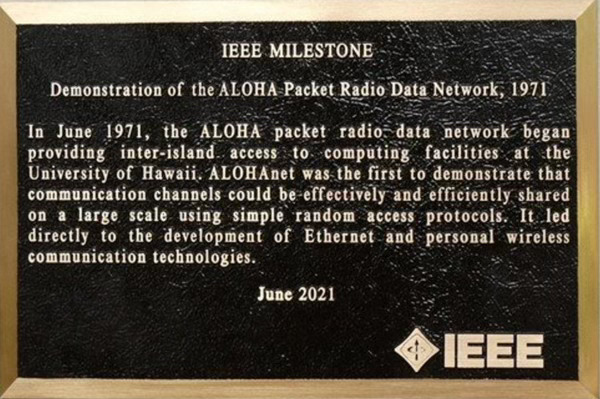
My thanks to the Engineering and Technology History Wiki (ETHW)1 for their thorough mention of this plaque and its significance in technological history:
Milestones:Demonstration of the ALOHA Packet Radio Data Network, 1971
Read on into this article beyond the description of the plaque, for the most thorough treatment of (what’s now known as) ALOHAnet that I’ve seen to date, such as:
6 Historical significance of the work
7 Obstacles (technical, political, geographic) that needed to be overcome
8 Features that set this work apart from similar achievements
See also Ollig’s related article:
The Journey From ALOHAnet to Ethernet: A LAN is born
Ollig also has a blog - Bits and Bytes OnLine that I now follow via RSS.
From IEEE Spectrum:
ALOHAnet Introduced Random Access Protocols to the Computing World
I take mild exception to the subtitle:
Now an IEEE Milestone, the data network was the first to use wireless communications
… Amateur Radio Operators had been using data communications over radio - Radio Teletype (RTTY) long before the ALOHAnet in the 1970s.
As I mentioned in Request to Send, there will soon be a lot of new material about ALOHAnet in Digital Library of Amateur Radio & Communications.
Australia Over The Horizon RADAR (OHR) to be Deployed in Canada
Big news for HF, and possibly a big upset in Canada / US military collaboration.
Apparently the surveillance RADAR systems for watching out for incoming missiles and planes towards North America via the North Pole is due for modernizing. The tone of the video hinted that US companies were expected to get the modernizing contract from Canada and continue to be integrated and use the same systems / technology as the US uses.
But Canada decided to buy a HF OHR RADAR, based on Australia’s Jindalee Operational Radar Network.