Zero Retries 0200
2025-05-02 - 200 (+) Issues of Zero Retries, What’s New With DLARC - May 2025, IP400 Ichiban - The Big Reveal, ZR Digital Conf 2025 Update, LinuxFest Northwest 2025, Introducing Project mini-shack
Zero Retries is an independent newsletter promoting technological innovation innovation in and adjacent to Amateur Radio, and Amateur Radio as (literally) a license to experiment with and learn about radio technology. Radios are computers - with antennas! Now in its fourth year of publication, with 2700+ subscribers.
About Zero Retries
Steve Stroh N8GNJ, Editor
Email - editor@zeroretries.net
Web version of this issue - https://www.zeroretries.org/p/zero-retries-0200
In this issue:
What’s New With Digital Library of Amateur Radio & Communications — May 2025
Comments for This Issue (redirect to Comments page)
Request To Send
Commentary by Editor Steve Stroh N8GNJ
Paid Subscribers Update
My thanks to Prefers To Remain Anonymous 72 for becoming a Paid Subscriber to Zero Retries this past week!
Financial support from Zero Retries readers is a significant vote of support for the continued publication of Zero Retries.
# # #
200 (+) Issues of Zero Retries
While this is the 201st numbered issue of Zero Retries (Zero Retries 0000 was the first, published on the 2nd Friday of July in 2021), I’ve also published some special focused issues that weren’t numbered.
Thus I consider the more meaningful “anniversary” issues of Zero Retries to be the issues that fall on the second Friday of July. In 2025, that issue - Zero Retries 0210 will be published on 2025-07-11 (fate willing) and that issue will begin the fifth year of publication of Zero Retries. And Zero Retries 0210 will, somehow, be published on a platform other than Substack.
I have no profound insights to offer about the longevity of Zero Retries other than consistency is a powerful tool. The “imperative to publish” has gotten in my psyche and I just don’t feel right during the week until Zero Retries is queued up for auto publishing, or 15:30 Pacific on a Friday passes and I’m frantically trying to finish it.
Well, maybe one other insight. With a single exception, all of the feedback I’ve received about Zero Retries has been positive. That’s a powerful motivation to keep going. It’s a lot harder to keep going when you don’t feel your work is being appreciated.
I owe profound Thanks to a select few people:
- My wonderful wife Tina who understands my long (mental / attention) absences while I’m at the keyboard. When it looks like I’m slacking off, especially on a Friday, she asks “Is Zero Retries done?” (in a loving, interested way).
- Steve Davidson K3FZT for becoming Zero Retries Founding Member 0000 and his wonderful advice (multiple times) on the bigger picture of Zero Retries.
- Zero Retries Pseudostaffer Kay Savetz K6KJN for numerous aspects of Zero Retries including being the most reliable contributor to Zero Retries with their monthly column What’s New with Digital Library of Amateur Radio & Communications, their fantastic work as the Archivist of DLARC, in charge of the digital equivalent of finding virtual shelf space for all of the material pouring into DLARC, and becoming friends and colleagues including our joint podcast Store & Forward.
- My co-conspirator Martin Alcock VE6VH who has literally made my dream (of more than two decades) of an advanced data radio for Amateur Radio VHF / UHF bands a reality with the IP400 Network Project.
- And of course the many paid subscribers and especially the Founding Member subscribers. There are expenses associated with Zero Retries (that no reader wants to hear about) that the paid subscribers are gracious enough to help me offset.
I’m also grateful to:
- The Zero Retries Pseudostaffers who were inspirational when I started Zero Retries and consistently contribute good ideas for Zero Retries content (and occasionally contribute content).
- The many Zero Retries trusted advisors (not a formal role, just an acknowledgment of thanks) for sharing their distilled wisdom with me, even when such wisdom stings a little when I’ve gotten something wrong.
- The numerous other content creators that strive to deliver excellent, independent content into Amateur Radio at no cost, such as Amateur Radio Newsline, Amateur Radio Daily and Amateur Radio Weekly, Amateur Television Journal, and The Random Wire. In addition to text, there are many excellent podcasts such as Ham Radio Workbench, and YouTube channels such as Tech Minds. What all of those have most in common with Zero Retries is that they don’t treat their Amateur Radio audience casually - they… we… all work hard at developing great content, and delivering it consistently. I’m pleased to be among such a group.
- The many, many commenters, both for commenting on Zero Retries content, and off the record / behind the scenes.
- The many authors of Zero Retries Interesting mentions on mailing lists, blogs, product pages, etc. (that typically get mentioned in the ZR > BEACON section).
That last point deserves a bit of mention. It’s a subjective estimate on my part, but most of what appears in Zero Retries isn’t content that I create. As I noted in my most recent presentation, much of what I do in Zero Retries is expose existing Zero Retries Interesting content that would otherwise only be seen by “silo’d” users. I cited the example of a group that developed a modem that largely doesn’t promote it outside its community and thus if you don’t already know about that project, you wouldn’t know to look for it to consider using it.
But in the biggest possible sense, I appreciate the community that has grown up around Zero Retries. I started Zero Retries out of frustration that all the cool and interesting stuff I was seeing, and like to discuss and learn about, wasn’t being discussed in Amateur Radio media. In toto, more than 3000 of you now have made me feel a lot less lonely in that perspective.
# # #
Zero Retries Digest?
My chat with a Zero Retries reader about “inventing more time to read Zero Retries” resulted in an idea - Zero Retries Digest as a variant of Zero Retries. As I imagine it, ZRD would a much smaller edition of ZR consisting of just the headline and a (hard) limit of one sentence of description of each topic in each issue of Zero Retries. The format of Amateur Radio Weekly is one model for this idea.
For example, in Zero Retries Digest, this article might be reduced to:
LinuxFest Northwest recap. Discussed a few presentations I attended and overall impressions. Link
The link would be for the full article in the “full” edition of Zero Retries. ZRD would have some additional benefits, such as input for a podcast
For example, I experimented this week with an Listen Later, AI-based service that you emailed a URL to the service and the contents of that URL would be converted to voice in podcast format, in a private podcast feed. It was painful1 to try to listen to the full content of ZR, especially in an acceptable, but not great AI voice. (I later learned I could speed up the AI voice and select different voices.) To date, every time I’ve tried listening to plain (not formatted for AI reading) text, the pacing and pronunciation of an AI voice reading text just irritates me.
But such a service probably would work with the much shorter format of ZRD. You could get an audio summary of the content in each issue of Zero Retries and for the few minutes of listening of ZRD - Audio Edition, you could probably forgive the imperfect AI voice.
It also occurs to me that in my previous attempts to do a Zero Retries Podcast, it ended up being too time consuming to compose a script and record and edit. What I found worked best, for me, was to distill an issue of ZR down to a handful of bullet points, and record in one pass. But in the end, still too time consuming.
But what might work would be to use AI to distill an issue of Zero Retries down to a series of bullet points plus a and one sentence for each distinct item, with perhaps two sentences for each feature article. My tests with AI for Zero Retries to date is that the domain knowledge required for Zero Retries is too specialized and obscure that AI just does a poor job of composing content. But my experience with AI in summarizing existing content is pretty good, such as AI summaries of Zoom sessions that I conduct during the week.
If I did create Zero Retries Digest (and I’m not committing to doing so - yet), offering it to paid subscribers would be a nice perk, hopefully delivered a day earlier than “full” Zero Retries. And… who knows… the way AI systems are improving weekly, once I put together a few issues of ZRD, I might be able to “show” an AI issues of “full ZR” and the corresponding ZRD issues that I manually put together, and then say “replicate this format into a ZRD for the new Zero Retries issue”.
# # #
My FCC GN Docket 25-133 Reply Comments Submitted
While I submitted my Reply Comments in GN Docket 25-133 on Monday 2025-04-28 Pacific time, that didn’t count as I did so after midnight Eastern time, so my comments were recorded as being received on 2025-04-29. But they were:
Filing Status DISSEMINATED
So, good enough.
Now I really understand how Communications legal firms earn their revenue when it’s time to comment to the FCC. There were well over 1,000 Comments and Reply Comments filed in GN Docket 25-133. To find items that might concern and thus require addressing requires a lot of staff to go through them in the time allotted . Or, the use of a well-focused AI. Neither is cheap. Then it’s time to write a well-crafted response, with backup citations in footnotes in the format that maximized impact at the FCC (those that get cited in FCC Report and Orders). And all references must be scrupulously accurate.
That was more work that I was able to do.
So I decided to take a different approach and tell a story as my Reply Comments with very minimal URLs, and no footnotes. My Reply Comments “story” is basically that some regulatory reform would enable Amateur Radio to be more relevant to society and contribute more meaningfully to development of radio technology. That in turn would encourage at least some US Amateur Radio operators to become radio technologists, and contribute US radio technology companies and maintain the US position of influence in radio technology. One trusted advisor told me that I did a good job with it for Amateur Radio. You can judge for yourself.
Related - from some of the Reply Comments I was able to read, the folks running General Mobile Radio Service (GMRS) repeaters (generally wide coverage repeaters operated by large well-organized groups) seem to be really (deeply) unhappy that FCC regulations prohibit linking of their GMRS repeaters.
There was also some significant pushback that the FCC should maintain the regulatory prohibition against linking GMRS repeaters.
# # #
Store and Forward Episode 12 — Big Plans
The big news of this episode is that Internet Archive received a second grant from Amateur Radio Digital Communications (ARDC) to enable DLARC to continue for an additional two years. There is already a queue of scanning work to be done, and digital material to be added. Steve observed that “all the infrastructure, systems, and relationships” are in place to make even more progress with this second grant.
Store & Forward had been on kind of an unspoken, uncomfortable hiatus since Episode 11 because both Kay and I were nervously awaiting the news from ARDC about the future of DLARC. If ARDC didn’t approve a grant to keep DLARC going, it wasn’t going to die, but the most likely outcome would be that it would coast down to “static”. And DLARC isn’t the kind of task that could be done solely by volunteers. You (really!) wouldn’t believe the amount of full time, and often grunt, butt-numbing work that goes into ingesting things into DLARC (so that they’re actually discoverable).
Thus S&F Episode 12 was either going to be a wake, or a celebration, and I’m dee-light-ed!!! that it’s the latter. Seriously! I mean it! Really jazzed! I’m privy to a tiny bit of amazing material that’s been on hold in the DLARC scanning queues. But, that’s Kay’s story to tell, and they give a few hints about that in the first feature story.
# # #
Have a great weekend, all of you co-conspirators in Zero Retries Interesting Amateur Radio activities!
Steve N8GNJ
What’s New With Digital Library of Amateur Radio & Communications — May 2025
By Kay Savetz K6KJN
Excuse the mess, there’s still confetti all over the floor of DLARC World Headquarters, where we’re celebrating a new grant from ARDC to continue growing the library’s content.
Amateur Radio Digital Communications, the organization that initially funded Internet Archive’s creation of the Digital Library of Amateur Radio & Communications, just gave a significant new grant so that we can keep building the library for another two years. I’m elated to be able to build on the solid foundation that we’ve created, to make the free online ham radio library bigger and better. Plans already in the works for phase two include acquiring and digitizing material donated by California Historical Radio Society and the SPARK Museum of Electrical Invention... and we still have (towering stacks!) of boxes of books and manuals from Fair Radio Sales to scan. Until then, here’s some of what’s new at DLARC.
I’m thrilled to announce that DLARC is now home to an amazing collection of Wireless Institute of Australia's Amateur Radio Magazine, from its start in 1933 through 2012. These issues were lovingly scanned years ago by Will VK6UU. His scans have been available online for years at Will’s web site, and World Radio History, and other places. The scans in the DLARC collection, provided by Will, are at a significantly higher resolution than the ones available elsewhere, making them easier to read, with clearer images and schematics. Like everything in DLARC, they’re full-text searchable.
Here’s more than 130 issues of AMSAT Satellite Report/Amateur Satellite Report. Radio Amateur Satellite Corporation’s newsletter began in 1981 as AMSAT Satellite Report (and yes, we have issue number 1). In November 1983 the name was changed to Amateur Satellite Report. The issues were part of an amazing collection donated by Hank Magnuski KA6M, more on that next month. (We’re missing a few issues to complete this collection of newsletters: do you have issues 79 to 125?)
We’ve also added dozens of new issues of The DX Bulletin, filling out the library’s collection. TDXB was written and published by Jim Cain, K1TN, from his Connecticut home. He published 324 issues from 1979 to 1986. In other newsletter news, a DLARC patron uploaded many issues of QRPp, the journal of the Northern California QRP Club — also going back to issue number 1, published in 1993. And we added 249 issues of 425 Magazine: the slick, colorful, monthly version of 425 DX News (“The Italian Weekly Bulletin for Serious DXers”).
The Amateur Radio Callbooks category of DLARC is constantly one of the most popular parts of the library, though it’s not the most glamorous. Maybe it’s hard to get excited about 2000-page books filled with teeny tiny print of names and callsigns — and yet, they’re useful and popular historical reference materials. I recently added 32 Callbooks to that collection (bringing it to nearly 150 books). The new Callbooks include The Consolidated Radio Call Book from 1922, the Fourth Annual Official Wireless Blue Book from 1914, and the 1926 Citizen’s Radio Callbook. There are more recent books from the New Zealand Association of Radio Transmitters and books covering North America as late as 1996.
We added conference presentations, papers, and other material from HamSCI, the Ham Radio Science Citizen Investigation. We now have material from their first conference in 2017 through the 2024 meeting. (Still to do: adding the March 2025 meeting.) We also updated the collection of conference material from GRCon, the annual GNU Radio conference, with videos and slide decks of talks from 2015 through 2025.
I fired up the ol’ 5.25” floppy drive to recover some interesting stuff from old disks: There’s packet radio software WA7MBL MailBox V2.04. It’s an DOS work-alike of the W0RLI MailBox software (which worked on CP/M systems). And there’s PBBS - Packet Bulletin Board System published by Wake Digital Communications Group in 1985. And, meeting minutes from the Northwest Amateur Packet Radio Association (NARPA) for 1990-1991.
If the name NARPA seems familiar, maybe it’s because they published a newsletter called Zero Retries. Here’s a new collection of two dozen of their newsletters, from 1985-1992.
This was an unexpected surprise: we scanned a handful of Jameco Electronics catalogs donated by a ham. In the process of deciding where to file them, I stumbled on Jameco’s own FTP site. (An FTP site! In 2025!) It’s still humming away and serving up digital versions of old Jameco catalogs. So I downloaded them all, organized them, and now there’s a Jameco Electronics Catalogs collection with 66 catalogs dated 1994 through 2018. The FTP site might be simply forgotten by the company, but kudos to any company that still runs an FTP server. If you run an FTP server filled with ham radio treasures, do let me know.
Digital Library of Amateur Radio & Communications is funded by a generous new grant from Amateur Radio Digital Communications (ARDC) to create a free digital library (only on the web, sorry not FTP) for the radio community, researchers, educators, and students. If you have questions about the project or material to contribute, contact me at kay@archive.org.
IP400 Ichiban - The Big Reveal
By Martin Alcock VE6VH and Steve Stroh N8GNJ
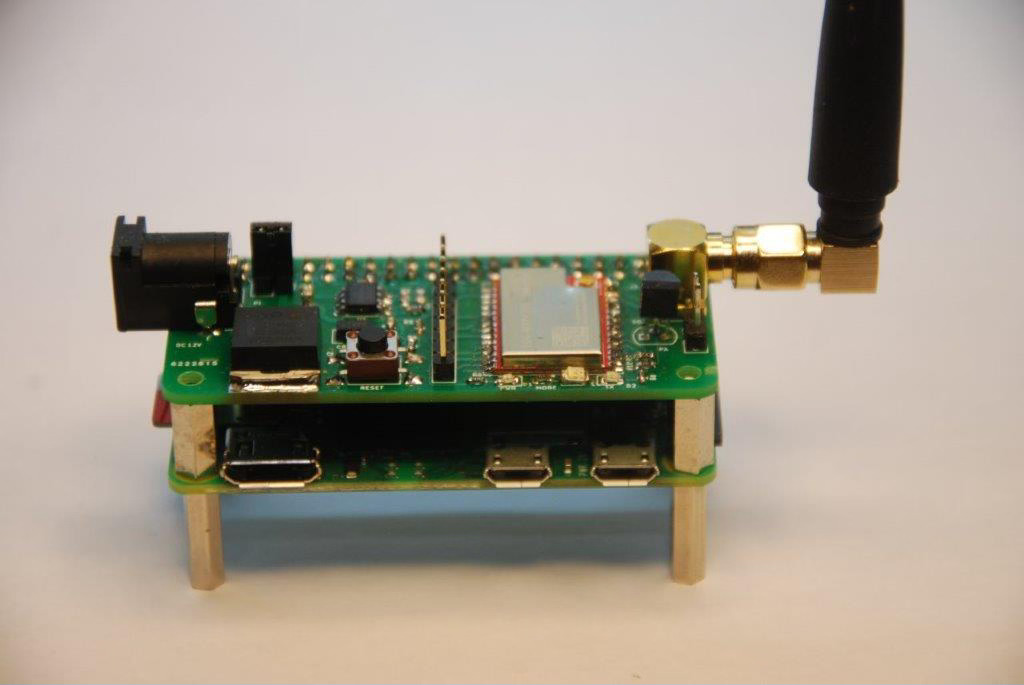
The IP400 Network Project is excited to reveal “Ichiban” (Japanese for “First One”).
Details of IP400 Ichiban
IP400 Ichiban is a Raspberry Pi HAT in a form factor to match Raspberry Pi Zero 2 W (as shown).
The unit in the photo above is a working unit (one of a pair) running (released) IP400 Software version 1.0. Testing has been done over the air.
The IP400 Ichiban unit in the above photo is a near-production unit and was assembled by hand. Production units will incorporate some minor hardware revisions and be assembled with automated production systems.
Technical details:
Input power: 2.1mm barrel connector, 12 volts DC @ 1.5 A (Ichiban supplies power to itself and the attached Raspberry Pi Zero 2 W).
Radio Frequency (RF) Power Output: (400 MHz Transceiver Module) - 100 mW (20 dBm).
Estimated Range: 2 miles (assuming reasonable antenna; antenna shown is for bench testing).
Frequency Range: 420-450 MHz (Amateur Radio 70cm band).
Modulation Method: 2FSK or 4FSK.
Channel Size / Bandwidth: (Default) 50 kHz (+ / - 25 kHz of user-specified frequency).
Symbol Rate: (Default) 50 kilosymbols per Second (using 100 kbps data rate).
Over The Air Data Rate: (Default) 100 kbps data rate.
Data Input / Output: Wi-Fi (Likely will support MicroUSB to Ethernet adapter, but has not yet been tested).
User Interface: SSH from host computer to RPi, then Minicom (terminal application) running on the Raspberry Pi to connect to IP400 Ichiban via serial interface.
Radio Chipset / Module: STMicroelectronics STM32WL33. Two variants are currently used in the initial 25 units of IP400 Ichiban:
Ebyte E04 module uses a 32 pin version - slightly lower transmit power
400 MHz Transceiver Module uses a 48 pin version - 100 mW / 20 dBm transmit power. It is highly likely that this module will be used in “full production” IP400 Ichiban units.
Because of minor incompatibilities between the two modules, as of IP400 software version 1.0, each module requires different software versions.
Additional technical details can be found on the Pi Zero HAT page.
For available settings, see the document: IP400 Node Software document:
Digital Radio Projects
IP400 Node Software
Document Number: IP400-MCU
Revision: 1.0
(or later revision)
Applications
Version 1.0 software for IP400 Ichiban includes:
- Automatic beacon
- Basic chat application
- Viewing adjacent stations (beacons heard)
These basic (diagnostic) applications are intended to test out the basic functionality of IP400 Ichiban and communications between two or more units over the air. Additional applications will rapidly be developed and integrated now that hardware development of IP400 Ichiban is complete.
Legal for development, testing, and use in US
Note that Ichiban Channel Size / Bandwidth and Symbol Rate can be specified to be operated within current (2025-05) US FCC Part 97 Amateur Radio Regulations for the 420-450 MHz band:
- Channel Size / Bandwidth: Maximum 100 kHz
- Symbol Rate: Maximum 56,000 Symbols per Second
Thus the urgency of seeking a FCC Special Temporary Authority or FCC Part 5 Experimental license to conduct testing and development of IP400 in the US is reduced. To test IP400 at its highest performance levels, absent US Amateur Radio regulatory changes, will require an STA or Part 5 license.
Public Demonstration at Hamvention 2025
The first in-person public demonstration of the IP400 Network System, with two functional IP400 Ichiban units, will be at Hamvention 2025 in Xenia, Ohio, USA - May 16-18, 2025.
The IP400 Network Project is grateful for the MMDVM Project to share their booth space to display and demonstrate IP400 Ichiban and discuss the IP400 Network Project. Steve Stroh N8GNJ will be demonstrating IP400 at Hamvention 2025 in Booth 2805 in Building 2 / TESLA.
Availability of development units
An initial production run of 25 IP400 Ichiban units, paired with Raspberry Pi Zero 2 Ws, with the latest software on a MicroSD card, are in production in May, 2025. These initial 25 units are expected to be available 2025-06-01.
- The initial 25 units will be made available only to IP400 developers.
- The initial 25 units will be supplied in pairs (minimum). This will enable developers to conduct end-to-end development and testing over the air.
- Those receiving the initial 25 units are expected to be largely self sufficient developers. IP400 software version 1.0 is not a completed, polished product suitable for end users.
To “get in queue” for the initial 25 units, please see the IP400 Order Form.
Availability of production units
An exact date of full production of IP400 Ichiban to commence is complicated by tariff issues between Canada, China, and US dramatically affecting small scale manufacturers such as the IP400 Network Project. Production quantities of IP400 Ichiban are projected to be available “Summer 2025” as previously stated.
IP400 Ichiban is expected to be available in several variations including a bare printed circuit board (PCB), a partially assembled printed circuit board (all surface mount - SMT components installed), and a fully assembled and tested unit.
For details see the IP400 Order Form.
A study of fulfillment options for IP400 Ichiban is still in development, including the possibility of using the services of a major fulfillment vendor. Using a major fulfillment vendor would reduce the complexity of a supplying IP400 Ichiban units to Amateur Radio Operators around the world.
Support
The IP400 email list - https://groups.io/g/ip400 will be used for:
- Selecting developers for the initial 25 units.
- Supporting developers that receive the initial 25 units.
- Reporting results of initial testing of developmental software.
- Discussion of needed features.
Future / Next Steps
Remote Power Connector
To maximize range from the 100 mW transmit power of IP400 Ichiban, the Remote Power Connector allows remote operation of IP400 Ichiban using typical Ethernet cable. For example, mounting IP400 Ichiban on an antenna pole near a 70cm antenna.
Grant Requested for further development, including 25 watt power amplifier
A grant proposal for further development of the IP400 Network Project hardware and technology has been submitted to Amateur Radio Digital Communications (ARDC). As of this announcement (2025-05-02), the IP400 Network Project is awaiting ARDC’s decision.
If the ARDC grant is received, one of the first projects undertaken with grant funds will be development of a transmit power amplifier suitable for use with IP400 Ichiban. This amplifier’s design goals include fast on/off switching speed, power output of 25 watts, low cost, and full compatibility with IP400 Ichiban.
Suggested labeling for experimental use of IP400 Ichiban
To operate a new, experimental radio system such as IP400 Ichiban with capabilities controlled by software that is changeable by the user, a notification label such as the following may be necessary… or just prudent.
This IP400 Ichiban radio system is operated by (insert Amateur Radio callsign).
This IP400 Ichiban radio system is intended for operation only within the Amateur Radio 70cm band of various countries.
This IP400 Ichiban radio system is intended to be operated only Amateur Radio licensees whose licenses permit them to transmit within the Amateur Radio 70cm band of their country.
This IP400 Ichiban radio system is constructed to good engineering standards, but proper operation and adherence to a specific country’s Amateur Radio regulations must be determined and confirmed by the individual Amateur Radio Operator.
This IP400 Ichiban radio system’s capabilities is changeable in software. Please consult each software version’s documentation for specific capabilities.
All technical details of this IP400 Ichiban system are publicly documented at:
https://github.com/adrcs/ip400
The IP400 Network Project team, and its sponsoring organization - Alberta Digital Radio Communications Society, and the developers of IP400 look forward to commencing full production of IP400 Ichiban to get IP400 technology into the hands of Amateur Radio Operators worldwide. Doing so will, we believe, create the Amateur Radio Data Communications Revolution of the 21st Century!
Zero Retries Digital Conference 2025 Update 2025-05-02
Zero Retries Digital Conference 2025 Call For Papers
Technical papers are sought for the in-person inaugural Zero Retries Digital Conference (ZRDC). ZRDC 2025 will be held at the Edward D. Hansen Conference Center in Everett, Washington, USA on Saturday September 13, 2025. The ZRDC is being hosted by the Zero Retries newsletter. Papers submitted for ZRDC 2025 will be published in the Conference Proceedings of ZRDC 2025. Authors do not need to participate in the conference to have their papers included in the Proceedings, nor must presenters submit a paper for the Proceedings.
The submission deadline for papers to be included in Conference Proceedings of ZRDC 2025 is August 11, 2025. Papers must be submitted via email to zrdc.papers@gmail.com in .PDF format. The manager of Conference Proceedings of ZRDC 2025 is Don Rotolo N2IRZ.
Accepted papers will be compiled into the Conference Proceedings of ZRDC 2025, but otherwise published exactly as submitted, and authors will retain all rights. Those wanting a printed copy of Conference Proceedings of ZRDC 2025 can create their own at Lulu (https://www.lulu.com/) and other print on demand vendors.
In this inaugural ZRDC, as a single day, single track conference, there are limited presentation slots. Thus paper authors that attend ZRDC 2025 cannot be guaranteed a presentation slot. If a submitted paper is accepted, but a presentation slot is not available, paper authors are encouraged to create a prerecorded video prior to ZRDC 2025. Links to such videos will be made available at ZRDC 2025 and considered for inclusion in the post-conference video collection.
To request a presentation slot at ZRDC 2025, please contact ZRDC Conference Manager Tina Stroh KD7WSF via email - tina@zeroretries.net, with “Paper Presenter” in the subject line.
Paper and presentation topic areas include, but are not limited to Open Source projects in Amateur Radio, radio networking, Software Defined Radio (SDR), digital voice/data systems, Packet Radio, digital satellite communication, digital signal processing (DSP), HF digital modes, Spectrum Management, “new” modulation and channel access systems such as Orthogonal Frequency Division Multiplexing (OFDM), Spread Spectrum, Time Division Multiple Access (TDMA), Global Navigation Satellite Systems (GNSS, aka GPS), Automatic Packet Reporting System (APRS), Linux in Amateur Radio, AX.25 and other protocols, mesh and peer-to-peer wireless networking, microwave communications, Internet interoperability such as 44Net, emergency and homeland defense backup digital communications in Amateur Radio. Papers on potential Amateur Radio regulatory reform and Amateur Radio in the 21st century are also encouraged. Papers do not have to include Amateur Radio to be considered, but should relate to radio technology in a “reasonably adjacent” subject area such as LoRa, or Software Defined Receivers, 802.11ah / Wi-Fi HaLow, or innovative commercial radio technology that could be applied to Amateur Radio.
Zero Retries Digital Conference is an annual in-person technology conference first held in 2025 in Everett, Washington, USA. ZRDC is an outgrowth of Zero Retries, an independent newsletter promoting technological innovation in and adjacent to Amateur Radio, and Amateur Radio as (literally) a license to experiment with and learn about radio technology. More information on Zero Retries is at https://www.zeroretries.org.
The latest information on ZRDC 2025 is maintained at https://www.zeroretries.org/p/conference, or just click the Conference link on the top bar of the Zero Retries web page.
There is a one-page PDF document of this article available for download on the Conference page.
# # #
Announcing the Zero Retries Digital Conference (ZRDC) Email List
Speaking of Zero Retries community, if you would like to stay abreast of the latest developments regarding the Zero Retries Digital Conference, you can join the ZRDC email list - https://groups.io/g/zrdc. This is intended as a low volume forum for announcements relating to ZRDC, discussion between attendees, ideas for presentations or demonstrations, feedback to the organizers, etc.
LinuxFest Northwest 2025
By Steve Stroh N8GNJ
LinuxFest Northwest (LFNW) 2025 was a lot of fun. Kudos to the organizers for bringing LFNW back to life and returning it to Bellingham Technical College.
The exhibit area featured several organizations that I learned more about:
- A local computer recycling organization that needed additional volunteers.
- The Raspberry Pi Club that meets weekly at Bellingham Technical College (but open to the public).
- System 76 showing off one of their new cases / systems that they “mostly” manufacture in the US. They also had some cool mechanical switch keyboards.
I only attended a few presentations, but three of them really stood out as stellar presentations:
- Project Caua: Start your own business, be your own boss by John “maddog” Hall. This is a fascinating idea for pico businesses with no capital requirements.
- In the Beginning.... also by John “maddog” Hall. This was a fascinating retrospective of Hall’s unique career and how formative he was in the rise of Linux.
- Spectrum Analysis by Isaac Konikoff KD7FKL. This was a great overview of various spectrum analysis systems and he brought a number of them. KD7FKL demonstrated a few of them, and then allowed the audience to get some hands-on time with them. It was very well received by the attendees.
One of the high points for me was an attendee spotting the logo on my Zero Retries shirt and complimenting me on my presentation last year. I said that I didn’t think my talk had made much of an impression, and he said “Well, you maxed out the room with more people wanting to attend than there were seats.” That was a good point, so next year I’ll apply to do another presentation on Amateur Radio as the original open source technology, and a survey of the many Zero Retries Interesting projects that are open source. By next April I’ll be more up to speed on GNU Radio (probably even on Linux), and I’ll be able to give a good demonstration of IP400.
I encountered another Zero Retries reader who was complimentary about ZR. We had a few minutes waiting for the Spectrum Analysis presentation to begin, so I got bold and asked “what can I be doing better in Zero Retries?” He replied “make more time in my day so I can read all of it”. That triggered an idea - see next item.
But the most Zero Retries Interesting aspect of LinuxFest Northwest was that it was a sunny day and walking between two buildings through a nice courtyard I was daydreaming that the courtyard would be a good place to do a small demo of Amateur Radio. I was thinking that next year, I’ll have and be familiar with my zBitx “Linux-driven” HF radio. Seconds later…
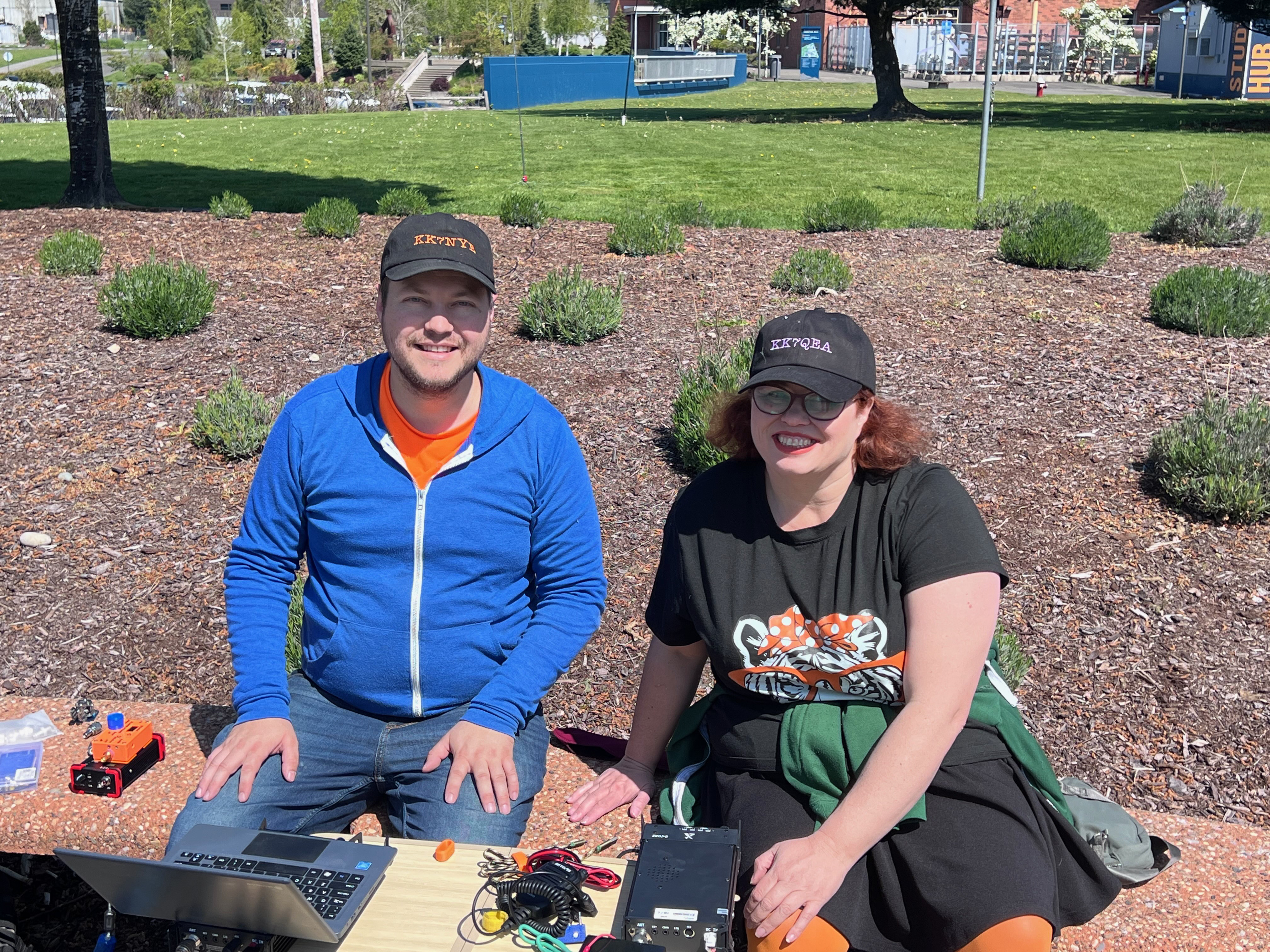
I encountered Kelly Simer KK7QEA and Chad Hirsch KK7NYE both working HF, “activating” LFNW 2025. It was really cool to meet them and talk to them. KK7QEA was working SSB voice contacts, and KK7NYE was working FT8. Both of them are from Henderson, Nevada and came to Bellingham to attend LFNW. Their “activation” got a lot of attention and interest from the LFNW attendees. I’m sorry that I didn’t get their contact information to stay in touch with them, though KK7QEA may be a Zero Retries subscriber by now.
What wowed me was their simple expedient of showing Amateur Radio in action rather than “talking up” Amateur Radio in a presentation like I did at LFNW 2024. They were both young, techie, obviously having fun, learning the vagaries of Amateur Radio… and sitting in the warm sunshine enjoying the day and talking to lots of folks.
Thus I think that I will attempt to do a “Zero Retries Interesting” Amateur Radio exhibit table, as well as doing a presentation at LinuxFest Northwest 2026 .
Thank you Kelly and Chad, and Kudos!
ZR > BEACON
By Steve Stroh N8GNJ
Short mentions of Zero Retries Interesting items.
The Communicator May / June 2025 Issue
Surrey Amateur Radio Communications newsletterzine - the May / June 2025 issue of The Communicator is now available for download or reading online. This issue is 124 pages… wow.
This was an interesting development:
Thanks to Blake VA7BWG and Reg VA7ZEB, we now have a comprehensive on-line searchable index of all issues back to 2007 by subject, author, or issue at:
https://search.communicator.ve7sar.net/
The article of how that service came to be is a good read all in itself An Index for The Communicator - pages 7 - 11.
I’m grateful that my contribution to The Communicator was noted in Editor John Schouten VE7TI’s QSK? editorial:
We welcome another contributor to The Communicator. Steve Stroh N8GNJ makes his debut on page 82. Steve hosts the popular and informative Zero Retries site. His articles reflect the true spirit of our hobby as an avenue for experimentation and development.
My first column in The Communicator - An Introduction to the IP400 Network Project is on pages 82 - 84 in the May / June 2025 issue of The Communicator.
# # #
T-Mobile Starlink Beta About to Commence
Email from T-Mobile:
Demand is high, and we’re adding thousands of people to T‑Mobile Starlink beta every day. We know you’re eager to try out satellite-powered messaging. Rest assured your place in line is secure, and right now there’s nothing you need to do.
When we’re ready for you, you’ll receive a welcome text to let you know you’ve been admitted into beta.Once you’re in the beta, here’s what to expect
The first time you enter satellite coverage you will receive a text confirmation.From then on, whenever you are out of reach from your land-based tower signals, your phone will automatically connect to T‑Mobile Starlink. It just works!You’ll be able to send and receive messages and share your location. That’s just the start. Up next after launch—share photos, use data, and more.
I’m a postpaid (direct, not MVNO) customer of T-Mobile and I signed up for the T-Mobile Starlink Beta out of curiosity. I don’t expect to be able to use it in the near future as we have pretty good mobile network coverage (including failover to other carriers) here in the Pacific Northwest. But during our trip cross country in 2022, I was shocked at the number of places on interstate highways in the Western US where there was no T-Mobile coverage (or failover, apparently).
Note that this service is very different than Apple’s satellite coverage, which relies on Globalstar satellites and an iPhone 14 or later which incorporates a satellite radio. The T-Mobile Starlink service can be used by any (currently, those signed up for the beta test) T-Mobile customer that has a reasonably modern mobile phone.
Tangentially related… I haven’t yet seen this personally, but I’m certain that mobile carrier microcells are being deployed all over the US (and the world) using Starlink as inexpensive backhaul. You no longer have to use microwave or fiber for a low-latency backhaul connection. You could easily assemble such a system with a Starlink terminal, microcell, and solar power system for a completely standalone, off grid, inexpensive system. For example, placing such a unit at a rest stop in a rural area that otherwise would have no mobile network coverage.
Or, on the next cross country car trip, I might just opt for the more reliable expedient of a Starlink Mini secured to the car roof with a magnetic mounting system for continuous broadband coverage nearly anywhere in North America (doesn’t work as well in dense urban areas).
# # #
Being an Amateur Without Either Radio or Antenna
Onno Benschop VK6FLAB on his podcast:
Have you ever considered tuning to a WebSDR, using it to pick a signal and using your computer to decode that signal? I'm aware that some sites provide a range of in-built decoders, but that doesn't cover the wide spectrum of modes that amateur radio represents, let alone the modes that are not specific to our hobby.
As I've said previously, many of the modes in use today are essentially the width of an audio stream. This means that if you tune a WebSDR to a frequency the audio comes out of your computer speakers. If that's voice, your job is done and you can hear what's going on. If it's something else, then you're going to have to find a way to decode this to get the message.
…
So, no antenna, no transmitter, no problem, still an amateur!
This “Amateur Radio over Internet” model extends not just to using a shared Amateur Radio club station, but shared Amateur Radio stations in situations such as high rise apartment buildings, retirement communities where the club station is at the community clubhouse building, etc.
There’s also the use case of accessing Amateur Radio repeaters (and non-repeater talk groups) via Internet that is explained so well every week by Tom Salzer KJ7T in his excellent Random Wire newsletter. For example, in this week’s issue, KJ7T mentions Extended Freedom Network, which I’d never heard of. Every issue of Random Wire includes Zero Retries Interesting content and thus recommended!
# # #
uConsole and RTL-SDR/LoRa/GPS/RTC USB Hub
Eric Grumling K0JEG via email:
The RTL-SDR/LoRa/GPS/RTC/USB Hub All-In-One Extension Board from HackerGadgets is a very Zero Retries Interesting add-on board for the Clockwork Pi uConsole. The uConsole is a RPI CM based handheld computer that was originally designed for game emulators but also has found use as a portable SDR, Meshtastic node and other experimental use. It looks like a big Blackberry Bold but more steampunk.
Also note they’re saying the RT820T2 chip is EOL, that’s not good news, but also that there’s a replacement part.
The uConsole is a sexy unit - I certainly see the attraction of using it with applications such as Meshtastic (though my big fingers would have a hard time with those tiny keys). Integrating an RTL-SDR (Software Defined Receiver), LoRa, and GPS makes it an even more powerful tool.
# # #
USB Tuning Knob for Software Defined Radio
Todd Carney K7TFC on his Mostly DIY RF blog:
A radio without a knob is like a cart without a wheel. Our TV remotes might lack them, and the dial telephone is now a museum piece, but nothing can match the thrill of making things happen by turning a knob. Okay, maybe that’s an exaggeration, but tuning a radio without a knob isn’t very pleasant, and a mouse-scroll wheel is a poor substitute. So to provide that sexy knob feel we’ve come to expect, MDRF is develop-ing a USB knob device that emulates the scroll wheel on a computer mouse.
All the software packages such as Quisk, SDR++, and others, respond to the scroll wheel by tuning the rig, up or down, by whatever increment is set by the software. So the MDRF USB Knob does the same thing, and it works side-by-side with your regular mouse. Additionally, it provides three user-programmable buttons to control other SDR-software functions. Most of the programs have keyboard shortcuts, and these can be assigned to the buttons of the USB Knob. This includes key combinations that are used–on a keyboard–with the Alt, Ctrl, or Shift keys.
Pete Juliano, N6QW, has been testing an alpha version of the USB Knob that does not include the buttons. You can see his demonstration video here: