Zero Retries 0195
2025-03-28 — IP400 Software v1.0 Released, Write for The SARC Communicatord, Excerpts from ARDC 2024 Annual Report, TIDRADIO H3 5W Multi Band Portable Radio
Zero Retries is an independent newsletter promoting technological innovation that is occurring in Amateur Radio, and Amateur Radio as (literally) a license to experiment with and learn about radio technology. Radios are computers - with antennas! Now in its fourth year of publication, with 2600+ subscribers.
About Zero Retries
Steve Stroh N8GNJ, Editor
Web version of this issue - https://www.zeroretries.org/p/zero-retries-0195
In this issue:
Comments for This Issue (redirect to Comments page)
Request To Send
Commentary by Editor Steve Stroh N8GNJ
Paid Subscribers Update
My thanks to Joe Hamelin W7COM for upgrading from an annual paid subscriber to Zero Retries to a Founding Member Subscriber this past week!
Founding members are listed in every issue of Zero Retries!
My thanks to Prefers to Remain Anonymous 69 for upgrading from a free subscriber to Zero Retries to an Annual Paid Subscriber this past week!
Financial support from Zero Retries readers is a significant vote of support for the continued publication of Zero Retries.
# # #
Gratitude for Paid Subscriptions
This week I read a news article this morning about how the contracting US economy and continuing inflation is impacting almost everyone’s income and basic costs of living.
After reading that article, I received two new paid subscriptions this week. Thus I’m grateful that so many folks, mostly Amateur Radio Operators, choose to support Zero Retries financially. I’m grateful for the revenue (which offsets expenses, and paid for some of our recent trip to HamSCI 2025 in Newark, New Jersey, USA).
So, Thank You, paid subscribers, for the financial votes of confidence in Zero Retries!
# # #
New Comments Record in Zero Retries 0194
We had a good time exchanging comments on the content of Zero Retries 0194 last weekend.
# # #
Updated Events Page
I’ve updated Zero Retries Interesting events for the first half of 2025 on the Zero Retries Guide to Zero Retries Interesting Events page (linked from the Zero Retries Guides top line menu item at www.zeroretries.org).
The upcoming events for me in 2025-1H are:
🚗 LinuxFest Northwest 2025
2025-04-25 thru 27 in Bellingham, Washington, USA
🚗 Hamvention 2025
2025-05-16 thru 18 in Xenia, Ohio, USA
🚗 SEA-PAC 2025
2024-05-30 and 31 and 06-01 in Seaside, Oregon, USA
2025 has been, and will continue to be a busy Zero Retries Interesting year in our household. Between conference travel, lots of planned development work in N8GNJ Labs (in addition to helping development of the IP400 Network Project), participating in organizing GRCon 2025, and culminating with travel to Pacificon 2025 in October (we greatly enjoyed attending Pacificon 2024).
There is also a stealth project actively in development which will be a lot of fun, but a lot of work, which I can hopefully reveal next week.
# # #
Have a great weekend, all of you co-conspirators in Zero Retries Interesting Amateur Radio activities!
Steve N8GNJ
IP400 Software v1.0 Released
By Martin Alcock VE6VH
The IP400 Development team is pleased to announce the release of the production software, now at version 1.0. This release supports an SPI connection between a Raspberry Pi and the Nucleo CC2 experimenter module, and also contains software for the Pi to enable exchanges with the node over an Ethernet UDP connection. The code is available at the ADRCS GitHub site, https://github.com/adrcs/ip400.
Full release notes can be found in the Node software description document. Further announcements will be made in the ensuing weeks.
Editor’s Note:
This is a huge achievement for the IP400 Network Project in its primary goal to release working IP400 Meshnode hardware for individual users in “mid 2025” to learn and experiment with IP400. I can attest that VE6VH has been “burning the candle at both ends” for the past several months on this project and the hardware development is proceeding apace with the software development.
Kudos Martin!
Write for The SARC Communicator
By Steve Stroh N8GNJ
In this era, to have any significant impact with the current generation, Amateur Radio content needs to be freely available. This is especially critical for Amateur Radio to attract and inform potential new Amateur Radio Operators. Amateur Radio content that is hidden behind paywalls is invisible, and effectively irrelevant in this era.
I’m of the “printed magazines” era. I learned a lot from Popular Electronics, Byte, and more other magazines than I can count. And only a few of them were free (controlled circulation, fully supported by ads). In short, I love magazines and they (were) my favorite form of self education. Given the value I received in self-education, I had no problem paying for magazine subscriptions. (At one point in my early career, with far more income than expenses, and virtually no distractions from intensive reading and study, I subscribed to more than 50 monthly magazines. That’s a longer story for some point in the future.)
Thus it took me quite a while to understand this era’s requirement (no longer merely a preference) for free content. One factor is a lot of younger, curious techies just don’t have the budget to afford subscription fees for magazines. For another, because of the Internet and now good translation, younger, curious techies anywhere in the world can access good content - as long as it’s not hidden behind a paywall.
In the years since I’ve been publishing Zero Retries, I’ve been asked several times to write for publications that are paid circulation only - what I would write is a work for hire, owned by the organization, and thus my writing wouldn’t be accessible to anyone who doesn’t pay the subscription fee1. I just learned of a notable exception to this - The Spectrum Monitor (TSM). While TSM is paid subscription only, the subscription fee is reasonable, with reasonable fees for back issues. TSM is interesting enough (and has interesting enough authors) that I’m now a paid subscriber. Another interesting factor of TSM is that writers for TSM are free to republish their material after it has been published in TSM. Thus I might consider submitting material to TSM, knowing that I can republish it in the open after it’s appeared in TSM.
Other than exceptions like TSM, I’ve become a rabid advocate of free and open content for Amateur Radio (including publishing everything in Zero Retries in the open). I credit much of this perspective from my time involved with Amateur Radio Digital Communications (ARDC) and their requirement that work resulting from their grants be made freely available.2
For example, I have previously referred curious potential Amateur Radio Operators to the archives of 73 Magazine in Digital Library of Amateur Radio & Communications because they could read all 43 years of 73 for free.
But as much fondness as I have for 73, having ceased publication in 2003, it’s not exactly contemporary. But fortunately, there is a publication that is contemporary, and free. The best such free and open content I know of, for a general audience in Amateur Radio is Surrey (British Columbia, Canada) Amateur Radio Communications bimonthly newsletter The Communicator. I call it a newsletterzine because it runs longer than 100 pages, thus definitely not your average Amateur Radio club’s newsletter.
The overall design of The Communicator is very well done - it reads and “feels” like a magazine with two columns, lots of photos and graphics and pleasing layout, consistent fonts, etc. Kudos to Editor John Schouten VE7TI. SARC even cleverly offers The Communicator as an online magazine if you’re viewing on a desktop / laptop / tablet by using the Calaméo platform - see the March - April 2025 issue via Calaméo.
One primary reason I like The Communicator is that it regularly includes Zero Retries Interesting content. The current issue includes articles on Amateur Radio Television (ATV), Amateur Radio satellite operation, experimentation, microwave operation, but no regular (that I recall) coverage of data communications in Amateur Radio. Hmmm…
A lot of writers I respect and enjoy reading are now regular contributors to The Communicator. I plan to join them in writing for The Communicator because some of the topics I write about in Zero Retries would benefit from wider exposure to a general Amateur Radio audience, such as the IP400 Network Project, the M17 Project, MMDVM-TNC, and others.
Thus I invite Zero Retries readers and potential writers of all general interest topics in Amateur Radio - construction, operating, clubs, etc. to consider also writing for The Communicator. The contact information for The Communicator is on the first “inside” page. Amateur Radio really needs a free, good, and interesting general interest publication like The Communicator. Please spread the word!
ZR > BEACON
By Steve Stroh N8GNJ
Short mentions of Zero Retries Interesting items.
Last Few VE7DXW RF Seismograph Boards Available
For background, see https://www.qsl.net/rf-seismograph/
From Phil Moscinski N2EU via email:
As you know, our mutual acquaintance Alex Schwarz VE7DXW became a Silent Key in June, 2024.
I have five (perhaps the last five) of Alex’s LIF2016 boards left. I’m asking $50 each, plus shipping. The proceeds will go to Alex’s wife Claire.
Alex’s website of his RF Seismograph research, and the details on the boards and downloads are at https://www.qsl.net/rf-seismograph/.
To purchase one of these boards, please email me - pmoscinski@gmail.com.
# # #
Excerpts from ARDC 2024 Annual Report
- A full description of all ARDC grants awarded in 2024.
- In 2025 the ARDC Tech Team will be focusing on the following efforts:
Release the VPN PoP project. This service will provide access to 44Net resources via Wireguard. Work is underway to integrate it with the Portal in time for a wider beta release by the end of the year. - Unveiling a report on from the first ARDC Grants Evaluations Team (GET).
I was very interested in seeing the complete list of all of the 2024 grants, particularly:
Deutscher Amateur-Radio-Club e. V. on behalf of Online Amateur Radio Community (OARC) & Localino
New Packet Radio Version 3.0 / Seeding UK and Ireland Usage
Expanding New Packet Radio capabilities in the UK and Ireland.
and
Multimode Digital Voice Modem (MMDVM)
Multimode Digital Voice Modem (MMDVM) Project
Continue full-time development of its open-source digital voice modem, which supports multiple amateur radio modes.
# # #
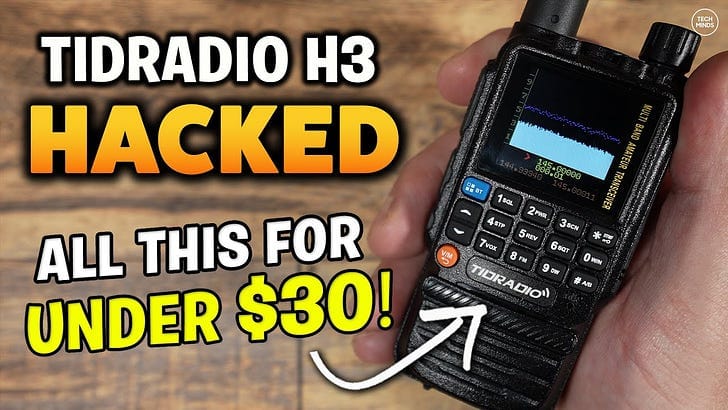
TIDRADIO H3 5W Multi Band Portable Radio
This radio was mentioned favorably in the comments of a previous issue, and it seems a remarkable value for $31, including a larger color display, USB-C interface for programming and charging, and Bluetooth.
The web page says “support open source” and thus I think this is one of the portable radios where alternative (the reference to open source?) firmware has been developed. A quick web search didn’t find any references other than Amazon and the company website.
Post Publication Update 2025-03-29
The Zero Retries readers came through spectacularly on my “no references found for third party software” plaint.
Nicsure alternative firmware for the TIDRADIO H3 - https://nicsure.co.uk/
Nicsure alternative firmware v1 and v2 - https://nicsure.co.uk/h3/nightly.php
Nicsure Manual version 2.0 - V2 Manual: https://github.com/nicsure/nicfw2docs/blob/main/TIDRADIO%20TD-H3%20User%20Manual%20for%20nicFW%20V2.pdf
Nicsure Github repository - https://github.com/nicsure
Nicsure YouTube channel - https://www.youtube.com/@nicsure
Tech Minds video on this radio -