Zero Retries 0188
2025-02-07 — New Kenwood TM-D750A, The Coming 21st Century AR Networking Revolution, Reality Check on FCC Regs for AR VHF / UHF, Updated IP400 RPi HAT, RadioMail 1.5, LiNK500 TNC, RepeaterSTART App
Zero Retries is an independent newsletter promoting technological innovation that is occurring in Amateur Radio, and Amateur Radio as (literally) a license to experiment with and learn about radio technology. Radios are computers - with antennas! Now in its fourth year of publication, with 2400+ subscribers.
About Zero Retries
Steve Stroh N8GNJ, Editor
Web version of this issue - https://www.zeroretries.org/p/zero-retries-0188
In this issue:
Reality Check on Updating FCC Regulations for Amateur Radio VHF / UHF
Comments for This Issue (redirect to Comments page)
Request To Send
Commentary by Editor Steve Stroh N8GNJ
A Delightful Hour Spent
The ZR > BEACON articles in this issue about RadioMail 1.5 and the mention in that announcement about the DIY599 LiNK500 TNC resulted in a delightful hour spent chasing various links and learning more about the “near death and resurrection” of the Robust Packet mode. Robust Packet is pretty amazing - designed from scratch for the vagaries of the HF bands using a 500 Hz bandwidth, use of (audio) Orthogonal Frequency Division Multiplexing (OFDM), Forward Error Correction (FEC), 200 or 600 bps, etc. It was fun getting caught up that Robust Packet is actively being developed and used.
Re-implementing Robust Packet is just one example that there is so much technological innovation going on, that we just (almost) don’t hear about. Robust Packet and the LiNK500 is yet another great example that computing power combined with new software is enabling things that in previous eras just was not possible to do. Now such things are practically routine (but, it’s still… radio… you know).
My congrats and kudos to Georges Auberger WH6AZ of Island Magic Co. for the excellent RadioMail app, and Oliver Harms DL4KA of DiY599 for the very interesting LiNK500 modem.
- - -
The Firehose (as in Attempting to Drink From) - dPMR (Digital Private Mobile Radio)
I think “Zero Retries Firehose Edition” will be the name of a periodic issue of Zero Retries of Zero Retries Interesting things I’ve found and want to share out, but just cannot fit into a story, or even a brief mention in the ZR > BEACON section. Just terse mentions, lots of them, with one sentence descriptions. Amateur Radio Daily calls its version of this idea Overdrive.
In this case, in doing a bit of web searching for mentions of Robust Packet, I found Wavecom Elektronik AG’s list of Advanced Protocols (that they offer “decoders” for).
One item was dPMR - Digital Private Mobile Radio. I hadn’t heard of (that I recall) dPMR, so did a quick web search, found the Wikipedia Digital private mobile radio article, and whee… there went yet another thirty minutes of delightful reading. A few (?) interesting things that leaped out at me about dPMR:
- Open, non-proprietary standard that was developed by the European Telecommunications Standards Institute (ETSI)
- Access method: FDMA
- Transmission rate: 4,800 bit/s
- Modulation: four-level FSK
- Digital voice
- 6.25 kHz channel, with a tight emission mask specified that you can use adjacent 6.25 kHz channels.
- License-free products for use in the 446.0–446.2 MHz band within Europe.
- dPMR446 equipment is capable of voice, data and voice+data modes of operation.
- Provisions for simplex (peer to peer), repeater, or trunked repeater operation.
- Implemented commercially - Icom IDAS, Kenwood NEXEDGE, Midland D-series.
Apparently dPMR dates back to the early 2000s, so by now it’s a mature standard. Thus I’m sure there are software-only implementations of dPMR by now for Software Defined Transceivers. When I have time… 🤣 I’d like to dive in a bit deeper into dPMR to see how well the data capability is implemented. By now there’s room for improvement / evolution of dPMR potentially used in Amateur Radio - replacement of the AMBE CODEC with (potentially) Codec 2, implement Forward Error Correction, etc. But that’s mainly for curiosity - we have M17 now, designed by Amateur Radio for Amateur Radio (with callsigns!) and it already uses Codec 2 and does data.
So many interesting data modes, so little time…
- - -
First Bellingham Snowmageddon 2025
Our first snowmageddon of 2025 in Bellingham arrived as predicted by the weather oracle (the weather app on our mobile phones). The barely sub-freezing temps are allowing the snow to hang around for a week or so, but not impact mobility. N8GNJ Labs was snowed in for a day because trying to shovel out a drift in front of the door, during the Canadian wind gusts, would have been a fool’s errand. But the most fun of the snowfall was seeing our two kittencats see snow falling for the very first time. I sent a photo of one of them looking back at us from their window bed, and the caption I included when sharing that photo with family was “Dad… there’s something weird about the rain.”
- - -
Have a great weekend, all of you co-conspirators in Zero Retries Interesting Amateur Radio activities!
Steve N8GNJ
The Coming 21st Century Amateur Radio Networking Revolution
I posit that Amateur Radio is poised to experience the equivalent of the Packet Radio Revolution, but in the 21st century, with 21st century technology.
Portions of this article are repurposed from other writing I’ve been doing behind the scenes.
It’s understandable to be skeptical when imagining yet another new networking paradigm in Amateur Radio making a significant impact. Especially factoring in “now, we have the Internet”. But consider the impact that the relatively simple (in comparison to IP400) TAPR TNC-2 had on Amateur Radio beginning in the 1980s. It’s not overstating the impact to recall the catchphrase Join the Packet Radio Revolution! The development of the TNC-2 spawned a cottage industry of new packet radio products and entirely new hardware (and software) vendors. At a point, a very large portion of Amateur Radio Operators became involved in Packet Radio. New clubs were formed. Entire networks were deployed. BBS systems forwarded messages over VHF / UHF and HF. New systems continually evolved and new technologies such as 56k RF modems and Packet Radio satellites were developed. And all of that arose from the TNC-2.
In the 2020s, Amateur Radio can leverage so many technologies, as I’ve discussed here in Zero Retries. But no one, no project, no organization has attempted to take full advantage of all those technologies in combination… until the IP400 Network Project.
Just a few technologies and trends that will eventually be integrated into the IP400 Network Project:
Dynamic Peer to peer mesh networking Many have a dim view of Amateur Radio mesh networking because of past implementations operating at 1200 bps Audio Frequency Shift Keying (AFSK), the routers being TNC-2s or equivalent (slow 8-bit processors, 64 kB memory, radios being on the same frequency (halving the throughput with each hop), etc. In the 2020s, we can easily implement multiple radio links at each node, including user nodes, we can use much faster and more robust links, we have much more compute power at each node, we have inexpensive GPS receivers to implement a common time base and precise location of each node, etc. Best of all, we can implement, experiment, and iterate - it’s easy to load new software.
Higher speed radios Per Martin Alcock VE6VH, the minimum speed of IP400 will be 100 kbps, which will be “legal” for use in the US - fits within the 100 kHz maximum bandwidth and 56,000 symbols per second maximum on the 420-450 MHz band.
ka9q-radio all band receiver The days of having to be on the same frequency to communicate are nearly past. There’s some protocol work to be created, but it will soon be possible to put out a call, or the data equivalent, on any VHF / UHF frequency or repeater, and be instantly connected to the person / system you’re calling, because receiving on all frequencies, simultaneously, will become easy and inexpensive.
Better, more robust modulations IP400 will introduce Orthogonal Frequency Division Multiplexing (OFDM) into Amateur Radio in the radio domain - independent radio frequency subcarriers… not merely audio frequency subcarriers. OFDM will have very profound effects when fully implemented.
More usable protocols such as TCP/IP IP400 will be able to route TCP/IP packets (initially IPv4, but hopefully soon IPv6, the protocol of the present). That means most TCP/IP apps we use can be used over Amateur Radio - web servers and browsers, email servers and clients, likely even live video at some point (future, faster IP400 radios). Recall that AX.25 was created for the technologies that were usable and accessible to Amateur Radio 45 years ago. TCP/IP was in use when AX.25 was created… it just wasn’t quite feasible to use it, widely, quite then1.
Cheap, powerful computers It’s impossible to overstate how game-changing this development is. We tend not to notice the impact of powerful computers because our current applications are so limited from narrow bandwidths and low-speed data applications, so Amateur Radio applications are largely background or “used only when operating”. But a real data communications system requires a dedicated computer for routing, supporting the network, acting as a web server, email server, etc. Few of us would want to dedicate our primary “big” computer to such tasks 24x7, but a $120 Raspberry Pi 5 is fully capable and inexpensive for such use.
And if a general purpose computer / processor isn’t powerful enough, we have cheap (enough) power Field Programmable Gate Arrays (FPGAs).Cheap, powerful operating systems We take Linux for granted now, but back in the day when packet radio was invented, single-tasking DOS with up to 640 kB of RAM and floppy disk storage was pretty good. We even have Real Time Operating Systems (RTOS) available now for computing processes that must be deterministic rather than asynchronous.
Supporting technologies Interfacing is easy now - Ethernet, USB, Wi-Fi, Bluetooth, standardized I/O buses. We don’t need to invent such things to support better radios.
More powerful beaconing A powerful concept by Bryan Hoyer K7UDR called “Hailing Channel” is nearly lost to obscurity now, but fortunately his presentation at the Digital Communications Conference 2012 is preserved on YouTube. Basically, a station should periodically beacon out all of its capabilities - frequencies it can operate on, its speeds, whether it has an email server and can accept email, if it has a web server, if it hears other nodes, if it has emergency power, weather data, etc. Yes, that is a lot of information, but again, we have a fast data mode now, and multiple channels to use.
More capable repeaters Multi Mode Digital Voice Modem (MMDVM) allows repeaters to provide services to different digital voice and some data modes. That’s just an early taste of what’s possible. Involving high profile, full duplex repeaters to data modes… and linking repeaters via radio… is a truly powerful capability.
More powerful tools for collaboration We used to mail paper newsletters and floppy disks to distribute information and software. Now we have websites, email lists, Discord, and Github. We can share, collaborate, and propagate new software versions more easily than ever before.
Computer and network familiarity Information technology, hacking, software development is more widespread than ever; it’s easy conceivable that the majority of Amateur Radio Operators in a decade will be comfortable with these technologies.
A culture of experimenting and hacking Amateur Radio has always had a culture of experimenting and hacking, first on radios, and more recently on computers, and now on Software Defined Radio technology. Increasingly, Amateur Radio appeals to those who experiment and hack with computers. Amateur Radio is presented to them, the response is often “Wait… I can experiment, and hack… with radios? Cool!”.
Also no one, no project, no organization has attempted to leverage all of those technologies to involve… update… modernize Amateur Radio VHF / UHF repeaters for the 21st century by doing more than voice and incidental data communications.
Finally, no project or organization (other than AREDN) has been interesting enough to appeal to (currently non-licensed) techies to consider getting involved in Amateur Radio… until the IP400 Network Project. The intense interest and rapid expansion of Meshtastic networks is proof that there is significant interest by individuals in data networking over radio; the IP400 Network Project could entice techies into Amateur Radio as “Meshtastic on steroids”.
Thus, I posit that the IP400 Network Project can realistically be considered The 21st Century Amateur Radio Networking Revolution.
Reality Check on Updating FCC Regulations for Amateur Radio VHF / UHF
By Steve Stroh N8GNJ
I’ve been (mistaken, it turns out) thinking hoping that the FCC would update the Amateur Radio regulations to remove symbol rate and bandwidth limits from Amateur Radio VHF / UHF bands in 2025. I now understand that’s not going to happen without a significant new effort.
I’m indebted to “Deeply Sourced Prefers to Remain Anonymous - DSPTRA” for patiently walking me through a number of incorrect assumptions about the FCC’s various processes, in several rounds of extended emails. I think I have the “big picture” correct in my mind now.
The original Petition for Rulemaking filed by the ARRL in 2016, which became Docket 16-239 requested removal of symbol rates on the Amateur Radio HF bands. In concluding Docket 16-239 in its Report And Order And Further Notice Of Proposed Rulemaking dated 2023-11-13, the FCC removed the symbol rate limits as requested and implemented a 2.8 kHz bandwidth limit for data communications in the Amateur Radio HF bands. With that, Docket 16-239 is now complete. As in closed. As in no further action.
As a pro-forma, a courtesy, perhaps just curiosity, perhaps an oblique invitation to submit a new Petition for Rulemaking, or to get some a priori discussion of the topic on record… the FCC noted that the Amateur Radio VHF / UHF bands also had symbol rate limits and bandwidth limits. The FCC invited comments as to whether those should be changed, as had been done with the Amateur Radio HF bands.
There were a small number of comments filed, almost all of which were favorable to removing symbol rates and bandwidth limits from the Amateur Radio VHF / UHF bands. I think that the ARRL’s first and second comments were insightful and provided ample justification for removing symbol rates and bandwidth limits. ARDC also offered insightful comments favorable to removing symbol rates and bandwidth. I also offered my comments favorable to removing symbol rates and bandwidth.
My mistake in having some hope for further action on changes to the VHF / UHF bands was assuming that because the FCC asked for comments on changing symbol rates and bandwidth limits on the Amateur Radio VHF / UHF bands… that if the comments were favorable for making changes, that the FCC would act upon those comments. I simply did not understand the unwritten rules and processes of how the FCC operates.
But in these recent emails, DSPTRA explained to me, more than once, that Docket 16-239 was concluded, and that no further action by the FCC would be forthcoming as part of Docket 16-239.
Now I get that.
Next Steps to Remove Symbol Rate Limits and Bandwidth Limits from US VHF / UHF Bands
There are at least some Amateur Radio organizations that surely understood the real dynamics of this situation (request for comments did not imply any further action would be undertaken), but didn’t act on that knowledge, in the more than a year since the FCC’s request for comments, and comments being submitted.
Beyond those few that chose to reply to the FCC’s request for comments… candidly, I’m a bit stunned that I seem to be the only one with a real interest in… trying to see those favorable comments through to a the requested changes. It’s abundantly clear to me that removing (archaic, now irrelevant) symbol rate limits and (excessively restrictive) bandwidth limits is truly needed for Amateur Radio in the US to continue to innovate in radio technology and realize the full potential of our ability to experiment with data communications in our VHF / UHF bands.
Thus if we in US Amateur Radio want to see symbol rate limits and bandwidth limits changed (preferably, removed completely) from the Amateur Radio VHF / UHF bands, there will need to be a new Petition for Rulemaking filed with the FCC, requesting such changes and providing strong justification for doing so.
That’s not an insurmountable task… but it will take significant time and effort… and at least some (possibly significant) funding to get such a thing accepted at the FCC for realistic consideration.
In our email discussions, DSPTRA made a number of recommendations on how to make a stronger case (than I was originally considering) for such changes, and beyond the solid points made by us “remove symbol rate and bandwidth limits” commenters. I won’t go into those additional recommendations here as discussing them in public at this early stage would probably be counterproductive.
As for next steps now that I really understand the situation… I plan to do what I do, and start writing (my best guess of) a Petition for Rulemaking to remove symbol rate limits and bandwidth limits from the US Amateur Radio VHF / UHF bands. Once I have that completed, then I’ll try to figure out how to move to next steps.
One of the primary things in my Modernizing Amateur Radio in the 21st Century (working title) Petition for Rulemaking, I’ll point out is that no other country has such limits, and having no symbol rate limits or bandwidth limits have had no calamitous effects. Especially not to our friends to the North, Amateur Radio in Canada. I think it’s instructive this latest “let’s dream big” project for advancing Amateur Radio data communications in the 21st century - IP400, originated in Canada. Canada’s Amateur Radio regulations are such that “if they can work out a new Amateur Radio technology, they can make use of that technology. Ditto the creation of New Packet Radio in Europe.
Implications for IP400 Network Project Development in the US
Soberly, as I finally came to understand all of this, I discussed my conclusions with Martin Alcock VE6VH, the creator of the IP400 Network Project. I recommended to him that for there to be any deployment of IP400 in the US in 2025, on the 420-450 MHz band, just as New Packet Radio also found necessary for NPR systems to be legal to use at all in the US, IP400 will have to include a SAFAUSR (Silly Accommodation for Arcane US Regulations) mode.
VE6VH chuckled and said:
No problem! In my early development, I’m already achieving a 100 kbps data rate with 50,000 symbols / second with (2 bits per symbol) in a 50 kHz bandwidth.
He was, of course, amused by my suggested name for that mode.
Thus those of us in the US that want to have some fun with IP400 will be able to do so.
But in the longer term, for IP400 to succeed (it’s not being developed solely for use in Canada and the US), there will have to be some significant, widespread testing undertaken of its higher performance features, such as 500 kbps data, in real world usage (transmissions over the air).
For US users of IP400 to be able to test the “advanced modes” of IP400 (beyond SAFAUSR mode) in mid 2025 or so, I expect to (attempt to) file a request for an FCC Special Temporary Authority (STA), or a request for a Part 5 Experimental License. I’ve been told by two knowledgeable sources that either of those can be submitted by individuals. The experiments conducted under an STA or Part 5 license will be in support of an eventual Petition for Rulemaking, and that will be prominently mentioned in the applications for an STA or Part 5 license.
ZR > BEACON
By Steve Stroh N8GNJ
Short mentions of Zero Retries Interesting items.
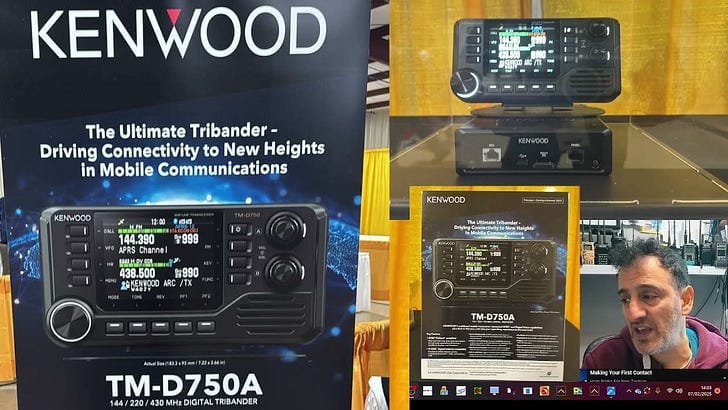
Breaking News - New Kenwood TM-D750A Mobile Radio Shown at Hamcation 2025
YouTube channel HAMTech RADIO SCANNER M0FXB CB DRONE HOBBY Diary seems to have the scoop: