Zero Retries 0184
2025-01-10 — What’s New at DLARC 2025-01, 2400+ Email Subscribers, HF Signals zBitx, SignalSDR Pro, DRATS2 Project, GLnet, New APRSdroid, ka9q-radio Video Series, Bald Yak Series (on GNU Radio)
Zero Retries is an independent newsletter promoting technological innovation that is occurring in Amateur Radio, and Amateur Radio as (literally) a license to experiment with and learn about radio technology. Radios are computers - with antennas! Now in its fourth year of publication, with 2300+ 2400+ subscribers.
About Zero Retries
Steve Stroh N8GNJ, Editor
Jack Stroh, Late Night Assistant Editor Emeritus
Shreky Stroh, Late Night Assistant Editor In Training
In this issue:
What’s New at Digital Library of Amateur Radio & Communications — January 2025
HF Signals zBitx - The 5 watts, all bands, all mode SDR in your pocket for $149
SignalSDR Pro - $900 Software Defined Transceiver with 2 TX and 2 RX
Examining Ambiguities in the Automatic Packet Reporting System
Followup to Zero Retries Mention of TEXNET - GLnet (Great Lakes Network)
FreeDV [Project is Seeking] New Project Leadership Team Members
New Developments in Personal Compute Capabilities - Opposite Ends
Comments for This Issue (redirect to Comments page)
Web version of this issue - https://www.zeroretries.org/p/zero-retries-0184
Request To Send
Commentary by Editor Steve Stroh N8GNJ
Paid Subscribers Update
My thanks to Prefers to Remain Anonymous 19 for renewing as a Founding Member Subscriber to Zero Retries recently!
Founding members are listed in every issue of Zero Retries!
My thanks to Gerry Brown KK7GAB for renewing as an Annual Paid Subscriber to Zero Retries recently!
My thanks to Bill Kreutinger KM6SLF for one year of being a Paid Subscriber to Zero Retries!
My thanks to Prefers to Remain Anonymous 61 for upgrading from a free subscriber to Zero Retries to a Paid Subscriber recently! PTRA 61 said:
Interest in Ham radio learning / experiencing more about it.
Financial support from Zero Retries readers is a significant vote of support for the continued publication of Zero Retries.
2400+ Email Subscribers to Zero Retries!
At the end of 2024, the email subscriber count of Zero Retries ticked up past 2400. Each time I update the “century” metric of Zero Retries email subscribers, I disclaim that it’s an imperfect metric of actual readership of Zero Retries. One recent issue is that there are folks subscribing to receive Zero Retries via email (and “followers” on Substack) that, from a quick glance at their areas of interest, don’t seem to have any connection with Amateur Radio, or radio technology. I think there is some implied quid pro quo amongst Substack creators and readers that if someone subscribes to Zero Retries, I’ll automatically subscribe to them (I don’t). Or there’s some kind of positive feedback within the Substack ecosystem from recommending a Substack publication like Zero Retries… even if your Substack publication has nothing to do with the one you recommended. Or something. “Followers” on Substack mystify me, and I’ve neve posted anything to those who “follow” Zero Retries (and I cannot delete “followers” as I can with email subscribers). Frankly, all the social media gamification that’s going on within Substack is something that I look forward to leaving behind when I do transition Zero Retries off Substack.
Another factor is that a lot of folks don’t want to subscribe to Zero Retries because of the “Substack issue”, which is heard and understood and to be rectified in the near term. Another is that many folks read Zero Retries via RSS feed, or only after I post mentions of a new issue on Mastodon and Bluesky social media platforms, which are impossible to quantify, other than having 300+ followers on Mastodon and 100+ followers on Bluesky, both of which I use exclusively for Zero Retries notifications and very minor interaction.
Nonetheless, the steadily increasing email subscription count does reflect that readership of Zero Retries is continuing to grow, overall, and for that I’m gratified. Thank you, Zero Retries readers! Without you readers, there would be little point in throwing text into the bitstream about all of the technological innovation that I find and share within and adjacent to Amateur Radio, which I delight in sharing with you here in Zero Retries.
Transition from Substack to Ghost - Still in Progress
I had hoped that this issue of Zero Retries would be the first to be published on the Ghost email newsletter platform. But truth be told, I enjoyed my recent two-week Holiday hiatus and relaxed and did very little Zero Retries work other than continuing to read and discover cool stuff about technological innovation in and adjacent to Amateur Radio, and bookmark such discoveries, as you’ll read in this issue.
Be assured that my intention to transition Zero Retries from Substack to Ghost is still in progress… just delayed a bit.
And to the advice of a trusted advisor to Zero Retries, I won’t be apologizing / explaining each week that the transition hasn’t happened. At most there will be one issue’s notice where I explain that the next issue will be published on Ghost, and any transition instructions if you want to keep receiving Zero Retries via email.
Intended Attendance at 2025 Amateur Radio Conferences
Tina KD7WSF and I have been discussing our / my attendance at various events in 2025, and here’s a terse list of our plans as of early January. More details as the events get closer (and our plans firm up).
(I’ll be updating the Zero Retries Guide to Zero Retries Interesting Events for 2025 events within the next week or so.)
- HamSCI 2025, 2025-03-14 and 15, in Newark, New Jersey, USA
- Hamvention 2025, 2025-05-16, 17, and 18 in Xenia, Ohio, USA
- SEA-PAC 2025, 2025-05-30 thru 06-01 in Seaside, Oregon, USA
- Pacificon 2025, 2025-10-10, 11, 12 in San Ramon, California, USA
This year, Tina and I hope to be semi-organized enough to designate a place and time during these events to do informal Zero Retries meetups.
Neat Hack for Amateur Radio Email Lists Overloading One’s Inbox
Google is threatening dire consequences now that my paid storage space exceeds 85% of the online storage tier I’m currently paying for. Some of that is from my extensive use of Google Drive (which really needs a good cleaning / reorganization). But most of it is from more than a decade now of intense use of Gmail, and my decision to move most of my Amateur Radio email list subscriptions to my primary Gmail address.
But recently, I discovered a neat hack to reducing my “Inbox Overfloweth with Amateur Radio email lists” issue - many groups.io email lists have an RSS feed!
For example, the “pretty active” 44net@ardc.groups.io email list has an RSS feed (listed under Group Information on the left sidebar):
https://ardc.groups.io/g/44net/rss
which I can subscribe to in my RSS feed reader.
The advantage is that I can set my subscription to the 44net email list to:
Special Notices Only
Receive only special notices sent by the moderators. (Go to the group's website to view other messages.)
or
No Email
Receive no group messages by email but remain subscribed so you can view content on the group's website.
… and in changing to either of those settings, I won’t be filling up my email inbox with all of the messages of that email list, but I will I retain my “full privileges” as a subscribed (and approved) member of that email list. If I see something from that email list in my RSS feed that I want to comment on, I can go to the web page of that thread and post a reply there.
Not every groups.io email list has an RSS feed - I’m not sure what the differentiation is between those that do, and those that don’t.
Disclaimer - I haven’t yet implemented this idea, but I think this will be a very handy tool and a significant reduction in my email inbox overload.
In This Issue…
I had intended to offer two articles - Trends I Hope to See in 2025 (and Beyond) and Explaining the Use Case for Data Over Repeater - Part 4. But as I stated earlier, I enjoyed my Holiday Hiatus and neither article progressed much beyond an outline during my Holiday hiatus. That coincided with a lot of developments and news that occurred during my Holiday hiatus period. Thus I’m deferring those articles to (hopefully) a future issue(s) of Zero Retries and devote most of the space in this issue to catching up with an “excess” of ZR > BEACON items. And, of course, the latest goodies that have been made available in DLARC, courtesy of Kay Savetz K6KJN.
Even with those two articles deferred, this issue is going to ridiculously overflow your email reader, thus I suggest just clicking this link to read this issue in a web browser.
Big Project In The Works
There is a big Zero Retries Interesting project in development that there simply isn’t time, or room, to properly cover in this issue. This big project will be revealed in Zero Retries 0185 next week, and there will be a role for Zero Retries readers, especially software / firmware developers.
I haven’t been this jazzed about an Amateur Radio development for a long time, and can’t wait to reveal it in partnership with my co-conspirator on the project.
Regarding the FreeDV HF Digital Voice Mode…
In ZR > BEACON in this issue, the lead story is about the new zBitx, a $150 Software Defined HF Radio. One standard feature of the zBitx leaped out at me:
The zBitx comes bundled with … FreeDV…
Thus I find it ironic that the $3649 FlexRadio FLEX-8400M Software Defined HF Radio features these modes:
SSB, CW, AM, SAM, FM, RTTY, DIGITAL
Note what’s missing in the list of modes that the 8400M is capable of? Yep. It doesn’t include the FreeDV HF Digital Voice Mode.
The FLEX-8400M that’s “Software Defined”… costing 24x as much as the zBitx… presumably far more capable and sophisticated than the zBitx… does not include the mature, capable, high performance open source FreeDV HF digital voice mode as a standard feature.
If I were FlexRadio, or a FlexRadio owner, I’d be a bit embarrassed that the zBitx is outclassing FlexRadio by including FreeDV as a standard feature.
‘Nuff said.
Have a great weekend, all of you co-conspirators in Zero Retries Interesting Amateur Radio activities!
Steve N8GNJ
What’s New at Digital Library of Amateur Radio & Communications — January 2025
By Kay Savetz K6KJN
Happy new year from DLARC, your free online ham radio library. What’s old is new again.
On January 1, a trove of old material entered the public domain in the United States. Written works from 1929 and sound recordings from 1924 are now free for everyone to copy, share, and adapt, including the cartoon characters Popeye and Tintin, and musical compositions Singin’ in the Rain and Boléro. This page at Duke University’s Center for the Study of the Public Domain has a great rundown of general-interest items that are newly free.
Here in the DLARC library, a bunch of radio-related material has also entered the public domain, including the 1929 books Principles of Radio, Short-wave Transatlantic Radio-Telephony, The Physical Principles of Wireless, and the kids’ chapter book The Boy Inventors’ Radio Telephone. There’s also Volume 17 of the Proceedings of the Institute of Radio Engineers. Here’s a list of everything in DLARC that was published in 1929. I’m sure there are many fun re-use cases for images in those old Radio-Craft magazines.
DLARC has newly added material from Techcon, the ARRL West Central Florida Section Technical Conference. Since 2015 the annual conference has specialized in technical talks including antenna design, digital voice modes, DSP, and APRS. I’ve added presentation slide decks, videos, and proceedings documents from the conference. (The 2025 conference is next month, you can attend in person or online.)
Turning to newsletters. DLARC has added 159 issues of ATCO Newsletter, the journal of Amateur Television in Central Ohio. The newsletter has been published quarterly since 1982, promoting ATV knowledge and activities.
(If amateur television is of interest, this is a good time to mention that DLARC has a bunch of other ATV newsletters, including VHF-UHF Digest, Amateur Television Journal, CQ-TV, CQ-DATV, and Community Antenna Television Journal.)
We’ve also added 159 issues of INDEXA, the newsletter of the International DX Association — a non-profit organization devoted to the enhancement of amateur radio, worldwide peace, and friendship. Founded in 1983, the group has sponsored hundreds of DXpeditions to rare and semi-rare countries.
And, DLARC now has 495 issues of The North Shore Amateur Radio Club newsletter. NSARC is based in Oshawa, Ontario, Canada. They’ve done an admirable job of scanning back issues of their newsletter, which has been published since 1968.
On the college radio front, my colleague Jennifer Waits recently wrote a post on the Internet Archive’s blog titled College Radio’s Rich Legacy: Latest Updates from DLARC. Stealing from her breathless post: “The archivists at New York University student radio station WNYU-FM have contributed a number of 1980s radio interviews with music luminaries, including LL Cool J, ESG, members of Sonic Youth, Billy Idol, and Jello Biafra. Also in the WNYU collection is audio from the station’s inaugural FM broadcast in 1973.”
As we enter the new year, I’d like to remind you that anyone can upload material to Internet Archive, to make that material available to everyone. All it takes is a free account. Feel free to upload something that you create or curate, then e-mail me if you think it’s a fit for DLARC. Just this week, Dick H. uploaded hundreds of newspaper clippings about WNTC Radio, which was a college radio station that he DJ’d at once upon a time. WNTC was the shared station of Clarkson College (now Clarkson University) and Potsdam State Teachers College (now SUNY Potsdam). Dick invested hours of his time to research and collect more than 500 news clippings, uploaded them to Internet Archive, and now the WNTC Clippings collection is part of the college radio collection.
Digital Library of Amateur Radio & Communications is funded by a grant from Amateur Radio Digital Communications (ARDC) to create a free digital library for the radio community, researchers, educators, and students. If you have questions about the project or material to contribute, contact me at kay@archive.org.
Editor’s Note - As always, see the DLARC Want List for Amateur Radio material that is known to have existed, but to date hasn’t been made available / donated to DLARC. For example, I hope to see the entire run of Digital Digest magazine in DLARC for my ongoing education of the history of Amateur Radio data communications.
ZR > BEACON
By Steve Stroh N8GNJ
Short mentions of Zero Retries Interesting items. (But a long section this issue!)
HF Signals zBitx - The 5 watts, all bands, all mode SDR in your pocket for $149
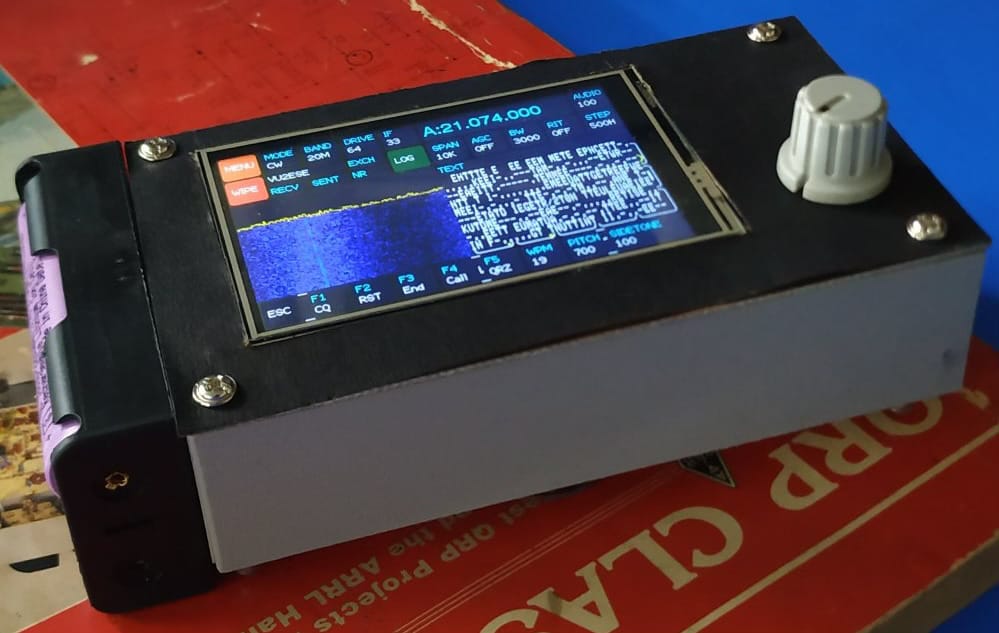
The zBitx is path breaking 5 watts, 64-bit integrated SDR radio. It covers 80M to 10, on CW/SSB/AM/FreeDV/FT8/SSTV with a 480×320 touch screen. It measures just 6.5”x3”x1.5” and it can run off two LiPo batteries (battery case included in the cost).
Take it everywhere!
All bands, All modes, All things
The zBitx will run every mode from CW to FT8 to FreeDV. With the built-in, N1MM style logger, macros, QSO recording and more, it is an integrated station that just works.
It gets better and better
The sBitx software that runs on the zBitx has the best-in-class open source software that keeps getting better all the time. With a large community of developers, hackers and experimenters working together, the zBitx never ages.
CW Deluxe
The zBitx is a CW dream machine for base station or field operations.Operation is so pleasing with the ringless CW filtering down to 50 Hz. Without the noisy Transmit/Receive relays,The on-screen keyboard with large keys on the 480×320 display makes typing CW a breeze.Excellent, sensitive CW decoderIn-built, N1MM style logger exports to ADIF formatEditable CW macros
Integrated FT8
The zBitx is a complete FT8 station. Just switch it on and start working FT8! Forget about the mess of wires, audio level settings and confusing settings. Just tune to the FT8 frequencies and tap on the callsign to complete a QSO!
Voice Modes
SSB and AM modes are with integrated voice equalizer. Variable voice bandwidth makes operation fatigue free in noisy conditions
Preloaded Apps
The zBitx comes bundled with Fldigi, FreeDV, QSSTV. Any RigCtrl compatible, Linux software will work with the zBitx.
Everything is included:
Insert two 18650 LiPo batteries (not supplied) and you are ready to hit the field. At home plug in a 9v power supply and work it from your monitor/keyboard/mouse. It has an in-built microphone and a high quality speaker.
Remote into it with just the web-browser on your phone/tablet/laptop.
SpecificationsSize: 156mm x 80mm x 35mm (including the battery case)Weight: 415 grams including two LiPo batteriesDisplay: 480×320 resistive touch screen display with an independentRaspberry Pico front panel controller.Software: Fully open sourced and available on https://github.com/afarhanHardware: Hybrid superhet, open source circuit with full descriptionFrequency Coverage: All international ham bands from 80M to 10MPower: 5 watts on all bands except reduced power on 15M, 12M and 10M bands.Power Supply: 6V to 9V.Receive Current consumption: 300 mATransmit Current consumption: 1.5 to 3A (depending on the Drive settings)Modes: USB/LSB/AM/CW/CW-Reverse/FT8/Digital modes (with FlDigi)Preloaded Apps: FreeDV, QSSTV, Fldigi and more are coming
This unit… is amazing! Not just for the price, but for the overall functionality! Not stated in the above, but it’s built around a Raspberry Pi Zero (the specific variant isn’t mentioned). This radio is running 64-bit Linux! You can connect it to an external display, keyboard, pointing device, and probably Ethernet (via a USB to Ethernet adapter).
There’s more details about the zBitx in an announcement thread on the BITX20 email list in replies by HF Signals’ founder Ashhar Farhan VU2ESE. Some highlights that leaped out at me:
Deliveries start in February.The last 4 years of experience with sBitx has shown that we have truly moved to being software defined. Most hacks are in software now. It then became imperative that software parts are easier to understand and to change.512MB is enough for every conceivable linux software. There is nothing to be gained with even going from 1GB to 2 GB. The software resides on the SD card, not in the memory. Only the required software is brought into the RAM. None of our software is RAM intensive. Some like the FT8 are CPU intensive but it is well within the capability of all the Raspberry Pis.
I really love the idea of a portable HF radio small enough to slip into a jacket pocket, and a wire antenna and coax into the other pocket, that can run sophisticated data modes and optionally can connect to a tablet computer. And that it’s running 64-bit Linux… and upgrading it to new (software) capabilities is as easy as flashing a new MicroSD card and swapping it into the radio. And that, all in, it’s under $200.
I’ll be placing my order for a zBitx when ordering reopens in February.
Kudos to VU2ESE and the HF Signals team. This is incredible technological innovation in Amateur Radio!
Post Publication Update:
My thanks to Peter Li K6PLI for the extended email discussion about the zBitx, extending back to its first mention at the Four Days In May 2024 conference when VU2ESE first teased some details about it. K6PLI kept an eye on the zBitx development much more closely than I could.
SignalSDR Pro - $900 Software Defined Transceiver with 2 TX and 2 RX
In crowdfunding at Crowd Supply through 2025-01-30, but currently “1040% funded”, planned to ship 2025-04-15.
SignalSDR Pro combines portability and performance. With roughly the footprint of a credit card or a Raspberry Pi SBC, SignalSDR Pro is the perfect companion for anyone who needs powerful tools without the bulk. From signal processing and spectrum analysis to communication systems and beyond, SignalSDR Pro allows you to tackle complex SDR projects quickly.
Unmatched Compatibility & Software Support
With a simple change in jumper settings and a swap of the microSD card, SignalSDR Pro becomes fully compatible with leading SDR hardware like ADALM-PLUTO and USRP B210, among other examples, so it can be integrate seamlessly into existing workflows.
As for software, SignalSDR Pro operates smoothly with GNU Radio, MATLAB, LabView, DragonOS, LTE Sniffer, Open5GS, srsRAN, GPS-Sim-SDR, OpenBTS, GQRX, and other popular platforms…
Features & SpecificationsTransceiver Chipset: AD9361FPGA: AMD Zynq™ 7020 SoCFrequency Range: 70 MHz - 6 GHzInterfaces: Gigabit Ethernet, Full Type-B USB 3.0External Clock Reference: YesSampling Rate: 61.44 MHzResolution: 12 bitsTransmit Channels: 2Receive Channels: 2Duplexing Mode: FullLogic Gates: 85k
What impressed me about this unit:
- Price is very reasonable for the capabilities,
- (Promised) reasonable delivery date,
- (Promised) compatibility with GNU Radio for ease of experimentation
- Frequency range encompasses five of the six popular Amateur Radio VHF / UHF bands (including 222-225 MHz in US and Canada),
- It’s a transceiver with separate TX / RX ports and can operate full duplex,
- Two transmitters and two receivers!
I saw this unit mentioned at the same time I was writing up my SuperPeater concept… and this unit, with two transmitters and two (wide band) receivers could potentially be the core of a SuperPeater with the additions of a transmit power amplifier(s) and of course, the (to be written) SuperPeater software.
This one is worth watching!
KV4P-HT v2 Kit Available from Halibut Electronics
Now Shipping! Images are still temporary for now.
Turn your Android phone into a modern ham radio transceiver. kv4p HT is an open source VHF radio that makes your phone capable of voice and text communication. The radio simply plugs into the USB C port on your Android smartphone and transforms it into a fully-fledged handheld radio transceiver. It’s completely open source. It’s small enough to fit in your pocket and take anywhere.
In stock (can be backordered)
There’s no mention of what makes this unit “v2”.
For more information about this project, see Zero Retries 0173 - KV4P HT - Turn Your Android Phone Into a Modern Ham Radio Transceiver.
Again, this is a kit, and some components are optional / additional cost (including the radio module), and some assembly (soldering) is required. I’m sure there are other sources for this project’s components, but I’m highlighting this unit being available from Halibut Electronics because HE is a reliable vendor, motivated for customer satisfaction, and based in the US.
Kenwood 222-225 MHz Radios and Repeaters
As far as I could tell, these are new units - not used / refurbished / modified / surplus.
I may be one of the last to know this, but Kenwood manufactures radios and a repeater that operate in the US / Canada Amateur Radio 222-225 MHz band. I don’t remember where I saw mention of this, but such units are available for sale from RHE Communications Radio in Richmond (Vancouver), British Columbia, Canada. In their Fall 2024 “Hot-List”:
On page 22, these units are listed as available for sale (at pretty reasonable prices):
- Kenwood TK-785KA 220MHz 20W, 250CH Amateur-ized Transceiver c/w Accessories: Mic, Bracket, Power Cord, Hardware
- Kenwood TK-285 220MHz Portable 5W, 250CH Amateur-ized Portable, uses accessories common to TK-280/380/480
- Kenwood TK-785-RPTR 220MHz 15W Repeater/Exciter assembled with rack mount, I/O connectors and modifications for repeater/duplex use
Confusingly, these units are not listed in the Winter 2025 version of the “Hot-List” that is currently online. Thus if you’re interested in these units, all I can suggest is to contact RHE at sales@rhecomm.com or by phone at 604-277-5020.
New M17 Foundation Wiki
M17 Foundation web page / blog:
Our own Wiki instance is up and running with open registration. Please help us with the effort to improve M17-related documentation. The journey begins here!
https://wiki.m17foundation.org
All accounts have to be approved to receive editing privileges.
Emphasis on new, and equal emphasis on M17 Foundation. This wiki is under the stewardship of the new M17 Foundation. The previous M17 website, and the previous M17 Wiki, were not being maintained.
To request an editing account for the M17 Wiki, see the Request Account link in the upper right corner of the wiki.
I’ve been asked to help contribute content to M17 Foundation, Wiki, a News page, etc. which I will be honored to help with in the coming months.
Announcing the DRATS2 Project
John Manning WB8TYW on the d-rats email list:
I have just created a new repository for rewrite of D-Rats.
I think this re-write is needed for several reasons.Most of D-rats users are using Microsoft Windows and the use of GTK+
makes it hard to provide an easy to install package.
GTK+ is continuing to make incompatible changes with new versions
making it harder make enhancements. The Glade editor for designing GTK+
layouts actually making things harder as it does not seem to be keeping
up with GTK.
The config subsystem needs a rewrite to fix existing problems and
requested features, the existing code structure makes that very difficult.
Tracking Wiki for this new project.
https://github.com/ham-radio-software/drats2/wiki/Rewrite-of-D%E2%80%90Rats-communication-package
It may be a while before I get something ready for testing, and most of
those tests will be of the "hello world" type packages at first just to
make sure that everything can install and run.
https://github.com/ham-radio-software/drats2/wiki/00100-Roadmap-for-new-version
As this will be being brought up in sections, hopefully it will help
someone learn programming and packaging processes.
The original project was called D-RATS, but WB8TYW chose the name DRATS2 for this project. D-RATS is software / protocol to take full advantage of the 900 bps data channel (streaming, no framing, no error correction, etc.) that’s built into all D-Star radios. The name D-RATS is wordplay on the name D-STAR. While D-RATS was an entirely independent development originally by Dan Smith KK7DS, it was promoted by Icom because D-RATS enabled data communications on D-Star radios (and repeaters) somewhat equivalent to packet radio.
While there are only a few Icom D-Star radios that implement the “DV Fast Data” mode2, hopefully DRATS2 can take advantage of DV Fast Data mode in those few Icom D-Star radios to do a 4500 bps data stream versus the original 900 bps data stream.
The Hard Truth about Hardware TNCs in Packet Radio
Billy Penley KN4MKB on his Modern Ham Blog:
I know this will not come as an easy pill to swallow for most people who come across this blog post. I implore you to read with an open mind. Hear me out and then build your argument in the comment section. This post is an effort to help guide those who may be looking into packet radio, to help steer them into the direction of the future. Hardware TNCs are an aspect of packet radio that people can’t just let go. While they can certainty be used, there is almost no reason to get one today with the software options that are available. There are a few exceptions we’ll get into. Let’s start off by talking about the reason for their existence.
In addition to his Modern Ham Blog, KN4MKB is the creator of the Modern Ham YouTube channel (also Zero Retries Interesting).
Overall this article is an excellent treatment of the advantages of “Software TNCs”3 (which is kind of a contradiction in terms) versus (legacy) Hardware TNCs.
KN4MKB has been doing a great job of explaining Packet Radio in this era with solid, well-explained hands-on experiences in his series Packet Radio 101.
I have two minor quibbles with the article. The first is the origin of the “TNC” which is an acronym for Terminal Node Controller. When Amateur Radio Packet Radio was first being developed in approximately 1978, “dumb terminals” were the primary display and input devices for any digital system. At that time, microcomputers existed (the MITS Altair debuted in January 1975), but cost thousands of dollars (for a realistically usable unit). Dumb (video) terminals were available surplus for a few hundred dollars. Thus for Amateur Radio Packet Radio, all of the networking, protocols, modem, user interface, etc. was incorporated into a standalone unit - the TNC. Of course, within a few years, inexpensive consumer computers became available, and those became the preferred display / input device for Amateur Radio Packet Radio. Another reason for the name Terminal Node Controller was to distinguish it from the “in development, available real soon now” (but never quite happened) Network Node Controller (NNC)… which is another story for an another time.
My second minor quibble with this article is the section Some Exceptions. In addition to some specific uses cases for the NinoTNC and the “mobilinkd” (that’s actually the company name; the actual current product is called the TNC4) hardware TNCs, I would add the venerable Kantronics KPC-3+ for the specific application of a standalone, remote APRS digipeater.
That the KPC-3+ is an old design is, in that specific application, makes it a solid choice. The KPC-3+ has been refined over a couple of decades now, especially its firmware, and is a solid, reliable unit for standalone, remote applications to provide an APRS digipeater.
And… a very, very minor quibble, that’s admittedly pretty “deep in the weeds” of terminology and Amateur Radio Packet Radio technology is that modern “TNCs” are all KISS TNCs and are built around modern microcontrollers which are capable of easily being updated and their capabilities expanded, such as been the case with the NinoTNC that has is in a state of continual evolution4. The use of the KISS protocol for communicating between the TNC and the host computer means that “most of the intelligence” of the TNC resides in an application running on the host computer, not the TNC itself, as was the case with legacy hardware TNCs (such as the KPC-3+… though that unit does have the ability to be used as a KISS device).
For those quibbles, I don’t fault KN4MKB for that lack of context. For a long time, a lot of Packet Radio history had lapsed into tribal knowledge, with only scattered historical packet radio information available online. Fortunately, that’s begun to change with the advent of the Digital Library of Amateur Radio & Communications, and the availability of material like the Vancouver Amateur Digital Communications Group’s newsletter “The Packet” and the first book published on Amateur Radio Packet Radio in 1981 - PACKET RADIO by Robert Rouleau VE2PY and Ian Hodgson VE2BEN.
Examining Ambiguities in the Automatic Packet Reporting System
I stumbled upon this interesting, deep, scholarly examination of the vagaries of APRS by Kenneth Finnegan W6KWF as his 2014 MSEE thesis.
The Automatic Packet Reporting System (APRS) is an amateur radio packet network that has evolved over the last several decades in tandem with, and then arguably beyond, the lifetime of other VHF/UHF amateur packet networks, to the point where it is one of very few packet networks left on the amateur VHF/UHF bands. This is proving to be problematic due to the loss of institutional knowledge as older amateur radio operators who designed and built APRS and other AX.25-based packet networks abandon the hobby or pass away. The purpose of this document is to collect and curate a sufficient body of knowledge to ensure the continued usefulness of the APRS network, and re-examining the engineering decisions made during the network’s evolution to look for possible improvements and identify deficiencies in documentation of the existing network.
W6KWF provides more info on his QRZ page - https://www.qrz.com/db/W6KWF.
After discovering this, I posted about it on the new APRS Foundation email list:
This might be newly relevant for the new effort underway in APRSF to update APRS standards, protocol, etc.
John Langner WB2OSZ replied:
Thank you bringing this to our attention.
Kenneth was absolutely correct in his assessment of the problem. Unfortunately, he made many mistakes in collecting and curating some of the institutional knowledge. The result could be spreading misinformation which others will then propagate. I would like to offer some corrections.
My response is attached.
WB2OSZ’s detailed response can be viewed at:
https://how.aprs.works/re-examining-ambiguities-in-the-automatic-packet-reporting-system-2/
I don’t think W6KWF can be faulted for
mistakes in collecting and curating some of the institutional knowledge
in 2014. There were then, and now, widely varying implementations of APRS; for example, Amateur Radio APRS operating on the LoRa Chirp Spread Spectrum modulation. The APRS documentation / specifications then available were (in my opinion)… “eclectic and fragmented”. In my opinion, correcting that situation is one of the prime and most immediate tasks of the APRS Foundation - to create an up to date APRS Protocol Specification incorporating all the proposed changes / additions / corrections proposed (and or widely agreed upon) since the previous formal APRS Protocol Specification that was created by TAPR.
Continuing the discussion on the APRS Foundation email list, WB2OSZ said:
The APRS Protocol Reference, affectionately known as APRS101.pdf, is from a quarter century ago. Bob WB4APR (SK) collected voluminous notes about corrections, clarifications, and new features for over 20 years. Unfortunately these were not merged into the original, making it very difficult for developers. I've conversed with multiple developers than didn't even know there were later updates. It is very important that all developers are working from the same specification so that all implementations will interoperate with each other.
My own personal, unofficial, compilation of the original and decades of updates can be found [at]
https://github.com/wb2osz/aprsspec
I've also included additional clarifications and tried to fill in the gaps identified by Kenneth.
For regular users, without the need to understand every tiny little detail, I strongly recommend "Understanding APRS Packets":
https://raw.githubusercontent.com/wb2osz/aprsspec/main/Understanding-APRS-Packets.pdf
The expectation is for the APRS Foundation to become the new custodian for the "official" version of the standard.
This is the kind of detailed discussion about sorting out lingering ambiguities in APRS that I hope the APRS Foundation will tackle to move APRS forward into the late 2020s.
Kudos to W6KWF for tackling this as a Master’s Thesis - another example of radio technology technological innovation occurring in Amateur Radio.
And kudos to WB2OSZ for his solo (as far as I can tell) work on pulling together all the disparate bits from a quarter century (?!?!?!) of evolution of APRS into what will hopefully become the APRS Specification v1.2, and that that updated specification will soon be formally within the custody of the APRS Foundation (currently it’s in the custody of TAPR). And, of course, be more regularly updated.
Followup to Zero Retries Mention of TEXNET - GLnet (Great Lakes Network)
In Zero Retries 0116, I wrote The TEXNET Packet Switching Network.
That article was mentioned on the TAPR xNOS email list, and Jay Nugent WB8TK posted a great followup about GLnet, a network in the midwest US that used TEXNET nodes.
I was a (distant) member of the Texas Packet Radio Society TPRS, living in Michigan but commuting each year to their annual meeting in Texas. It was always the weekend before or the weekend after the TAPR meeting in Tucson, so it was a fun WEEK for me hitting each organizations annual meeting!
Along with several others, we ran the "GLnet" (Great Lakes Net) network of TexNet nodes throughout Michigan, Indiana, a bit of Ohio and a bit of Illinois. They were linked together at 9600 baud using old UHF RCA radios, and one 6-meter link (that was always so-so depending upon the time of day).
I still have *several* TexNet nodes stacked up in my basement. They were Z80 based with one 9800 modem and two 1200 baud modems on a single PC board. It was designed and coded by the "Tom Tom" team. One "Tom" designed the hardware and the other "Tom" coded ALL of the AX.25, memory management, timing, and PMS (Packet Mail Server) code in Z80 Assembly! The code was burned onto an EPROM, including any configuration information - so it wasn't for the faint of heart. I still have the source code somewhere in my archives.
The user interface was SO incredibly easy for the users to connect to any station at any node with a single command. There were also Sysop commands (password protected) that allowed for diagnostics and remote reboots, and PMS message management.
The 'networking' code was build around a MESH model where they automatically detected one another and set up Primary, Secondary, and Tertiary route tables. So should a link go down or become congested, packets would take alternate routes to their destinations. This was FAR more efficient and much faster than anything Software-2000 put out with their NetROM offering.
Any node could have a hard drive attached and serve as a "PMS" packet mail server. There was NO NEED to do Heirarchical mail forwarding as you simply used the network to get to the PMS, wherever it was, and read/post email and bulletins.
One serial port on a TexNet board could be assigned to watch the NWS weather teletype wire. It would store select, pre-determined, weather PRODUCTS to SPECIFIC message numbers on the PMS hard disk.
The Tom-Tom team knew what they were doing and were FAR ahead of their time! Makes me want to fire up a couple of those nodes and refresh a few crusty brain cells remembering the past :)
I’m kind of bummed to read that GLnet extended into Ohio and I missed participating in that as an advanced packet radio network. But perhaps GLnet developed after my time living in the Cleveland, Ohio area (1984 through 1987) and then moved to the Seattle, Washington area. I got to know some of the folks that developed TEXNET and I agree with WB8TK that TEXNET was way ahead of its time. I’m delighted that such a thorough explanation of it survived (the Ham Radio series) and perhaps some of the best of TEXNET could be incorporated into a future Amateur Radio network system - it’s all just software now… right?
Post Publication Update:
Tom McDermott N5EG followed up on the mention of TEXNET in an email:
Also - you mentioned TEXNET in the same issue. The two Tom's that are described were:
1. Tom Aschenbrenner (then WB5PUC, now WA9EXS) who wrote the NCP (node) software (Z80 assembly), and
2. myself (the other Tom) who did the hardware, Layer 3 routing protocols, the network management system, and the automatic AMTOR bulletin data.
We had a contiguous system from northern Mexico through Texas, Louisiana, Oklahoma, Arkansas, and Missouri all linked with 9600-baud 70cm radio links. It provided DXcluster linkage for many clusters before the internet.
Texnet had network-wide (redundant) BBSes where you could log into any node and just type BBS and you would be automatically linked to the nearest reachable BBS. The system automatically received AMTOR W1AW bulletins on 20m and put them on the BBS without human intervention. The system kept track of the number of AMTOR character errors in each bulletin, and as propagation provided a better version at certain times of day, the BBS would auto replace a lower-quality (high character error count) bulletin with one that had a higher quality (lower number of character errors). So within about 24 hours there were usually zero-character-error versions for all the bulletins on the network BBSes. It used the old Technical Material Corp (TMC) crystal-controlled single channel SSB 1U-rack receivers.
It had a full graphical network management system, with mouse-click display of link status, node parameters, etc. It was possible to display full network statistics from the GUI. That was pretty cool in the 1980's. It was connected to the National Weather Service office in Tulsa, and forwarded the old ASCII-encoded doppler weather maps anywhere in the network.
You had to have an offline map background on each client computer (due to the otherwise large number of bytes) but the NWS ASCII would draw the weather features onto that map in real time - that data was only about 1kB or so.
The maps were pretty coarse by today's standards.
My thanks to N5EG for that additional context on TEXNET!
New Version of APRSdroid (and a 15th Anniversary)
Michael NA7Q on the aprsfoundation email list:
Happy 15th Birthday APRSdroid!
Today marks the 15th year since APRSdroid began. Thanks for DO1GL for creating such a wonderful app, as well as all those who have contributed to it!
As a birthday present, I have a major release today with many enhancements, and one complete overhaul of offline mapping! Feel free to grab this birthday release!
https://na7q.com/aprsdroid-release/
It now supports offline mapping directly with mbtiles files! No termux or other nonsense needed!
And in that link:
Extra Features not in the official APRSdroid
OverviewDigipeater (direct or full)IGating (2 way!)Messaging tweaks for advanced usersRadio Control for Vero, BTech, Radioddity and othersOffline maps with mbtilesMic-E CompressionMic-E Statuses (including EMERGENCY!)Standard CompressionBluetooth Low Energy (unstable, unfinished, not recommended)DigiRig supportMetric or Imperial UnitsDisabling Hardware AccelerationOther under the hood changes
What is APRSdroid?
APRSdroid is an Android application for Amateur Radio operators. It allows reporting your position to the APRS (Automatic Packet Reporting System) network, displaying of nearby amateur radio stations and the exchange of APRS messages.
APRSdroid is Open Source Software written in Scala and licensed under the GPLv2.
Features
You can use APRSdroid to connect to the APRS network via different means:APRS-IS via Internet (WiFi or mobile data connection)AFSK (audio connection between your radio and the smartphone)Bluetooth-serial connection to a TNC
Once connected, you can beacon your presence, see which stations (amateurs and repeaters) are around and send/receive APRS messages.
This isn’t just impressive for the new, updated features, but for the stability and longevity of APRSdroid as the APRS app for Android devices. I’m primarily an IOS device user (iPhone, iPad) and even I’m well aware, from long reputation, of APRSdroid.
Kudos to DO1GL and NA7Q for this new APRSdroid version, and the longevity of APRSdroid. An app doesn’t live a useful life for this long without careful design and patient maintenance to deal with continual changes and updates to platform.
FreeDV [Project is Seeking] New Project Leadership Team Members
David Rowe VK5DGR on the ARDC Community email list:
We are looking for people to join our Project Leadership Team (PLT). The attached document explains what we are a looking for.
Please feel free to forward this to any people you think might be interested, or good candidates for the FreeDV PLT, however we would prefer the document is not placed on any public web sites or mailing lists.
More information - FreeDV-002 PLT V2.0:
The FreeDV project is looking for new members for our Project Leadership team.
FreeDV is at an inflection point. After two years of R&D (kindly supported by an ARDC grant) our new RADE technology has demonstrated HF digital voice performance highly competitive with SSB over HF radio at a range of SNRs. In VHF/UHF applications Codec 2 is a viable replacement for close source codecs (M17). There is a growing community of Radio Amateurs using RADE every day. After a quarter of a century of being tied to closed source vocoders, the Amateur radio and commercial communities are attracted to open source vocoders for next generation radio systems.
…
To achieve our goals we need to expand our leadership team (PLT):Help us manage the project, for example discuss and set goals for the project,approval of expenditure, best way to direct resources.Time commitments are a 1 hour Google meeting, and a few hours of email every month.You can leave at any time with 30 days notice.It is an unpaid (volunteer) position.Being on the committee does not imply you need to work on any other activity on the project (e.g. coding or promotional tasks) - unless you want to.
We are particularly interested in people with any of these skills/attributes:People that live outside of North America, e.g. in Asia or Europe, that are comfortable with English language Google meetings and email. We’d like to represent all Hams in the world!Radio sales and marketing experience, strong people skills, to help us bring RADE technology to Hams of the world, and work with radio manufacturers.Project management experience to help us manage our grant.Writing skills, comfortable in Google docs.Radio, signal processing, or software development professionals to assist with technical mentoring/review.In addition to the PLT role, enough time and motivation to get "hands on", and complement/assist the current developers, e.g. in marketing, conference attendance, website content, posting to social media, signal processing review (in a paid or volunteer role).
If you believe in what we are doing, and would like to help - please reach out to us on freedv-project-leadership-team@googlegroups.com and tell us a little about yourself.
FreeDV (and the earlier, related development of the free, open source Codec 2), is a signature achievement of Technological Innovation in Amateur Radio. If you have some of the skills that are requested, this is a great opportunity to materially contribute to Amateur Radio’s future.
M17 is my 2025 Resolution. Join me.
Interesting discussion thread on Reddit r/amateurradio:
I want to talk and learn. I want to bust through the ham stagnation/segmentation of spendy vendor-specific solutions and try something new. M17 checks the boxes, but I'm a total noob in this space. What I have gleaned so far from other threads and sites:We can buy a CS7000 HT with M17 support or modify hardware like the TYT MD380. Are there other HT's that noobs should be looking at with full support to get started?Are Handsets that run OpenRTX and M17 the only way forward? Are there other ways or cross-mode methods to use M17? For example are there MMDVM bridges that can connect DMR/YSF/D* etc to M17?Similar to the above question, I think I saw that DVSwitch could support USRP2M17? Does this require a specific hotspot or does it give analog guys like me a path?It's no fun if we can't talk. What's the best active channel/TalkGroup/Reflector to use once we get there?
Anyone else want to join/help/guide us on this endeavor? TIA
I particularly enjoyed the comments of grouchy_ham:
One of, maybe even the biggest, roadblock is repeaters. The usefulness of V/UHF radios is massively increased by repeaters. Without repeaters capable of use with a new protocol, it’s a really tough sell. Why would I, as a repeater owner (if that were the case) be interested in “upgrading” my system to accommodate a new protocol that may or may not take off?
As an end user, why would I buy a radio, especially an HT, with a digital protocol that isn’t supported by a local repeater or preferably, a network of repeaters, that it can be utilized with? I have a D-Star capable radio in an area without a single D-Star repeater in range. Thankfully, D-Star is not why I bought the radio.
Yep! grumpy_ham’s perspective supports the concept of a SuperPeater, which will support M17 as the primary digital voice mode.
Is VarAC Legal? Is it Even Desirable?
Peter Marks VK3TPM on his marxy's musing on technology blog:
I'm sure [VarAC] works well as there are enthusiastic users but it seems to me that it's a proprietary version of an OFDM modem hosting a proprietary chat protocol. Also, VARA only runs on a proprietary commercial operating system from Microsoft.
The authors are clearly in this to make money, for example an alert is shown every time I do anything asking me to either transfer 68 euros or "continue evaluating" it. I pushed the Tune button in VARAC and it shows an alert saying that to Tune you must pay.
This all seems to go against the open philosophy of amateur radio.
First, VK3TPM makes a fundamental mistake in the premise of this article, conflating VarAC with VARA. The former is a sophisticated chat / email (and many other features) application by Irad Deutsch 4Z1AC that runs on the VARA modem platform developed by Jose Alberto Nieto Ros EA5HVK. Note that EA5HVK also offers applications equivalent to VarAC - VARA Chat and VARA Terminal.
Thus, any discussion about the “legality” of the usage of “VarAC” on Amateur Radio bands should be directed toward VARA as that is the system that actually transmits on Amateur Radio spectrum. VarAC (and VARA Chat and VARA Terminal) is an application that “rides on top of VARA”.
This “issue” of “proprietary” modes / software / operating systems used on Amateur Radio going against the “open philosophy” of Amateur Radio flares up every so often. Such discussions seem to quickly subside when it’s pointed out that there are many “proprietary” technologies widely in use in Amateur Radio, including all the digital voice modes that use the proprietary DVSI (AMBE) CODEC (DMR, D-Star, System Fusion, etc.), data modems such as Pactor 4, and even the wide use of LoRa which is a proprietary implementation of Chirp Spread Spectrum. All of these systems are used widely in Amateur Radio. In my interpretation, as long as such systems are widely available for purchase and use, enabling easy monitoring / participation of communications on Amateur Radio spectrum, it seems a hard case to make that they should be considered illegal, or implementations of “encryption”.
I, for one, am glad that these proprietary systems are in use in Amateur Radio as they provide an example of what’s possible to accomplish in Amateur Radio:
The digital voice modes that use the proprietary DVSI (AMBE) CODEC have proven the utility of digital voice in Amateur Radio VHF / UHF bands. Those systems gave rise to M17 as an open source equivalent system developed within Amateur Radio, for Amateur Radio that is now gaining significant traction, such as one (and soon, more) radio that incorporates M17 (not requiring modification).
Pactor 4 is a proprietary data mode for HF that provides up to 10.5 kbps data rate in a 2.4 kHz channel. That’s a benchmark that can be aspired to by open source developers. For example, VARA HF (software only, using existing audio interfaces, running on a Windows PC), achieves 6.7 kbps in a 2.4 kHz channel… which has given rise to an open source equivalent of VARA HF called Rhizomatica Mercury which also achieves 6.7 kbps in a standard HF channel.
VARA FM is capable of up to 25 kbps in a standard VHF / UHF FM channel, using a Windows computer, a high bandwidth audio interface, and a radio with a flat audio connection (bypasses the pre-emphasis / de-emphasis stages). Even using microphone and speaker connections on a standard FM radio, VARA FM can achieve nearly 13 kbps and most notably, VARA FM can auto-negotiate a connection between a fast (“wide”) VARA FM station and a slow (“narrow”) VARA FM station. The equivalent in (non-proprietary) packet radio of sharing a channel between 1200 bps and 9600 bps stations simply isn’t possible as there is no negotiation between a 1200 bps and a 9600 bps station.
The example of VARA FM’s speed and reliability (using OFDM techniques, Forward Error Correction - FEC, channel sounding, negotiation of best common speeds, etc.) have revitalized the use of data communications on Amateur Radio VHF / UHF, with up to nearly 21x the usual 1200 bps data rate (and error prone due to no FEC). But some progress is being made to develop non-proprietary systems such as MMDVM-TNC which implements various speed tiers from 9600 bps up to 38400 bps5 with integral Forward Error Correction.LoRa is a proprietary implementation of Chirp Spread Spectrum. LoRa is extremely popular because its developer, Semtech, has made LoRa (radio) modules very inexpensive, enabling many new use cases such as Meshtastic. In the US, LoRa is widely usable by hobbyists because it is implemented for the license-exempt 902-928 MHz band. Because 433 MHz is a license-exempt portion of spectrum in Europe, LoRa can be used within the Amateur Radio 420-450 MHz band in the US. In using LoRa, spread spectrum technology is finally becoming widely used in Amateur Radio. As discussed in Zero Retries 0113 - LoRa Implemented in GNU Radio Environment, the proven utility of LoRa has given rise to an open source implementation of LoRa within the GNU Radio Environment.
Recall that UNIX and DOS and Windows were / are proprietary computer operating systems, wholly owned by various corporations, but those examples gave rise to open source operating systems such as BSD, Minix, and Linux.
Thus I posit, that proprietary systems in Amateur Radio are useful in showcasing how much can be accomplished in Amateur Radio and thus inspiring those that are so inclined, and capable, to create alternatives to proprietary systems, perhaps open source alternatives.
And, if the proprietary systems persist indefinitely, like DMR is likely to for VHF / UHF repeaters… lets just enjoy and use our amazing capabilities that are possible within Amateur Radio, proprietary systems, or open source systems.
Successful Tests with Rattlegram - Dec 2024
John Desmond EI7GL on his EI7GL....A diary of amateur radio activity blog:
Rattlegram is an app for a smartphone and it allows users to send short text messages over the radio. The beauty of the app is its simplicity. There is no need for wires or interfaces, the user just needs to hold their smartphone next to the microphone and loudspeaker of their radio.
The burst of data from the Rattlegram app only lasts for about two seconds. It's really simple to use. You just compile a short message on the app, press PTT on the radio and tell the other person you're sending a message, hold the microphone of the radio next to the smartphone and press 'TRANSMIT' on the app. The person on the receiving end gets the error free message on their app a second or two later.
Good to see Rattlegram get some attention / activity. Rattlegram is the “beta” implementation of the Ribbit project.
In saying:
I get the feeling that Rattlegram is a bit like a solution looking for a problem. It's a tool that I'm sure some resourceful operators will find a use for.
I don’t think EI7GL quite understands the intended use case for Rattlegram / Ribbit… which was not intended for Amateur Radio (though Amateur Radio isn’t precluded from using it).
Rattlegram / Ribbit is designed for individuals that have access to portable radios (and mobile phones) to send and receive text messages off-grid via personal portable radios. No built-in data communications hardware or software in the portable radios is required (though it would be cool to see if Ribbit / Rattlegram could be adapted to use some of the new Bluetooth linking available in the newest portable radios). The use case of Rattlegram / Ribbit is short messages via personal communications (voice) radios such as:
- Family Radio Service (FRS)
- PMR446 (Europe)
- Citizens Band (should work great with FM now enabled in US Citizens Band)
- Multi Use Radio Service (MURS)
- Maybe even General Mobile Radio Service (GMRS)
To proactively address the plaint that data / messaging is prohibited / restricted on these radio services / devices… how can it be prevented / regulated against when you’re just transmitting audio tones acoustically between a mobile phone and a portable radio - not even connecting via external microphone / speaker connection?
I’ve made the case that while there are various personal radio services available for voice communications… there is no Citizens Data Radio Service6 available… but there should be. This is the 21st century where text messaging is more prevalent than voice phone calls.
Radio spectrum regulators should really catch up with this trend of the past 25 years, and thus I applaud the developers of Ribbit / Rattlegram for addressing this use case.
My thanks to Amateur Radio Weekly Issue 363 for mentioning this article.
Getting Started With ka9q-radio Video Series
Tom McDermott N5EG on the HamSCI email list:
I've uploaded Getting started with ka9q-radio Part 5.
It covers setting up and configuring a headless Linux server to host ka9q-radio and ka9q-web, and demonstrates running it remotely.