Zero Retries 0171
2024-09-27 — Dewayne Hendricks WA8DZP is a Silent Keyboard, A 144 / 222 / 440 MHz 9600 APRS Stack… and Network!, NinoTNC Firmware Updates
Zero Retries is an independent newsletter promoting technological innovation that is occurring in Amateur Radio, and Amateur Radio as (literally) a license to experiment with and learn about radio technology. Radios are computers - with antennas! Now in its fourth year of publication, with 2100+ subscribers.
About Zero Retries
Steve Stroh N8GNJ, Editor
Jack Stroh, Late Night Assistant Editor Emeritus
In this issue:
Video - Setup IP Network over Packet Radio with IL2P and Direwolf
Video - Tech Minds Review - The FIRST Commercial M17 Digital Radio - CSI CS7000-M17
Ideas for APRS Foundation Request For Comments Process / System
International EME Conference Archive on Digital Library of Amateur Radio & Communications
Well-Informed Commentary on the new FCC Part 88 (Dedicated Spectrum for Drones)
20 Years Later, Real-time Linux Makes it to the Kernel - Really
Comments for This Issue (redirect to Comments page)
Web version of this issue - https://www.zeroretries.org/p/zero-retries-0171
Request To Send
Commentary by Editor Steve Stroh N8GNJ
Paid Subscribers Update
My thanks to Merik Karman VK1DF / VK2MKZ for renewing his second Founding Member Annual Subscription to Zero Retries this past week!
Founding members are listed in every issue of Zero Retries!
My thanks to Prefers to Remain Anonymous 12 for renewing as an Annual Paid Subscriber to Zero Retries this past week!
My thanks to Phil Marquis K6HSV for upgrading from a free subscriber to an Annual Paid Subscriber to Zero Retries this past week!
K6HSV said “Beats the heck out of reading QST.“
My thanks to Jeffrey Komori KH6JUZ for becoming an Annual Paid Subscriber to Zero Retries this past week!
My thanks to Prefers to Remain Anonymous 51 for becoming an Annual Paid Subscriber to Zero Retries this past week!
My thanks to Prefers to Remain Anonymous 52 for becoming an Annual Paid Subscriber to Zero Retries this past week!
Financial support from Zero Retries readers is a significant vote of support for the continued publication of Zero Retries.
Upcoming Events Countdown
Pacificon 2024 in San Ramon, California, USA on 2024-10-18 thru 20 in 3 weeks. Tina KD7WSF and I plan to attend Pacificon 2024 (which makes it “major” to us).
My presentation at Pacificon 2024 - Tracking Technological Innovation in Amateur Radio will be on Saturday 2024-10-19 from 16:00 - 16:50 in Contra Costa Salon 2.
See the Zero Retries Guide to Zero Retries Interesting Events for additional events.
My FCC Docket 24-240 Reply Comments Filed
Well, I got my Docket 24-240 Reply Comments submitted, but I did so after business hours in Washington DC, but still well within “2024-09-20”. I wasn’t quite sure if my submission would be considered to have been submitted that day, but the timestamp on my submission, processed the next business day (2024-09-23) says 2024-09-20, and the status of my submission says
Filing Status DISSEMINATED
So I think my Reply Comments will be duly considered.
Comments are still coming in (more than 1800 now), nearly a week after the 2024-09-20 deadline, and those late comments are being marked as DISSEMINATED.
NextNav isn’t dissuaded by the thousands of negative comments. Their Reply Comment said, in part:
The Commission will of course carefully consider the feedback from all commenters, as will NextNav, but the key takeaway is this: No one else has proposed a credible solution to the widely recognized and increasingly urgent problem that the United States has no widescale TPNT service to complement and back up GPS where the GPS signal is obstructed or when outages occur. Even many of those opposed to NextNav’s Petition acknowledge that a terrestrial complement and backup to a satellite-based PNT service is critically important to safeguarding U.S. national security, public safety, economy, and way of life. As there is no prospect of the U.S. government funding a standalone terrestrial PNT network, NextNav offers the only concrete opportunity to enable a widescale terrestrial PNT service—one that has a clear path to availability in consumer devices such as cellphones—without spending taxpayer dollars.
NextNav is really disingenuous here - there were other “credible solution[s]” discussed in the submitted comments. NextNav’s proposal is not the only credible potential solution to this issue. I, for one, think we should rebuild the LORAN (eLORAN) system.
I’ve been amazed before, and this is yet another example, of the seemingly inexhaustible budgets available to communications law firms to aggressively lobby the FCC when there’s a credible prospect of getting the FCC to (however reluctantly) agree to allocate “free spectrum”. If the FCC declines NextNav’s proposal… they (or a successor, who buys NextNav’s assets out of bankruptcy) will be back, eventually.
Some Zero Retries readers from outside the US wrote to me basically saying:
What a screwed up system the US has with the FCC when a private company with a specious claim, who hasn’t really done anything to prove out their technology claims, can credibly threaten to bankrupt hundreds of companies and obsolete billions of devices.
I couldn’t offer any argument to their assessment.
Have a great weekend, all of you co-conspirators in Zero Retries Interesting Amateur Radio activities!
Steve N8GNJ
Dewayne Hendricks WA8DZP is a Silent Keyboard
By Steve Stroh N8GNJ
A remembrance of my very smart, and kind friend and mentor, Dewayne Hendricks WA8DZP.
Since this article will likely be shared outside of Amateur Radio (also called Ham Radio), when an Amateur Radio Operator has died, they are referred to as a Silent Key (SK). This terminology dates back to the very early days of Amateur Radio when communications were conducted solely with Morse Code, by tapping on a Morse Code key. Thus, when an Amateur Radio Operator dies, their “key goes silent”. In the more modern form of Amateur Radio that Dewayne and I were involved with, using data communications technology, “Silent Key” is archaic. Thus in Zero Retries memoriams, I began using the terminology “Silent Keyboard” in such situations, since data communications folks generally make more use of keyboards than Morse Code keys.
Dewayne was an incredibly smart person, with amazing bandwidth and mental stamina. In my decades of knowing him, our interactions and conversations were generally about radio technology (Wireless Internet Access), Amateur Radio, Internet access, regulatory issues, and various other issues.
Years before I met him, I knew of Dewayne by reputation as one of his early notable accomplishments in the early Amateur Radio Packet Radio era in the 1990s was was to port KA9Q’s “NOS” TCP/IP package (originally written for MS-DOS) to the Macintosh in the “Classic Mac” era, which was (I think…) the first implementation of TCP/IP running on the Mac. There was… nothing… in common between those two different types of computers in that era. Thus Dewayne’s accomplishment of making KA9Q NOS became legendary to those of us in Amateur Radio who understood how challenging that project was.
Along with TAPR President Greg Jones WD5IVD (another, way too soon Silent Keyboard), Dewayne was instrumental in TAPR’s “focus on the future” in the late 1990s as illustrated in this prescient paper - A New Vision for the Amateur Radio Service. At the time, many of us “digital enthusiasts” in Amateur Radio wanted to experiment with more modern, digital types of radio technology and the FCC rules severely restricted such experimentation. Dewayne, and later TAPR, was involved with a “Special Temporary Authority” by the FCC to conduct testing that ordinarily would be outside FCC’s regulations for Amateur Radio. The results of that testing eventually justified some relaxation of the strict rules against using such digital technology in Amateur Radio.
I first met WA8DZP at the 1996 Digital Communications Conference in Seattle, Washington when he was the featured speaker for the Sunday “Deep Dive” technical seminar. WA8DZP would be explaining about the (then) new unlicensed “Part 15” wireless networking devices that were becoming available and could potentially be repurposed for Amateur Radio use. (This was way before 802.11 or Wi-Fi made such devices common.)
Dewayne subtly revealed his intense interest in Science Fiction to us at that conference. His “outfit” at the conference unremarkable - a black pullover sweatshirt, notable only because of the life-size (and looking totally authentic) Star Trek (the Next Generation) Starfleet logo “communications badge” on his upper chest. That… and Dewayne wasn’t willing to be taken to the nearby Kinko’s 24 hour copy shop to download his presentation handout for printing until after he had watched the first episode of a new science fiction television series called “Dark Skies”. Given that that show came on at 9:00 or 10:00 that evening, my wife Tina got irritated at that delay and told me:
“I’m going home to my daughter. You deal with him.”
At the Kinko’s, because of the late hour, there was a church bulletin for a large church that had to be completed before they could work on Dewayne’s handouts that we would need on Sunday morning. So we waited for about an hour and we started talking about his presentation subject, “Part 15” radios. I listened attentively… but I couldn’t quite believe the claims Dewayne was making about the capabilities (and the relatively low cost) of these new types of radios.
After seeing Dewayne’s presentation on Sunday, I still felt that his claims were a bit too good to be true, based on my extensive background in Amateur Radio Packet Radio. I was highly skeptical that “1 watt, 20 miles, 1 Mbps, on 902-928 MHz” was doable without extraordinary effort like using large, focused dishes to achieve that level of performance.
One of the reasons I was skeptical about Dewayne’s claims was that I was a voracious reader of all kinds of computer periodicals, and I had not heard of such devices in my reading. But, I was lucky that my employer at that time had access to the pre-commercial Internet and I could use the NCSA Mosaic web browser to look up the companies and products that Dewayne mentioned. WOW, he was right! He wasn’t exaggerating his claims about those Part 15 devices, and the reason that I wasn’t reading about these products was that these companies were selling all the products that they could make, and they didn’t (then) need to advertise to the computer industry.
After that experience, I dived deep into learning about this new type of radio technology. I became mildly obsessed about the subject, and when I spotted a request for writers about the new “public” Internet, and Internet access technologies, I offered to write a monthly column on “Wireless Internet Access”.
It was a long and winding path from that weekend, to becoming a writer about radio technology, and most recently, Zero Retries, this newsletter about technological innovation that’s happening now in Amateur Radio. But, looking back, it’s easy to place the primary “pivot point” of my becoming a writer back to that weekend when I had my mind blown that an entirely new level of radio technology had become possible… that I became intensely interested in, thanks to Dewayne. Wireless Internet Access is completely normal now, and even a small industry (Wireless Internet Service Providers - WISPs). But back then, it was very novel, very bleeding edge, and learning about it early, thanks to Dewayne, was “my writing ticket”.
In that era, Dewayne was in demand as a Subject Matter Expert on broadband wireless technology (that wasn’t cellular telephony). Dewayne’s influence in that industry extended to his appointment to the Technological Advisory Committee at the FCC where his opinions were carefully considered - the FCC was literally asking for Dewayne’s opinion. Dewayne lived in Fremont, California where the “Broadband Wireless Internet” industry was in full swing. In my writing, I was tracking dozens of companies developing unique radio technology, and whenever I mentioned one to Dewayne, he was already aware of it. I was envious of Dewayne’s access to the very early broadband Internet via the first @Home “cable Internet” system which provided 10 Mbps symmetric Internet access. Dewayne was also was an early user of the Metricom wireless Internet access network, which was first deployed in Silicon Valley.
One of the most unique aspects about Dewayne making presentations about Broadband Wireless technology (and he made a lot of such presentations), was that he always worked Amateur Radio into the presentation and presented having an Amateur Radio license as an entry into using Amateur Radio spectrum as a “proving ground” for experimental radio systems. He told me of many radio “experiments” conducted in Silicon Valley… some of them are better left unmentioned even now.
One of Dewayne’s mentors about radio technology was Paul Baran who was a very influential technologist who founded two influential companies - Metricom and Com21. Metricom used the 902-928 MHz band for wireless Internet access using “microcells” clamped to streetlights. Com21 was an early manufacturer of what’s now known as cable modems. One of Dewayne’s technology insights for Amateur Radio was that Com21’s cable modems were one of the earliest implementations of Software Defined Radio technology - a data radio whose characteristics could be changed with a few software commands, rather than changing the hardware of the radio. Dewayne worked for Com21 briefly and had some test units made to prove out his theory, and they worked as he expected (some of the “experiments” I referenced), but Com21 was uninterested in making products for Amateur Radio.
Dewayne’s professional exploits are now the stuff of legend, and he was profiled in Wired Magazine (practically the equivalent of a knighthood in tech circles in that era) in a January 2002 article titled “Broadband Cowboy” - https://www.wired.com/2002/01/hendricks/ Dewayne’s various “wireless Internet” projects took him to Mongolia, to Tonga, and to Native American reservations. Dewayne stated to me once that he was part of a group that met with President Bill Clinton in the oval office to brief President Clinton on the (then) new “Internet”. (I never had the nerve to ask him if he “dressed up” for that meeting.)
Others have done a far better job of explaining Dewayne’s many professional interests and kindnesses beyond my interactions with him. David Rosenthal did the the most complete telling of Dewayne’s accomplishments (beyond the Wired article) that I’ve seen to date - https://blog.dshr.org/2024/09/dewayne-hendricks-rip.html.
Dewayne was a fan of the Apple Macintosh (and, if memory serves, worked at Apple for a while) especially after they began making “laptops”. The first “luggable Mac” I saw Dewayne with at an Amateur Radio conference was huge and heavy… but he had his computer with him and most of us had to leave our (desktop) computers at home. I was a much later convert to the Mac, and so when Apple did their periodic “reveals” of new systems, Dewayne and I exchanged our impressions. Most recently we were both impressed with Apple’s Vision Pro augmented reality headset. I mentioned a project I’d read about to create a full virtual model of the USS Enterprise (original series) for the eventual development of a good enough virtual reality headset - like the Vision Pro. The idea of “virtual Enterprise” was that you could wander the entire ship in virtual reality (which of course, was never possible in real life as only a few selected portions of the ship were ever built as full scale sets). I told Dewayne that as soon as “virtual Enterprise” was available, I would buy a Vision Pro just for that. Dewayne was equally enthusiastic and said that he would buy one also.
With all of Dewayne’s many personal and professional accomplishments, I was always humbled by his acceptance of me as a peer. He would always take my call or reply to my emails. In the decades since that fateful Sunday in 1996, Dewayne and I became friends and confidants, sharing our respective insights about radio technology, Amateur Radio, regulatory issues, and general technology, and life.
I learned late in our relationship that Dewayne devoted significant time in his life to mentor young folks through The Mentor Project - https://mentorproject.org. For more than a decade, he had relocated from Fremont, California to his family home in Detroit to help his elderly mother, and his mentees were both virtual and in-person. For decades Dewayne curated an email list called Dewayne-Net - https://dewaynenet.wordpress.com where he mentioned interesting and/or important, or occasionally just funny or interesting science fiction articles to a list of many significant people. It was amazing to see some of the reply comments he would get that he would include in a later issue of Dewayne-Net. It was a rare “score” for me that something I suggested to Dewayne was mentioned on Dewayne-Net… and it was so cool that he referenced my contribution “from friend Steve Stroh”.
One of the very few things that I “beat” Dewayne to in “advanced Amateur Radio” was my involvement with Amateur Radio Digital Communications (ARDC) - https://www.ardc.net, which is an organization that makes grants to Amateur Radio projects, research and development, and most notably scholarships. I began working with ARDC on their Grants Advisory Committee in 2021 and talked about it a lot to Dewayne. Dewayne became very interested in ARDC’s work and applied and was accepted onto the same committee in 2022, and he just completed his three year term at the end of 2023. One of the most memorable things that was mentioned about Dewayne when I talked to other folks at ARDC about his passing was Dewayne’s habit of when we would vote to recommend a grant proposal for funding, most of us said “Aye” or “Yes”. Dewayne would always say “Make It So!” which was a oft-uttered phrase of Captain Picard of Star Trek The Next Generation. ARDC’s remembrance of Dewayne is now online - https://www.ardc.net/remembering-dewayne-hendricks-wa8dzp-sk/
One of the lasting legacies of Dewayne on my life was making introductions for me to a group of very smart people who prefer not to be named or publicly acknowledged (not for any bad reasons - they just prefer to interact with each other confidentially). Dewayne was deeply embedded in that group from the very beginning, and that group has been a very informative part of my life that continues to enrich my life, personally and professionally.
In July 2021, I “pulled the trigger” on a wild experiment I called Zero Retries Issue 0000. It went out to a very small group of folks who I had alerted about it. Dewayne was one of the earliest, and the most impactful “cheerleader” when I began Zero Retries. Dewayne didn’t want to be publicly acknowledged - he preferred to remain in the background. I am forever indebted to Dewayne for his early, enthusiastic influence on Zero Retries and sharing his very broad and deep knowledge and perspective. Dewayne was usually the first to click “Like” when I published each issue of Zero Retries and he told me that he waited eagerly for each new issue (and missed it when I was occasionally late in publishing). I will miss seeing that “Like” show up, often within minutes of auto-publishing at 15:30 Pacific.
Dewayne’s “Keyboard went silent” last Friday 2024-09-20, painlessly I’m told, after a brief illness. I’m blessed that I talked to him the previous day and was able to tell him how grateful I was for his friendship and acceptance as a peer, and all the times he helped me along in my writing career.
I also told him, in total sincerity, that he had made his own unique dent in the universe, that only he could have done, and that I was blessed to be his friend. He chuckled at that, and thanked me.
In our talks, Dewayne got me to commit to doing three things that I have yet to complete… but now they’re a priority. The first is to get my Amateur Radio Extra license (I’m currently a General). The second is to visit the Henry Ford Museum of American Innovation in Dearborn Michigan. Despite growing up in Ohio, just a few hours away, I never have made the time to visit it, and Dewayne was a fanatic fan of it. Third, read Isaac Asimov’s Foundation series… all of it. I started it after the new (Apple) television series and found it dense going. Dewayne sputtered at me when I begged off “Steve - we’re living in Empire now”. Only fans of Foundation will understand that remark.
I will profoundly miss my friend Dewayne.
I wish you had Live(d) Long(er) and Prosper(ed) (more), Dewayne! 🖖
WA8DZP from N8GNJ… 73 and QRT.
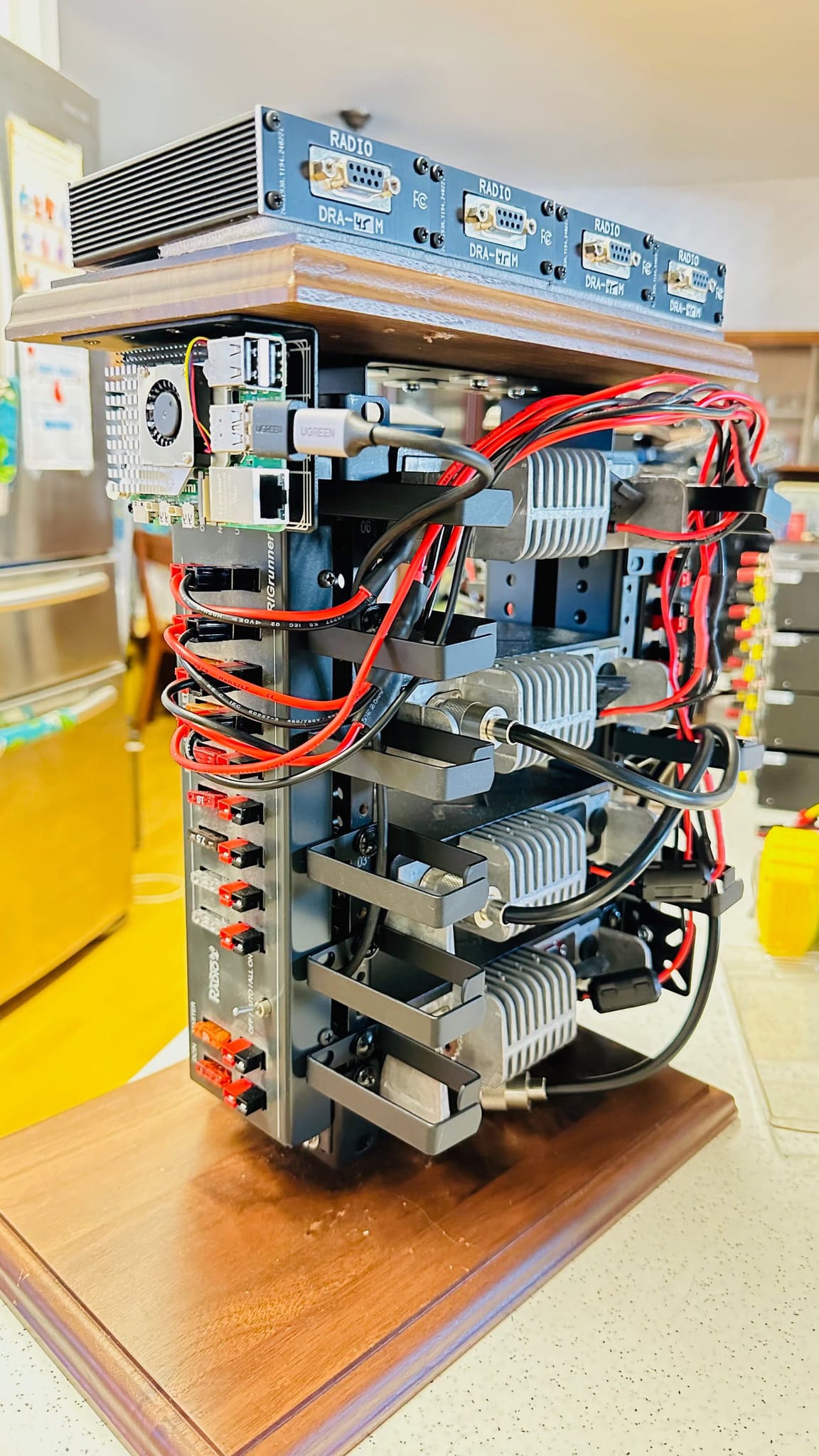
A 144 / 222 / 440 MHz 9600 APRS Stack… and Network!
By Steve Stroh N8GNJ
I discovered a Zero Retries Interesting project in progress, by a highly motivated fan of APRS, to build a network of 144 / 222 / 440 APRS digipeaters on the island of Oahu in Hawaii, USA.
My discovery started with a post by Ron Kochanowicz on the Facebook Group 220 MHz Radio Group:
Jeffrey, KH6JUZ, is bundling a BCM-220 with his 70cm and 2m rigs to build these awesome APRS stations. This [is] being deployed in Hawaii on Oahu. This is really cool to see.
Kochanowicz also links to Bridgecom Systems blog post and a YouTube video (below) with a brief interview of KH6JUZ about his goals with this project: