Zero Retries 0169
2024-09-13 — 2100 Subscribers!, What’s New at DLARC - 2024-09, 802.11ah / HaLow Gets More Mainstream, and Potentially, Integrates with AREDN, Radio-obsessed Civilian Shaping Ukraine’s Drone Defense
Zero Retries is an independent newsletter promoting technological innovation that is occurring in Amateur Radio, and Amateur Radio as (literally) a license to experiment with and learn about radio technology. Radios are computers - with antennas! Now in its fourth year of publication, with 2000 2100+ subscribers.
About Zero Retries
Steve Stroh N8GNJ, Editor
Jack Stroh, Late Night Assistant Editor Emeritus
In this issue:
What’s New at Digital Library of Amateur Radio & Communications - September 2024
Kay Savetz K6KJN802.11ah / HaLow Gets a Bit More Mainstream, and Potentially, Integrates with AREDN
Steve Stroh N8GNJComments for This Issue (redirect to Comments page)
Web version of this issue - https://www.zeroretries.org/p/zero-retries-0169
Request To Send
Commentary by Editor Steve Stroh N8GNJ
Paid Subscribers Update
My thanks to Prefers to Remain Anonymous 49 for upgrading from a free subscriber to an Annual Paid Subscriber to Zero Retries this past week!
My thanks to Prefers to Remain Anonymous 50 for becoming a Paid Subscriber to Zero Retries this past week!
Financial support from Zero Retries readers is a significant vote of support for the continued publication of Zero Retries.
Major Conference Countdowns
Pacificon 2024 in San Ramon, California, USA on 2024-10-18 thru 20 in 5 weeks. Tina KD7WSF and I plan to attend Pacificon 2024 (which makes it “major” to us).
My presentation at Pacificon 2024 - Tracking Technological Innovation in Amateur Radio will be on Saturday 2024-10-19 from 16:00 - 16:50 in Contra Costa Salon 2.
See the Zero Retries Guide to Zero Retries Interesting Events for additional events.
Reply Comments on FCC Docket 24-240 Due on Friday 2024-09-20
If you’re an Amateur Radio Operator in the US, you should care about FCC Docket 24-240, a plan to radically reconfigure the 902-928 MHz band for the proprietary advantage of one company, and would likely render the band nearly unusable for Amateur Radio and most unlicensed (Part 15) uses.
For background, see Zero Retries 0168 which explained the issues from a Zero Retries perspective.
There are two phases of comments:
- Comments on Docket 24-240 were due by end of day 2024-09-05.
- Reply Comments (essentially, comments on the comments) are due by end of day next Friday 2020-09-20.
As of this writing, 958 comments are on file with the FCC for Docket 24-240.
If you didn’t file a Comment, you can still file a Reply Comment. In the FCC’s Electronic Comments Filing System, in the TYPE OF FILING, be sure to select REPLY TO COMMENTS (because we’re now in the Reply Comments period).
Pro Tip - The definition of “Reply Comment” is pretty loose there really isn’t any. The intent of the FCC Reply Comment period is, again, comments on the comments, and if it came to a really detailed legalistic parsing, anything that isn’t a direct comment on a (previously filed) comment wouldn’t be relevant to the FCC. But from everything I’ve been told, “Comments” filed in the “Reply Comments” period are still accepted and considered.
So… just say something. Every little bit helps. Sadly, some large Amateur Radio organizations, and companies, with paid staff, didn’t file comments.
Hopefully we’ll dodge this bullet and 902-928 MHz will be even more usable.
It’s my opinion that if Docket 24-240 is declined and the 902-928 MHz band remains configured as it is now, in just a few years, Amateur Radio and unlicensed (Part 15) users will look back and feel that a major bullet was dodged because both Amateur Radio and unlicensed users will be making more and better use of 902-928 MHz than most folks can imagine at the moment.
Why? Because of the standards effect of IEEE 802.11ah and Wi-Fi HaLow which is (finally) a Wireless Local Area Network (WLAN) standard for the unique properties of spectrum (like 902-928 MHz) below 1 GHz1. Now that there is both a technical standard and an interoperability standard, lower cost units are emerging, and interoperability can be assumed. That means a mass market - better hardware, lower prices, and rapid evolution due to competitive pressure.
There is precedent to imagine such a scenario. The FCC legalized “communications” use of the Industrial, Scientific, and Medical (ISM) bands like 2.4 GHz in 1985. In the following years, some proprietary Wireless Local Area Network (WLAN) hardware emerged for the ISM bands. But it took the creation of the IEEE 802.11b standard being finalized around 1999 that a mass market for Wireless Local Area Network (WLAN) could emerge with reasonably affordable hardware and reasonably assured interoperability. In the IT industry, standardization matters if you want things to really scale… and we finally have good standards for a mass market for consumer (and experimenters, and Amateur Radio) use of 902-928 MHz for data.
2100 Subscribers To Zero Retries!
Unlike previous “century bumps” to the Zero Retries subscriber count that were traceable to a prominent mention of Zero Retries, this latest “century bump” seemed organic - slow, incremental adds (and the usual 3-5% unsubscribes) since hitting 2000 subscribers as of Zero Retries 0165 on 2024-08-16. So, thank you newest subscribers to Zero Retries!
That latter bit deserves periodic mention. The subject matter of Zero Retries - speculation, cheerleading, advocacy, breathless fawning coverage of “Zero Retries Interesting” developments about data communications, microwave, space, general technological innovation in and adjacent to Amateur Radio… isn’t for everyone. Not to mention the irreverent and highly personal editorial tone… Not to mention a lot of folks who read other Substack newsletters who blindly subscribe to every newsletter Substack suggests, including Zero Retries now that the subscriber count is in the thousands.
Thus each week there are always a few folks that unsubscribe to Zero Retries, which is normal, expected, and fine. For those that choose to stick around - Welcome, and Thanks!
Update On Plans To Migrate Zero Retries to the Ghost Platform
For reasons previously discussed, I am actively working to migrate Zero Retries off the Substack newsletter publishing platform to the Ghost newsletter publishing platform by the end of 2024. After a lot of study, I’m comfortable that a migration of Zero Retries from Substack to Ghost is feasible. There are some minor issues to be figured out, and a lot of preparation work to be done, thus a completion date months in the future.
I believe that Zero Retries will be even stronger once it’s hosted on Ghost as Substack is trying to evolve into a new social media ecosystem for (mostly) consumer-focused topics, especially politics. Substack’s “you might be interested in…” suggestions to subscribers of other (non-technical) Substack newsletters referencing Zero Retries are getting kind of comical now.
Going forward, I’ll provide regular updates on the migration, and provide early access to the new platform to the Founding Members and Paid Subscribers. For at least a few weeks, perhaps longer, I’ll likely be publishing Zero Retries in parallel to Substack and Ghost before shifting entirely to Ghost.
Presentation to Granite State Amateur Radio Association
Within one hour of publishing Zero Retries this week, I’ll be doing a presentation about Zero Retries, and the Zero Retries perspective on Amateur Radio to the Granite State Amateur Radio Association (GSARA). I know nothing about GSARA other than they were curious enough about future trends in Amateur Radio to invite me to speak, and they have a very nice, approachable, modern website which, if a person curious about Amateur Radio was directed to, would retain their interest in learning more about GSARA.
In my presentation, I’ll touch on some of the critical technologies and trends about Amateur Radio in the 21st century that I’m seeing in writing Zero Retries. I’ll post the presentation slide deck next week.
Happy Zero Retries Anniversary to Kay Savetz K6KJN
K6KJN has been contributing their What’s New at Digital Library of Amateur Radio & Communications columns to Zero Retries for more than one year now.
Primarily, I’m very grateful to K6KJN for their work on DLARC - it is an incredible resource for Amateur Radio worldwide! Everything that has gone into DLARC - all 124,000+ items, has been “touched” (perhaps “guided” is a better descriptor) by K6KJN in some way, and that is a lot of work. Sometimes that’s hard physical work as in K6KJN’s recent trips to Denver Colorado and Lima Ohio to rescue valuable collections of material for DLARC.
I’ve contributed a lot of material to DLARC, and it’s truly a dream to see some of my unique Amateur Radio material appear in DLARC such as Packet Radio Magazine, thanks to K6KJN’s hard work.
But I’m also grateful to K6KJN for their monthly articles, written uniquely for Zero Retries, of insight into DLARC and Internet Archive’s activities and operations. K6KJN’s first (or, as they termed it, their “Zeroth”) column was in Zero Retries 0115 on 2023-09-08 - One Year Update on Digital Library of Amateur Radio & Communications (DLARC). That article was intended as a one-off “report out” about DLARC, but it was well-read in Zero Retries and at my suggestion (or K6KJN’s… I forget - “mutual agreement”), K6KJN began submitting articles monthly. It’s always a small thrill for me to be able to “read it first” of each monthly article.
Over the past year, K6KJN and I have worked well together, first ingesting my hundreds of pounds, and dozens of boxes of material into DLARC and IA. When I’ve been in the Portland, Oregon area we usually meet up and chat and sometimes I hand over some electronic media for K6KJN to personally read and post into DLARC. Then we began chatting about areas of mutual interest, including what’s now called retro computing (Kay knows a few things about Atari home computers). At some point we became friends, and that relationship evolved into our partnering on the Store and Forward podcast, published “approximately biweekly”.
Kay - Thanks for your hard work on DLARC, your support of Zero Retries, and your friendship this past year!
Early Publication of Zero Retries 0170 Next Week
As with Zero Retries 0168, I plan to publish Zero Retries 0170 early next week to provide some perspective on FCC Docket 24-240 Reply Comments period that ends on Friday 2024-09-20. Unlike Zero Retries 0168, I expect Zero Retries 0170 won’t be a single topic.
Will the Rabid Pace of Technological Innovation In (and Adjacent to) Amateur Radio Please Slow Down?
At least, for a bit? 🤨
Of course, I’m being facetious - I love that interesting stuff keeps happening, and I love reporting it out to all of you, but wow, it just keeps coming! This week I was not expecting that Teledatics’ crowdfunding campaign through Crowd Supply would go live, and as you’ll read below, I consider that development very Zero Retries Interesting.
Have a great weekend, all of you 2100+ co-conspirators in Zero Retries Interesting Amateur Radio activities!
Steve N8GNJ
What’s New at Digital Library of Amateur Radio & Communications - September 2024
By Kay Savetz K6KJN
Program Manager, Special Collections
Internet Archive, Digital Library of Amateur Radio & Communications
Zero Retries Pseudostaffer
Material from Bob Cooper’s (Coop) estate continues to get digitized, and boy is it paying dividends.
One of Coop’s many publications over the years was Coop's Technology Digest, a “confidential industry newsletter" published ten times a year. It’s filled with super interesting contemporary news about television, radio, and the internet. Unsolicited Email Overloads Internet! Titanic Released on VHS! 51-53 MHz Problems Between New Zealand Radio Operators and Ministry of Commerce! It’s all there. 91 issues of the digest were published: the first issue was August 8, 1991, the last was August 29 2002. I found a majority of the issues in the Denver warehouse — all scanned and online now — but somehow we’re missing 19 issues, tantalizingly close to a complete set. Making matters tricky is that the newsletter was published out of New Zealand and it had a pretty small subscription base (about 150-200 subscribers.) Other than DLARC, it only seems to be available in one library in New Zealand. I’ve added those issues to the DLARC Wantlist.
More than a decade before that, Coop published Community Antenna Television Journal “as a service to the CATV/MATV industries serving the American television viewing public.” (I knew CATV meant cable television. I didn’t know that MATV stands for Master Antenna Television, referring to a system where multiple television sets, typically in a large building or complex, are connected to a central antenna or satellite dish.) Although the journal is about cable TV, I am positive there are amazing ideas and history in these pages for amateur television enthusiasts. The first issue was 1974. We have online every issue through June 1979, then only some issues after that date. I don’t know when he stopped publishing CATJ — we have some 1986 issues, so at least that long.
And two decades before that, Bob Cooper was writing for the American Ionospheric Propagation Association’s newsletter, “TV-DX”. The AIPA was a club for TV and FM DXers — enthusiasts who tried to receive standard television and radio signals from as far away as possible. The group was founded in 1953 and lasted until 1963. Thanks to Bob’s estate, we have 60 issues of the TV-DX newsletter. It’s hard to know exactly, but if that isn’t every issue the group published, it’s pretty close. Cooper began writing for that newsletter in 1954 at age 16.
In non-Coop news, the California Historical Radio Society has also been inundating us with amazing material. I’m particularly intrigued with The Low Band Monitor, a newsletter devoted exclusively to 160m, 80m & 40m DXing. It was published by Steve Gecewicz K0CS under the pen name "Lance Johnson". He passed away in 2021 at the age of 73. K0CS wrote extensively about DXpeditions, contests, and sunspots. He started publishing Monitor in 1993, and it ran through at least 2001. But we have only 18 issues, though 1996. I’d love to find more issues of this little publication.
CHRS also sent us a bunch of tapes of CHRS Radio News, an audio newsletter that was published by that group. It featured interviews, segments on radio history, and clips of old-time radio. (Bonus: I digitized the tapes at my new stand-up desk digitizing station.)
CHRS also sent us an ARRL Emergency Communications public service announcement on an adorably tiny reel of 16mm film. Our friends at Prelinger Archives digitized it for us. It’s a little 30-second ad for ham radio featuring Pernell Roberts and Gregory Harrison, stars of Trapper John, M.D, shot on that set.
When I schlepped 200 boxes of books and manuals from Fair Radio Sales to the digitizing center, I handed them one special box and asked them to prioritize it. Sure enough, here it is: scans of 76 Fair Radio Sales catalogs published from 1970 through 2011. These catalogs are a crazy glimpse into the various radio and electronics surplus items sold from their Lima Ohio warehouse over the course of 41 years.
Speaking of catalogs: Recently added to the Ham Radio Outlet Catalog library is the oldest HBO catalog that we have so far: Spring/Summer 1995. Considering that the company has been around since 1971, it seems like we have a lot of catalogs left to add. Do you have any stashed away?
The 2024 EME (Earth-Moon-Earth) conference took place last month in Trenton, NJ. I’ve added all of the papers and slide decks from that event to DLARC’s International EME Conference archive. They didn’t record the talks, but you can learn a lot by browsing the papers and PowerPoint decks of presentations like 432 MHz Moonbounce with a Small Dish and EME at the Deep Space Exploration Society. The next EME con will be held in 2026 in Tenerife, Canary Islands. Sorry for this hot take, but that seems like a more enticing destination than New Jersey.
I haven’t mentioned it much in Zero Retries because ya’ll want ham radio and not college radio, but there’s a whole lot of historical interconnection between the two. My colleague Jennifer Waits has been working on DLARC’s college radio collection, now nearly 1,600 items strong, that includes radio station program guides, flyers, playlists, ‘zines, correspondence, books, academic theses, and magazines. Almost all of this material is freshly digitized, never online before, including 90+ issues of the Intercollegiate Broadcasting System’s Journal of College Radio. Here’s Jennifer’s blog post with more info about DLARC’s College Radio collection.
This final item is a tease, a tantalizing peek into a collection that’s coming to DLARC later this year. Check out these QSL Pennants and Radio Stickers. Most hams know about QSL cards, but perhaps fewer are familiar with QSL pennants: decorative flags or banners for radio stations. I scanned this collection of pennants as part of a much larger collection of shortwave material that I’m excited to tell you more about soon.
Next month I’ll be at Pacificon in California, giving a presentation about DLARC and hanging out at the DLARC booth. Come say hi. First, I need to create some materials for the booth. I’d like to print some brief quotes about how people have benefitted from the materials they’ve found in the library. So if you’d like to provide some feedback about how DLARC has helped you, please shoot a me quick message at the email address below.
Digital Library of Amateur Radio & Communications is funded by a grant from Amateur Radio Digital Communications (ARDC) to create a free digital library for the radio community, researchers, educators, and students. If you have questions about the project or material to contribute, contact me at kay@archive.org.
…
K6KJN and N8GNJ are co-hosts of the Store and Forward Podcast - a podcast about the past and future of amateur radio. K6KJN offers their perspective about recent developments in the Digital Library of Amateur Radio and Communications, and I offer my perspective about recent exciting developments covered in Zero Retries.
802.11ah / HaLow Gets a Bit More Mainstream, and Potentially, Integrates with AREDN
By Steve Stroh N8GNJ
I’ve been following the progress of a small company in Westford, Massachusetts, USA called Teledatics for more than a year now since the introduction of their initial product that operated in the 902-928 MHz band, which I discussed in Zero Retries 0038 - Halo TD-XPAH - New 902-928 MHz 802.11ah Radio. Teledatics has now begun its crowdfunding campaign for HaloMax, its next generation of 802.11ah / HaLow products for 902-928 MHz.
Reference - Zero Retries 0162 - New Distance Record Claimed for 802.11ah (Wi-Fi HaLow) on 902-928 MHz (33 cm) Band
This is one of those rare “best of times / worst of times” moments for experimenters… or just users… of radio technology for fast data communications.
The best of times perspective is that in the past few years, IEEE 802.11ah / Wi-Fi HaLow has emerged as a technical standard and an interoperability standard, which opens the possibility of longer range “Wider-Fi” radio-based networking using the 902-928 MHz band. To date, the vast majority of products for data communications in 902-928 MHz have been proprietary, and thus expensive, and non-interoperable with other vendor’s products.
The worst of times perspective is the requested reconfiguration of the 902-928 MHz band by NextNav in FCC Docket 24-240. If the FCC agrees with NextNav and reconfigures 902-928 MHz per NextNav’s request, that would almost certainly destroy the utility of the 902-928 MHz for unlicensed (Part 15) users such as those who would like to use 802.11ah / HaLow products.
For months, I’ve been in email communication with Teledatics CEO James Ewing about Teledatics’ pending next generation of 802.11ah / HaLow products. (It’s a relief not to have to keep this information confidential any longer.) My initial contact with Ewing was to point out that there’s a potential market for Teledatics’ products for 902-928 MHz with Amateur Radio Operators who have enhanced capabilities in 902-928 MHz including the ability to operate higher power transmitters than unlicensed (Part 15) users. In particular, I mentioned the possibility of extending Amateur Radio Emergency Data Network (ARDEN) mesh networking into 902-928 MHz. Currently AREDN is capable of being used in the 2.3 / 2.4 GHz band with some Wi-Fi and Wireless ISP (WISP) units, but is mostly used in the 5.x GHz band. While 5.x GHz works with clear line of site (think users looking up at a mountain or communications tower with no trees in the way), those with trees in their path are constrained, and AREDN usage isn’t really practical… or at least reasonable without a tall tower to “shoot above the trees”.
But, the physics of radio spectrum is that 902-928 MHz radios (similar to VHF and UHF radios) can penetrate trees. So if we could add 802.11ah / HaLow units to an AREDN mesh, on the logical level that 2.x and 5.x GHz AREDN users could interoperate with 902-928 MHz AREDN users, that… would be highly useful.
It’s a fantasy… for a later time, that 802.11ah / HaLow units could be adapted to operate in the (shared) Amateur Radio bands at 219-220 MHz, 420-450 MHz, and 1240-1300 MHz. The 802.11ah standard includes channel sizes as small as 1 MHz, for up to 12 Mbps (using 256-QAM). Thus that idea is feasible, potentially through the use of a wideband transverter, but creating such a unit would require demonstrating a reasonable market within Amateur Radio.
Ewing was intrigued enough at my suggestion of Amateur Radio usage of Teledatics’ products and the potential of AREDN, especially that it is open source and based in part on OpenWRT, that he recently got his Amateur Radio license - KC1UDQ so that he can experiment with Teledatics products with Amateur Radio capabilities in addition to using it for unlicensed (Part 15) activities.
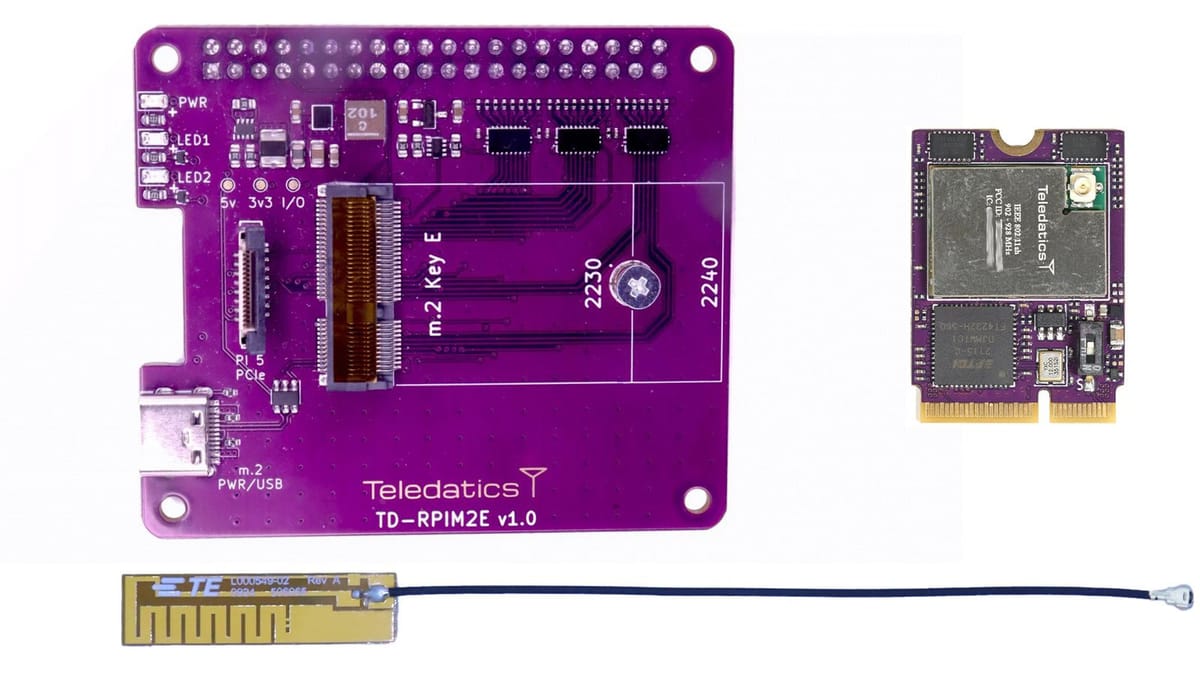
This week, Teledatics launched their crowdfunding campaign for their family of HaloMax™ Long-range Wireless products through Crowd Supply. There are a number of units offered, the most interesting of which (to me) is the
HaloMax™ Raspberry Pi bundle
Raspberry Pi compatible daughterboard, TD-HALOC HaloMax™ m.2 card, TE Connectivity L000549-02 3.3 dBi antenna
$119 $8 US Shipping / $18 Worldwide
Personal note… it still blows my techie mind that a data radio unit that can potentially do > 100 Mbps in 902-928 MHz… comfortably fits in half of the palm of my hand (m.2 form factor). I’ve long since come to terms that a 1 TB memory “card” the size of my smallest fingernail could easily be lost in a shag rug carpet if it was dropped… but I’m still working on grokking that level of capability and compactness for radios.
That’s a really reasonable price point for experimenting with the capabilities of 802.11ah / HaLow. Of course, multiply that x2 for being able to do one’s own experiments, but if this became a club (or just a few co-conspirators) project, a group buy would be a lot of fun.
I think these new Teledatics products (HaloMax) are the most compatible with Amateur Radio experimentation with 802.11ah / HaLow that I’ve seen to date. They can be integrated into a “radio on pole” unit, (theoretically - needs to be tested) powered by a Raspberry Pi using a Power over Ethernet (POE) HAT. The Teledatics units provide an external antenna connector so that a reasonable gain outdoor-rated 902-928 MHz antenna can be used.
But… a few disclaimers:
First, if you participate in this crowdfunding campaign, the stated ship date (which really can’t be more than an estimate) is 2025-02-09. That said, the production will be done in the US, so this date is probably a lot better than the more usual “let’s hope that our suppliers in China come through on time” estimate.
Second, this is a crowdfunding campaign, with all the baggage of that form of “purchase”.
Third, there is of course the issue of the future of 902-928 MHz (in the US) with FCC Docket 24-240.
All that said… despite having had some poor experiences with previous crowdfunding campaigns through Crowd Supply, with (what I consider) poor oversight and poor customer service from Crowd Supply… my history of communications with Teledatics CEO James Ewing gives me enough confidence in this Crowd Supply crowdfunding project to “buy in” for at least a pair of the Raspberry Pi bundle.
But that last is just me and my personal perspective.
Update - tap, tap, mouse, mouse, click click… I’m now a backer of HaloMax for two Raspberry Pi bundles. I look forward to February, 2024 and unlike the previous units from Teledatics, these will get on the air soon after they arrive.
ZR > BEACON
By Steve Stroh N8GNJ
Short mentions of Zero Retries Interesting items.
New Ryobi 18V ONE+ 120-Watt Power Source With 12V Output
I’m a member of the “Ryobi ONE+” household battery devices “tribe”. There are many other such tribes2 based around interchangeable batteries and portable power tools that use those batteries. Having bought into the Ryobi ONE+ ecosystem of batteries and gadgets nearly a decade ago now, I’m content to be locked in to the ONE+ tribe. In my opinion / observation / usage, Ryobi does a decent job of coming out with good gadgets and the batteries are of good quality and are reasonably long lived - I have several batteries that have lasted seven years and are still working well. It’s also convenient that many ONE+ units are stocked at Home Depot3.
The one gadget that I’ve wanted, and until very recently, Ryobi did not offer, was a power module that could output 12 volts (has an internal DC-DC converter). There have been numerous non-Ryobi ONE+ 12 volt adapters that use dubious electrical connections, 3D printed cases, poor mechanicals, etc. Considering the energy density of my larger Ryobi ONE+ batteries, I wasn’t willing to consider using something like those. I just kept hoping for a ONE+ 12 volt adapter from Ryobi, and finally that wait is over.
The new “18V ONE+ 120-Watt Power Source with 12V Output”4:
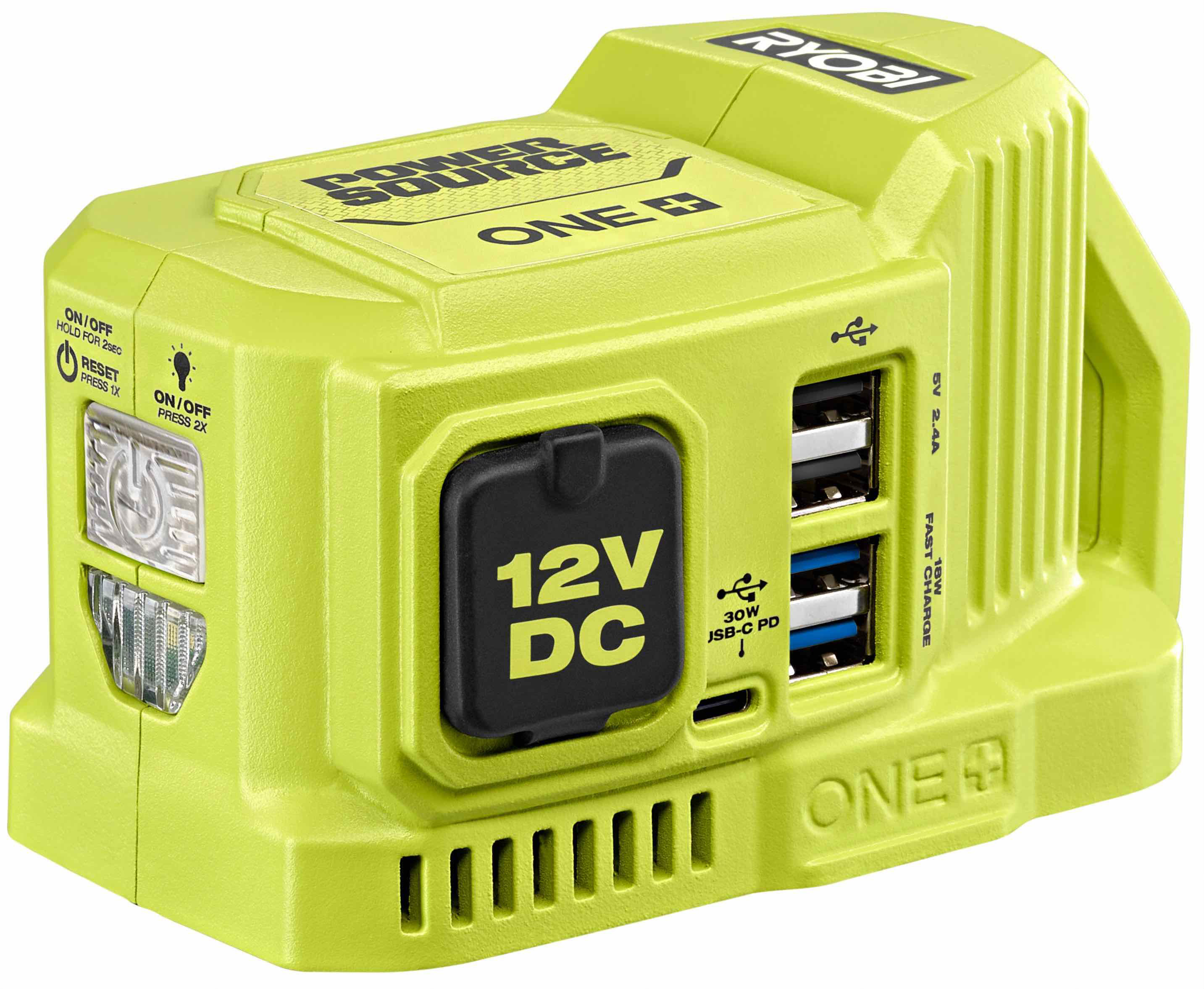
Under the “12VDC” flap is a “cigarette lighter” socket, and Ryobi states that it’s good for “120 watts”, so doing the math, you can pull up to 10A out of that. But considering the largest batteries I have are 7AH units, that big a load is not that realistic. But in a pinch, for recharging some Amateur Radio systems, phones, tablets, and other USB-powered devices, it looks like a good choice (I bought two). Of course, the logical accessory to this for Amateur Radio use is a mating plug and Anderson PowerPole adapter and splitter, which I already have.
Obviously this isn’t the solution to backup 12 volt DC power, especially given that I have to switch batteries for long term power needs, but I like that it’s a point solution. Where I need 12 volt backup power for a while (like on a project bench), I can just plunk one of these down and don’t have to run extension cords from my other AC to 12 volt power supplies or bigger backup power sources. I can just pick this up, plug in the load, and it’s usable for hours.
If you just need 2x USB A ports for ONE+ batteries (no 12 volts, no AC, no USB-C, there’s the Ryobi 18V ONE+ Portable Power Source.
Mercury v0.3 - Linux and Windows
Rafael Diniz on the ARDC Community email list:
We just released Mercury 0.3. Now runs on Linux and Windows.
ChangeLog:
- Audio I/O rewrite.
- Windows support
- New shared memory modes
- Command line switches
More at: https://github.com/Rhizomatica/mercury/releases/tag/0.3
I uploaded a Windows binary here:
https://github.com/Rhizomatica/mercury/releases/download/0.3/mercury-0.3-w64.exe
Briefly, Mercury is “just a modem” (software equivalent of a dialup modem; not even as full featured as a typical Terminal Node Controller - TNC). Thus Mercury requires other software to manage it to establish connections, work with the computer to upload, store files, display incoming data, handle the keyboard, etc.
But in that simplicity… is huge flexibility:
Supported clients
Mercury alone is not very useful. A client is needed to receive and transmit information using Mercury. The folder "examples" has a transmitter and receiver example to use with the TX_SHM and RX_SHM modes. A more complete client called HERMES-BROADCAST to be used for data broadcast which uses RaptorQ codes is available here: https://github.com/Rhizomatica/hermes-broadcast .
For a simple ARQ client which supports hamlib, take a look at: https://github.com/Rhizomatica/mercury-connector
Any VARA client should be compatible with Mercury. Compatibility support is not complete. If you find a VARA client which does not communicate, please report. Base TCP port is 7002 (7002 control and 7003 data).
For a more complete ARQ client which integrates Mercury to UUCP, look at: https://github.com/Rhizomatica/hermes-net/tree/main/uucpd
It would be cool to see how Mercury performs with a good control program like VarAC.
I can envision Mercury as the HF component in a basic HF station for data communications, especially given Rhizomatica’s other goal of using an open source radio such as the sBitx. Add a basic power supply and a basic HF antenna, and you have a decent data communications radio for regional communications.
And this is only version 0.3! I’m very much looking forward to see Mercury evolve over the coming years.
OpenRTX Team Releases First Open Source Version for A36plus MAX
Per email from Wojciech Kaczmarski SP5WWP:
The renowned developer team, OpenRTX, has recently released the first open-source version for the Talkpod A36plus MAX. This marks a significant milestone for the A36plus MAX, a device equipped with 128K+2M of large memory. This substantial memory capacity not only supports basic functionalities but also provides developers with a robust environment to expand and customize features according to their needs.
Key Features of A36plus MAX With its expansive memory, the A36plus MAX offers endless possibilities for developers to innovate. Whether you want to add new functionalities or enhance existing ones, the A36plus MAX provides the perfect platform. Its color LED screen opens up opportunities for creating engaging mini-games, displaying clearer radio waves, signal waterfalls, and much more.
It’s finally happening, in a substantive manner, that radio manufacturers are directly supporting open source alteration of the operating characteristics of their radios. The manufacturers that embrace this trend will do very well.
Though this development specifically references OpenRTX, which has done amazing things with some other radios, this announcement isn’t definitive about the scope of what third party, open source software can actually do to the base characteristics of the radio:
Whether you're interested in enhancing the device's functionality or exploring the possibilities of its color LED screen…
OK, nice that third party software can:
… creating engaging mini-games…
But what’s really needed is to have access to the base functionality of the radio for adding, for example, M17 compatibility or especially (audio based) data modes, access to I/O such as USB connectivity (do data modes with the A36plus MAX plugged into a laptop via USB…), remote control (change frequencies, etc.).
Again, this is finally happening, and not a moment too soon for our newest generation of younger Amateur Radio Operators with a techie background that are coming in ready to engage their mad hacking skilz on radios!
Two Notes About IPv6
Comment on Zero Retries 0166 by Ben Kuhn KU0HN:
Hurricane Electric (one of the big tier-3 internet transit providers) offers free IPv6 "certifications." I put it in quotes because I don't think it would really help on a resume, but the program is a great way to learn IPv6 by doing. To make it all the way through you need to set up IPv6 somehow, either using an allocation from your ISP or one of their IPv6 tunnels, and set up DNS, a web server, and a mail server. It's a great little home lab activity.
Email from Ren Roderick K7JB:
Interesting video by Network Chuck about a recent attack on IPv6...