Zero Retries 0162
2024-07-26 — Irrational Exuberance About Amateur Radio - Four Data Points, New Distance Record Claimed for 802.11ah (Wi-Fi HaLow) on 902-928 MHz (33 cm) Band, WSJT-X SuperFox Verification is Flawed
Zero Retries is an independent newsletter promoting technological innovation that is occurring in Amateur Radio, and Amateur Radio as (literally) a license to experiment with and learn about radio technology. Now in its fourth year of publication, with 1900+ subscribers. Radios are computers - with antennas!
About Zero Retries
Steve Stroh N8GNJ, Editor
Jack Stroh, Late Night Assistant Editor Emeritus
In this issue:
Irrational Exuberance About Amateur Radio - Four Data Points
New Distance Record Claimed for 802.11ah (Wi-Fi HaLow) on 902-928 MHz (33 cm) Band
Comments for This Issue (redirect to Comments page)
Web version of this issue - https://www.zeroretries.org/p/zero-retries-0162
Request To Send
Commentary by Editor Steve Stroh N8GNJ
Paid Subscribers Update
My belated thanks to Prefers to Remain Anonymous 21 for becoming a New Annual Paid Subscriber to Zero Retries on 2024-02-09. That acknowledgement should have appeared in Zero Retries 0139, and I apologize for that omission.
My thanks to Prefers to Remain Anonymous 06 for being a Renewed Annual Paid Subscriber to Zero Retries this past week!
My thanks to Prefers to Remain Anonymous 07 for being a Renewed Annual Paid Subscriber to Zero Retries this past week!
My thanks to Prefers to Remain Anonymous 40 for upgrading from a free subscriber to Zero Retries to an Annual Paid Subscriber to Zero Retries this past week!
Financial support is a real vote of confidence for continuing to publish Zero Retries.
Major Conference Countdowns
- JARL Ham Fair 2024 in Tokyo, Japan on 2024-08-24 and 25, in 4 weeks!
- Pacificon 2024 in San Ramon, California, USA on 2024-10-18 thru 20 in 12 weeks. Tina KD7WSF and I plan to attend Pacificon 2024 (which makes it “major” to us). I have offered to do a presentation about Technological Innovation in Amateur Radio, and (I think) my proposal has been accepted.
See the Zero Retries Guide to Zero Retries Interesting Events for additional events.
The Writing Just Gets Away From Me Sometimes
This is yet another issue of Zero Retries where the content just got away from me, and the only external indication that I had written too much was that my butt became numb from sitting too long. There are many times over the now three years of Zero Retries where the writing is just fun, and this was one of those weeks.
You’ll notice a lot of attention given to the 902-928 MHz band in this issue. There are three reasons. The first is because it’s probably my favorite band, mostly for all the interesting “Part 15” uses it has been put to over the decades since being opened for communication use in 1985. For example, a continuously deferred writing project, that I still hope to do one day, is to write a small book about the history of Metricom, who was the first company to attempt to provide a commercial Internet service using an ISM band, preceding the rise of Wireless Internet Service Providers doing so by at least a half-decade, if not more. When Metricom attempted that, the FCC initially said, “Um no, you can’t provide a commercial service in an ISM band”. Metricom said “show us in your rules where it says we can’t”. Point taken, and the FCC stood down. If you’re really interested in 902-928 MHz, I recommend reading that section in the great book Wireless Spectrum Finder, beginning on Page 153. (Thank you, Internet Archive, for making it available online, and author Bennett Z. Kobb AK4AV for writing a great book!).
The second is that writing about the myriad, and at times downright whacky uses of 902-928 MHz will be one of many recurring themes in a newsletter that I will launch sometime in Fall, 2024 that will feature my unconventional perspective on the foibles of the telecom / Internet industry. (How’s the construction of that new 5G network coming along, Dish Networks?) Most of the stories I’ll write there will relate to radio technology. I’ll be telling interesting stories to a non-Amateur Radio audience that will hopefully find that newsletter interesting enough to pay a reasonable subscription fee. At a minimum, it will be an interesting experiment for a year to see if it’s a viable product.
Third, 902-928 MHz is the “magic band” between UHF and Microwave with some of the best aspects of both. It’s nearly as large as 420-450 MHz (26, vs 30 MHz), but still relatively easy to work with, using yagi beam antennas, reasonably-priced coaxial cable, etc. with less risk to eyeballs, etc. from microwave transmissions.
Calculated Ignorance of Amateur Radio
Post publication update - see Zero Retries 0165 - Followup to The LEO Satellite Industry Needs More Engineers for an update relevant to this mini-article. Turns out, Amateur Radio is a prominent part of this program.
In Zero Retries 0140, I wrote an article titled Amateur Radio and the Growth of the Spectrum Workforce in the US National Spectrum Strategy (which turned out to be a short series). Basically, the US needs (and the US Government painfully recognizes this need) many more employees that understand radio technology. It was painful to see the “gyrations” that the panelists (and government agencies) have done to recruit people into training programs to create such expertise… all while completely ignoring the existence of Amateur Radio and that participating in Amateur Radio is a defacto self-education in radio technology.
In ZR > BEACON in this issue, I mention a similar situation about the Low Earth Orbit (LEO) satellite industry needing more employees with expertise in radio technology… but completely ignoring that Amateur Radio has been self-educating Amateur Radio Operators on radio and LEO satellite technology - for decades!
Originally I thought this was simple ignorance; the perception that Ham Radio was a thing from back in the 1950s with a huge antenna on a tower, with Grandpa sitting in the basement in front of a big tube radio set, tapping on a Morse Code key… right? That couldn’t possibly have anything to do with modern telecommunications - cell phones, Wi-Fi, or LEO satellites… right?
But now I think something else is occurring - a “calculated ignorance” of the existence of Amateur Radio and the role of Amateur Radio Operators to self-educate themselves about radio technology. I remember a memorable phrase attributed to a principal of Ziff Davis magazine publishing group when Popular Electronics (which featured a lot of electronics projects that hobbyists could tackle) transitioned to “Computers and Electronics” (with few or no projects). The quote was something like “We’re glad to make that change; we’d rather not be publishing magazines for the dirty fingernails crowd”.
I don’t think this “calculated ignorance” of Amateur Radio can last much longer - in government, in companies, in society. They need the help, (and they need it more, every month). Their “system” of recruitment, special programs, scholarships, industry training, isn’t working, at least fast enough. The “spectrum workforce” is rapidly aging out, having drawn from the big pool of radio technology experience resulting from the two way radio industry, the early cellular industry, the military (back when they didn’t depend mostly on satellites, so they cared about training radio operators), the Bell system employing lots of radio technology experts to maintain microwave networks and car telephones, even television repair. Radio equipment broke a lot back then, so you needed a lot of people that could keep it all working. Now, you mostly hear about computers and networking, and not much need for radio technology expertise if you follow the manufacturer’s guidelines for deploying Wi-Fi access points.
In considering the replacement of the Spectrum Workforce that’s aging out, it’s a much shorter leap to reach into the ranks of Amateur Radio to get that expertise than starting from scratch. In saying that, I’m not positing that the average Amateur Radio Operator is qualified to start designing cellular towers or user terminals for Low Earth Orbit satellites on the basis of their Amateur Radio experience. (I’m sure not!) But Amateur Radio Operators understand the basics of radio technology from their hands-on experience a lot better than the average person who’s never had any hands-on experience with radio technology. If you start with a Ham, you get a better, more capable Spectrum Workforce - like Qualcomm did when they recruited and hired Phil Karn KA9Q. (Read on for the relevance of that reference.)
Congrats to Tom Salzer KJ7T on 100 Issues (and 1000 Subscribers) of Random Wire Review Newsletter!
This week, KJ7T has published another all Zero Retries Interesting issue of Random Wire Review and it coincides with achieving 1000 subscribers. It’s work and commitment to publish your content consistently, and keep it consistently interesting that 1000 people commit to following your work and allow your content to come into their email inbox every week.
Congrats, Tom, and I look forward to Random Wire Review every Friday morning!
73,
Steve N8GNJ
Irrational Exuberance About Amateur Radio - Four Data Points
By Steve Stroh N8GNJ
- Nothing great has ever been accomplished without irrational exuberance.
Tom Evslin - Irrational exuberance is pretty much the business model of Zero Retries Newsletter.
Steve Stroh N8GNJ
I used to have these two quotes on the “masthead” of Zero Retries… until Zero Retries started to get “too long” and I moved them to the About Zero Retries page to make more room for “content”.
My “irrational exuberance” about Amateur Radio has gotten me through some rough moments and low points over the three years I’ve been writing Zero Retries, such as observing too much unwarranted (in my opinion) gloom, apathy, and misogyny, and way, Way, WAY too much “Well… that’s not real Amateur Radio…” stupidity being expressed.
There is just so much cool and interesting about Amateur Radio, and even if I had started as an Amateur Radio Operator as a teen (as some have), I don’t think two full human lifetimes would be enough to learn all that I’m endlessly curious about within Amateur Radio. Here are three four recent stories from my perspective about why Amateur Radio (and having Amateur Radio as a part of your life) is just cool, and keeps me endlessly interested in always learning more.
HamWAN Lookout Node Repair
Last Saturday 2024-07-20, I spent the day on top of a local mountain - Lookout Mountain1. I was one of three “ground crew” on a mission to repair two dead sectors of the “Lookout” node of the Puget Sound Data Ring (aka HamWAN).
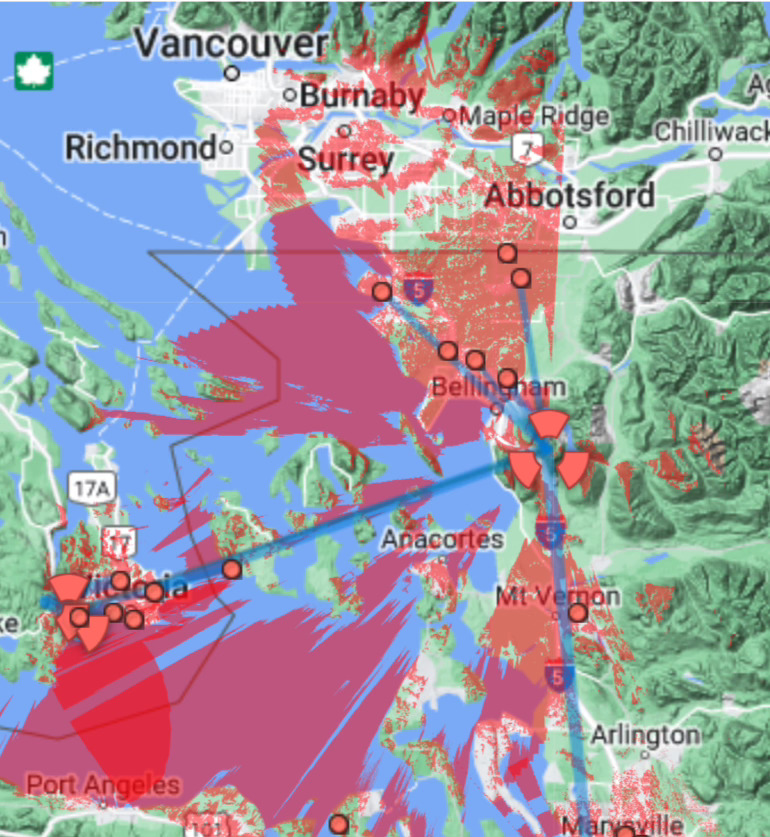
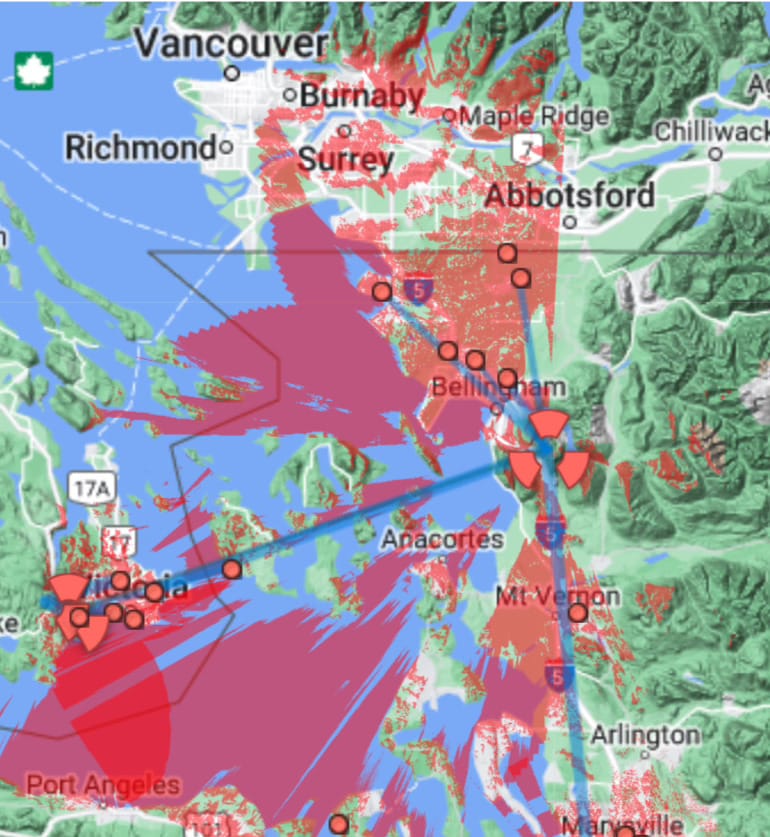
Here’s the detail from clicking on the “nuclear symbol” of the “Lookout” node near Bellingham, Washington:
Lookout
Three sectors, plus backhaul links to SnoDEM,and Triangle Mnt
Triangle-Lookout link
Lookout-Snodem linkdistance: 53.0 milessignal strength: -58 dBmspeed: 115.5 Mbps
The red overlays indicate a general coverage to one of the sectors on Lookout on 5.9 GHz, with reasonable effort on the user’s station such as getting a dish antenna elevated in the clear.
“Sectors” are 120 degree coverage on 5.9 GHz (Amateur Radio semi-exclusive) for user access. “Links” are point-to-point, narrow-beam, high performance redundant links for “backhaul”. Triangle is another high profile communications site in British Columbia, Canada to the North, and “Snodem” is a communications tower at the Snohomish County (Everett) Washington Department of Emergency Management headquarters.
During the previous winter, the Lookout node experienced cable damage to two of its three sectors and it was hoped that replacing the cables would restore the two sectors for full function. Fortunately that was the case - while it wasn’t simple, easy, or fast to replace the damaged cabling for the two tower climbers, it was a known process and we were able to complete that task. By late afternoon, Lookout’s three sectors were working, along with the two point-to-point links, restoring the full functionality of the Lookout node.
The Puget Sound Data Ring - PSDR (the name of the this particular network, the original / proof of concept) HamWAN (the overall technology / network architecture) is a remarkable achievement of a small group of dedicated Amateur Radio Operators to build a resilient, high speed microwave network that covers the heavily populated areas of Western Washington from Bellingham in the North, nearly to Vancouver Washington in the South. One of the primary points of design of each PSDR node is that if there is damage to sectors or point to point links on a node, the node incorporates all necessary services for that node to continue to function “standalone”. Thus users on a single sector can continue to communicate via that sector, or multiple sectors, etc. with no dependence on centralized services such as the case (and, thus, failure prone) cellular networks, or commercial microwave networks, etc.
The existence, for years now, of PSDR has been a point of irrational exuberance to me. PSDR demonstrates that a small group of Amateur Radio Operators can create and maintain such a network, and the network owners allow its use, unrestricted, by any Amateur Radio Operator that can put in the minor work to build their own user node, and learn enough about TCP/IP networking to use it without causing disruption to the network or other users. There are a number of Amateur Radio microwave networks in the US, but most (that I’ve heard of) are restricted to “authorized” users, not general access. Rocky Mountain Ham Radio’s Amateur Microwave Network is an example. That PSDR is “open access” is thus more remarkable. PSDR is “living proof” of the relevance of Amateur Radio in the 2020s - a long-distance, multi-node, high speed TCP/IP network supporting modern network services and devices such as VOIP phones, live view cameras, videoconferencing, large file transfers, etc. PSDR lives up to the ideals of Amateur Radio by offering free-to-access services and thus actively encourage Amateur Radio learning and experimentation. PSDR also makes a handy backup communications system when other communications systems fall down.
Long time readers of Zero Retries have read my regular references to the “glory days” of the Puget Sound Amateur Radio TCP/IP Network, the network of 9600 bps bit-regenerating data repeaters operating in the Seattle, Washington area in the 1990s. As much as I miss the PSARTN, and hope (and evangelize) for the equivalent capabilities in the 2020s… having the pretty unique microwave, fast, all-TCP/IP Puget Sound Data Ring is the modern equivalent of the PSARTN.