Zero Retries 0146
2024-04-05 — Amateur Radio Data Appliance: URC & U-Pi-S, Connect Systems Unveils Planned Radios With M17 as a Standard Feature, Detailed Plans for Immediate Future of APRS Foundation
Zero Retries is an independent newsletter promoting technological innovation that is occurring in Amateur Radio, and Amateur Radio as (literally) a license to experiment with and learn about radio technology. Now in its third year of publication, with 1500+(!!!) 1400+ subscribers.
About Zero Retries
Steve Stroh N8GNJ, Editor
Jack Stroh, Late Night Assistant Editor Emeritus
In this issue:
Connect Systems Unveils Planned Radios With M17 as a Standard Feature
Web version of this issue - https://www.zeroretries.org/p/zero-retries-0146
Request To Send
Commentary by Editor Steve Stroh N8GNJ
Zero Retries Hits 1500 Subscribers!
Honestly, folks… when I began publishing Zero Retries in July 2021, I had no idea that my quirky little newsletter about a niche, of a niche, of a niche1 would become this popular.
For the benefit of newer subscribers, Zero Retries was begun solely out of frustration that despite so much technological innovation occurring in Amateur Radio, there was no one place to know about it / read about it. Such stories were only mentioned very occasionally in the “mainstream” Amateur Radio media. Eventually that frustration boiled over into publishing Zero Retries. At that time, I could imagine that Zero Retries might, conceivably achieve 500 subscribers - that would have been fantastic. 1000 subscribers was “oh… my…”.
And, now, 1500 subscribers?!?! Really, I had not imagined that milestone. In addition to email subscribers, I also have a small following on Substack (via the Substack app) and readers from my notifications of new issues of Zero Retries on Mastodon (@n8gnj@mastodon.radio) and Bluesky (@n8gnj.bsky.social).
This latest surge in subscribers was, in large part, to a very nice mention by Mark Herbert G1LRO - see the first story in this issue. Thanks G1LRO!
My sincere thanks to all the Founding Members and Paid Subscribers who are helping keep Zero Retries going by offsetting some of the expenses incurred with Zero Retries. I plan to publish mention of all financial contributors annually on the (July) anniversary issue.
Major Conference Countdowns
- Hamvention 2024 in Xenia, Ohio, USA on 2024-05-17 thru 19, in 06 weeks!
- HAM RADIO 2024 in Friedrichshafen, Germany on 2024-06-28 thru 30, in 09 weeks!
- JARL Ham Fair 2024 in Tokyo, Japan on 2024-08-24 and 25, in 20 weeks!
See other events at the Zero Retries Guide to Zero Retries Interesting Conferences.
Sometimes Zero Retries Practically Writes Itself
This is one of those rare weeks that at the beginning of the week, I already know the major themes of the upcoming issue of Zero Retries. Significant developments happened throughout the weekend immediately following Zero Retries 0145, and the challenge is in capturing it all to report out here in Zero Retries.
For this issue… Zero Retries probably wrote itself too much. I have no idea what Substack is going to do with an issue this large. Substack’s new “statistics state this issue is 9703 words, 481 sentences, and “reading time - About 45 minutes”. I previously worried about that problem and once published a long issue of Zero Retries in three simulatenous parts, but that ultimately proved to be a bit too painful to manage. So, I’m going to just let fly with this way-too-big-for-an-email-newsletter Zero Retries 0146… and we’ll see how it goes.
DLARC Box 24 - Away!
This past week I packed up and shipped my 24th box of paper media relating to Amateur Radio and Communications to be digitized and made available in Internet Archive’s Digital Library of Amateur Radio & Communications (DLARC). I’m very proud to participate in DLARC and contribute unique material into DLARC that’s never been available online and publicly accessible. Box 24 included:
Issues of the original Zero Retries, the newsletter of the Northwest Amateur Packet Radio Association (NAPRA),
Orbit Magazine issues 1 - 18 (except, somehow, Issue 10),
Various Amateur Radio books2 I purchased inexpensively at a recent electronics flea market,
Manuals and sales material about a major manufacturer’s packet radio products from the 1980s.
Seriously folks… look around your shack at the paper (and electronic) media that you’ve accumulated and imagine its value to future (and present) generations of Amateur Radio Operators… and its likely demise at the recycler’s if you don’t make provisions for it now, while you can. If you’re so inclined to contribute to DLARC, contact:
Kay Savetz K6KJN
Program Manager, Special Collections
Internet Archive, Digital Library of Amateur Radio & Communications
kay@archive.org
And, kudos to ARDC for having the vision to fund a large grant 3 to Internet Archive to create DLARC… and gratitude to K6KJN for stepping up to manage DLARC (it’s a lot of work).
Excitement About Amateur Radio Technological Innovation
I mean no disrespect to anyone for their opinions… but from my perspective (albeit being occasionally privy to some exciting, but private info)…
If you aren’t excited about the potential of Amateur Radio in the next few years… you’re just not looking at the same end of the “telescope” that I’m looking at.
In 2024 and beyond, Amateur Radio has better tools, more opportunities, and more talent and collaboration coming into it than ever before. If all you’re seeing in Amateur Radio is the same old, same old… and “inevitable decline”, you’re simply not looking in the right places. There’s so much going on in Amateur Radio and adjacent to Amateur Radio that I can’t keep up at times to report out all of what’s going on in technological innovation in Amateur Radio.
I’m a bit silo’d off in this corner of the world, writing Zero Retries and working on various projects in N8GNJ Labs. To keep up my personal enthusiasm for Amateur Radio, it’s become apparent that I gotta get out more and mingle with the co-conspirators of technological innovation in Amateur Radio. Home Power magazine used a great phrase to describe such folks - Them That’s Doing.
Part of that is to go where such folks gather, and yes, that’s on me to get myself there. Though I’m unable to attend Hamvention 2024, I’ll be attending SEA-PAC (Seaside, Oregon, USA) in June and Pacificon (San Ramon, California, USA) in October. I also hope to “go North” a bit and perhaps mingle with some of the folks at various Vancouver, British Columbia Amateur Radio Clubs (especially Surrey Amateur Radio, which is the parent organization of the amazing newsletterzine The Communicator).
But another part of having more interactions with co-conspirators in technological innovation in Amateur Radio is to create online opportunities specific to Zero Retries Interesting subject matter. To that end, within the next few months I’m going to start a series of Zero Retries videoconference meetings specifically to discuss Zero Retries Interesting topics. For example, I’m a big fan of Radio Amateur Training Planning and Activities Committee (RATPAC) - they do a great job, and some of their presentations are quite Zero Retries Interesting.
One unique aspect of the Zero Retries videoconferences will be that with Zero Retries, I can follow up presentations with written material, beyond what RATPAC (or most other Amateur Radio videos) do with posting videos and slide decks. With 1500 potential attendees from the Zero Retries subscriber list, that would be a bit overwhelming, so I’m going to have to figure out a way to keep it manageable - To Be Determined.
In The Meantime…
- There are a few mostly sunny days in the weather oracle’s (app) forecast for this coming week that I’m looking forward to.
- I’m still contemplating next steps about the bent antenna pole. Fixing it will require ladder work that I’m not looking forward to.
- The Color Computer ephemera still awaits boxing up.
- I’ll be working on an outline for my talk later this month at LinuxFest Northwest 2024 here in Bellingham, Washington on the subject of Amateur Radio and Linux. The actual presentation will be about Amateur Radio and the Open Source ethos, not just Linux.
- I’m overdue on a long-deferred project to put a radio on the air with VARA FM; my thanks to a long-waiting co-conspirator for this here in Whatcom County who is ready to test with me. Then, build up a VARA FM demonstration system with two 222 MHz radios, two modems, and two laptops for a planned demonstration later this month.
- I’ll be spending significant butt-in-chair time spent on my upcoming book The Zero Retries Guide to Amateur Radio in the 21st Century.
- Zero Retries 0147 is already starting to write itself with a Zero Retries Interesting article contributed and an interesting development already influencing the theme of that issue.
73,
Steve N8GNJ
Amateur Radio Data Appliance: URC & U-Pi-S
By Steve Stroh N8GNJ and Mark Herbert G1LRO
In Zero Retries 0136 - Reimagining Amateur Radio Part 2 - Data Appliance, I wrote a description of what I through Amateur Radio needed to participate on Amateur Radio data modes was an integrated, clean system that could be stuck in a corner (no need for a “shack” or even a desk) and you accessed it and conducted your Amateur Radio (data) activities via a laptop or tablet or phone from the comfort of your couch or favorite chair. To my delight, Mark Herbert G1LRO read my concept of an Amateur Radio Data Appliance… and then created one!
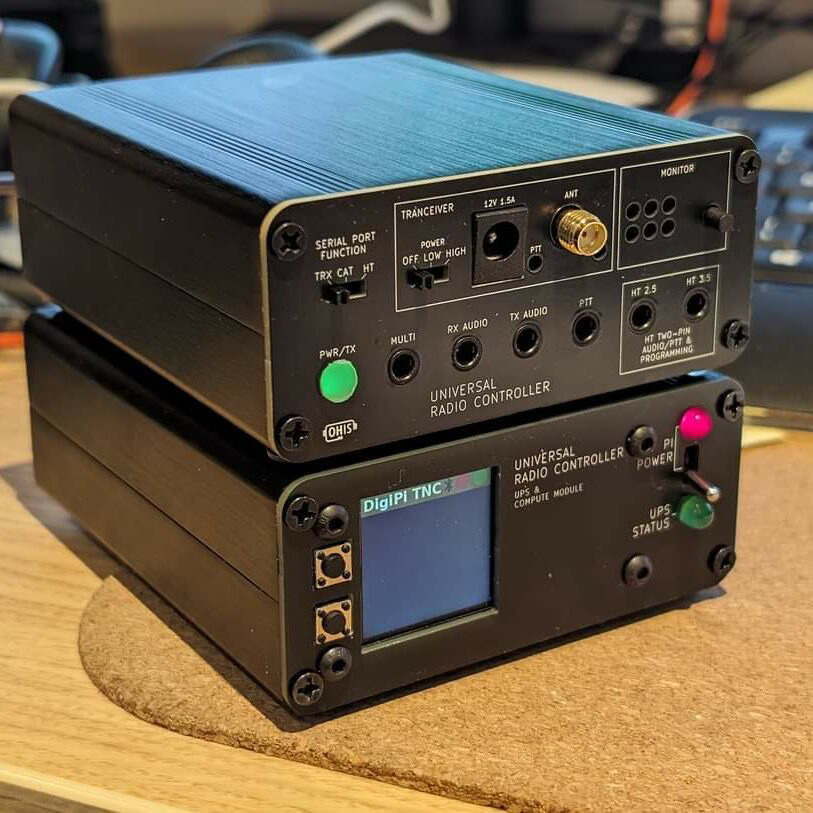
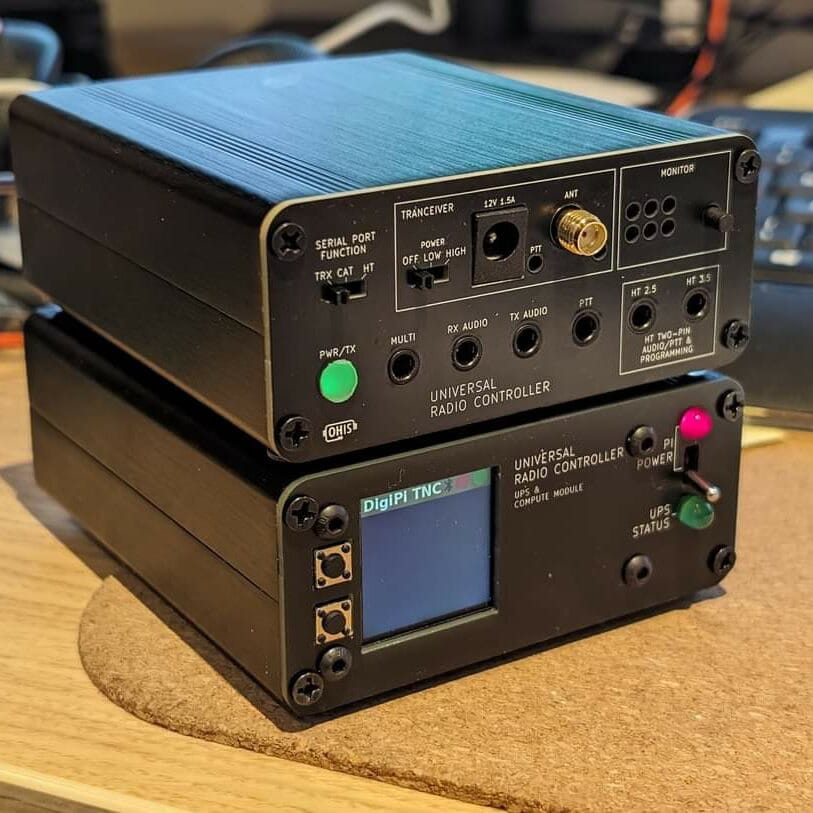
G1LRO teased this same photograph on Facebook on 2024-03-05, but didn’t provide any details, thus I refrained from speculating, and didn’t mention it at that time.
Over the weekend of 2024-03-30 and 31 (somewhere… I can’t find the mention now), G1LRO teased about “the big announcement tomorrow”. Being a fan of G1LRO and his continually expanding the capabilities of the URC, I made a point of checking out G1LRO’s website first thing Monday morning, and wow…
Here G1LRO’s blog post, verbatim:
Amateur Radio Data Appliance: URC & U-Pi-S:
Currently under development on the G1LRO workbench is the U-Pi-S. This unit is a companion to the Universal Radio Controller (URC) that provides key elements to create the full specification of the Amateur Radio Data Appliance.
In this article by Steve Stroh N8GNJ, Steve sets out the functionality required to create the Amateur Radio Data Appliance, being:Power supplyBattery backupRadio transceiverModemEmbedded computer with a minimal display for status / health / troubleshootingNetworking required to for remote access via “household” network (not Internet)Most of all, cabling to interconnect all of the above
The U-Pi-S is new to the line-up as it contains the power and computing facilities to create a full antonymous Amateur Radio Data Appliance.
Inside the U-Pi-S is a 12V 15W UPS with 5V power management to operate the integrated Raspberry Pi Zero-W processor. The new Pi-Zero provides ample horsepower to drive most current Ham software, and also has a small LCD screen with control buttons to display and manage system information.
On the rear panel is a high-power 5V output (1.5A) via USB to power the transceiver module, and a separate data USB connection from the Raspberry Pi to connect to the URC main functions. Additionally a 12V UPS-protected output is present to drive low-power equipment.
Inside the U-Pi-S are the main power and computing components to support a stand-alone digital micro-station
Using the upcoming URC transceiver module, a complete stand alone system can be made for uses such as APRs digipeater, simplex repeater, packet node, Allstar Node etc.
The unit runs the DigiPi software Ham Radio software suite especially well, and you’ll find specific articles are making DigiPi run on the URC on this site. Of course you can run virtually any ham radio software written for the Raspberry Pi on the U-Pi-S and URC, DigiPi is just one example.
In Steve’s article he proposes: “With the Data Appliance I’m imagining, add an antenna that’s appropriate for the individual user’s situation, and the new Amateur Radio Operator can operate Amateur Radio data modes within their apartment, condo, or home with a minimum of hassle. Sit down at the kitchen table, or the couch, with their laptop, tablet, or phone when it’s convenient. The Data Appliance is tucked out of the way in a corner, perhaps even on an apartment or condo balcony with a small solar panel and antenna.”
The mission for this unit is to have the URC with Transceiver and UPS providing some foundation for how Amateur Radio could be re imagined / re conceptualized to be more relevant to younger techies in the 2020s.
Please subscribe to the Zero Retries newsletter for valuable updates on the world of digital amateur radio https://www.zeroretries.org.
To be clear,
- All credit for this newest unit goes to G1LRO - it’s entirely his creation. I had no idea this unit existed (I didn’t collaborate on this project) until his unveiling of it on 2024-04-01.
- This is not an April Fool’s Day prank (G1LRO was asked that on a Facebook comment, and he said No, it’s real).
G1LRO had a bit of a head start on the Data Appliance concept as I explained in the original article when I mentioned the Universal Radio Controller V2 as a partial implementation of the Data Appliance concept:
But, with the addition of the (in development) VHF/UHF Transceiver Personality Board…
… the URC V2 takes a giant leap towards becoming a Data Appliance, albeit at 2 watts transmit power. There is some assembly required by the user (as I read the article) that requires the user to install either a VHF or UHF radio module, and some other components. Commendably, the URC V2 information is available as open source.
It was a masterstroke of G1LRO to incorporate a DigiPi (also mentioned in my original article) as part of his implementation of a Data Appliance.
G1LRO’s URC transceiver module (previously referred to as the VHF/UHF Transceiver Personality Board) is apparently still in development, so all of the elements of a URC Data Appliance aren’t quite ready for sale, but with this development, it appears imminent!
I’m grateful to G1LRO for giving form to my concept of an Amateur Radio Data Appliance. I can’t wait to get one in N8GNJ Labs and put it on the air.
YouTube Overview of Universal Radio Controller
Also on 2024-04-01 (coincidentally, I think), Matthew Miller M0DQW published an overview of the Universal Radio Controller (but not the UPS & Compute Module unveiled today) on his Tech Minds YouTube channel.