Zero Retries 0134
2024-01-12 — Now, We Wait for the FCC to Decide on Bandwidth Limits for VHF / UHF Bands, Enhancing Amateur Radio with What3Words
Zero Retries is an independent newsletter promoting technological innovation that is occurring in Amateur Radio, and Amateur Radio as (literally) a license to experiment with and learn about radio technology. Now in its third year of publication, with 1200+ subscribers.
About Zero Retries
Steve Stroh N8GNJ, Editor
Jack Stroh, Late Night Assistant Editor Emeritus
In this issue:
Now, We Wait for the FCC to Decide on Bandwidth Limits for VHF / UHF Bands
Web version of this issue - https://www.zeroretries.org/p/zero-retries-0134
Request To Send
Commentary by Editor Steve Stroh N8GNJ
Hamvention 2024, Ho!
Hamvention 2024 in Xenia, Ohio, USA countdown - 19 18 weeks!
Whither ARRL…
(Briefly, briefly…)
It’s hard to reconcile the organization that had the commendable vision to recommend (what “Amateur Radio conservatives” might regard as) a radical change to the Amateur Radio VHF / UHF bands (see the lead story below)…
from the organization that seems bent on creating more organizational chaos. While my perspective on the ARRL remains mostly unchanged, it has softened somewhat after seeing the effective, progressive representation of the ARRL, and Amateur Radio, with its comments to the FCC in Docket 16-239.
Make no mistake, the ARRL’s comments were the result of a professional (lawyer) being paid to do so. But, seeing the ARRL file comments, and no other Amateur Radio organization doing so (some of which could afford similar professional legal representation), was sobering. Simply put, the professionals can be counted to show up, with competence, to engage with the FCC… and that requires consistent funding.
A trusted advisor to Zero Retries has regularly made the point to me regarding ARRL that the chaos and dysfunction in ARRL is simply a microcosm of our current national… societal turmoil… and checking out on that isn’t really an option. Thus, my advisor posits, if you’re a US Amateur Radio Operator with any desire for Amateur Radio continuing into the future, not supporting ARRL isn’t an option. As an ARRL member, our influence is to vote on representatives (Division Directors and Vice-Directors), and provide them with our perspective.
Food for thought in the coming months.
Change of Plans for Video - Not on Substack
While I haven’t decided “Wither Substack” (see Zero Retries 0133 - The Substack Problem), one immediate conclusion is that I won’t be going forward with doing video on Substack. Again, no conclusions quite yet, but it’s not looking good for continuing on Substack. Yes, YouTube or Vimeo are options, but at this moment I don’t need another near-vertical learning curve in attempting to do video on my own.
Zero Retries Guide to Interesting Conferences
I’ve updated the Zero Retries Guide to Interesting Conferences page with all the Zero Retries Interesting conferences I was able to find information on for 2024. I’ll check for updates on other conferences periodically and update it several times through 2024. New to this update is a sentence or two about why a conference is Zero Retries Interesting.
Nice Mention of Zero Retries in Amateur Radio Daily
Zero Retries got a nice mention in Amateur Radio Daily’s Happy New Year! post:
Thanks again to N8GNJ and Zero Retries for referencing Amateur Radio Daily a number of times…
You’re welcome Cale (Mooth K4HCK)! I’m a fan of K4HCK’s two big projects - Amateur Radio Daily and Amateur Radio Weekly. The latter is a must-read on Saturday mornings and it’s always fun to see something Zero Retries Interesting like MeshCom 4.0 (see ZR > BEACON, below) in ARD or ARW that I didn’t spot. While Amateur Radio Weekly, in particular, seems like a quick read, I can attest that it’s serious work to monitor a lot of feeds and sort through those to bring readers a concise summary of interesting stories about Amateur Radio each week.
73,
Steve N8GNJ
Now, We Wait for the FCC to Decide on Bandwidth Limits for VHF / UHF Bands
By Steve Stroh N8GNJ
Summary of the comments filed on FCC Docket 16-239.
The cutoff date for comments to the FCC on Docket 16-239 was end of day (Eastern - Washington, DC) January 8, 2023.
To see the comments that were filed for yourself,
- Go to https://www.fcc.gov/ecfs/search/search-filings
- In the Proceeding(s), type 16-239
- Wait a few seconds for the search engine to find:
- 16-239 | Amateur Baud Rate
- Click on that
- Then scroll down and click the big Search bar.
Seventeen individuals and one organization took the time and effort to file comments. I commend:
Michael Adams, Tom Azlin (2), D. William Buhler, Ron Economos, Michael Gray, John Eric Grumling, Michael Hembry, Benjamin Kuhn (2), Steve Lampereur, Dennis Roth, Josh Shupack, Willis Keith Stroud, Jeremy Taylor, and Steven Truffer (2).
Those cited above are the most recent commenters who responded to the FCC’s Further Notice of Proposed Rulemaking that requested comments on removing the symbol rates for the VHF / UHF bands and asking for comments on changing the bandwidth limits on the VHF / UHF bands.
ARRL FCC Comments - Surprisingly Progressive
I also commend the ARRL for filing comments. They showed up, and (commendably) offered a bold recommendation to the FCC (paraphrased):
Delete the bandwidth limits on the VHF and UHF bands.
The deep understanding of the FCC by the ARRL’s Washington Counsel, David R. Siddell K3ZJ, is apparent in the ARRL’s comments.
The history of the first phase of this proceeding demonstrates the difficulty of accommodating fast-paced technological change. The reasons for the more regulatory approach in the HF range are mostly absent in the LF, VHF and UHF bands that are subject to the FNPRM, and those differences underly the difference in approach suggested herein by ARRL.
To me, this was the most salient point that matters to the FCC in considering changes to the Amateur Radio regulations, and kudos to K3ZJ for making it. From the perspective of the FCC, it’s preferable (by far) to not to get petitioned, regularly, in the coming years by Amateur Radio Operators seeking more flexibility in the Amateur Radio regulations for new modes, such as what motivated the ARRL to submit Docket 16-239.
Instead of continuing to restrict Amateur operations by limiting the symbol (baud) rate and signal bandwidth limits, ARRL suggests that a better approach is to rely on the good operating practices generally observed on the subject bands and the existing FCC Amateur Part 97 regulations that require each licensee to operate with “good engineering and good amateur practice”, to “cooperate in selecting transmitting channels and in making the most effective use of the amateur service frequencies”, to never “willfully or maliciously interfere with or cause interference to any radio communications or signal”, and to limit bandwidth to the minimum necessary for the information rate and emission type employed.
Again, K3ZJ’s deep understanding of the FCC’s perspective is on display here, reassuring the FCC that there are other Amateur Radio regulations that can counterbalance the potential of any “bad actors” that emerge to take unreasonable advantage of the requested regulatory change.
Individual Commenters - We Showed Up
It should be noted that most of the recent commenters in Docket 16-239 made use of the Express Comment option. In my recommendations to file comments in Zero Retries, I should have mentioned the Express Comment option more prominently, that it’s pretty easy and quick to “fill in the form with your brief comments” rather than the more laborious choice to “compose a letter” that I, ARRL, Benjamin Kuhn, and Dennis Roth opted for.
Kudos to Jeremy Taylor and Ron Economos for filing their comments in December. Both made recommendations to increase the maximum bandwidth on various VHF / UHF bands, and Economos referencing STEM students being able to experiment with modes using wider bandwidths.
Tom Azlin W7SUA and Dennis Paul Roth N3AZB provided well-informed suggestions on maximum bandwidth for the 2200 and 630 meter bands (but no comment on VHF / UHF bands).
Josh Shupack KI7GRA offered a brief, but poignant comment as a “relatively young operator”:
It’s important to keep amateur radio relevant for the incoming generation of digital natives.
KI7GRA’s brief comments are a great example that, brief as his comments were, they’re more influential to inform the FCC about the future of US Amateur Radio VHF / UHF bands, than the tens of thousands of US Amateur Radio operators who didn’t bother to comment.
Willis Keith Stroud W4WKS’ comments were similarly brief, endorsing my comments to remove all symbol rates and bandwidth limits from the VHF / UHF bands.
Steve Lampereur KB9MWR commented that all bandwidth limits should be removed from the VHF / UHF bands, observing that there have been no adverse affects from there being no bandwidth limits for the 902-928 MHz (33 cm) band.
Michael Hembrey comments were to change from baud rate to bandwidth limits, and have those changes apply across all amateur bands and frequencies.
John Eric Grumling recommended removing all symbol rates and bandwidth limits in reference to using new (within Amateur Radio) techniques like Time Division Multiple Access (TDMA) and Code Division Multiple Access (CDMA).
Similar to Grumling, Michael Gray recommended removing all symbol rates and bandwidth limits and made reference to new (within Amateur Radio) techniques such as Orthogonal Frequency Division Multiple Access (OFDMA) and and “burst mode relay”. Gray was also the only commenter to address the FCC’s request for “… provide support for the modification, including any associated costs and benefits”:
Extraneous regulations with no benefit only *INCREASE* the cost of administration and enforcement. Given the lack of benefit bandwidth limitations convey, they result in a needless cost to the FCC and people of the United States.
I was humbled that Benjamin E. Kuhn KU0HN used my comments as a template, but used his own background and experience to support his suggestions. I particularly enjoyed:
It could be argued that SDR technology could be used within imposed bandwidth limitations, this will eventually prove to be a short-sighted position. To paraphrase an old system engineering maxim from the early days of the Unix operating system, “By preventing someone from doing something stupid, you may also be preventing someone from doing something clever.”
In his comments, Steven Truffer made the point that if higher speed modes are feasible, the time a channel is in use is reduced.
Reply Comments Period
Again, I am no expert on FCC processes, procedures, or precedents. After the FCC’s stated period for comments closes, there is another period for Reply Comments. Apparently that period is 15 days after the Comments close:
Public Comment Periods
When a Petition for Rulemaking, an NOI, an NPRM or an FNPRM is announced in a Public Notice"("Notice"), the Notice generally will contain a deadline for filing of public comments and instructions on how to file comments. This deadline generally will be 30 days after publication of the Notice, and reply comments typically are due 15 days after that.
The first Reply Comment was filed by Michael D. Adams regarding the ARRL’s comment:
While I agree with ARRL’s recommendation to remove symbol rate limits on the bands subject to the FNPRM, I am concerned with the prospect of completely removing bandwidth limits.
It’s puzzling that Adams simultaneously agrees with the ARRL’s recommendation… and is concerned about that recommendation. In my opinion, the ARRL comments provide ample justification and reasoning that other portions of the Amateur Radio regulations provide ample incentive to apply “good Amateur practice” for selection of appropriate bandwidths.
The second reply comment was by Ron Economos with a fine-grained reading of the Amateur Radio regulations:
I fully agree with the ARRL's position that all symbol rate and bandwidth restrictions should be deleted on the 2200, 630, 6, 2, 1.25 meter and 70 cm bands. In addition, the following items are required to completely delete all restrictions. 1) Footnote 97.307(f)(2) should be deleted from the 6, 2, and 1.25 meter bands in the 97.305 table. 2) The 6 meter band should include footnote 97.307(f)(8) in the 50.1 to 51 MHz segment. In other words, the 6 meter band should be unified to 50.1 to 54 MHz in the 97.305 table.
And… checking a few hours before publication time, some other Reply Comments have been submitted.
Dennis Zabawa and Janis Carson AB2RA (1) (2)… are not happy… with the ARRL’s comments of no bandwidth limits because… chaos will inevitably ensue? I don’t quite get the substance of Zabawa and AB2RA’s disagreements with previous comments.
By my math, 15 days past comment cutoff of January 8 is January 23rd, but call it January 22nd to be safe.
Update / Correction: The cutoff date for Reply Comments is January 22, 2024 so “to be safe”, I suggest submitting Reply Comments in by January 21st.
In addition to my fellow commenters providing food for thought, a few other ideas came to mind for potential reply comments (you can reply to your own comment), such as:
- Amateur Radio has many Software Defined Radios available for use, but most are designed for the HF bands and operate through 54 MHz (includes the 50-54 MHz 6 meter band). Thus it makes sense to allow experimentation with wider bandwidths within 6 meters to take advantage of those many HF Software Defined Radios.
- I think that Steven Truffer’s comment that higher speed transmissions can equate to reduced channel time deserves further discussion as a method of potentially increasing the shared use of Amateur Radio spectrum. Humans need seconds to transmit information. With a high speed data communications system made possible with wider bandwidths, computers can transmit information in milliseconds.
- It might be “airing dirty laundry” with the FCC, but the fact that the 2 meter band (144-148 MHz) and much of 440-450 MHz has many coordinated repeaters does not equate that those bands and sub-bands are “full”. In reality, very few repeaters have substantial activity these days - these bands are now mostly quiet. A simple spectrum analyzer plot over 24 hours “tells the tale”. But perhaps that’s something we shouldn’t mention to the FCC… at least directly. Unless push comes to shove with “the band is full - don’t change anything” specious arguments.
Organizations That Didn’t Show Up
Lastly, it’s disappointing that US-based Amateur Radio organizations that could reasonably be expected to provide comments to the FCC did not do so, including:
See the footnotes for why it seemed to me that each organization had standing to comment in Docket 16-239. If you’re a member of one of these organizations, consider asking the leadership why they didn’t consider it important enough to provide comments in the Docket 16-239 Further Notice of Proposed Rulemaking.
Enhancing Amateur Radio with What3Words
By Andrew McCaskey WA4MTP
Editor’s Note: My thanks to WA4MTP for offering this interesting perspective on an alternative coordinate system than the Latitude / Longitude, and grid squares.
Imagine prioritizing the exchange of meaningful, verifiable information in amateur radio contests and POTA operations, rather than just callsigns and proforma 599 signal reports. What if this information could have real-world applications, be familiar to emergency responders, and easily explained to the public?
Enter What3Words (W3W), a geocoding system assigning three unique words to every 3x3-meter square globally using GPS, available by smartphone app or internet browser.
Company founder Chris Sheldrick discussed its concept in a 2017 Ted Talk and W3W is already used by emergency responders and integrated into some luxury cars.
While my familiar 6km x 9km amateur radio Maidenhead grid [EN71aq] is great for propagation verification, W3W excels in generating precise location communication. Enter ///dome.stump.pack in the app, and you have my future antenna site located within a few feet.
What3Words is a natural fit for POTA- specific location of the POTA station and direct navigation to locations of interest such as parking, services or camps by non-hams using the smartphone app.
What3Words is a natural fit for Emergency Preparedness Drills- The app stores the W3W database locally on the device, allowing you to find your current what3words address offline. You can navigate to a what3words address of an incident or resource using a compass mode without a data connection.
What3Words is ripe for experimentation- W3W offers a public API and Voice API in multiple languages.
What3Words can make contests like Field Day more relevant - and deliver an easily digested story for publicity to the general public.
How about a change up for contesting in 2024? A suitable multiplier for a successful W3W QSO two way exchange of W3W info might do the trick.
- What3Words (W3W): https://what3words.com
- Emergency responders using W3W: https://t.ly/hLeGO
- Luxury cars with W3W integration: https://t.ly/s9mqC
- Chris Sheldrick's Ted Talk: https://t.ly/dtuGS
- W3W public API: https://t.ly/1VOHk
Editor’s Postscript: There is some controversy about What3words being a proprietary system with public benefit and a public Application Programming Interface (API). Apparently there’s sufficient benefit and usability with W3W that some public safety agencies are using it. In my opinion, W3W being proprietary is not substantively different than, for example, Google Maps, which is also proprietary with public benefit and public API, which is widely used in Amateur Radio.
ZR > BEACON
By Steve Stroh N8GNJ
Short mentions of Zero Retries Interesting items.
ARRL Guide to Filing Comments with FCC
At the very end of its story ARRL Responds to FCC Proposals, there is this mention:
An ARRL guide to filing comments is available at https://www.arrl.org/arrl-guide-to-filing-comments-with-fcc.
The story is good “meta” information about the ARRL’s perspective on its comments written for the Amateur Radio audience rather than the more scripted, targeted language of an FCC filing.
The guide is good info - bookmarked! (But, of course, I wish they had publicized its existence prior to Docket 16-239 comments closing - if it did exist then.)
Easy AllStarLink
Tom Salzer KJ7T on his The Random Wire newsletter:
For me, the points in favor of AllStarLink are:It is built on open source software. That is something that is important to me.It uses high-quality codecs for voice, the same codecs used in many business-oriented voice-over-ip phone systems. Being able to clearly hear what is being said is becoming more important to me as my hearing changes with age. The audio quality is usually superb.You can buy a solution or build a solution. This appeals to my interest in becoming a better builder.The technology can be used to control repeaters or operated as an individual node in the AllStarLink network. I like flexibility in the tools I use.When part of a repeater system, people can connect over radio or over an internet connection. I find this more inclusive than the idea that if you aren’t using a radio (or you aren’t a CW operator, or you aren’t using a vacuum tube radio, or or or), you aren’t really a ham.You can make simplex contacts or participate in nets, nearby or across the planet. While AllStar works fine for conversations with hams close by, it shines in situations where geographic distance would otherwise hamper conversations.If you are near a repeater with AllStarLink, you can operate over RF. If no such repeater is near you, you can operate over an internet connection.Being limited to licensed amateur radio operators, folks on AllStar tend to be intelligent and well mannered, making for pleasant, productive interactions.All of AllStarLink is open to operators holding a Technician license. If you are a licensed ham, you have access to the entirety of AllStarLink.
KJ7T offers a good guide to AllStarLink with points I had not heard before, and makes a reasonable case for building (or buying) an AllStarLink node that works with good old plain FM portable radios.
MeshCom 4.0
Institute of Citizen Science for Space & Wireless Communication (ICSSW):
MeshCom is a project to exchange text messages via LORA radio modules. The primary goal is to realize networked off-grid messaging with low power and low cost hardware.
The technical approach is based on the use of LORA radio modules which transmit messages, positions, measured values, telecontrol and much more with low transmission power over long distances. MeshCom modules can be combined to form a mesh network, but can also be connected to a message network via MeshCom gateways, which are ideally connected via HAMNET. This enables MeshCom radio networks, which are not connected to each other via radio, to communicate with each other.
My thanks to Pseudostaffer Jeff Davis KE9V and Amateur Radio Weekly for mentioning MeshCom. I wasn’t able to find a description of what’s different / new in 4.0. I was also not previously aware of ICSSW - interesting organization!
FreeDV 2020 Mode Using Raspberry Pi 5
Mooneer Salem K6AQ on the digitalvoice mailing list:
I finally managed to get the Raspberry Pi 5 that I preordered a few months ago. Unlike with the 4, it appears that we're finally able to handle 2020 mode. The audio also sounded as expected, albeit at pretty low volume.
Background on FreeDV 2020 Mode:
… The new FreeDV 2020 mode uses LPCNet Neural Net speech synthesis technology developed by Jean-Marc Valin. The goal of this mode is 8kHz audio bandwidth in just 1600 Hz of RF bandwidth. FreeDV 2020 is designed for HF channels where SSB an “armchair copy” – SNRs of better than 10dB and slow fading. FreeDV 2020 uses the fine OFDM modem ported to C by Steve (K5OKC) for the FreeDV 700D mode.
From the context, I gather that FreeDV 2020 Mode previously required a “desktop class” computer, but now FreeDV 2020 Mode can be done with a comparatively inexpensive Raspberry Pi 5.
DB9 Breakout Board / Pass-through Adapter
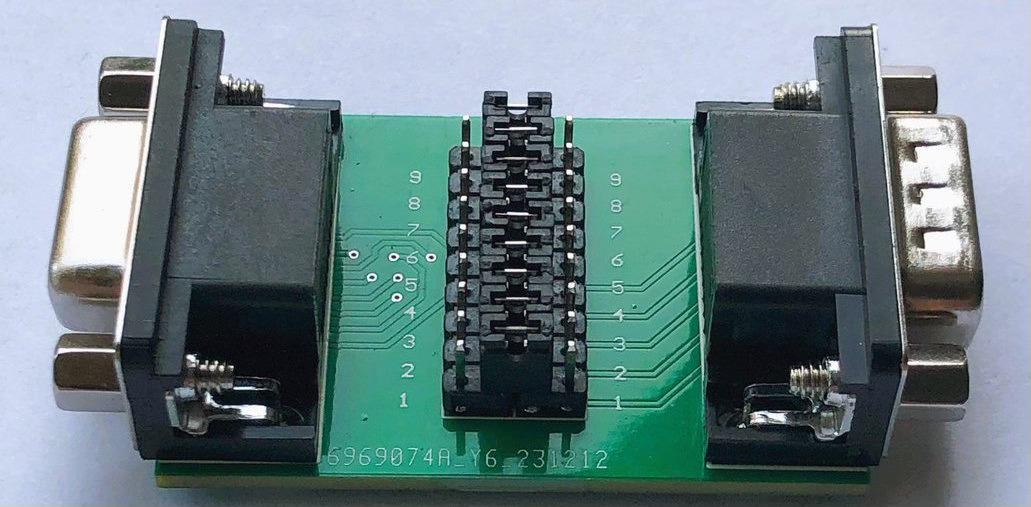
Description
D-subminiature DB9 connectors are often used for serial communications: RS232, RS485, CAN, etc.
Specificationsmale and female connectorsbreak-out board with all signals accessible via header pinscustom wiring using supplied jumpers and/or external flying wires
Applicationspass-through, crossover, custom wiringcustom wiring for any or all 9 signalsserial port sniffing
It’s often the simple things that make (technological) projects easier. Yes there were similar adapters to this back in the day, but this design strikes me as elegant with jumpers instead of requiring jumper wires for all connections.
I dropped a note to “RiverMicro” the creator of this device suggesting that a version of this unit with RJ45 connectors would be highly useful (thinking of using the now ubiquitous RJ45 connectors for microphones on most mobile Amateur Radios) and they replied that they have such a unit but it is currently out of stock (briefly).