Zero Retries 0131
2023-12-29 - 1200+ Subscribers!, Print and the Digital World, Amateur Radio & Satellite Communication Promoted in MAPCON 2023 at Ahmedabad (Gujarat) INDIA
Zero Retries is an independent newsletter promoting technological innovation that is occurring in Amateur Radio, and Amateur Radio as (literally) a license to experiment with and learn about radio technology. Now in its third year of publication, with 1100+ 1200+ subscribers.
About Zero Retries
Steve Stroh N8GNJ, Editor
Jack Stroh, Late Night Assistant Editor Emeritus
In this issue:
Web version of this issue - https://www.zeroretries.org/p/zero-retries-0131
Request To Send
Commentary by Editor Steve Stroh N8GNJ
1200+ Subscribers!
The jump from 1100 to 1200+ subscribers was the fastest 100 subscriber increment in Zero Retries’ history - approximately five weeks. Thanks again folks for the vote of confidence in subscribing to Zero Retries. Much of this recent 100 subscriber increment is thanks to my interview on Eric Guth 4Z1UG’s QSO Today Podcast (477, on 2023-11-25).
Welcome Don Rotolo N2IRZ to Zero Retries as a Contributing Author
Don Rotolo N2IRZ is a longstanding friend, Zero Retries Founding Member 0003, and a fellow “Digital, Mostly” Amateur Radio Operator. At some point decades ago, N2IRZ and I met (likely at a Digital Communications Conference), and we “connected” over our shared intense interest in Amateur Radio Packet Radio, and we’ve stayed in touch since. Years ago, long before I began actually publishing Zero Retries, I had floated the idea of Zero Retries to him. Purely of his own volition, N2IRZ created a printed mockup of what he understood my idea to be and sent it to me. That printed mockup just surfaced this year as I’ve been slowly sorting out my Amateur Radio archives for potential donations to Digital Library of Amateur Radio & Communications (DLARC).
For twenty-five years now, N2IRZ has authored the Digital Connection column in CQ Amateur Radio Magazine, and before that he authored the Digital Data Link column in CQ VHF Magazine. I appreciate and learn from N2IRZ’s perspective. Most recently, I “debated” (in text) N2IRZ in the Zero Retries 0111 article Rebuttal to Don Rotolo N2IRZ’s Digital Connection in May, 2023 CQ Amateur Radio. I enjoy N2IRZ’s writing to the point of subscribing, briefly, to CQ solely to be able to read (and provide a measure of support for) N2IRZ’s column.
N2IRZ normally writes “Zero Retries Interesting” material such as The Whys and Which(es) of Networks: Help Deciding What You Need (Page 51 - 54, CQ, May 2023 issue). N2IRZ’s column for the November, 2023 issue of CQ was a departure from technical content, but well worth reading for his well-considered perspective on the fate of print media for Amateur Radio.
Unfortunately that column is in limbo due to CQ’s “delay in publishing”. Given the currency of this particular column, N2IRZ requested space in Zero Retries for it to be published in a timely manner, and I happily agreed to run it as the lead article in this issue.
Nice Attribution of Zero Retries on Amateur Radio Newsline
Amateur Radio Newsline is a respected, beloved institution of Amateur Radio, and I check in on it every few weeks to keep current on the “headlines” of Amateur Radio. I appreciate that AR Newsline makes the scripts of their… audiocast… available for text-preferred folks like me. On Newsline’s Report 2407 for Friday December 15th, 2023, there was this item:
DIGITAL LIBRARY RELEASES ITS WISHLIST FOR HOLIDAY AND BEYOND
Though I was pretty certain that “Digital Library” being referred to was Digital Library of Amateur Radio & Communications (DLARC), I checked it out in case there was another “Digital Library” for Amateur Radio that I wasn’t aware of (other than the equally amazing World Radio History).
DIGITAL LIBRARY RELEASES ITS WISHLIST FOR HOLIDAY AND BEYOND
STEPHEN/ANCHOR: Everyone has a holiday wishlist and the Digital Library of Amateur Radio & Communications is no different - except it's more of a WANT-list, as we hear from Andy Morrison K9AWM.
ANDY: The Digital Library of Amateur Radio & Communications has passed the milestone mark of 100,000 radio-related items ranging from podcast episodes, manuals, catalogues, newsletters and books. Like the universe itself, though, the need goes on endlessly and the Internet Archive's program manager for special collections. Kay Savetz, K6KJN, has created a DLARC Wantlist that identifies gaps in the collection that need filling. Kay says on the library website that he will update the list as those needs change. For now, however, the wishlist includes issues of Hambrew Quarterly, published by George De Grazio, WFØK, who is now a Silent Key; the original Wirebook and Wirebook II; and RAIN Reports in any audio format from 1992, 1998, 2000, and 2003.
The library was created in 2022 with the help of funding from Amateur Radio Digital Communications and is a project of the Internet Archive. It also contains material about pirate radio, amateur TV, low-power FM and shortwave listening.
The library of course also has a wishlist for donations and those will be matched on a 1-to-1 basis.
See the link in the text version of this week's newscast to see what else the library can use.
I'm Andy Morrison K9AWM.
[DO NOT READ: https://archive.org/details/dlarc-wantlist]
(DLARC, ZERO RETRIES NEWSLETTER)
It was amazingly cool to see Zero Retries cited as the source of that item! I’ve been a fan of Amateur Radio Newsline for decades, and began listening to its predecessor called (I think) Westlink Radio Network shortly after I was licensed in 1985. “Westlink” was transmitted as an audio bulletin on the North Coast Amateur Radio Club’s 145.29 repeater on Sunday evenings during the club’s weekly social net and, as they used to say, it was “up to the minute Amateur Radio News”, and being produced week by week and distributed electronically, it provided more current news than newsletters, and especially magazines.
Discussion re: FCC Docket 16-239
My comments on FCC Docket 16-239 regarding elimination of symbol rate restrictions and possible changes in maximum bandwidth for the Amateur Radio VHF and UHF bands are still in progress. My available writing time around Christmas was compressed - joyful and relaxing, but compressed.
A late addition to my planned comments is to frame my comments to directly embody three of the five elements of Part 97.1 - Basis and Purpose:
(b) Continuation and extension of the amateur's proven ability to contribute to the advancement of the radio art.
(c) Encouragement and improvement of the amateur service through rules which provide for advancing skills in both the communication and technical phases of the art.
(d) Expansion of the existing reservoir within the amateur radio service of trained operators, technicians, and electronics experts.
Earlier this week I was invited to an interesting meeting about 16-239 which was requested to remain private. While I can’t tell you about the meeting, I can tell you that going into the meeting, I felt that my perspective on suggesting potential changes as part of 16-239 was progressive, perhaps even aggressive. To my amusement, and increased respect, my perspective was actually more conservative than many of the other attendees! The outcome of the meeting was even better than I imagined. I was in good company and I have high hopes for a good (progressive) outcome from FCC Docket 16-239 in 2024.
Comments on FCC Docket 16-239 are due to the FCC by 2023-01-08.
So Many (Amateur Radio) Blogs…
The emergence of the website Blogs.Radio a few months ago (at least that’s when I discovered it) was simultaneously a valuable addition to my being able to find even more Zero Retries Interesting material… and a minor burden. The latter because Blogs.Radio pointed me to so many good blogs that I now want to follow for Zero Retries, that I’m more behind in my Zero Retries Interesting reading than I’ve ever been. It’s a good problem to have, and I just have to be more methodical about carving out dedicated time to browse all these newly discovered blogs to not let the unread ones balloon out of control. I had promised to publish a list of my most Zero Retries Interesting blogs / feeds, and I still plan to do so.
73,
Steve N8GNJ
Print and the Digital World
By Don Rotolo N2IRZ
Digital Connection, CQ November 2023
Why printed periodicals are suffering, and some ideas on what to do.
Editor’s note: N2IRZ wrote this article for the November 2023 issue of CQ Amateur Radio Magazine <https://cq-amateur-radio.com/>, and it is expected to appear there once publication restarts. Do note that this article neither speaks for CQ, nor is it endorsed by them - indeed, they disagree with some of the points made. But, after writing for CQ for over 25 years, they agreed that Don had earned some leeway and intend to publish it. Until then, he decided that it might prove interesting for the Zero Retries audience. He asks everyone seeing this to kindly avoid reposting or copying it, as this would have a negative effect on his employers at CQ, and by extension, on him. Thank you for cooperating.
Many of us are old enough to remember the days before the internet, when print periodicals were a primary source of information in the world. Of course, before TV, and before radio, they were just about the only form of information, aside from word of mouth and perhaps singing minstrels. But radio and TV were somewhat limited in the quantity of information they could deliver, since that delivery takes time. How long would it have taken Walter Cronkite, KB2GSD (SK), to read the entire New York Times every day? Certainly much longer than the half-hour he had to deliver the day’s news.
Even after the internet arrived, newspapers still delivered most of the world’s news, and magazines (including this one) delivered useful non-news information to niches of society, whether they be woodworkers, photographers, knitters, pilots or even amateur radio operators. Because this information was valuable, and there were few sources for it, subscribers were willing to pay a nominal fee to get it. Certainly, the more valuable the information, the more it usually cost. I remember an electronics industry magazine from three or four decades ago that could be had every month for something like $900 a year – and that’s not in 2023 dollars!
Today, we get this kind of information online, usually for free. Certainly, some organizations need a revenue stream to pay for the effort it takes to build a competent and reliable publication, and so they use a paywall, one way of monetizing that information. The Wall Street Journal, Sports Illustrated, Consumer Reports, QST and CQ all have costs that have to be recovered somehow, and now that most advertising dollars all seem to flow to Facebook, Google and X-formerly-known-as-Twitter, that somehow is becoming more and more dependent on subscription dollars.
The problem is that as publishers raise their print subscription prices (see: ARRL), fewer and fewer subscribers find that the cost offers a good value. This runs the risk of starting a death spiral. As a publication loses subscribers, the value of an advertisement in that publication also drops, so not only is there less revenue from ads, but fewer advertisers as well. As the costs for printing and mailing a bunch of paper continue to rise, the pressure to recover those costs also rises, so subscriptions go up in price again. And we lose more subscribers, and the cycle gets vicious.
Then you have people and organizations delivering content for free. YouTube is one example, where you can find a short (or sometimes excruciatingly long) video on just about any topic, from repairing your home A/C unit to adjusting a carburetor on a lawnmower, all for the cost of your time to watch it. Or any number of blogs, forums, group.io lists, and so on, all there for the taking. Now, admittedly, the signal-to-noise ratio of many of these online resources tends to be quite low – everyone’s got an opinion, and most of them stink – but if you’re judicious with your reading and have a good common-sense filter, you can get by. For an example of a decent amateur radio publication that is totally free, have a look at the Surrey Amateur Radio Communicator <http://tinyurl.com/25974j98>, a bi-monthly magazine that is surprisingly good. I’m sure you can think of others, including this publication you’re reading.
The point is, there are a boatload of excellent resources out there, simply for the taking. And not just in ham radio, but literally for every single hobby, pursuit, endeavor and business that there is. Is it really any wonder that the printed page is suffering? According to a report on statistica.com, there are some 2,514 fewer newspapers in 2022 compared to 2004, a decline of over 28%. And the pace is accelerating, reportedly losing 6% a year recently.
An interesting and detailed look at this decline, by Clay Skirky, can be found at <http://tinyurl.com/2p98xhj2>. This is a worthwhile 10-minute read, discussing how we got into this situation, and more interestingly, why “... their most passionate defenders are unable... to plan for a world in which the [newspaper] industry is visibly going away”.
So, how does one get out of this mess? While I am no expert, the short version is to give away the information for free.
Ah, you say, that’s great, but editors and their colleagues need to eat, right? Why yes, yes they do. The challenge before us is to think revolutionary thoughts about the business model, in which we first reduce the need for revenue to a sustainable point, and then identify ways to get that revenue. As mentioned above, simply asking the users to pay more isn’t going to work.
Let’s start with costs. Eliminating the printing-on-paper process cuts about a third of the monthly costs for a printed publication. Not having to mail it, while further hastening the demise of the U.S. Postal Service, cuts about another quarter of the monthly costs, a total savings (so far) of around 60%. Hopefully, you now have a better understanding of the ARRL’s decision to charge an extra $25 a year for mailed print copies of QST.
Now those of a certain age, myself included, simply dislike reading things on a computer screen, tablet or phone. While I am highly sympathetic, we need to start living in the 21st century and get over this dislike. If you have the money, you can certainly print a copy on paper for yourself. I, for example, print out the Wall Street Journal’s daily crossword puzzle, every day that my newspaper delivery person fails to drop that bagged pile of paper in my driveway, which is more frequently than I prefer. You see, with my print subscription, I also get online access. The point is, while I prefer words printed on paper, and even pay more for that service, I can certainly adapt to not having my preference satisfied.
Where else can we save money? How about the exorbitant salaries of all those columnists? (Full disclosure: Columnists are not paid well). Ah, you say, if we want quality writing, don’t we have to pay for it? I say, no, not really. I mean, it’s one thing to write your club’s newsletter, but to have a regular column, or just a feature article, published in a respected international publication like CQ is something on a higher level. And, being independent of the ARRL, a regular report of their goings-on might have some level of interest in the general amateur community. After all, only around 20% of American amateurs are ARRL members (which supposedly represents the other 80% as well), and that number will surely drop significantly next year.
My CQ salary doesn’t pay my mortgage, but frankly I’d do it for free (shhh. Don’t tell the editor). I truly enjoy delivering useful information to readers, along with having a small-but-sturdy soapbox for my ideas, and I suspect many people would jump at the chance if offered. (By the way: You, too, can write for CQ or even Zero Retries. For CQ, read their guidelines and send something in. The editors perform miracles every day). OK, so we can cut contributor expenses to near zero, saving perhaps another 10% of a month’s costs, meaning we’re left with 30% of what we started with. There are also smaller ways to reduce office and administrative expenses, but let’s ignore those for now and have a look at distribution channels.
I’d mentioned paywalls, which only paying customers can get past to view the content being published. This is a holdover from when the information was much more valuable because it could not be found elsewhere. But now we have to re-think this. Now that we might get along on only 30% of what we needed before, it is still really necessary? In my opinion, yes and no.
While having a subscriber base has value, counting on them to finance a good chunk of the costs is looking bleak. But giving the content away for completely free seems, well, not quite right. I propose that subscribers (or, better said, Supporters) get first crack at the content, and some short time later – say three months – it gets released to the rest of the world for free. For that privilege, and some others still to-be-determined, they would need to pay a small amount of money, say $6 a year. Not going to break anyone’s budget, 50 cents a month, but enough to justify the benefits they receive.
This might actually increase the number of readers – subscriptions should increase at such a low cost, and free distribution would capture eyeballs that might otherwise be missed. Some of those eyeballs might be former QST subscribers... err, League members. And, as the number of readers increases, guess what? Ads become more valuable. Even if the price of the ads doesn’t increase despite the greater penetration – or better still, if prices decrease – advertisers should find the publication more attractive for getting their ads in front of more of their desired demographic. This is the opposite of a death spiral: As readership increases, demand for ads increases, so advertising revenue also increases. Oh, and those ads can be larger, color is free, links to websites are trivial, and so on.
Can we count on money from the supporters plus increased advertising to deliver 30% of today’s monthly expenses? Well, to answer that, let’s consider that CQ still publishes every month, as they have for over 79 years. If they were not getting at least, say, 80% of their needed revenue each month, do we really think they’d still be in business? So, cut costs by 70%, cut subscriber revenue by 60% but increase their numbers, and my woefully uninformed opinion is that yes, if costs were cut by that amount, subscriber and advertiser revenue shuld easily cover it, after a several-month lag while things got caught up with each other.
So how, exactly would readers get their magazines? Well, online, of course, but as standard, unprotected and non-DRMd PDF files. Readers could print the whole issue if they wished, for the cost of paper and ink, and take advantage of all the features a PDF viewer has to offer. Of course, they could also share that content with non-subscribers, so there would have to be some kind of plea in each issue. I’m thinking of something like “This is an experiment. We’ll definitely go out of business if you redistribute the non-free editions. So please don’t, let non-supporters wait the few weeks until the issue is released for free. Thanks”. I suspect that paid supporters would respect that.
Oh, and things like content limits would disappear. This could allow for carefully curated guest articles and editorials, broadening the interest of CQ outside of contesting and its other more traditional focus. I can think of dozens of new things I’d like to read about in addition to what’s already in CQ, and I am sure you can, too. Broader appeal means more readers, again the opposite of a death spiral.
If you have a digital subscription to CQ, you are familiar with Zinio. I’ve written about them twice, at the very start and just a few years ago. While I do love the functionality and stability of their platform, I see this as another possible way to save some costs. Right now, the CQ website is hosting a few editions of CQ, as PDFs, for free. All that would be needed is a simple paywall for supporters, where they would find a few recent issues of the magazine, the rest being elsewhere and available to everyone.
Dear readers, so far this much must be obvious: neither CQ, QST, or truthfully any magazine or other publication, is immune from where the print industry is going. Anyone who believes differently is simply hiding their head in the sand. We can’t bring back the heydays of buggy whips and sealing wax, so best we put out heads together and think our hardest to adapt, since failure means death.
What do you think? Please comment on this article and let me, Rich Moseson W2VU (Editor of CQ), and Steve N8GNJ know your thoughts, because the only remaining independent amateur radio print publication in North America would really like to know.
73 de N2IRZ
Copyright © 2023 Donald Rotolo N2IRZ
ZR > BEACON
By Steve Stroh N8GNJ
Short mentions of Zero Retries Interesting items.
KISS TNC Using FreeDV Data Modems
Editor’s Note: In the email edition of this issue, this project was incorrectly attributed to Tom Fanning M0LTE. The developer of this project is “xssfox”.
Features:KISS interface (virtual serial, or TCP)ChatDATAC1, DATAC3 and DATAC4 modes
On Raspberry Pi, requires Bookworm [current Raspberry Pi OS] or Python 3.11 to be installed.
This is a newly released project. The description of this project’s features is a bit… economical… with context 😀 Not even a clever name, just a functional description of the software.
So I’ll supply a bit of context. This is apparently another software KISS TNC, which means it can be used with any packet radio application that can use a KISS interface such as the G8BPQ BBS (and other applications) or WINTNC to name just two. The FreeDV modems, developed for digital voice, are by now very well proven for use on HF as robust and efficient. It’s cool that xssfox has created this option. FreeDATA is similar that it also uses the FreeDV modems to transport data rather than digital voice, but is a graphical user interface app.
My thanks to Tom Fanning M0LTE for pointing out this interesting project.
In Search of a Modern Packet Radio Bulletin Board
Thomas Karpiniec VK7XT:
I’ve been thinking about this for many years now and I think there’s a gap for some new digital amateur radio software that handles bulletin boards and realtime chat.
In the past this was done over packet radio using BBS software like FBB. This system is workable but it really is from a different era and it’s no longer an attractive way to communicate, for a few reasons:The interface that you use to control the BBS is transmitted over the radio in realtime. It’s text-based, and slow and difficult to operate. This was a good decision back when we were using dumb terminals attached to TNCs. Now we have extremely powerful PCs that can display GUIs.Separate BBSes now often depend on the internet to sync up with each other.You have to log on in distinct sessions, rather than sending and receiving messages at any time.You are relying pretty heavily on the BBS operator, even if you have a computer and a radio ready to run all the time.
…
I already have much more detailed notes about how all this information could be encoded and synchronised across participants in the network. I’m drafting this system under the name “Chatteroo”. I think I’m at the point where I just have to start writing some code and see what comes of it. The first transmission target will be AX.25 and I want to use myax25crate to provide access to TNCs (hardware or software) on all platforms.
This article is from 2022-01-01, but it remains a very valid perspective. VK7XT is exactly right - the Packet Radio Bulletin Board System (PBBS) paradigm that us Packet Radio veterans are familiar with is decades old now, and is totally inappropriate… absolutely antiquated… for the 2020s. In fairness, the old BBS paradigm was designed in the 1980s when dumb terminals (or the computer software equivalent) were the norm, and to be usable, BBS’ had to be compatible with the simplest computers; Commodore 64s were commonly in use in Amateur Radio Packet Radio. But we now have inexpensive, but powerful compute power, and even faster and more robust modems. My memory is hazy and I don’t have time to research this (please assist, Zero Retries readers), but there was a system proposed, or perhaps implemented, that did some of what VK7XT proposes that assumed intelligence on the user end running a client that had specific knowledge of the PBBS. When the client connected to the PBBS, there would be a brief handshake and then the PBBS would know that the client was “smart” and adapt its transmissions. For example, the PBBS would transmit the menu and the list of messages only at the beginning of the session, and the client would cache those, so airtime wasn’t wasted repeatedly transmitting the menu prompt. Or perhaps I’m remembering the streamlined interface that was used to exchange data between two PBBS’.
As VK7XT demonstrates, there are many interesting projects out there that have the potential to substantively modernize Amateur Radio. Hopefully by highlighting this project in Zero Retries, VK7XT might get a little encouragement to continue this project, and perhaps some talented help for development and testing. I’ve already dropped him an email with some encouragement and an offer to be a beta user.
Other VK7XT posts relating to Amateur Radio. Another interesting project of VK7XT’s is ax25-rs:
This project aims to provide everything you need to write cross-platform packet radio software in Rust.
Amateur Radio & Satellite Communication Promoted in MAPCON 2023 at Ahmedabad (Gujarat) INDIA

MAPCON 2023 is a conference sponsored by the Institute of Electrical and Electronics Engineers (IEEE) Microwave Theory and Technology Society (MTT-S) and Antennas and Propagation Society (AP-S) - Microwaves, Antennas, and Propagation Conference. This article by Rajesh Vagadia VU2EXP was posted on QRZ.com.
Amateur Radio & Satellite Communication was promoted in the prestigious MAPCON 2023 Conference at Ahmedabad - Gujarat INDIA from 12 to 14 December 2023.
It was an international platform for sharing of research, technologies in the field of microwaves and antennas, wherein many national/international eminent personalities shared their vision, expertise and knowledge. MAPCON-2023 carried various technical sessions, invited talks, workshops, tutorials, special sessions, student design competitions, industry sessions and state of the art Exhibition. Participants include researchers and leaders of IEEE Antenna & Microwave community, defence & Space industry partners & Startups, Academia and eminent speakers from Government organisations like ISRO, SAC, IN-SPACe etc.
Rajesh Vagadia VU2EXP (Regional Coordinator of AMSAT-INDIA) was invited by Shri Rajeev Jyoti Sir (Director IN-SPACe) & MAPCON 2023 Committee for MAPCON Exhibition and promote Amateur Radio & Satellite Communication for educational purpose. Rajesh Vagadia VU2EXP & team member Shyama Vagadia VU3WHG (B.Tech. - ICT 4th sem student of Marwadi University, Rajkot) successfully participated in the MAPCON Exhibition for 3 days from 12 to 14 Dec 2023.
The article is rich in details about the event including a number of photographs of the promotion of Amateur Radio. This kind of outreach on behalf of Amateur Radio into professional conferences such as MAPCON 2023, especially conferences that relate to radio technology and / or have a high attendance by engineering students, is exactly what Amateur Radio needs to be doing to promote itself as a useful and educational adjunct to their formal education. Kudos to Rajesh Vagadia VU2EXP and Shyama Vagadia VU3WHG for their promotion of Amateur Radio at MAPCON 2023.
Raspberry Pi OS Bookworm and Raspberry Pi 5 Firmware Updates Recommended
David Cooley N5XMT on the RaspberryPi-4-HamRadio mailing list:
[Since a month ago] there has been a newer build or two of bookworm, and firmware has also been updated. Runsudo apt update && sudo apt full-upgrade -y && sudo rpi-eeprom-update -d -a
To bring it all up to the latest version. I’m part of the beta testers for Bookworm, and its first release was way too premature, but [it] seems the powers that be ignored the beta testers and their bug reports to surprise users with the new OS, and make sure the [introduction of the Raspberry Pi 5] had an OS that would (somewhat) work.
DRAWS Update
Bryan Hoyer K7UDR on the nw-digital-radio (Northwest Digital Radio) mailing list:
Our GPS Receiver has been obsoleted. We have [ordered] samples for testing.
If all goes well DRAWS™ should be available in February!
As a small Amateur Radio manufacturer, Northwest Digital Radio was hit hard by the electronic components parts shortage of the past several years. I remain impressed by the DRAWS unit, and look forward to it being available for purchase again.
Shacktopus – Paleo Smartphone and Shack-to-Go
Steven Roberts N4RVE on his Nomadic Research Labs blog:
A decade after this project, while giving a talk at Google for an audience of engineers and executives, I was explaining the architecture of the 2005 Shacktopus system. The drawing below was sprawled across the two screens, and suddenly I heard a gasp from the back of the hall. “Hey, that was the first smartphone!” someone cried. Indeed, with a network of communications and data collection tools, the micro always on with a flexible graphic user interface, it was a precursor to what is now in my pocket… although sadly, it never reached the point of becoming an actual product. (The “first” label is highly subjective, and could go all the way back to PDA/voice hybrids and other pioneering tech from the nineties depending on the definition… so don’t take it too seriously. But this was way ahead of the curve when it comes to communication tools with embedded sensors and opportunistic connection capabilities.)
(It was notably not the first camera phone – that distinction goes to my friend Philippe Kahn, who cobbled together his digital camera and a cellphone to share photos of his daughter’s birth in 1997.)
Anyway, Shacktopus emerged from my simple desire to take the tools that I had been building into the Microship, and integrate them all into a minimal substrate-independent package… not a computerized bicycle or geeky trimaran, but a kit that could always be with me, however I happened to be traveling.
…
And that’s what Shacktopus is all about. Named in honor of its ham-radio roots coupled with its multi- pronged design, this is a complete Shack-to-Go with added Internet access, adaptable power system, remote control, environmental sniffing and data logging, tracking and telemetry, multiple audio options, on-board security system, robot-operator and logging capability, universal audio filter, synthesized speech response and event notification, and, well, the list goes on for quite a while. It’s BEHEMOTH in a pack, only more so.
The context of this is that N4RVE is famous for his series of computerized bicycles - Winnebiko and later BEHEMOTH that he used for several tours throughout the US. N4RVE had “retired” from BEHEMOTH and bicycle travel and had begun development of his Microship project when Shacktopus was conceived.
This is a fascinating, detailed, long-form story about a well-envisioned product, that was groundbreaking in that era. For completely understandable reasons, Shacktopus was ultimately never realized. In my opinion, Shacktopus would still be a worthy project in this era, made even more feasible by embedded computers such as the Raspberry Pi series, and Software Defined Radios to “do whatever is needed from a radio”. For example, the Kantronics KPC-3+ TNC unit would not be required in this era, replaced by a simple audio interface and some software running on the primary processor.
Pi-Apps - The most popular app store for Raspberry Pi computers. 100% free, open-source and written in shell scripts
Jonathan Weaver on the NW Digital Radio mailing list:
I’d suggest installing pi apps then wine and x64 using pi apps. I’m not sure how the performance will be. But impressively, I can run native x64 windows applications on a pi4. Here’s the link to pi apps, it makes installing x64 emulation and wine easy.
https://github.com/Botspot/pi-apps
I was unaware of Pi-Apps! A quick looksee revealed:
Introduction
Let's be honest: Linux is harder to master than Windows. Sometimes it's not user-friendly, and following an outdated tutorial may break your Raspberry Pi's operating system.
There is no centralized software repository, except for theaptrepositories which lack many desktop applications.
Surely there is a better way! There is.
Introducing Pi-Apps, a well-maintained collection of app installation-scripts that you can run with one click.
Pi-Apps now serves over 1,000,000 people and hosts over 200 apps.
Wow - learning about Pi-Apps, Raspberry Pi just got even more useful and usable for me for being able to run Pi-Apps to painlessly install various applications. So…, um, OK, yes - let’s do that to set up a Raspberry Pi with WINE to be able to run Windows applications on a (relatively) inexpensive Raspberry Pi. Given the falling cost of embedded X86 computers that can run (and usually include) Windows, this isn’t necessarily a cost savings, especially when choosing a Raspberry Pi 5 with its required special power supply, adding an SSD, etc. But the biggest win (no pun intended) to me would be using WINE instead of Windows, to run, for example, VARA FM and VarAC. WIth WINE, you don’t have to fight Windows to stay in the same configuration as originally installed - no bloatware, no advertising, no nagging for updates, etc.
A WSPR Monitor Running on an old Android TV Box with OpenWebRX and RTL-SDR
From RTL-SDR.COM:
Thank you to Joseph IT9YBG for writing in and sharing with us his experience in getting Armbian and OpenWebRX running with an RTl-SDR V3 smoothly on an old A95X Android TV Box. These TV Boxes have an AMlogic S805 chip and Joseph writes that he is quite impressed by the performance of the chip.
To install the Armbian Linux operating system Joseph used the instructions from i12bretro and installed OpenWebRX after. Then together with his RTL-SDR Blog V3 dongle he turned the device into a cheap dedicated WSPR (Weak Signal Propagation Reporter) monitor allowing him to free up his Raspberry Pi 3 which was used for the task previously.
I think that inexpensive “appliance computers” like this dedicated to a single, interesting radio application are a great idea. As receive-only devices they can be gifted to folks interested in radio but not (yet) having an Amateur Radio license.
HamClock Home Page
HamClock is a kiosk-style application that provides real time space weather, radio propagation models, operating events and other information particularly useful to the radio amateur. HamClock was introduced in my QST article in the October 2017 issue and has been actively developed and expanded ever since.
Speaking of running dedicated apps on inexpensive “appliance computers”, I’ve seen several videos lately discussing HamClock. It took a few minutes of web search to find the creator’s (Elwood Downey WBØOEW) website: https://clearskyinstitute.com/ham/HamClock/.
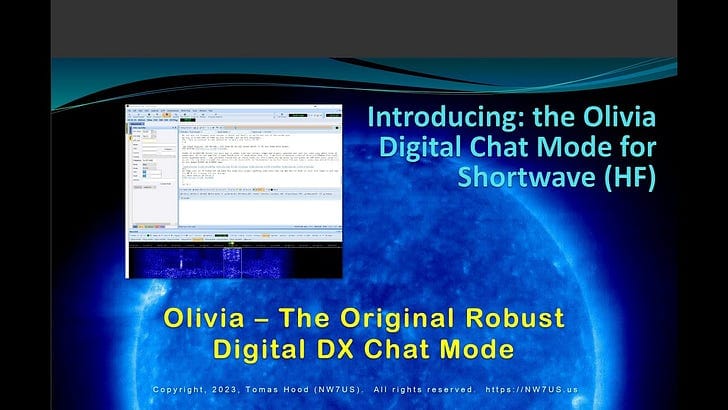
Olivia Digital Mode on HF Intro
Tomas Hood NW7US on the digital-mode-radio mailing list:
Please share this video with your local ham community and around social media. This is the introduction of Olivia that was presented to the [Raleigh Amateur Radio Society - RARS] monthly meeting.