Zero Retries 0130
2023-12-22 - Reimagining Amateur Radio Repeaters in the MMDVM Era, Interesting Thread on digitalvoice Mailing List, Bob “Coop” Cooper K6EDX / ZL4AAA is a Muted Microphone
Zero Retries is an independent newsletter promoting technological innovation that is occurring in Amateur Radio, and Amateur Radio as (literally) a license to experiment with and learn about radio technology. Now in its third year of publication, with 1100+ subscribers.
About Zero Retries
Steve Stroh N8GNJ, Editor
Jack Stroh, Late Night Assistant Editor Emeritus
In this issue:
Breaking - Chaos Communications Conference “Capture the Signal” Event
Web version of this issue - https://www.zeroretries.org/p/zero-retries-0130
Breaking - Chaos Communications Conference “Capture the Signal” Event
This Zero Retries Interesting event is 2023-12-27 through 2023-12-30.
SDR Capture the Signal - Fun with Software Defined Radio and GNU Radio
What is a Capture The Signal (CTS)?
There are several riddles about digital signals, modulations and other systems to analyze with different difficulties. A CTS is one of the best possibilities to learn a lot in a short time. To be suitable for beginners and more experienced people there is an introductory part about the most important concepts of digital signal processing, gnuradio and software defined radio. The focus is on trying out things yourself than downloading a tool that does everything for you. So simply register an account for yourself and begin. :-)
Why?
To encourage you to learn interesting things about GNURadio, digital signal processing and Software Defined Radio.
When?
During 37C3 from 27.12. - 30.12.2023. You can join from anywhere, you do not need to be at 37C3 and don´t need a ticket!
My thanks to Grégoire Détrez SA6DTZ for the pointer to this event.
Request To Send
Commentary by Editor Steve Stroh N8GNJ
Paid Subscribers Update
My thanks to Bill Kreutinger KM6SLF for becoming a Paid Subscriber to Zero Retries!
My thanks to Gerry Brown KK7GAB for becoming a Paid Subscriber to Zero Retries!
Financial support is a real vote of confidence for continuing to publish Zero Retries.
Is It Really a Software Defined Radio?
For full context see the article below - Interesting Thread on digitalvoice Mailing List.
My friend Larry Gadallah NM7A and I have an ongoing conversation that we periodically revisit about what is a practical description for a Software Defined Radio? NM7A posits (my interpretation) that a unit isn’t really an SDR if its functions cannot be modified from the capabilities originally shipped with the radio by an individual.
My practical description of an SDR is “is the majority of the unit’s functionality determined by the software running on the unit, or the unit’s hardware”? As in, can additional, substantial features be added to the unit solely with software?
An example of a unit that meets both NM7A’s and my definition of an SDR is the Analog Devices ADALM-Pluto. NM7A - I can modify the function of the unit with software of my choosing / design. N8GNJ - The unit’s functionality is (solely) determined by the software running on the unit.
NM7A’s and my discussions about SDR usually center on the FlexRadio 6xxx units. NM7A posits (again, my interpretation) that FlexRadio’s 6xxx units aren’t SDR because the functions of the radio cannot be modified from the capabilities originally shipped with the radio, by an individual (such as NM7A).
With my interpretation, FlexRadio’s 6xxx units are SDRs because FlexRadio can add additional, substantial features to the units solely with software. But, while FlexRadio could add such features, and arguably has done so, the primary features of the FlexRadio 6xxx units are determined solely by FlexRadio1 and not users.
After decades of digital voice use in Amateur Radio, all of which to date is encumbered in various ways by software patents, FreeDV is a refreshing change in that paradigm - a software-only, open source implementation of a capable, practical, reasonable digital voice mode developed within Amateur Radio… that hardly anyone uses because the only way to do so is external devices or cumbersome software running on a host computer.2
Although this discussion and the article below is about FreeDV, the same situation applies to the M17 Project which is open source, software-mostly digital voice and messaging developed for use on VHF / UHF with repeaters, radios, linking, and a full protocol suite.
Like FreeDV, no manufacturer of Amateur Radio VHF / UHF units / systems has yet chosen to implement M17 as a native capability… when clearly there is ample capability to do so in newly developed units such as the brand new Kenwood TH-D75A.
After watching the discussion about FreeDV (see below), and since the only practical way that FreeDV can be made to work with FlexRadio’s 6xxx units is to add an external bit of hardware that can be “hooked into” SmartSDR via the APIs… I’ve come up with a more practical, pithy definition of whether a unit is, effectively, a Software Defined Radio worthy of the name for use in Amateur Radio:
Can a unit claimed to be a Software Defined Radio…
be made to / will it / does it run FreeDV on the radio?
If no, then manufacturers as FlexRadio (to date, has not integrated FreeDV into a $2000+ radio that clearly has the hardware and software capability to do so), deserve a <insert favorite raspberry expression>.
From now on, I will be making a point at every opportunity to talk to a manufacturer of Amateur HF radios that claim to be “Software Defined Radio” to ask “Does it run FreeDV on the radio as just another mode selection”? If they reply in the negative, <insert favorite raspberry expression> “Oh, how quaint - a Software Defined Radio that isn’t capable of doing FreeDV as a native mode”.
Or, when we finally do get “Software Defined Radios” for VHF / UHF, echo the above substituting “M17” for “FreeDV”.
Radio Technology in the Real World - T-Mobile “Personal CellSpot”
Having “fixed the Internet problem” (see below), I decided to address the frustration of not having mobile telephony features (especially texting to non-iPhones) usable on my phone while I was working in the Faraday Cage that is N8GNJ Labs (a steel sided and roofed workshop building). Any feature that uses Internet works fine on the N8GNJ Labs Wi-Fi - except T-Mobile’s Voice Over Wi-Fi, which refuses to stay selected after I set it up (and confirm my address for E911).
I went to a nearby T-Mobile store to discuss the malfunction of Voice Over Wi-Fi and was told “Oh, that doesn’t really work”. I asked about arranging for a picocell unit, and was met with blank stares. Since there wasn’t a real sale to be had from my presence in the store (despite being outnumbered by four staffers with no other customers in the store) I was directed to call T-Mobile’s customer support to arrange for a “Cell booster”. Arranging for the “Cell booster” took 45 soul-sucking minutes on the phone, most of it on hold, of course, or listening to call center background chatter and keyboard clacking.
To T-Mobile’s credit, the unit arrived the next day. I glanced at the “Quick Start Guide” for any “gotchas”, connected Power, Ethernet, and “GPS” antenna and after an hour, I still don’t have “cell service” despite lots of indicators blinking rapidly. Upon further reading, I saw this:
It can take up to 2 hours to complete the device set up.
Wow. Just… wow. 2 hours to do a firmware update and self-provision? As they used to say about the “new TCP/IP protocol”… same day service in a nanosecond world.
After about 2.5 hours, I get an email and text:
Your T-Mobile 4G LTE CellSpot address has been confirmed and setup has been successful.
Uh… no. Every indicator on the unit except the POWER indicator is flashing, and half of those are amber rather than green. And, of course, no change in my ability to make a call in its presence. I’m going to have to call T-Mobile “tech support” (outside the shop) and jump through their inane first level technical support. I’m going to have some reading material in hand so I don’t go nuts. I’ll save that particular frustration for sometime next week after the Christmas holiday.
I really don’t know how people with minimal tech skills deal with stuff like this.
Comcast Begone! Solely Starlink
I returned the Comcast cable modem (with prejudice!) this week and my household’s Internet needs are now being nicely handled entirely by Starlink. Inside the house, Wi-Fi is handled by the newly-released Ubiquiti UniFi Express Wi-Fi Access Point. As with all “prosumer” devices, setting it up requires a higher degree of understanding of networking and wireless during setup, but once you get past that, it works very well. Despite it being located at one end of the house, it fills up my entire house with reliable Wi-Fi, even on 5 GHz. Credit where due - I learned about the UniFi Express from the Crosstalk Solutions YouTube channel which did a great job of explaining its capabilities.
73,
Steve N8GNJ
Reimagining Amateur Radio Repeaters in the MMDVM Era
By Steve Stroh N8GNJ
Because of their ubiquity, Amateur Radio repeaters can be a valuable communications resource in emergencies. But given that the vast majority of Amateur Radio repeaters are voice-only, such repeaters are of limited utility in a data-first world.
This is something of a continuation of my article in Zero Retries 0127 - Digital Voice or Data - Not an Either Or Choice.
My friend Peter Dahl WA7FUS mentioned that Jonathan Naylor G4KLX had given a presentation to the Seattle-area Puget Sound Repeater Group on Multi Mode Digital Voice Modem (MMDVM). The presentation was recorded and publicly available on PSRG’s website:
November 2023 Educational Meeting Recording. The video for Development of the MMDVM and the Modes that it Supports is now available: November 2023 Educational Meeting. The program was given by Jonathan G4KLX, a core contributor to MMDVM and the mind (and coder) behind MMDVM Host. MMDVM stands for Multi Mode Digital Voice Modem, and it’s an open-source framework (both hardware and software) that serves as a gateway to DMR, DSTAR, YSF, P25, and NXDN, all in one place. The program covered the digital voice modes that the MMDVM supports and the strengths and weaknesses of each.
I’m an admitted fanboy of G4KLX for his newest work on MMDVM to create the new MMDVM-TNC data mode, but I’ve never seen one of his presentations until now.
One key point I learned from G4KLX’s presentation is that he developed MMDVM so that Amateur Radio Operators could build repeaters for digital voice modes instead of being forced to buy commercial digital voice repeaters to experiment with digital voice modes over a wide area. For example, prior to MMDVM, if you wanted to bring up a Digital Mobile Radio (DMR) repeater, your choices were to buy a Motorola or Hytera DMR repeater. For D-Star, Icom. For System Fusion, Yaesu. For NXDN, you had a choice of Icom or Kenwood.
With that key knowledge, I now have absolutely no fear that creating a new multi-mode repeater based on MMDVM, or rebuilding an existing repeater to use MMDVM, would be breaking any new ground. MMDVM was released in 2015 and has been in development (in fits and starts), and repeaters based on MMDVM have been built and in use since then.
MMDVM as a digital voice (only) system isn’t too Zero Retries Interesting. Well, maybe a little as using MMDVM instead of a “hard coded” commercial repeater is an elegant hack. But voice repeaters, even digital voice repeaters… meh. It’s hard for me to find interesting conversations on actual (as in transmitting and receiving radio signals, from my radio) repeaters rather than voice bits over Internet.
But with G4KLX developing MMDVM-TNC as a new, powerful data mode based on modern technology… that can be implemented as just another software update on existing MMDVM hardware (including repeater MMDVM hardware)… that is Zero Retries Interesting!
Folks, let’s be honest with ourselves. In 2023 and beyond, the vast majority of existing Amateur Radio voice repeaters, including digital voice repeaters, are quiet the vast majority of the time. Such repeaters are systems in search of a productive use, and a justification of continuing their allocated frequency assignments. Yes, a few repeaters are “standing by” for emergency use and receive regular use by net activity or actual drills. A very few others have active user communities that keep them reasonably busy3. Many… perhaps most others, only “pretend” to be busy because they are linked in a network to other repeaters… so one conversation can be heard on many geographically separated repeaters.
Yet, there’s tremendous promise and potential of Amateur Radio repeaters to be useful as a communications facility in a emergencies because they are decentralized4, independent, and usually offer wide-area coverage.
But, again, let’s be honest with ourselves folks. Trying to convey complex information by voice (other than limited tactical communications such as “dispatching” activities), in what is now a mostly data-centric world, is just antiquated. Fast, reliable data communications is now the baseline for communications being useful in an emergency. This is why AREDN and other microwave networks are growing so fast and becoming so ubiquitous - fast, reliable data communications have become what is primarily needed in an emergency. But AREDN is microwave, and it’s hard to build microwave networks in many areas.
I posit that building new, and rebuilding existing Amateur Radio repeaters around MMDVM should, rapidly, become the new normal paradigm for Amateur Radio repeaters.
Proof of Concept - W6CX-DV
One example of an MMDVM-based repeater is the Mount Diablo Amateur Radio Club’s W6CX-DV -- MultiMode Digital Voice Repeater:
Welcome to the W6CX Digital Voice (DV) repeater! MDARC is pleased to provide our members and users within RF range with three DV modes by use of MultiMode technology. This allows more people to benefit from our wide-coverage DV repeater.
MultiMode
Our Digital Voice (DV) repeater supports D-STAR, DMR and C4FM (Fusion). When idle, the repeater listens for all 3 modes. Once a given mode like D-STAR is heard, the repeater gives preference to that mode for 20 seconds after a transmission, to preclude another mode from interrupting the QSO.
We recommend, when you are about to key up, first check your radio (S-meter or receive signal strength bars) to see if the repeater is already busy with another mode. It's quick and easy to glance at your radio before first keying up.
For a lesser-used repeater that it’s decided to accommodate data, add several more modes:
MMDVM-TNC 9600 (and potentially 19,200) bps data with Forward Error Correction (FEC) - fast, reliable data communications.
POCSAG paging
So, for such a repeater that accommodates data, a slight rewrite of the intro for W6CX is appropriate:
When idle, the repeater listens for all 3 digital voice modes and all 3 data modes. Once a given mode like D-STAR or MMDVM-TNC is heard, the repeater gives preference to that mode for 20 seconds after a transmission, to preclude another mode from interrupting the QSO or data transmission.
To that I would add:
Because this repeater is intended for “realtime” use by users, during “human” hours (generally 06:00 to 22:00), please refrain from using the repeater for data transfers that would occupy the repeater for more than a few minutes. Sending short emails or text messages is generally acceptable. Between 22:00 and 06:00, the repeater can be used for large data transfers - large emails, file transfers, or bulletin distribution.
Or, given that there are many repeaters that are effectively unused and could be repurposed for data use with little impact, reverse the above:
This repeater has been repurposed to primarily support data communications. Digital voice usage is still possible, but the repeater may be in use with a data mode for several minutes at a time while transferring email, files, or bulletins.
W6CX-DV demonstrates that multimode usage of a repeater isn’t just possible… it’s being done… it’s in daily use. Such multimode repeaters aren’t merely a “wave of the future” technology / capability… they’re a “wave of the present” technology / capability.
The MMDVM-TNC data mode is still in development, but there’s no need to wait for that to be completed before beginning to plan new MMDVM-based repeaters, or rebuild existing repeaters around MMDVM.
But… it’s going to take some convincing… some enthusiastic evangelism. My first query about the possibility of building a new MMDVM-based repeater was to a Seattle-area Amateur Radio club with a highly technical membership. It didn’t go very well; one party didn’t even reply.
Reimagining Amateur Radio Repeaters in the MMDVM Era is going to be a hard slog. But I think it’s something that’s vital to Amateur Radio, especially as a demonstration to newer, younger tech-centric Amateur Radio Operators for whom a keyboard holds much greater interest and utility than holding a microphone to talk to a stranger.
Lastly, speaking of AREDN microwave networks, VHF / UHF repeaters used for data such as MMDVM-TNC are natural complements to (high speed data) microwave networks. VHF / UHF coverage is ubiquitous (at least compared to microwave networks), and data can be passed seamlessly between VHF / UHF repeater and AREDN networks with a simple gateway station(s) that have connectivity to both networks.
Please let me know what you think of MMDVM-based repeaters.
Interesting Thread on digitalvoice Mailing List
By Steve Stroh N8GNJ
There has been an interesting thread evolving on the digitalvoice mailing list revolving around the use of the FreeDV digital voice protocol designed for use on HF.
The original posting (root of the thread) is
Fwd: ARLB031 ARRL Hails FCC Action to Remove Symbol Rate Restrictions
Initially the discussion was about the minutiae of Emissions Designators (is FreeDV data, or voice, or ???). But then some interesting comments and observations began to emerge.
(My take - soon enough everything is going to be data with dynamic types of payloads, with a protocol ID. Let’s just get rid of Emissions designators, reserved sections per mode, etc. But mine is definitely a minority opinion.)
This comment from Joanne Dow W6MKU was fun:
Hokay. I have several SDRs. A subset of them can transmit signals. I can write SDR transmit software that takes in digital audio and directly generates a digitally modulated signal say on 14.222 MHz. Where is the SSB transmitter in this picture? Is the signal magically SSB anyway because .... why? This is magical thinking not technical thinking.
That said, there is, perhaps, a point to separate speakers and listeners from typists and readers. I'll listen to arguments that are free of magical thinking that this is a pertinent point rather than a triviality. The ARRL has some good heads that seem to be utterly incapable of communicating to others in a logical fashion.
I still not they are not regulating how often I can change my transmitting/receiving frequency. I figure 8000 times per second might be quite interesting. (Those were fun days in the early 70s.)
And thus the conversation diverged into parsing what transmissions are “digital” and what transmissions are “data” for the purpose of band segmentation and Emission Designators.
W6MKU weighed in again with a pithy, on-point comment:
Everybody who remembers the SSB / AM wars raise your left hands. SSB was tried and found successful in the ham marketplace. I fear DV won't because it's not possible for the big radio manufacturers to include DV in their transceivers. They're not going to go GPL any time soon. (as in Hell freezing over?)
(Donning my full on protective gear) May I suggest a shift to BSD, MIT, or Apache licenses?
Mooneer Salem K6AQ (one of the developers of FreeDV):
From what I understand of the LGPL, it shouldn't cause problems for the manufacturer (i.e. needing to release any source code) as long as they don't modify the FreeDV code. Even if they had to modify the Codec2 library for whatever reason, they'd only need to publish the stuff they changed.
Anyway, manufacturers will be more likely to include FreeDV if (a) it's documented well enough to easily be able to integrate it (in progress) and (b) if there's demand from their customers. For those of you who want to see it in actual radios, definitely reach out to your manufacturer of choice and let them know you want FreeDV support!
Discussion now shifts to the merits of various open source licenses.
For anyone that did not have the opportunity to catch the online TAPR conference last Saturday, you may have missed a quiet little announcement, that has some pretty BIG implications for FreeDV, to this very point.
Here’s a link to the recorded session on YouTube. (1088) tapr 2023 - YouTube
In particular, there were 2 presentations, for FreeDV.
I gave one on the normal operation and configuration of the client software, with a small glimpse of a NEW way to use FreeDV on a Flex 6000 series radio, as well as an Icom IC-705 radio. ezDV device.
This will also work with any other radio as well like the way the SM1000 does, just not as seamless as the previous 2 radios mentioned.
Then Monneer-K6AQ presented the ezDV device to do this with, that he designed, and will very soon be available for purchase through the TAPR online store. Much appreciation for TAPR to recognize the need for something like this to made available for all.
If your on FreeDV today, and access the FreeDV Reporter page,
https://qso.freedv.org/
you will see a few of using this device right now with excellent results, and a great deal more functionality than the Waveform implementation of many years ago. As this does NOT require ANY software to be installed on the radio itself. It just makes a wifi connection to link to the radio.
Building on the really great work that Flex did as an early concept, this NEW method allows for multiple modes, Analog, 700D, 700E, 1600 for now, similar to the SM1000 modes, Voice Keyer for CQ messages, and the ability to flash new firmware over the network to stay very current with the many changes taking place in FreeDV every week or so.
And this shows up on the Flex radio as 2 NEW modes, much like USB and LSB, there is now FDVU and FDVL. After you have selected the mode you want to operate in like 700D via a simple web interface, you then just select the FDVU mode on the radio, dial up the frequency like 14.236 or anything else, and use any mic you want, such as the PC mic, or the local mic on the radio, and your on the air, quick and easy.
As an added bonus, if your accessing your Flex 6000 series radio remotely via an Ipad, Iphone, or PC, again, you just select the FDVU mode, and your ready to go. Nothing to install on the other devices to take advantage of these features.
Does anyone else think that it’s a bit… kind of missing the point of a Software Defined Radio (SDR) to need external hardware to add a new radio mode like FreeDV? I understand that this is an expedient way to add a function like FreeDV to a FlexRadio unit that FlexRadio, for whatever reason, chooses not to implement in FlexRadio’s SmartSDR?
There are a few well-known problems here that are not going to be fixed without an additional rule-making. I would encourage people who are really interested in such to make one. Anyone can and I'd be happy to help, having worked on such things as removing the code testing requirement. You definitely do not need ARRL, indeed their participation is potentially of negative value because they have previously been influenced to remove a regulation-by-bandwidth NPRM by their membership, who felt it was a threat to their analog operations.
Yes, modulation designators were great for describing simpler modulations but are fatally flawed in that they include the type of payload.
Yes, regulating digital communication by payload is inherently flawed because it can be anything from moment to moment and generally is more than one thing.
The simplest way to approach this is two-pronged:
1. File for an STA (special testing authority) that other hams can sign on to, which allows the sort of operation you want; digital communication with inherently multiple payloads, in various band segments. Note on the STA that is an experiment that is likely to result in a request for rule-making. STAs are generally easy to get. After issuance any FreeDV operator can sign on to it.
2. File for rule-making. Find someone in congress to write to FCC and encourage them to act, if they don't do so on a timely basis (this is what ARRL just did).
And, as I finish this article, the discussion continues.
For the forseeable future, Amateur Radio will probably be split between the traditionalists (that advocate segmentation by their perception of) type of signal - analog versus digital, weak signal versus stronger signals, etc. and the progressives such as W6MKU, K6BP, and myself that digital modulation (and the payload / protocol is… whatever is in vogue this week) is the wave of the present, and we should just get on with adapting to that reality.
To move US Amateur Radio toward modernity, I think that K6BP’s advice for an STA is good. From my perspective (having participated, peripherally, in the Amateur Radio Spread Spectrum STA), the primary requirement of requesting an STA is someone / some organization that will sponsor it to do the required paperwork with the FCC and is reasonably good at herding cats in getting information from the STA participants for that paperwork.
As for getting FreeDV (and other data modes) as native modes on radios, I think us “progressives” are just going to have to campaign to the Amateur Radio HF radio manufacturers to include FreeDV as a native mode, and if they don’t, adopt the attitude of “Oh, how quaint - a Software Defined Radio that isn’t capable of doing FreeDV as a native mode”.
Bob “Coop” Cooper K6EDX / ZL4AAA is a Muted Microphone
It is with a deeply saddened heart I announce the peaceful passing of my dearly loved husband, Robert Britt Cooper at 4:30 pm on May 15, 2023. “Coop”, the one and only. We shared much love, laughter, pleasure, intellectual debate, and silliness together. We were best friends. I will miss him. If you would like to contact me, my name is Phoebe Beach and my email address is: matahorua@xtra.co.nz.
“Coop”, as he was best known, was a pioneer… perhaps the pioneer in consumer / hobbyist reception of television signals via satellite. I only knew of “Coop” peripherally, from reading occasional articles about him that he was constantly engaged in a battle of wits with the television broadcasting industry over receiving television signals from satellites. (From hazy memory…) I think I read in one of his books that his perspective was that if a company was going to transmit signals onto his property, he felt he had the right to do with those signals as he wanted. That included defeating the simple encryption on those early satellite video transmissions intended for network distribution to television stations and cable television systems. (Again, hazy memory…) Coop’s “evangalism” about receiving video from satellites in books and articles proved, against the skepticism of the television industry, that there was a market for consumers receiving video via satellite, and that receiving equipment suitable for consumer use was feasible (and could be made affordable).
Coop’s website - https://www.bobcooper.tv/index.html - is still online and is a fascinating archive of his eclectic career. Coop gives an awesome credit to Amateur Radio:
If there is one thread of continuity running through the 81 years since RCA's 1938 Model ‘A’ it would be ‘amateur’ or ‘ham radio’ operators. Behind virtually every new creation, improvement, challenge there was a ham; a ham built the first cable TV system (Oregon - 1948), the first (NOT FCC licensed!) TV (reception) booster ‘stations’ (1950) and translators (1948 in Pennsylvania!); others created the first home satellite receiving systems (1976). Now, a ham has perfected the first high-quality live television via Internet technology. From 1938 until 2019, those who would control television's reception and use have deliberately worked to quash the next level of development. New technology, improving old, has routinely been labeled as ‘piracy’ and those who create it ‘pirates’. “Television's Pirates” traces these developments and with great depth the people (hams) behind 'piracy' in 928 pages of fascinating reading.
I think I’m going to have to read Television’s Pirates which is long out of print, but at least there’s a copy of it in Internet Archive.
My thanks to Pseudostaffer Jeff Davis KE9V for pointing out Coop’s passing.
ZR > BEACON
By Steve Stroh N8GNJ
Short mentions of Zero Retries Interesting items.
ka9q-radio Development Continues
At the recent TAPR Mini-DCC, Phil Karn KA9Q gave an update on his ka9q-radio software - slide deck, video.
One of the more interesting prospects for solving the many requests for a graphical user interface, especially a waterfall display, was this expedient (currently theoretical) solution:
Help Wanted…Graphical user interfaces for individual channelsEspecially a waterfall displayMarry with an existing web SDR?
That last point sounds quite interesting.
ezDV for FreeDV Will Be Available via TAPR
Also from the recent TAPR Mini-DCC…
ezDV is essentially a standalone modem for the FreeDV digital voice mode for HF, and to date, it’s been an open source development project. But now, apparently it’s about to become a product. This info was only disclosed in Mooneer Salem K6AQ’s presentation and slide deck:
TAPR to produce and sell ezDVTAPR is funding final testing and productionTarget date for TAPR Store: beginning of 2024Will include the ezDV board, battery and enclosure
No other details on the TAPR website or the FreeDV website.
ESP32-APRS Tracker, ESP32-APRS Mini Terminal, and ESP32-LoRA Projects In Progress
Another interesting presentation from the TAPR Mini-DCC was by Jason Rausch K4APR about several projects he’s working on - ESP32-APRS Tracker, ESP32-APRS Mini Terminal, and ESP32-LoRA - presentation and slide deck. The Tracker and Mini Terminal are designed to interface with a mobile radio. The LoRa unit has an integral radio.
A few bits about ESP32-APRS Tracker, which has been in development for two years:
USB-C Power/DataImproved transmit audio low-pass filter - Tweaked capacitor valuesMore LEDs! - Power, Transmit, DCD, Receive (good) packet, Bluetooth, WIFI and GPSWIFI AP on Boot buttonImproved multi-decoder routines - Almost every packet is decodedTracker Timeslotting - 0-60 SecondsFull Bluetooth support for SPP and iOS/Bluetooth LE - Full testing with Android and iOSSensor Data - Voltage, Current, Temperature, Humidity and Pressure reportable in comment with tags %V, %C, %T, %H and %P
ESP32-APRS Mini Terminal:
All features of the ESP32-APRS Tracker320x240 Color TFT LCD with Resistive TouchComplete re-write of the graphics engine used on the original monochrome YagTrackerAll screens scaled up to fit new resolutionFull color iconsMap plot screenIncludes same internal GPS and telemetry sensorsCompact and perfect add-on to any VHF radio to make a mobile APRS station
ESP32-LoRA:
All-in-one LoRA device - “LoRA Swiss Army Knife”Can be a tracker, digipeater, iGate and LoRA “modem”Built-in 1W UHF LoRA transceiverOn-board GPSOn-board sensors for Voltage, Current, Temperature, Humidity and PressureBluetooth support - SPP and BLEKISS over Bluetooth to any device running APRS software that supports KISSUSB-C Power/Data InterfaceSMA ports for UHF radio and GPS receiverSMA-RP port for WIFI/Bluetooth
In the Q&A after his presentation, K4APR indicated that these products will likely become available in 2024 through his company - RPC Electronics.
Turn Island Systems Updates
Beacon Blaster 6 Now Supports WSPR
Email from Paul Elliott W6CXC:
[To date,] the Beacon Blaster 6 project has successfully generated many thousands of multi-frequency FST4W spots during and since the recent solar eclipse, and has now updated software that activates WSPR operation. The wsprdaemon program has also been updated to extract spectral spreading information from WSPR spots (previously only available in the FST4W mode). This greatly expands the universe of transmitters and receivers, potentially providing massive amounts of data for ionospheric structure and propagation analysis.
From the product website:
I’ve been running [Version Version 2.3.1] (or the previous version) for a few weeks now, and it runs well. The latest version of wsprdaemon is able to calculate spectral spreading for WSPR as well as FST4W, so there’s little reason not to switch over to WSPR.
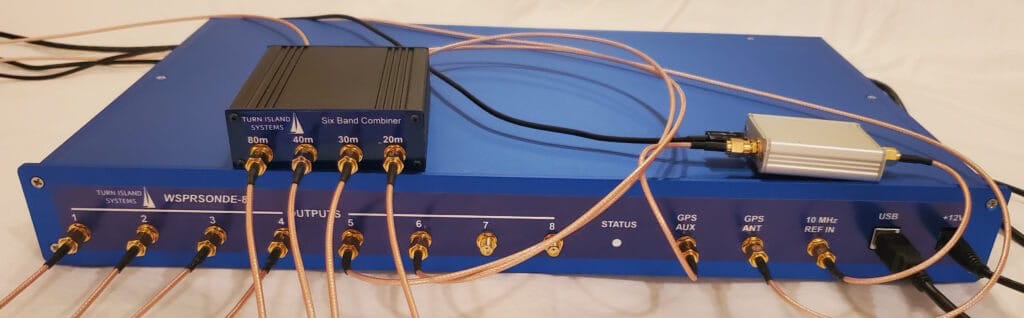
Announcing the next stage in Beacon Blaster evolution: The WSPRSONDE-8!
[The WSPRSONDE-8] is still in development, but the initial prototypes look very promising. Similar in many ways to the BB-6, this has the same type of frequency-flexible 1W Digital (square wave) outputs, the same GPS and 10 MHz clock reference inputs, 9-24VDC input, and USB configuration port. The WSPRSONDE-8 supports both WSPR and FST4W-120 modes.
But the WSPRSONDE-8 adds these new features:Eight frequency-flexible outputs, 1W, 160-6 meters (requires external filtering)Spurious output levels greatly reduced. The BB-6 was designed to meet a spurious output level of -40dBc or better. The WSPRSONDE-8 uses a different modulation technique to provide close-in spurs typically better than -90dBcA single-board design that eliminates the many subassemblies and interconnections inside the BB-6. This is a rugged system.
The WSPRSOND-8 provides ultimate frequency accuracy and stability limited only by the external 10 MHz reference.
I’m continually amazed that these systems are being developed, manufactured, sold, and supported… solo by WB6CXC.
Mostly DIY RF P3ST SSB Transceiver Kit for 15, 17, and 20 Meters
After several months of development, MDRF is pleased to offer this kit version of N6QW's P3ST SSB Transceiver for 15, 17, and 20 meters. Its modular construction allows for easy assembly, testing, and modification. Most of Pete's recent designs are intended as experimenter's platforms. Any of the modules that make up the P3ST's superhet SSB architecture can be swapped out for different designs or modifications. By the way, any of the modules can be used in other homebrew rigs as well, and they will be available for sale separately.
Modules plug into headers on the motherboard which carry relay-switched power. Where possible, components are spaced apart as far as possible for ease of assembly by those who suffer from FFS (fat-finger syndrome). With a standard module size--2.5 x 1 inch (5 x 6.4 cm)--and connector spacing, it will be easy to swap them out or to modify them.
The regular price for the full P3ST kit (all PCB boards, components, RG173 coax, and online manual and documentation) is $109.95. As an introductory and holiday offer, the price will be $99.95 through 1/3/2024.
Unlike many low-power HF radio kits that claim to be “builder-friendly” but have a high density of components making for a complex assembly, the P3ST seems to take “builder friendly” to a more logical extreme. Those “daughterboards” look easy enough to assemble, slowly, carefully. One often vexing construction issue for such radios is assembling the coils - some people are good at it and find it easy, and some don’t find it so easy. Mostly DIY RF has a good answer:
A set of all seven toroid coils and transformer is available pre-wound for $34.95.
The P3ST sounds like a pretty cool inexpensive, low power HF radio. I can easily imagine fabbing up a simple plexiglas enclosure to show it off.
One last thing that I didn’t quite puzzle out is the actual controls of the P3ST, and the announcement was cryptic about it:
And finally, the beating heart of the P3ST: the digital VFO/BFO controller. The version pictured is interim. The version to be shipped will be on a different PC board. The controller uses the now-venerable combination of an Si5351 module controlled by Arduino software. In this case, however, the microcontroller module is a Seeed Studio Xiao with a Raspberry Pi RP2040 MCU. It will run any program intended for an Arduino (including the Si5351 and other libraries) or it can be programmed in MicroPython or Circuit Python. Digital connections to the outside world (display, rotary encoder, etc.) are made through the I2C bus.
So… there’s an external display and controls needed? To be developed? Already developed and available for use with the P3ST? (None are apparent on the company’s website.) Or a host computer? Not clear.
Project Yamhill Continued Progress
Jason Milldrum NT7S continues to make progress on his new design, modular, low-power HF transceiver, “Project Yamhill“:
Project Yamhill is the successor to the Willamette Transceiver, also known as the qrp-l Group Project. The purpose of this endeavor is to provide a platform to learn about radio electronics at a system level. Modules that correspond to the blocks of a block diagram will be the basis upon which different types of radio designs will be created. A modular 3D printed backplane will be the chassis, user interface, and power supply for the radio experiments. The desired goal is to have a high-performance CW QRP transceiver at the end of the main project run, however there would be the capacity to build many other types of radios from the blocks as desired, such as a SSB transceiver, run more transmit power with a linear amplifier that can provide 20 watts or more, data radio, simple receiver, different architectures such as a phasing receiver, etc.
All designs and code will be permissively open sourced so that an end user is able to build one by himself if desired. All radio design specifications will be published, along with detailed information about how the user can make his own measurements with affordable test equipment to ensure that his radio is performing as expected.
His latest installment - Project Yamhill Active Audio Filter concludes with:
What’s Next
I’ve got a large stockpile of various Project Yamhill PCB designs on hand, just about ready for fabrication. Plus I finished the layout of the new 80 meter CW QRP transceiver board as well, and I’m itching to get that one too. I realized that I had forgotten one additional PCB design that’s necessary for an initial build: a board that gives a BNC antenna connector. This should be an easy one to knock out in an afternoon. After that, I will go back through each board design for one last review, and then should be ready to export the Gerbers and send them off to fab. Exciting times!