Zero Retries 0123
2023-11-03 — My Feedback to Radio World, EMCOMM: An Amateur Radio Robust Alarming System, SDR / 10 GHz Data Downlink, PacSat Project, and CubeSatSim - From 2023 AMSAT Space Symposium
Zero Retries is an independent newsletter promoting technological innovation in Amateur Radio, and Amateur Radio as (literally) a license to experiment with and learn about radio technology. Now in its third year of publication, with 1000+ subscribers.
About Zero Retries
Steve Stroh N8GNJ, Editor
Jack Stroh, Late Night Assistant Editor Emeritus
In this issue:
My Feedback to Radio World for Their Recent Article on Amateur Radio
SDR / 10 GHz Data Downlink, PacSat Project, and CubeSatSim - From 2023 AMSAT Space Symposium
Web version of this issue - https://www.zeroretries.org/p/zero-retries-0123
Request To Send
Commentary by Editor Steve Stroh N8GNJ
New Paid Subscribers
My thanks to new Paid Subscriber “Prefers to Remain Anonymous 16” for their financial support of Zero Retries.
My thanks to new Paid Subscriber Peter Neubauer KD0QXJ for his financial support of Zero Retries.
Financial support is a real vote of confidence for continuing to publish Zero Retries.
Welcome (Many) New Subscribers (From Nice Mention in Radio World)
Lately, the Zero Retries subscriber count is ticking up significantly, likely from a nice mention in Radio World (… the leading news and career resource for broadcast radio owners, managers and engineers all over the world.) on 2023-10-27 by Randy J. Stine - FCC Wants to Bolster Amateur Radio:
Steve Stroh, editor of amateur radio newsletter Zero Retries, says the need for improved data communications in amateur radio also coincides with spectrum becoming more “noisy” due to “pollution” by systems such as LED lighting, small switching power supplies and even solar panels.
“That noise has an outsize impact on analog modes such as voice and very low power transmissions. Improved data communications modes, including digital voice modes, can overcome the noise issues,” Stroh said in an email to Radio World.
Stroh says he is happy to see the FCC address the same limitation on the amateur radio VHF and UHF bands — where there is arguably much greater potential for technological innovation in data communications technology — if it wasn’t for the data rate and mode limitations.
“Fortunately, in its proposal, the FCC recognizes that the symbol rate and mode issue does include the Amateur Radio VHF and UHF bands. Thus the FCC’s proposal is a very good one that will significantly benefit Amateur Radio,” he said.
I was a bit surprised to see that Stine focused more on the noise quote than much of the rest of my commentary (see the story below), but I guess that served the story best. It was kind of cool to be mentioned in the same article as a quote from the ARRL.
Family Status, Publishing Zero Retries On Schedule (and Sometimes Not)
Only reluctantly do I mention family and personal issues here in Zero Retries. My perspective is that you’re reading Zero Retries to learn about Technological Innovation in Amateur Radio, not about the mundane events in my household. In Zero Retries 0122, I referenced
… some personal issues that have consumed almost the entire week
as explanation for Zero Retries unusually publishing late, and (at least in my mind) a bit incomplete. My family took me to task a bit for that terse explanation and told me it’s reasonable for a bit more explanation, which is that my wife Tina had hip replacement surgery last week. There were some mild complications that (unexpectedly) consumed the week. Tina is doing fine, recovering nicely, and she’s already at that magical point of such surgeries where, in recovery, she’s in less pain and has more mobility than before the surgery.
I had planned ahead for that busy week for Zero Retries 0122 to some extent and only had a few last-minute small items to add to Zero Retries 0122. But, when the major Zero Retries Interesting news about the FCC November Open Meeting dropped, that really necessitated an additional, timely article.
Brief Starlink Update for N8GNJ Labs
Starlink continues to be the Internet connection in N8GNJ Labs and my office where I do the majority of writing of Zero Retries. Even with my marginal “expedient installation”, Starlink continues to perform well. I have the Starlink Network Statistics web page (generated internally by my “Dishy McFlatface”) displayed in the corner of my display, and it’s interesting to note that Starlink ramps its data rate up and down depending on what I’m doing. If I’m editing Zero Retries, the data usage is low (Substack’s only editing is via a web-based editor), and the download data rate is correspondingly low. But if I’m downloading files, the download data ticks up. This makes sense considering that I’m sharing spectrum and resources with all the other Starlink users in a Starlink satellite’s footprint as they pass overhead, and a ground station or two.
It’s kind of mind-blowing (to me anyway…) to go to https://satellitemap.space, select Starlink, and see just how many Starlink satellites are providing Broadband Internet Access from space, and knowing that all my Internet activity is via satellites! SpaceX is now launching Starlink v2 Mini sats with improved radio technology (until they can launch the “full size” v2 satellites on the still-in-development Starship rocket). Starlink also suffers from using kind-of-marginal Carrier-grade Network Address Translation (CGNAT) for IPv4 services. In mid-2023, Starlink apparently enabled IPv6 to all customers, but their older routers do not support IPv6 (to be determined if mine does, or doesn’t). That will be an interesting science project in the coming months to enable IPv6 (which per some reports does not block incoming ports like CGNAT does).
The Prescient Lyle Johnson KK7P
In Zero Retries 0037 - Banquet Speech by Lyle Johnson WA7GXD I told the story of being in attendance at… now that I think about it, the best speech about Amateur Radio that I’ve ever heard, (then) WA7GXD (now KK7P) was the banquet speaker at the ARRL and TAPR 1996 Digital Communications Conference in Seattle Washington, USA on September 21, 1996. In text, it’s a quick read. In the wake of the FCC’s decision to eliminate symbol rates from Amateur Radio HF bands1, I marvel at this prescient statement by KK7P:
My feeling of how Part 97 should read is easy — “Here's your band limits. Have a nice day.” I think we could fit the whole of Part 97 on this side of this three by five card in large type. So that even a bifocal guy like me could read it without glasses.
That echoes my perspective on this issue. More accurately, KK7P’s foresight helped me develop my perspective on this issue.
Direct VHF / UHF RF to / from Digital - We’re Finally There!
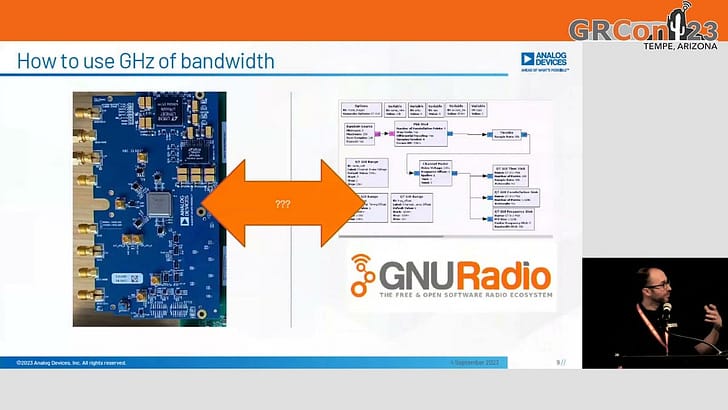
One of the many great talks recently released as part of GNU Radio Conference 2023 was “Analog Devices Sponsored Talk - Direct RF Managing the extreme”.