Zero Retries 0114
2023-09-01 - GNU Radio Conference - A Few Zero Retries Interesting Talks, Instructive Exchange Between Representative and FCC Chair, New AREDN Software Production Release
Zero Retries is an independent newsletter promoting technological innovation in Amateur Radio, and Amateur Radio as (literally) a license to experiment with and learn about radio technology. Now in its third year of publication, with 900+ subscribers.
About Zero Retries
Steve Stroh N8GNJ, Editor
Jack Stroh, Late Night Assistant Editor Emeritus
In this issue:
Web version of this issue - https://www.zeroretries.org/p/zero-retries-0114
Request To Send
Editorial by Steve Stroh N8GNJ
Prefers to remain anonymous is the Newest Zero Retries Founding Member
My thanks to new Founding Member 0004 who prefers to remain anonymous, joining:
Founding Member 0000 - Steven Davidson K3FZT
Founding Member 0001 - Chris Osburn KD7DVD
Founding Member 0002 - Don Rotolo N2IRZ
Founding Member 0003 - William Arcand W1WRA
If you’d like to financially support Zero Retries, becoming a paid subscriber is greatly appreciated and helps offset expenses incurred in publishing Zero Retries. Paid subscriptions for Zero Retries are entirely optional, as explained in this special issue of ZR - Zero Retries Administrivia - Activating Payment Options.
Proud Parents
As you read this, the preceding week has been busy for my family preparing for the wedding of our daughter Merideth Stroh KK7BKI to Max Pepper on Sunday, September 3, 2023 in Portland, Oregon. My wife Tina KD7WSF and I have been blessed beyond reason with Merideth as our daughter, and our blessings have continued in Merideth and Max’s mutual choice of each other. I proposed having a “special event HF station” at the wedding, but that idea was vetoed by Tina.
With all this joyful activity and so many friends and family to spend time with, there will be little time for the longish process of writing an issue of Zero Retries from scratch (or, just filling in the template 😊). Zero Retries 0114 (this issue) and Zero Retries 0115 will be mostly written in advance without my usual daily editing during the week prior to publication as new developments emerge.
GNU Radio Conference - A Few Zero Retries Interesting Talks
By Steve Stroh N8GNJ
The 2023 GNU Radio Conference (GRCon) begins next week. It’s one of those conferences / areas of interest that aren’t quite Amateur Radio, but are adjacent to Zero Retries Areas of Interest. I hope to attend GRCon, perhaps in 2024, and do a Zero Retries Perspective on it. For other such conferences, see the Zero Retries Guide to Interesting Conferences.
For decades now, it’s been the case that electronic units almost always have an element of, or are now mostly software. Incorporating a processor is simply the most cost-effective, simplest, and fastest method to implement an electronic circuit or system. We’re now nearly at that same threshold of radio technology, and what BASIC (or, perhaps, PASCAL) is to computers, the GNU Radio Environment is to Software Defined Radio technology. For beginners in GNU Radio, there is the graphical front end to GNU Radio called GNU Radio Companion which allows one to “drag, drop, and combine” SDR code modules. In 2023, Amateur Radio is well into the transition to Software Defined Radio, and benefits considerably from contributions by those that are proficient with Software Defined Radio technology such as GNU Radio.
Although I have no background in Software Defined Radio (other than a fan and dilettante user), these are some of the most interesting talks I saw on the schedule and would attend them if I was attending GRCon. I hope GRCon will make these talks available on video as some past GRCon talks have been.
Building Basic Data Transmission Systems with GNU Radio
In this workshop, we'll constructively go through building a simple transmitter and receiver system for a basic modulation scheme, starting from a clean-sheet GNU Radio companion window.
The target audience is users who have used GNU Radio before, but not intensively, or new users. Some DSP basics will be helpful.
We cannot get enough of these sorts of getting started in GNU Radio tutorials.
Lunar Internetworking with GNU Radio
In this paper, we introduce a basic LunaNet GNU Radio library, aiming to make full-stack lunar mission communications and networking easily accessible. The library implements pieces of the LunaNet Interoperability Specification (LNIS) - the protocol suite defined for international commercial and government lunar mission internetworking.
The library is used with GNU Radio, a free, open-source software. LunaNet can be viewed as analogous to the Internet for the moon, and will similarly benefit from an easily available general-purpose stack that works with free or low-cost components (e.g. GNU Radio and commodity software defined radio hardware platforms).
As a child of the 1960s when a permanent base on Luna seemed like a logical, inevitable progression of the US Space Program, ”LunaNet” just leaps out at me.
Keynote: Eric Blossom
Eric Blossom founded the GNU Radio project in 2001 and ran it as a full-time undertaking through 2010. Eric was responsible for the original architecture and implementation of GNU Radio, including the fundamental concepts of blocks, streaming data, the buffering system, and the first two generations of schedulers. If there's something about GNU Radio that bugs you, there is a good chance that Eric is to blame.
He is deeply grateful for all of the people who have used and supported GNU Radio over the years and particularly to those who have worked to evolve it into a more powerful and useful tool. Eric has spent the last 6 years at Planet Labs, one of the leading "new space" companies, building a family of high speed radios used to downlink imagery of earth from Planet's constellation of satellites. These satellites are in a 500km orbit, and the radios downlink imagery at > 1.5Gb/s, totaling terabytes of data per day across the constellation.
Eric Blossom K7GNU has deep roots in experimentation in Amateur Radio. As an example, see this article - A Different Way to Think About TAPR as one small example of how GNU Radio and Amateur Radio complement each other. The article also mentions Matt Ettus N2MJI, who I’ve written about previously in Zero Retries, and it’s interesting to see how both K7GNU and N2MJI have leveraged their knowledge, in part from Amateur Radio, to create new space technologies.
Amateur Radio, DSP and GNU Radio
This talk will look at amateur radio's mandate, licensing requirements and the newly-emerging “technologist” versus “communicator” demographic within the hobby. It will describe how gnuradio could be used to teach DSP and SDR techniques to new and existing amateurs (especially those in the “communicator” demographic) with the goal of keeping the hobby relevant and able to continue to advance the radio art in the 21st century.
It seems logical to me that anyone who wants to get proficient with GNU Radio would want to get licensed as an Amateur Radio Operator because it’s literally a license to experiment with radio technology… and thus be able to transmit, legally, in a number of portions of spectrum - HF to microwave.
Design of a 1296 MHz SDR Radio System for EME
EME or Earth Moon Earth communications requires sensitive receivers, relatively high power transmitters and signal processing to be able to communicate by reflecting a signal off the moon. This talk will discuss the system and RF design details in making an EME capable station. The topics include the system link budget, antenna requirements, detailed RF receiver and transmitter design.
The signal processing path will be discussed in detail including the auxiliary control functions for tracking and real time frequency control. Results will be shown for a functioning system.
Dennis Rosenauer AC7FT is an old friend with vast knowledge and capability in radio technology. I’ve known of AC7FT’s EME system in development for a while now and have looked forward to him presenting the details as his system incorporates a number of innovations.
Amateur Radio License Exams
It’s good to see that similar to DEF CON, GRCon offers in-conference Amateur Radio license examination.
No Commercial Amateur Radio Sponsors
Kudos to ARDC for being a major sponsor of GRCon23, but it’s sad that they are the only “Amateur Radio name brand” sponsor of GRCon23. Clearly Amateur Radio manufacturers are not getting the message to get their brand in front of this group of techies that are (by definition) intensely interested in radio technology.
GRCon23 looks like it will be, as always, a fun, interesting, highly educational event.
Instructive Exchange Between Representative and FCC Chair
By Steve Stroh N8GNJ
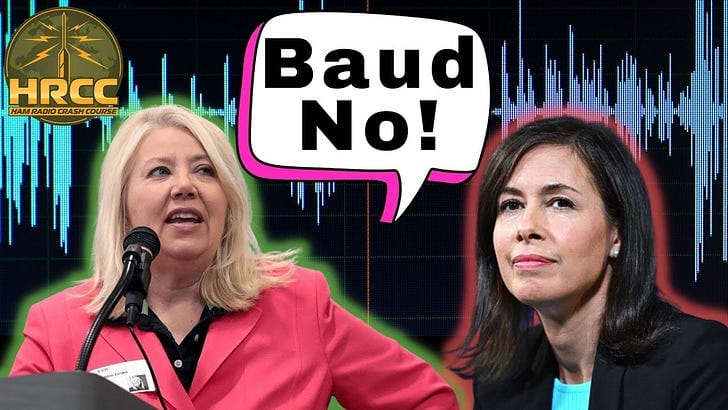
There is a fraught relationship between (US) Amateur Radio and the (US) Federal Communications Commission (FCC), but a recent public discussion indicates maybe there’s hope for progress in updating FCC Amateur Radio regulations.
There was a recent remarkable (to me, anyway) direct acknowledgement of the importance (and even, just the existence) of Amateur Radio in a recent Congressional hearing shown in this recent episode of Ham Radio Crash Course: