Zero Retries 0101
2023-06-02 - Paywalled Amateur Radio Content Part 3, Lots of ZR > BEACON Items
Zero Retries is an independent newsletter promoting technological innovation in Amateur Radio, and Amateur Radio as (literally) a license to experiment with radio technology.
About Zero Retries
Steve Stroh N8GNJ, Editor
Jack Stroh, Late Night Assistant Editor Emeritus
In this issue:
Paywalled Amateur Radio Content Part 3 - Content from Specialized Technology Organizations
Web version of this issue - https://www.zeroretries.org/p/zero-retries-0101
Request To Send
Editorial by Steve Stroh N8GNJ
As this issue publishes, I’m attending the SEA-PAC conference in sunny???1 Seaside, Oregon. I was asked what I’m excited about in attending SEA-PAC and I replied that the only things I think will be Zero Retries Interesting at SEA-PAC will be the possible display of the new Icom IC-905 (perhaps it will even be touchable), and talking to FlexRadio about any new developments.
But, more than the tech, I think that Pseudostaffer Dan Romanchik KB6NU mirrored my feelings about SEA-PAC well in his latest newsletter:
Hams start going to Dayton for the technology. They keep going for the people.
…
Technology was certainly the initial draw for me, but it's not why I keep returning. I didn't buy a single thing this year. What keeps me going back are the people. Every year, I meet old friends, hams who I've only met on the air, and make new friends.
I admire KB6NU’s restraint in leaving Hamvention without having purchased anything… When I attend Hamvention, I don’t have that much willpower.
Unlike most of my Amateur Radio conferences that I enjoy attending (such as TAPR DCC), SEA-PAC isn’t a technical conference, but it’s held in a nice vacation venue2. At SEA-PAC, I do a little bit of flea market shopping (not looking for anything in particular - N8GNJ Labs is full of more projects than I have lifetime left), but mostly I look forward to conversations with interesting people and old friends.
Next year, if the evolution of Zero Retries proceeds roughly in sync with my fertile imagination, Zero Retries might even be an exhibitor at SEA-PAC.
Speaking of conversations at SEA-PAC, if you’re a Zero Retries reader also attending SEA-PAC and would like to chat, look for me in my blue Zero Retries hat, and when it’s appropriate to have a radio on, I’ll try to monitor 223.44 MHz on my trusty Kenwood TH-D6A portable.
Prior to publication, this has been another busy week with considerable travel, thus this is another (what I consider) short shrift issue of Zero Retries. I have some significant things to discuss in future issues of Zero Retries, but those require more butt-in-chair time than I’ve been able to allocate lately.
That lack of butt-in-chair time manifests as missing formatting issues, misteaks, typos, etc. as well as a general paring-down to Substack-recommended length and minimal proofreading. This issue will definitely overflow your mailer, so you might save yourself a bit of frustration and click the button below to go to the web version.
This also another week with no podcast a deferred podcast (I plan to catch up). It’s been surprising to me that a brief “conversational” audio recording takes more preparation time than pounding text into a keyboard, but (at least for me), it does, but then when I started Zero Retries, each issue took nearly a week, and now it’s down to a fraction of that. There was also an interesting development that I’ll discuss soon related to the Zero Retries Podcast which will considerably streamline podcast production.
I also haven’t been able to finish reading and replying to comments from several previous issues of Zero Retries, thus I haven’t caught up to feature some comments in Zero Retries. Thanks for your understanding.
Happy Summer (at least those of us in the Northern Hemisphere)!
Paywalled Amateur Radio Content - Part 3
Content from Specialized Technology Organizations
By Steve Stroh N8GNJ
In this last installment on this subject, I posit that the content produced by Specialized Technology Organizations should be publicly accessible. British Amateur Television Club provides a model for offering content as an incentive for financial support of the organization and making their content publicly accessible.
Part 1 - Publicly Accessible Amateur Radio Content (Zero Retries 0099)
Part 2 - Update on the “Content Beyond the Paywall Is Irrelevant” Perspective - Facebook
My thanks to Tom Fletcher for his comment by in Zero Retries 0099:
I NEVER pay to get past a Paywall, no matter what the “valuable” content is.
I had meant to include this discussion in (what became) Part 13 of this series, but I couldn’t quite phrase it well enough by writing cutoff of Zero Retries 0099. Fletcher’s comment helped me clarify my thinking.
Within Amateur Radio, in general, in this era, in my opinion, content should default to being publicly accessible, unless the content very, very specialized or a compelling reason to restrict content to “paid only”.
Exceptions That Justify Payment / Paywall
One such exception, in my experience, was the W5YI Report which targeted the Amateur Radio industry - manufacturers, retailers, ARRL4 officials, even FCC5 staffers with a timely publication (published biweekly, if memory serves). My perception, from the content6, most of the readers of W5YI report read it to help them be informed in their jobs involving Amateur Radio, thus it was entirely reasonable for W5YI Report to be a paid subscription - easy to justify the subscription fee as part of their jobs.
Another exception was the excellent 220 Notes7 newsletter by Arthur Reis K9XI. During the period that 220 Notes was published (1981 - 1994), the US 220 - 225 MHz band (now the 222 - 225 MHz band) was a nearly forgotten band in much of the US, and mention of it was rare. 220 Notes dived deep into the subject, discussing equipment, band planning, usage, regulatory issues, etc. You couldn’t help admire K9XI for his dedication to, and passion for the 220 - 225 MHz band and want to support him.
Focused Organizations Should Make Their Primary Content Publicly Accessible
In my stance that content should default to being publicly accessible, I'm making exception, for now, for highly specialized (usually technical) content published by “focused” organizations. It’s my guess that the leaders of those organizations are of the “magazine era” and in their minds, the organization’s specialized content is the primary reason for “members” (subscribers) to pay “dues” (subscription fees) to the organization.
This is a sensitive topic, and in this discussion, I’m trying to add more light than heat, so I’ll tread lightly and not mention organization names.
With no public access to an organization’s primary content, it’s hard for those who are new to Amateur Radio to tell if the organization is worth supporting. They simply don’t know the storied history or the current efforts of the organization because they are new to Amateur Radio.
The cynical view (which I’ve heard multiple times from a number of people) is…
”Without a paywall, they’ll just rip us off, read the good stuff, and not support the organization”.
The more charitable view of keeping primary content restricted to paid members is…
“We reserve our primary content as a perk for joining and supporting the organization”.
I think that such views are shortsighted. If the organization is doing good work, it should be obvious that the organization is worth supporting. But, again, it’s sometimes hard to tell what’s really going on with the organization with a “first, pay up, then you can see our content and what we’re doing” model.
Good example by British Amateur Television Club
Public access to primary content doesn’t have to be a binary choice between “give it all away” versus “lock it all up”. I’m impressed with the approach that the British Amateur Television Club (BATC) took with their archives for their newsletter CQ-TV:
Editions of CQ-TV published more than 2 years ago are available for free download on this page.
A full index of articles content dating back to issue 1 is available on the BATC wiki.
With that model, BATC makes their primary content good publicly accessible, albeit two years old8. That’s good enough for my purposes, to know that BATC is “giving back” to Amateur Radio, and providing some incentive to support BATC.
At least, it worked for me — I plan to join and support BATC.
ZR > BEACON
By Steve Stroh N8GNJ
Short mentions of Zero Retries Interesting items.
Zero Retries Pseudostaffer Dan Romanchik retires as ARDC Communications Manager
Wednesday, May 31, 2023, was my last day as an employee of Amateur Radio Digital Communications, the private foundation that’s “empowering the future of amateur radio and digital communication.” It was a great job, but in the end, it was a job, and now it’s time to do something different. I wouldn’t quite call it “retirement,” but it’s pretty close.
What was (and is) cool about KB6NU’s “retirement” from ARDC is that KB6NU was a prolific writer and explainer of Amateur Radio before joining ARDC. With that background, he lent his perspective to ARDC and made connections for ARDC that it wouldn’t have been able to do without him. Having helped launch ARDC to its current stature within Amateur Radio, I think KB6NU can justifiably feel “job well done, now moving on”. (I feel similarly about my two years on the ARDC Grants Advisory Committee.)
I doubt that KB6NU will be “retired” for long.
MikroTik Nv2 (Air interface used for HamWAN User Access)
On the HamWAN Mailing List, there was this interesting passing mention by Douglas Kingston KD7DK:
HamWAN has standardized on Mikrotik gear and we use their NV2 TDMA protocol to get the best bandwidth possible.
Also mentioned in that same message was a presentation (PDF) by David Savage as a good backgrounder - MikroTik Nv2 - New and Improved Wireless Networking with Nstreme Version 2
One highlight:
Nstreme
The use of TDMA - Time Division Multiple Access is inherently more spectrally efficient than Frequency Division Multiple Access (FDMA), IE, duplex operation involving two frequencies, one for transmit, one for receive, versus one frequency (simplex) used for both transmit and receive.
The features of Nstreme Version 2 are significant differentiations for Amateur Radio use because user access to HamWAN nodes uses the (semi-exclusive to Amateur Radio) 5.9 GHz band… and there’s not much spectrum there (compared to 20 MHz channels [and wider] channels that are commonly used on the 5 GHz band.
Product Updates from FlexRadio at Hamvention 2023
It’s always fun to hear from FlexRadio. In its 2023-05-31 The Flex Insider newsletter (emailed, not yet online), FlexRadio reported out from its banquet(s) at Hamvention 2023 which they use as a venue for announcements and interesting information. I wish they would record these and make them available on YouTube for those of us who cannot attend Hamvention.
FlexRadio announced the End of Life (EOL) of the FLEX-6700, citing a successful ten-year lifetime and ongoing component shortages for the product.
But to offset that news…
Maestro Update
During the Dayton Hamvention, CTO Steve Hicks, N5AC presented some of the new features coming up in our latest version of the Maestro.8” Display size, capabilitiesIncreased WiFi CapabilityImproved WiFi radio + antenna (MIMO)WiFi 6 compatibleImproved CW sidetoneNew rechargeable battery option - easily obtained worldwideNew power indication/switch matches M-Series RadiosNew pseudo-differential MIC connectionExternal Display OutputSerial USB pass-thru for RS232 devices such as RotatorsNew optimized hardware connections
Maestro is FlexRadio’s “detached front panel” for their radios. Maestro is just… cool… in that it’s a network-native device - Ethernet or Wi-Fi. There are no other connections between the (actual) radio and Maestro.
Those are significant updates. I was glad to see one that I was hoping for - External Display Output - that will be a cool feature of a FlexRadio system on display in a public venue. Wi-Fi 6 compatibility is nice, but it would have been better to include Wi-Fi 6E compatibility, but that’s a quibble.
Post Publication Update - FlexRadio was at SEA-PAC and during their seminar I asked Steve Hicks N5AC about Wi-Fi 6E and he said that the new version of Maestro uses an integrated compute module with the Wi-Fi built-in, in this case Wi-Fi 6 (reasonable answer).
TAPR Hamvention 2023 Videos Now Online
My thanks to Pseudostaffer Jeff Davis KE9V for spotting that TAPR’s videos from Hamvention 2023 are now online.
Dave Larsen, KV0S, announced that he has finished processing and uploading videos of TAPR events at the 2023 Hamvention. They are now online on the TAPR Digital YouTube site.
My sincere thanks to KV0S for doing the nearly-thankless work of editing and uploading those videos. For me, video editing is a slog, and I greatly appreciate those like KV0S that can do such work for the benefit of Amateur Radio.
Cornbread Road Audio Series Returns!
Speaking of Pseudostaffer Jeff Davis KE9V, he recently announced:
Return to Cornbread Road
Somewhere back in my long ago I wrote a short story about about a secret society of hams in a little country town where all is not as it seems…
Cornbread Road was originally produced in audio format in 2011. Thirteen episodes of about ten minutes each released once each week between the summer solstice and the autumnal equinox that year. I haven’t kept it online because of bandwidth limits and associated costs though I have brought it back for limited runs several times since its initial release. I plan to release the entire series again this summer using the original schedule. Episodes will begin reappearing here on the solstice (June 21) with one episode released each week until the equinox (September 23). It’s a progressive story intended to be told in sequence.
It was always my intention to follow up Cornbread Road with other, similar short stories in audio format, but my career went into overdrive about the same time and I simply never found the time. Having solved that problem, my interest in the production of other audio ham radio related stories has returned. Hopefully this re-release will be the beginning of other new releases.
KE9V is too modest by half about Cornbread Road; overall it’s a great story with good plot development and KE9V integrates the tech in the story quite well. I certify that Cornbread Road is Zero Retries Interesting (there are some delightful technical and radio twists in the story) and that if you enjoy Zero Retries, you’ll enjoy listening to Cornbread Road each week as he releases episodes.
Video Review of the Icom IC-905 SuperRadio
Pseudostaffer Jeff Davis KE9V was particularly busy this week! KE9V recommends this video review of the Icom IC-905 which dropped 2023-05-30.
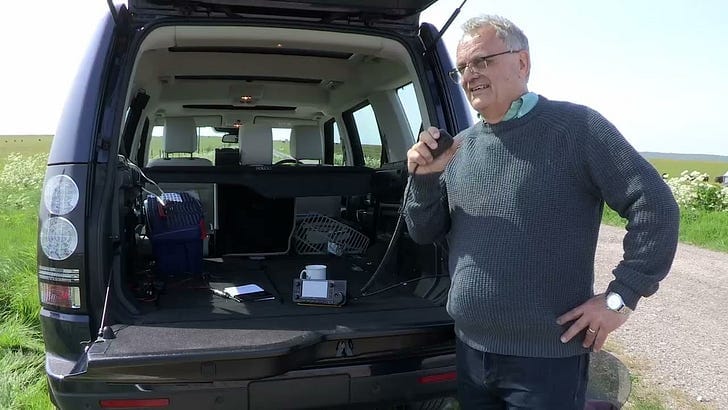
With the much-anticipated UK release of our all new IC-905 SHF/VHF/UHF All Mode Transceiver around the corner, we were lucky enough to get our hands on two of them and asked our friends at TX Films to see if they would like to be the first to do a review. In the resulting YouTube video Bob McCreadie (G0FGX) of TX Films, along with Dave Crump (G8GKQ) and Noel Matthews (G8GTZ) from the British Amateur Television Club, put the IC-905 through its paces, producing a video that demonstrates the IC-905's impressive features and capabilities.
In the video, Bob McCreadie takes us through various aspects of the IC-905 including:
Introduction to the IC-905 SHF/VHF/UHF All-Mode Transceiver.Connectivity…an overview of the sockets and connections on this radio .Menu navigation on the IC-905.Overview of the RF Unit and Transverter.Field Test on Bulbarrow Hill in Dorset including ATV and 10Ghz SSB Tests.