Zero Retries 0092
2023-03-31 - Amateur Radio and the Big Disruption, Linux Packet Node, Talkpod A36Plus 7 band portable radio
Zero Retries is an independent newsletter about technological innovation in Amateur Radio. Zero Retries promotes Amateur Radio as (literally) a license to experiment with radio technology.
About Zero Retries
Steve Stroh N8GNJ, Editor
Jack Stroh, Late Night Assistant Editor Emeritus
In this issue:
Request To Send
BEACON Edition well received
My experiment in Zero Retries 0091 to publish a second edition of Zero Retries - the BEACON Edition (The Quick Mentions Edition of Zero Retries) seemed a success. Of the 17 votes (out of 750+ readers), 65% voted “Love the idea”. Good enough for now.
N2RJ Has Resigned as Hudson Division Director (and ARRL Board)
Regarding the discussion of Ria Jairam N2RJ being sanctioned by the ARRL Board (Request to Send in Zero Retries 0082 and Zero Retries 0083), it’s noteworthy that N2RJ has now resigned as Director of ARRL’s Hudson Division. I said previously:
In the end, the fallout of that bad decision is going to hurt ARRL. Perhaps it will hurt minimally, or it may hurt severely - too soon to tell. The ARRL Board is on the wrong side of history on this issue - it's being hyper protective and insular when it should be looking at the bigger picture.
ARRL CEO David Minster N2AA espouses rhetoric about building diversity:
To change the look of amateur radio from a diversity perspective will take many years. Focusing — seriously focusing — on youth programs and STEM education outreach today is the only realistic future for amateur radio to replace the tens of thousands of hams who will leave the hobby in the coming decade.
In talking to younger folks, a primary thing they’ve told me is that they just don’t “see themselves represented” in Amateur Radio. What they do see, especially in ARRL and especially in ARRL leadership is mostly not young, mostly male, not much racial diversity, etc. ARRL will have a hard time in their recruitment of youth and “STEM education outreach” if those youth being recruited don’t “see themselves represented”.
Thus, in my opinion, the resignation of N2RJ from ARRL leadership is a significant loss to ARRL as a whole and its leadership in particular, because seeing N2RJ in a leadership role at the ARRL did provide some of that needed “see themselves represented”.
Now they won’t.
de Steve Stroh N8GNJ
Amateur Radio and the Big Disruption
By Steve Stroh N8GNJ
Amateur Radio Emergency Communications… and emergency communications in general, operate under the assumption that a communications emergency occurs when normal communications infrastructure is damaged or overwhelmed. Examples are hurricanes, floods, wildfires, etc.1 It’s further assumed that with planning and preparation such as building Emergency Operations Centers (EOCs), communivations vehicles, trained professionals and volunteers, hardened emergency communications facilities, reservoir of emergency equipment, etc. that emergency communications can be maintained.
But what if those assumptions aren’t valid? What if a disaster occurred that completely disrupted the telecommunication infrastructure we depend on - multiple systems simultaneously disrupted?
The following is purely a thought experiment… at the moment.
My news sources are eclectic and varied. I’ve been graciously included in three “communities of thought” where I’m usually the dumbest person in the conversation. Thus, mostly I read and learn. Over the decades, I’ve seen these communities (collectively) offer perspectives and predictions that have often turned out to be prescient. Having “proven themselves” (to me, anyway), I’ve come to pay attention when these communities of thought start highlighting worrisome trends.
One such trend that’s been discussed lately is anticipating “the next big one”. Not a natural disaster, not a major economic downturn but an event that would affect multiple major infrastructure in the US, simultaneously. Just imagine the impact of an event that shuts down…
- A mobile telephone network (example, T-Mobile),
- A major Internet Service Provider (example, Comcast),
- A primary telephone network that provides E911 services (example, CenturyLink),
- A major credit card company (example, Mastercard),
- A major cloud services provider (example, Google Gmail),
- A VSAT (Very Small Aperture Terminal) satellite services operator (example, gas stations verify gas purchases via satellite to authorize a gas pump to dispense gas),
- An airline’s reservation / scheduling system goes offline (example, Southwest),
- A major city’s traffic coordination system that dynamically sequences traffic lights (example, New York City).
- A petroleum pipeline company whose pipeline monitoring system goes offline and thus has to shut down the pipeline (example, Columbia Gas).
- A major power grid goes down for hours… or days… (example, New York City blackout, Texas ice storm).
The above doesn’t factor in the second-order effects; for example, the Texas power grid not only affected electrical power, but disrupted food distribution (grocery stores couldn’t operate), credit cards couldn’t be used, gas stations (generally) could not pump and sell gas, etc.
What’s really sobering in the above scenarios is that each of these disruptions has happened… just (fortunately) not all at once. Some of those scenarios have happened multiple times.
The above scenario also doesn’t factor in the possibility that not just “A” segment of communications infrastructure gets shut down, or smaller combinations get shut down.
What… if it all… gets shut down? As in:
- All mobile telephone networks,
- All major Internet Service Providers,
- All primary telephone networks that provide E911 services,
- (Etc.)
Insane? Unimaginable? Impossible? Just cannot happen?
I posit that it such a scenario is sane, is imaginable, is possible, and could happen.
In discussing the following scenarios, I’m not giving over Zero Retries to doomsday scenarios / apocalyptic justifications for “prepping”, etc. Outlining these scenarios - briefly, incompletely, and perhaps inaccurately, is merely scene-setting for the primary discussion about how Amateur Radio could be part of the solution.
Scenario 1 - Overwhelming cyberattack.
We in the US are wholly dependent on our telecommunications infrastructure. Many of us don’t even carry any cash - we just have our credit or debit cards (or equivalent on a smartphone) and with the ability to instantly verify validity of the funds in the account, which is very convenient. Very few of us have “landlines” any more, and if we do, they’re probably Voice Over Internet Protocol (VOIP) telephones. Most of us don’t receive paper bills for our services, just email notifications of automatic electronic debits and deposits.
Thus a cyberattack that significantly disrupts the US telecommunications (and other) infrastructure would be devastating. It wouldn’t be a cyber attack… such a massive attack would be a cyber war. All of the cyberattacks to date can (in my opinion) be described as skirmishes, or at most, minor battles - not a cyber war. But cyberwar isn’t a distant possibility2 - cyber war against the US is, by far, the most likely opening move when China decides it’s time to “take back” Taiwan.
Scenario 2 - Carrington Event Scale Coronal Mass Ejection (CME)
Zero Retries Pseudostaffer Jeff Davis KE9V offers this succinct explanation:
Kill Shot
March 24, 2023
A massive eruption of solar material, known as a coronal mass ejection or CME, was detected escaping from the Sun at 11:36 p.m. EDT on March 12, 2023. The CME erupted from the side of the Sun opposite Earth. Fortunately, it wasn’t a replay of the Carrington event of 1859. The eruption was on the opposite side on the Sun, facing away from the earth.
Dodging the Apocalypse by J.R. Dunn
Estimates suggest it was ten to one hundred times more powerful than the 1859 event. Had it been an earth-facing, direct, head-on kill-shot, well, you wouldn’t be reading this.
Scenario 3 - Electromagnetic Pulse (EMP) (Nuclear Explosion in Atmosphere)
An enemy attacking the US by causing an EMP is perhaps even likelier than initiating cyber war, and perhaps even more effective. Unlike increasing security on telecommunications infrastructure to reduce the severity of cyberattack / cyberwar, little can be done (with less than military budgets) to protect electronic systems against EMP. Thus an EMP would be devastatingly effective.
…
In all three scenarios, telecommunications as we (civilians know it) would effectively cease to exist, for a significant period. So, what could Amateur Radio do? We’d like to think that Amateur Radio wouldn’t be much affected by a cyber attack / cyber war… but is that true? Think about how much Amateur Radio has come to rely on Internet access - to manage repeaters and operate repeater networks; operate remote stations when you can’t have antennas on premise, how microwave networks are interconnected with Internet, how a lot of “Amateur Radio” activity is (in reality) VOIP through Internet-connected “Hotspots”, Winlink, Automatic Packet Reporting System (APRS) aggregating to Internet servers and websites, etc.
I take little pleasure in suggesting that, perhaps, Amateur Radio might want to attempt to “live without Internet”3 to see what that particular worst-case scenario might be like in its roles as "communications of last resort".
But for the CME and EMP scenarios… they’re hard to imagine… but looking backwards in history, sometimes we suffer most precisely from such a failure of imagination about worst-case scenarios. For communications, most of us could be reduced to using to smoke signals, carrier pigeons, or messengers running around with pieces of paper. Almost anything with an antenna, or connected to a power line will be disabled.
Except, perhaps, for the RFBitBanger radio. I confess to being a bit (mentally) dismissive of this project, thinking it was yet another “scratching my itch” low power HF radio project. That is, until I made the connection between the above, and this description of the RFBitBanger:
The RFBitBanger is an off-the-grid QRP radio. It is not just designed to be used off the grid, it is designed to be assembled and maintained off-the-grid. Most radios require specialized parts that would be difficult to obtain in an extreme parts shortage or in remote places. This radio is designed to be assembled and maintained using the most common jellybean components that might be in a hobbyist junkpile. It will mainly support low bandwidth/digital modes to make the most of limited power.
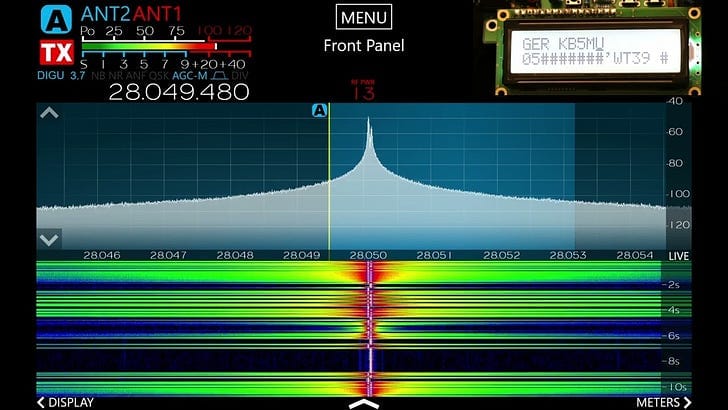
The first prototype of the RFBitBanger transmitting was demo’ed on YouTube a few weeks ago by Paul Williamson KB5MU: