Zero Retries 0080
2023-01-06 - Followup on Zero Retries 0079, Packet Radio Networking - Active and Growing
Zero Retries is an independent newsletter about technological innovation in Amateur Radio.
About Zero Retries
Steve Stroh N8GNJ, Editor
Jack Stroh, Late Night Assistant Editor Emeritus
In this issue:
- Request To Send
- Followup on A Vision for Zero Retries Interesting Amateur Radio in 2029
- Packet Radio Networking - Active and Growing
- Feedback Loop
- Join the Fun on Amateur Radio
- Closing The Channel
Request To Send
Happy 2023 to all you Zero Retries Subscribers / Co-Conspirators!
I’m writing this issue of Zero Retries about a week in advance as I’ll be traveling back to my hometown of Port Clinton, Ohio USA from 2023-01-03 through 01-09 to visit a very dear friend who is now on hospice care. Given the nature of the trip, I decided not to bring a laptop to work on Zero Retries. Thus there will probably be some Zero Retries Interesting news that will hit between 2022-12-31 and 2023-01-06 and not reflected in this issue… but I’ll catch up.
Seeing some other newsletters and blogs, it’s obvious that I got out of traditional synch with Zero Retries over the 2022 holidays. If I had planned ahead a bit better, A Vision for Zero Retries Interesting Amateur Radio in 2029 would have been a great “Christmas Present” for Zero Retries subscribers in Zero Retries 0078 on 2022-12-23, and Zero Retries 0079 on 2022-12-30 would have been a recap of 2022. I do plan to put out an 2022 recap, perhaps as early as Zero Retries 0081. I would have done that for this issue, but it’s a lot of work to plow through a years worth of Zero Retries, so that will have to wait a bit.
Zero Retries 0079 exceeded 1000 Total Views in the first three days, which Substack explains as The total number times this post was viewed as an email, on the web, or in the Substack mobile app. That many “Total Views” in so short a time is a new record for Zero Retries.
I had intended to include at least some Zero Retries Interesting news in ZR > BEACON this issue, but between the two articles below, the dreaded (!) Near email length limit banner appeared.
de Steve N8GNJ
Followup on A Vision for Zero Retries Interesting Amateur Radio in 2029
I had a lot of fun writing A Vision for Zero Retries Interesting Amateur Radio in 2029 in Zero Retries 0079. As usual when I’m having fun writing… to the point of consuming the entire issue. Again, I believe that all of what I wrote there is feasible.
AmGEO Organization / AmGEO-200 Payload
I imagined a new organization to fund and support AmGEO-2001 because existing2 Amateur Radio organizations just don’t seem that… receptive… to the energy, enthusiasm, and social media savvy of younger folks. Thus it seemed feasible to imagine a new organization - Amateur Radio GEO Association (AmGEO) that would. I was particularly proud to imagine this aspect of AmGEO:
Most of the operating expenses of AmGEO are covered by older members who chose to financially support AmGEO-200. It doesn’t hurt that AmGEO transmits the names and callsigns of sponsoring members during the monthly AmGEO meeting held on AmGEO-200.
The transmission of names and callsigns for significant financial contributors would be akin to naming a building on a college or healthcare campus or a civic building for a primary contributor… or a concert organ3. I'll guess that there a number of Amateur Radio Operators who would enjoy making a significant financial contribution to an ambitious project like AmGEO-200 that included some public acknowledgement.
Evolution of Amateur Radio Repeaters
A sadder projection that I didn’t make in the article is that by 2029 I expect that that there will be significantly fewer Amateur Radio repeaters, at least those that are located on tall buildings, broadcast towers, or mountaintops. One reason for that projection is (my observation) that Amateur Radio repeaters are simply getting less use, and with fewer users comes fewer volunteers and funding to keep them going. Another is that most high profile sites suitable for repeaters are no longer owned / managed by individuals that are sympathetic to Amateur Radio, and especially the practice of offering free or discounted site rent. Worst is that such sites increasingly require commercial quality (not older or homebrew) systems, an engineering study (to insure no interference to other users), and antenna installation and maintenance done only by professional tower crews. Those new costs make an Amateur Radio repeater infeasible for many Amateur Radio groups.
Thus, one way to make Amateur Radio repeaters more feasible and affordable is to combine multiple user groups, and multiple modulation systems, into existing (and upgraded) repeaters. That is already being done to some extent by installing MMDVM modems into repeaters, allowing a repeater to provide multiple digital voice modes.
Software Defined Receivers - Missed Opportunities for Technological Innovation
I continue to be amazed at the capabilities of software defined receivers (SDRXs), and dismayed at how little the capabilities of SDRXs have changed Amateur Radio. The Amateur Radio mindset seems unable to let go of the concept of transceivers compromised by complexity, capability, and expense because of including a receiver. Now that we have SDRXs, why not “let go” of the concept of a transceiver and vastly simplify a radio by making it just a transmitter?
I attended Hamvention 2022 and one of the primary (for me) seminar speakers was Phil Karn KA9Q where he discussed his current project, KA9Q-Radio. It’s (more than) unfortunate that Hamvention did not record KA9Q’s presentation (or if it was recorded, it hasn’t yet been made public). What KA9Q is doing is… amazing! KA9Q’s 2021 DCC paper explains KA9Q-Radio in text, but his Hamvention 2022 presentation was far more compelling. Thus, to me, it’s not much of a leap to imagine the AllVU SDRX.
One minor example of the power of an SDRX is that few Amateur Radio Operators have 6 Meter (6M - 50 - 54 MHz) radios, but it’s a very useful VHF band that all Amateur Radio Operators can use. For the minor cost of as little as $30 for a quality (genuine RTL-SDR) SDRX, all Amateur Radio Operators can receive 6M. Thus, imagine a group setting up a bulletin station on 6M that transmitted bulletins, files, etc. using a flood file protocol such as RadioMirror, FLAMP, or a more recent example, RattleGram / Ribbit, or perhaps even UUCP. (Doing so on a small scale is one of the many projects on the list for N8GNJ Labs in 2023.)
Black Box Radios
Another AmNet product, the BB-100 (BB - Black Box) was a simple “black box” whose user interface was a smartphone / tablet app or a web app running within a computer’s web browser.
This didn’t seem like much of a projection, but rather an observation that Amateur Radio radio units, even those with minimal, remote control / display units, are increasingly problematic in modern vehicles. That, while simultaneously, vehicles are evolving to make it smartphone use convenient - magnetic mounting / inductive charging points on the dash, wireless audio integration, etc. Clip the smartphone into the magnetic mounting point, insert your smartphone earbuds, and bring up the “BB-100” app and you’re on the air. Some smart vendor is going to get this right, and soon. Such a product would blaze right past all of the existing Amateur Radio vendors - Blackberry versus iPhone redux.
Amateur Radio Standards Organization (ARSO)
This imagined organization and mission was based loosely on a concept called Amateur Radio Engineering Task Force (ARETF) by Kenny Richards KU7M and Bryan Hoyer K7UDR - kudos to both of them for their vision. Unfortunately, ARETF didn’t achieve much mindshare - partially my fault for not being able to give it much attention in competition with Zero Retries.
Operation Reach Out
Operation Reach Out was an actual project… just not for Amateur Radio. My imagined Operation Reach Out was inspired by the efforts of the Wireless Internet Service Providers Association (WISPA). WISPA is now a large telecommunications industry assication, but in its early days WISPA members would regularly travel to Washington DC to talk directly to FCC personnel and explain their perspective of what they were doing in providing Internet access in rural areas using license-exempt spectrum. FCC personnel couldn’t believe that companies were doing so, let alone doing so successfully. Thus the “yes, my company is doing this” perspective face to face eventually persuaded FCC personnel to pay attention to the WISPs, their capabilities, and their unique needs. In my opinion, WISPA (and those early face to face visits) helped make the Citizens Broadband Radio Service (CBRS) usable for small Wireless Service Providers… and everyone else, not just for behemoth wireless telephony companies.
Amateur Radio Omnipedia
The Amateur Radio Omnipedia was first inspired by the success of the Digital Library of Amateur Radio and Communications (DLARC) and the frustration of trying to browse through the material assembled there. I’m confident that something like the Omnipedia will eventually emerge to make DLARC browse-able. But, an equal inspiration was a story told to me by an Amateur Radio Operator about their experience in trying to add good material about Amateur Radio Packet Radio to Wikipedia:
… tried to place Amateur Radio information in Wikipedia, but the vast majority of Wikipedia volunteer editors knew nothing of Amateur Radio so a lot of Amateur Radio information on Wikipedia was removed or “dumbed down” by (non-Amateur Radio) volunteer editors.
Per my source, this actually happened. Wikipedia can be a harsh environment at times. Thus with DLARC needing a better index, I think that the Omnipedia is an idea whose time has come. But, as with many other Amateur Radio infrastructure ideas, it really needs a long term perspective. Instead of an individual Amateur Radio Operator (or small group) getting a new domain and throwing together a website or wiki and be subject to the “account holder hit by a bus” issue, we need a better system for long term support of things like the Amateur Radio Omnipedia that can survive for a long period.
Amateur Radio Showcase
Amateur Radio Showcase, the imagined competition for video documentaries on Amateur Radio, was inspired by a recent wonderful documentary video - HAM from Kal Bailey, a Documentary Filmmaker student at the University of Montana. You might quibble that HAM was hardly a comprehensive overview of Amateur Radio… but after watching it you won’t want to. Imagine having a few such documentaries released every year.
GNU Radio / GNU Radio Companion for Amateur Radio
If you’ve ever seen a GNU Radio Companion (GRC) demonstration4 done by someone who really knows GRC, you immediately grasp the potential of being able to “build” a radio or modem out of conceptual building blocks. I'll speak solely for myself in saying that what I think I need is “GNU Radio Companion With Training Wheels - optimized for Amateur Radio”. I would love to have the ability to have pre-built modules for things like, say, “9600 bps FSK Modem” and “50 % Forward Error Correction” and “Control settings for Kenwood TM-V71A”, etc. Such a thing is, conceptually, “a simple matter of software, demonstration, documentation, bug fixes, and maintenance”. Perhaps some community.
There are individuals out there that are capable of such work, but they're busy in school, building radios in hardware, etc. Paid work is paid work, and all things being equal, some people would love to work on a project like GRC4D-AR if they can get a multi-year grant to keep the roof dry, fridge full, and the bar tab paid.
Imagine how much fun Amateur Radio would be if we did have the ability to build exactly the kind of radio we want mostly by dragging and dropping blocks on a monitor? Well, I know I would enjoy that very much.
Hopefully this fills in a few of the blanks about A Vision for Zero Retries Interesting Amateur Radio in 2029.
Steve Stroh N8GNJ
Packet Radio Networking - Active and Growing
There were a number of mentions of Amateur Radio5 data communications in December 2022 that served to illustrate (to me) that there’s ongoing, and (I posit) growing interest and capable technology in Amateur Radio Packet Radio and packet radio networking in Amateur Radio.
High(ish) Speed Packet - Some Practical Advice on Breaking the 1k2 Barrier
(I became aware of this column in December.) This was a great Digital Connection column by Don Rotolo N2IRZ in the July 2022 issue of CQ Magazine (pages 70-75)6. N2IRZ did a great tutorial about how to get surplus commercial radios working at data speeds higher than the “every radio will do it” speed of 1200 bps Audio Frequency Shift Keying (AFSK).
Rhizomatica Mercury
In December, Rhizomatica released their “Mercury” modem software package as open source. As I discussed in Zero Retries 0076, Mercury has been in use in a system (not Amateur Radio) and is thus well-proven. Mercury seems highly capable, incorporating Orthogonal Frequency Division Multiplexing (OFDM) techniques and Forward Error Correction (FEC) and it’s potentially usable on VHF / UHF, not just HF. Mercury isn’t usable as it was released - it’s “just a modem” and will require integration into other existing systems, such as Dire Wolf, or perhaps an entirely new system.
Mobilinkd LLC TNC4
In December, Mobilinkd LLC announced on the mobilinkd mailing list that it’s developing a successor to their popular TNC3 - the TNC4, with some improvements over the TNC3:
It has better low-frequency response which is needed to interface with more radios when doing M17 and 9600 baud.It fixes an issue with DC biasing which can occur due to the design of the multiplex PTT circuit. This could lead to clipping in the TNC3.It has over-voltage protection. We have had very few failures of the TNC3 in the field. A large portion of the failures we have seen were due to over-voltage on VUSB -- all the parts on the 5V rail would be blown. A common thread has been using cheap USB PD adapters in a vehicle while operating an HT. I suspect these devices have poor EMI handling and can switch to high-voltage in the presence of RF. So I added an OVP IC to the TNC. This seemed prudent given the next item.And, the number one requested feature of the new TNC: It has a USB-C connector.The firmware for the TNC4 will ship with M17 data support. And you can do M17 voice on Android using a USB-OTG connection. M17 via BLE is hit or miss depending on the Android device.
While the tech of the TNC4 is interesting, it’s more interesting (and encouraging) that Mobilinkd sees enough demand in the Amateur Radio market to justify designing and manufacturing the TNC4.
Rattlegram / Ribbit
Although it’s not designed for Amateur Radio, Rattlegram / Ribbit employed a lot of useful technology such as (very robust) 50% Forward Error Correction and OFDM techniques to achieve 2800 bps. That data rate might not sound impressive until you factor in that it’s 50% of the “full” data rate (the other 50% of the data rate is used for FEC) and it’s using “acoustic” coupling which (I *think* would cause at least some data loss compared to a cable). Not to mention the modulation isn’t optimized for the potential use of a “flat audio” connection in some Amateur Radio units. While the web page says:
Ribbit is open source and currently in its early stages of development.
I can’t find a pointer to Github or other open source code repository. Hopefully that will come as promised. Once the source code for Rattlegram / Ribbit is available, it may be possible to make use of Rattlegram / Ribbit’s modem technology in Amateur Radio, similar to Rhizomatica Mercury.
EastNetPacket Discussion of 6PACK
There was an interesting discussion on the EastNetPacket mailing list of “6PACK”, a technique for using multiple TNCs with a computer back when serial ports on computers were somewhat scarce, expensive, and problematic. Basically, the serial port cabling of the computer and TNCs was configured to “round robin” the inputs and outputs of each TNC into each other (the first TNC’s TX was connected to the second TNC’s RX, etc.), and use special 6PACK firmware in the TNC. Data was passed into and out of each TNC sequentially and back into the computer.
As I read this email discussion, I was interested not so much in the technology of 6PACK (it was a solution for a situation that’s no longer an issue now that we have USB and USB multiport serial adapters), but rather how active the discussion was. It reflected that there’s a lot of interest in Amateur Radio Packet Radio (and more generally in Amateur Radio networking) and especially in creating, reviving, and growing Packet Radio networks such as EastNet along the East Coast of the USA.
Seminar on NinoTNC and NCPacket / TARPN
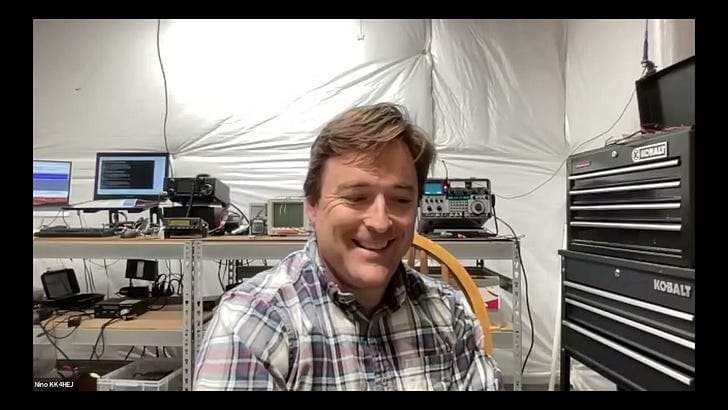
An email from Tadd Torborg KA2DEW on the TARPN mailing list mentioned a presentation that he and Nino Carrillo KK4HEJ gave in December to the Online Amateur Radio Community (OARC), a group based in the UK. KA2DEW mentioned:
OARC members are doing packet radio, recently bought a large number (40+) NinoTNCs and are pondering networking and whatnot.