Zero Retries 0078
2022-12-23 - New 7 Watt New Packet Radio Modem, Symbol Limit Legislation Introduced, Technological Innovation of Rattlegram / Ribbit
Zero Retries is an independent newsletter about technological innovation in Amateur Radio.
About Zero Retries
Steve Stroh N8GNJ, Editor
Jack Stroh, Late Night Assistant Editor Emeritus
In this issue:
- Request To Send
- New 7 Watt New Packet Radio Modem
- US Legislation Proposed to Force FCC to Replace Symbol Limit on HF with 2.8 kHz Bandwidth Limit
- The Technological Innovation of Rattlegram / Ribbit
- ZR > BEACON
- Feedback Loop
- Join the Fun on Amateur Radio
- Closing The Channel
Request To Send
Happy Holidays to all you Zero Retries readers! It’s been a good year for Zero Retries. Zero Retries began 2022 began with 224 subscribers, and it will conclude with 600+ subscribers.
One of the many delights of writing Zero Retries is discovering new approaches to technological innovation in Amateur Radio and associated fields. Such was the case in (re)discovering Rattlegram / Ribbit through the perspective of Andreas Speiss HB9BLA and his excellent YouTube channel HB9BLA Wireless.
I’ll write more about this in a series of articles in Zero Retries in 2023, but a goal for N8GNJ Labs in 2023 is to build a variety of “testbeds” for Amateur Radio data communications. Testbeds will include a variety of computers, modems, radios, etc. that will be able to interoperate within N8GNJ Labs (using dummy loads). Knowing more about Rattlegram / Ribbit has caused me to broaden my scope of the testbeds to include IOS and Android smartphones because technological innovation in Amateur Radio is now expanding from “computers with software” to “phones with apps”.
And, to follow along with HB9BLA’s promised series, I’m going to spin up number of dedicated computers to run GNU Radio with a simple “audio network” by mixing the built-in audio inputs and outputs of those computers via an inexpensive audio mixing unit.
Crowd Supply Falls Down
Disclaimer - this is a personal observation, one person’s experience.
I am a backer of a Crowd Supply development project called CaribouLite RPi HAT
A fully open source dual-channel SDR Raspberry Pi HAT with a tuning range up to 6 GHz.
The latest update from this project on 2022-10-25 indicated that shipments would begin in December, 2022. Nothing heard since then. I queried Crowd Supply about this lack of status updates on that project and Crowd Supply has not replied.
This is a sad development. My trust in backing new Crowd Supply projects is now broken. It’s possible that I may buy products via Crowd Supply, but I won’t back Crowd Supply projects that are in development.
de Steve N8GNJ
New 7 Watt New Packet Radio Modem
As often happens, looking for one thing finds another. I did a quick lookup on New Packet Radio for an article in this issue, and discovered
New Packet Radio Modem Version 2, NPR-H 2.0 on Tindie.
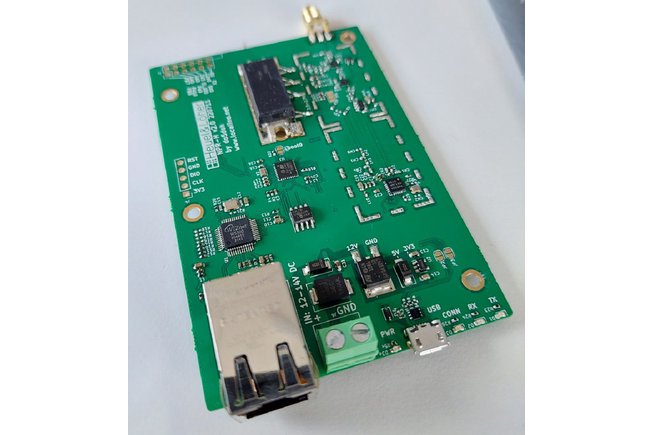
I’ve discussed New Packet Radio a number of times here in Zero Retries. Tersely, it operates on 430 MHz, with a 100 kHz channel, with data rate of 500 kbps. Despite the name, it has no relation to “traditional” Amateur Radio Packet Radio.
This unit is an independent implementation of a New Packet Radio unit (NPR’s creator released it as Open Source) with the advantage of an integral “reasonable transmit power” (7 watts) transmitter and additional memory. Understanding the capabilities of this unit, and the differences from the original New Packet Radio design, will require a bit of study.
This new unit, with reasonable transmit power, may well cause New Packet Radio to take off.
US Legislation Proposed to Force FCC to Replace Symbol Limit on HF with 2.8 kHz Bandwidth Limit
Read for yourself:
ARRL Patting Itself on the Back - Rep. Lesko Introduces Bill to Replace Symbol Rate Limit with Bandwidth Limit
Congresswoman Debbie Lesko’s press release - Lesko Introduces Bill to Protect Amateur Radio
Congress.gov - H.R.9664 - To direct the Federal Communications Commission to amend part 97.307(f) of title 47, Code of Federal Regulations, to allow greater flexibility in data communications in the amateur radio service, and for other purposes. (Wording of H.R.9664 not yet released.)
FCC 97.303 [includes “(f)”] - § 97.307 Emission standards.
…
Summary
In my opinion, persuading Congresswoman Lesko to introduce H.R.9664 in the last few days of the 117th Congress was a vainglorious stunt by the ARRL. Doing so was shortsighted and has no realistic chance to change US Amateur Radio regulations, and could actually have the opposite effect of retarding (even further) chances of reforming US Amateur Radio Regulation to accommodate technological innovation. The FCC does not like getting “spanked” by Congress.
…
Disclaimers
- This is entirely a US issue; Amateur Radio regulations in other countries don’t (as far as I’m aware) don’t have onerous, antiquated “symbol rate” limitations like the FCC does for US Amateur Radio. Non-US readers can skip this article unless you’re interested in the broken relationship between US Amateur Radio, the ARRL, and the FCC.
- In what I write below, I have no formal background in any of the above - legalese, regulatory, legislative, etc.
- I get why the ARRL wanted this and perhaps felt that this was the only way to get what they wanted, but if they were going to “risk big”, they should have “asked big” - try to fix the entire symbol rate issue in the US Amateur Radio regulations.
- As I write this at the end of the week, the text of H.R.9664 is not publicly available. Perhaps some of my issues outlined below are addressed in the text. The verbiage of Congress.gov (see above) is reasonable - nothing specific to HF, or a bandwidth limit of 2.8 kHz. But, given the ARRL’s verbiage:
… require that the Federal Communications Commission (FCC) replace the current HF digital symbol rate limit with a 2.8 kHz bandwidth limit.
and Congresswoman Lesko’s verbiage:… to eliminate the current Symbol Rate Limit set by the Federal Communications Commission (FCC) and replace it with a 2.8 kilohertz (kHz) bandwidth limit.… I’m pessimistic that the text of the bill will be reasonable. - This action is now in progress. At this point there would be more harm than good in trying to stop it or change it. Hopefully it will fade out quickly… but the FCC won’t forget this “spanking”. What I’m trying to explain here is that this move was short-sighted, could have been done better, should have been done better, and I wish we had done better.
…
At a glancing blow reading (which is all most US Amateur Radio Operators will ever know about this), the headlines that are being reported (see above) seem laudable. Someone persuaded Congresswoman Lesko that “some simple legislation” would help out Amateur Radio.
But digging deeper, I think this Hail Mary pass, getting someone in Congress to introduce legislation to “get the FCC’s attention”, was a bad idea.
First, this legislation has an approximately infinitesimal possibility of passage in the waning days of the 117th Congress. If it has any “legs” at all, it will have to be re-introduced in the 118th Congress. Congress has big issues to work on, and there’s the issue that the 118th Congress will have the House of Representatives and the Senate with different majority parties, so this issue will be down in the noise.
The intent of the bill seems to be to to “spank” the FCC for ignoring Amateur Radio (and the ARRL). ARRL President Rick Roderick K5UR said as much:
I hope that the Commission will act to remove this harmful limitation without waiting for the bill to be passed.
In my opinion, this tactic won’t work. The FCC, normally composed of five Commissioners, is currently deadlocked with two Republican Commissioners and two Democrat Commissioners. Thus getting substantive rules changes will likely not get done. Even if, somehow, this bill were to advance in Congress, the requirement will simply get added to the FCC’s To Do List for when a fifth commissioner is eventually confirmed.
Then there’s the issue that the narrow wording - “HF”, “2.8 kHz”, etc. wouldn’t significantly approach the Congresswoman Lesko’s stated goals:
“With advances in our modern technology, increased amounts of data can be put on the spectrum, so there is less of a need for a regulatory limit on symbol rates,” said Congresswoman Lesko. “I am pleased to introduce this important piece of legislation to update the FCC’s rules to support the critical role amateur radio operators play and better reflect the capabilities of our modern radio technology.”
From all appearances (again, the text of H.R.9664 is not yet available), this doesn’t address the (to me) more burdensome issue of symbol rate limitations applied to Amateur Radio VHF / UHF bands. With no symbol rate limitations on Amateur Radio’s VHF and UHF bands, Amateur Radio could do some significant technological innovation because no other radio service, or company, is paying attention to advancing data communications technology in VHF and UHF spectrum.
Here are some examples why regulation by symbol rate in the US is retarding technological innovation in Amateur Radio:
- New Packet Radio (NPR) uses a 100 kHz channel on 430 MHz channel to achieve up to 500 kbps. For US use, they had to create a special (limited) mode:
Note for USA : Due to CFR 47 Part 97.3 FCC regulations, for the 70cm amateur radio band (restriction to 100kHz and 56kBaud), only the setting “modulation 20” of NPR-70 seems to be legal in USA. Please always check your local amateur-radio regulation before buying and using NPR70. Modulation 20: Symbol Rate 50kS/s, bandwidth 100kHz, raw datarate 100kb/s raw, usable datarate 65kb/s.
The damning thing about this is that even in the “US version” NPR still uses a 100 kHz channel - the “US version” just runs slower… it’s “dumbed down”. There is absolutely no benefit of the symbol rate limitation. - RPX-100 is an innovative project to create a practical software defined multiband VHF / UHF transceiver. “Practical” because unlike current software defined VHF / UHF transceivers, RPX-100 will transmit at reasonable power levels - 30 watts. Like New Packet Radio illustrates, there’s no good reason to retard the potential performance of an eventual commercial version of RPX-100 to comply with the archaic symbol rate limitations in the US.
- Rattlegram / Ribbit (see next article) doesn’t fit into any neat regulatory categories.
I think it likely that limiting the scope of this bill to “HF” and “2.8 kHz channels” will cause at least a small stink. I’ll guess that there will be mentions to Congresswoman Lesko “why didn’t you address all the symbol rate limitations in US Amateur Radio in your bill?” If / when that happens, Congresswoman Lesko will rightfully feel blindsided, because as it was explained to her, that wording would be a big help to Amateur Radio. If she cares to dig into it (and she could easily do so by assigning a staff member to do so) it will quickly be discovered that in reality, this bill would only fix a minor issue - the ARRL (and a small number of US Amateur Radio Operators) will get to use their shiny SCS Pactor 4 modems at full speed on HF without needing to request an FCC Special Temporary Authority. After all… how many of us really want to buy a $1200+ modem to run a proprietary data mode only on HF?
If we US Amateur Radio Operators really want to get the US Amateur Radio regulations updated to reflect modern radio technology and realize the potential for experimentation and technological innovation that’s now possible, doing so will require much more vision, methodology, and motivation than what the ARRL has exhibited. One stellar, but severely under-appreciated vision for US Amateur Radio regulatory reform is this document from Bruce Perens K6BP in 2017:
TECHNOLOGICAL ADVISORY COUNCIL (TAC) TECHNICAL INQUIRY INTO REFORMING TECHNICAL REGULATIONS
ET Docket No. 17-215
Before the Federal Communications Commission Washington, DC, 20554
This [document] concerns the Amateur Service. Amateur Radio is unique in that it promotes self- education, experimentation, and participation in technology by individuals on a non-commercial basis. As a service that inherently requires a technical participation of the licensee, I believe the basis and purpose of the Amateur Service and all of its rules are potentially within the mission of the TAC’s study. I am not in general asking for rules to be merely simplified. Rather, I am asking for modernization of rules, some of which have remained unchanged for 65 years or more. My comments present proposed new text in some cases.
US Amateur Radio Operators deserve substance like what K6BP outlines… not stunts.
The Technological Innovation of Rattlegram / Ribbit
Disclaimer: Rattlegram / Ribbit wasn’t developed specifically for Amateur Radio, thus there’s no accommodation for automatic transmission of an Amateur Radio (or other radio service) callsign. That’s not a showstopper for Amateur Radio experimention, just something to be aware of and accommodated, such as when you’re experimenting with it over Amateur Radio… drop in your respective callsigns via voice, and you’re complying with the letter of the law.
I was a little confused when I got this email from Andreas Speiss HB9BLA on 2022-12-10:
Just released a video about Rattlegram which I found in your newsletter. So you got a shout-out. Thank you for this great idea!
Rattlegram? I went back and checked, and I didn’t mention Rattlegram in Zero Retries. I thought he must have confused Ribbit, which I did write about in Zero Retries 0075:
Interesting Projects In Development
New0075 Ribbit - Data communications via any two-way radio; modem is a smart phone app, which transmits and receives data to / from the radio acoustically. For those of us who’ve been connecting radios and modems forever… with cables… it’s understandable to look at Ribbit as “Oh, that’s cute” and get back to wiring radios and modems. But the authors did a neat trick with Ribbit - by keeping the interface as “acoustic”, they neatly sidestep all the complications about whether data modes are authorized on a particular radio service. One example is (US) Citizens Band - data modes are not included as an authorized mode. But using Ribbit requires only keying the microphone close to the smartphone’s speaker. It… just works.
But browsing the Ribbit website a bit deeper, I went to the download link, which directed me to the Google Play store, and found:
Try Ribbit today! Transmit text messages over VHF/UHF Tech demo published as ‘Rattlegram’ on Google Play Store. Test your app decoding with this YouTube Test Video. Why is app not called ‘Ribbit’? We reserve the ‘ribbit’ name when the app will be ready for general release.
Gotcha! Rattlegram is the experimental version of (eventually) Ribbit.
From this point, for efficiency, I’ll only mention Rattlegram, not Ribbit.
Since he was nice enough to mention Zero Retries, I watched HB9BLA’s video for a few minutes and was fascinated. I later went back and watched it all the way through… and then did so a second time. First impression - there is much more to Rattlegram than I initially understood. Second impression - HB9BLA is a great instructor. One commenter said it very well:
A semester's worth of comms-101-theory explained in 13 easy-to-digest minutes. Bravo :)