Zero Retries 0073
2022-11-18 - Thought Experiment - Amateur Radio Social Network - On Amateur Radio, We Use Baofeng's “Heart” For Our Projects, Testing New AREDN Software, DX’ing Jupiter!
Zero Retries is an independent email newsletter about technological innovation in Amateur Radio, for a self-selecting niche audience. It’s free (as in beer) to subscribe.
Steve Stroh N8GNJ, Editor
Jack Stroh, Late Night Assistant Editor Emeritus
In this issue:
- Request To Send
- Thought Experiment - Amateur Radio Social Network - On Amateur Radio
- Andreas Speiss HB9BLA - We Use Baofeng's “Heart” For Our Projects
- Testing New AREDN Software
- DX’ing Jupiter!
- ZR > BEACON
- Feedback Loop
- Join the Fun on Amateur Radio
- Closing The Channel
Request To Send
I’ve applied for an account on Mastodon - n8gnj@mastodon.radio; my application is pending as I write this approved. As with most folks trying out the Mastodon social network of late, my trying out Mastodon is a reaction to the chaos occurring at Twitter under new ownership / management. At first I thought the Twitterpocalypse was overblown. Because I curated my Twitter experience for Zero Retries tightly, initially there wasn’t any noticeable difference under the new ownership of Twitter… until there was. Every week since the ownership change, there have been fewer and fewer tweets that are Zero Retries Interesting tweets. Twitter accounts that I followed and were highly useful have stopped posting, and many of those have simply left Twitter. At this point, it seems quite possible that Twitter’s utility to Zero Retries will dwindle to “not that useful”, thus it’s time to consider other options. I’ll remain on Twitter as long as it continues to be more useful than not.
I have no opinions yet on the utility of Mastodon. One potential downside versus Twitter is that the mastodon.radio server that I’ve requested an account on is intended for use by Amateur Radio Operators. The downside of that focus on Amateur Radio is that on Twitter, I was able to follow folks that were posting Zero Retries Interesting items that had not much to do with Amateur Radio, but were useful and interesting to discuss in Zero Retries. I’m not sure how easy / efficient / possible it will be to replicate that on Mastodon.
It’s worth noting that there are long-established communities of thought specifically for Amateur Radio. Despite the annoying and spammy blinky advertising, QRZ features news and forums, as does eHam. Unfortunately, I just didn’t see very much that was Zero Retries Interesting on either QRZ or eHam1. I’m sure there are Discord servers for Amateur Radio… oops, maybe not. Not to mention that the various YouTube channels and mailing lists on groups.io and Google Groups on Amateur Radio topics often serve as defacto communities of thought.
So… regarding Mastodon… we’ll see.
de Steve N8GNJ
Thought Experiment - Amateur Radio Social Network - On Amateur Radio
To complete this article by deadline (I’m a bit behind this week) I won’t discuss some successful and active Amateur Radio Networks on Amateur Radio such as HAMNET, HamWAN, and AREDN that are largely based on microwave linking. Not to mention the network that has grown up around the QO-100 geosynchronous payload that’s accessible to most Amateur Radio Operators in the Eastern hemisphere. Those networks certainly deserve inclusion in the discussion below - at some future time, including the curious issue that while these high-speed networks can accommodate social networking software and systems such as Mastodon… very few actually do so.
As I was thinking about social networking for Amateur Radio Operators… my thoughts started turning towards (re)building a “social network” on Amateur Radio. This might get a bit hard to follow for those that weren’t deeply immersed in Amateur Packet Radio back in the 1980s, so allow me to do some explanations of the way it was.
Before there was public access to the Internet (access was restricted to universities, industries involved in government contracting, and US government), there were various networking systems; kind of proto Internets. Examples were Compuserve, FidoNet, Bulletin Board Systems (BBS), and Amateur Radio Packet Radio networks, including Packet Radio Bulletin Board Systems (PBBS). There was also Usenet which was kind of Internet, kind of not Internet, that wasn’t subject to the restrictions on direct access to the Internet.
Of course, once “civilians” were able to get access to the Internet, all of the above dwindled drastically - the Internet was just so much better.
Amateur Radio Packet Radio, and PBBS worked as a social network for Amateur Radio, and it all worked on Amateur Radio. As an Amateur Radio Operator, you connected via Amateur Radio VHF or UHF to your local PBBS, and you downloaded any individual messages (email) and then read bulletins, either local or from other parts of the country (or world) and downloaded any new files in the file library.
There were so many problems with the way we used to do Packet Radio networking and using PBBS…
- It was slow. 1200 bits per second data transfer, and if the channel was busy, there were collisions with other users transmitting, requiring retransmissions, etc.
- Packet Radio networking was only somewhat effective as it was based on TNCs with a 1 MHz processor, 32 kB for firmware, and 32 kB for Random Access Memory (RAM).
- For each user to have a file or bulletin, it had to be retransmitted individually; not very efficient on “channel time”.
- The majority of the VHF and UHF bands were used for FM repeater voice communications. Packet Radio had to be “shoehorned” into the FM repeater paradigm.
- TNCs and computers were expensive. By comparison to today, software was primitive and trouble-prone running on single-tasking operating systems like PC-DOS.
Of course, it’s very different now.
- We have radios that can do data much faster such as the Yaesu FTM-6000R which includes a “flat audio” connection for fast data. We even have entirely new families of data radios for Amateur Radio such as New Packet Radio and RPX-100.
- We have new data modes such as VARA FM and even Packet Radio reimagined for embedded computers and using a high performance audio interface. The NinoTNC and Dire Wolf software can do up to 9600 bps and can also enable Forward Error Correction (FEC). Not only can we do faster over-the-air speeds, but we can do it more reliably using FEC.
- To do networking, we now have inexpensive embedded computers such as the Raspberry Pi with processors operating at speeds > 1 GHz, essentially unlimited storage (SD cards) and up to 8 GB of RAM. That amazing compute power enables a much more powerful operating system - Linux, instead of firmware embedded in a Read Only Memory (ROM) chip.
- TCP/IP was an exotic mode compared to Packet Radio. Now, it’s mainsteam and built-in to Linux. TCP/IP over Packet Radio “just works”.
- Wide area networking was generally done with digipeaters on a single frequency. A packet was received by the digipeater, and then retransmitted on the same frequency. Under ideal conditions / usage, that cut the potential capacity of the wide-area channel by 50%.
- That cheap, abundant compute power has moved data modes into the realm of software such as Dire Wolf, needing only a reasonable audio interface. It’s also enabled much more sophisticated PBBS capabilities.
- Usage of Amateur Radio VHF / UHF bands has fallen dramatically, thus using channels for data is much more feasible than it used to be.
In fairness to their vision (for nearly a decade now), and to give credit where due, the “it’s different now” perspective is most of the premise of Terrestrial Amateur Packet Radio Network (TARPN).

An ever expanding group of Amateur Radio operators are working together to use many VHF/UHF radios to link multiple ham radio stations in a digital network for the purpose of having fun in a fun, educational, hobbyist-controlled environment, built using ham radio infrastructure based on packet radio technology. No Internet traffic is required or even desired! Goals [include]Linked entirely over hobbyist-controlled radio equipment;To establish camaraderie;Inspire the curious;Attract and retain new hams including younger hams.
The software suite that TAPRN has developed incorporates Packet Radio Bulletin Board Systems and realtime chatting. There are elements of the TARPN vision that I quibble with such as a strong preference that to join a TARPN network requires building your own NinoTNC, no use of repeaters, and insistence on dedicated channels for radio links, but generally I support what TAPRN is trying to do. A TAPRN network is a social network for Amateur Radio that operates on Amateur Radio.
In addition to what TAPRN has chosen to do, Amateur Radio has some really amazing technology and capabilities that we can incorporate into a vision of an Amateur Radio social network.
- Amateur Radio has other bands to make use of including “6 meters on 50-54 MHz and “1.25 meters” on 222-225 MHz.
- We have very inexpensive software defined receivers that can now receive all of the Amateur Radio VHF and UHF bands. With that kind of receive capability, we can build Packet Radio Networks that are very different from the single-frequency for transmit and receive. For example, what if a PBBS listened on 2 meters (144-148 MHz) and transmitted on 6 meters (50-54 MHz). 6 meter transceivers are rare now, but 50-54 MHz is easily within the range of an inexpensive software defined receiver, so nearly anyone could receive transmissions from the BBS.
- What if instead of each individual user downloading the same bulletin, we just “flood” bulletins to all users simultaneously using a broadcast-and-fill protocol such as RadioMirror or flamp?
- What if we used “unused repeater time” in the wee hours to synchronize all BBS systems in an area with the same files, the same bulletins, exchange inter-BBS email, etc.
The primary point of this thought experiment is that we have many, and very good, very capable tools to reimagine social networking for Amateur Radio Operators over Amateur Radio. Let’s start doing so!
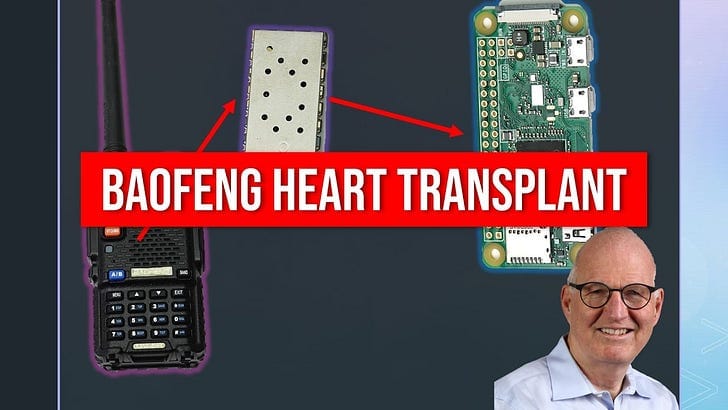
We Use Baofeng's “Heart” For Our Projects
Andreas Speiss HB9BLA
Most of us own a Baofeng. It is cheap and does the job. What would you say if we could transplant its “heart” and combine it with a Raspberry Pi or an ESP32? We would get a dirt cheap and compact device for all sorts of analog and digital modes.