Zero Retries 0067
AREDN Update, GPS Jamming

Zero Retries is an independent email newsletter about technological innovation in Amateur Radio, for a self-selecting niche audience. It’s free (as in beer) to subscribe.
Steve Stroh N8GNJ, Editor
Jack Stroh, Late Night Assistant Editor Emeritus
In this issue:
- Pseudosponsor - Hackaday Supercon 2022
- Request To Send
- AREDN Nightly Build Update, and Personal AREDN Experimentation
- GPS Jamming - Correspondence with Time Nut John Ackermann N8UR
- First Results – World’s Largest Jammer (& Spoofing) Test
- ZR > BEACON
- Updata - FPGA is Field Programmable Gate Array
- Zero Retries Sponsorships
- Join the Fun on Amateur Radio
- Closing The Channel
Pseudosponsor - Hackaday Supercon 2022
Hackaday Supercon 2022 is the Ultimate Hardware Conference and you need to be there! The return of Supercon is taking place in just a month. We’ve got 45 fantastic talks and workshops planned for the three-day weekend, and they are as varied and inspiring as the Hackaday community itself.
Request To Send
Ah, October, my favorite month! The weather continues to be absolutely amazing gorgeous Fall here in Whatcom County, Washington, USA. It’s like waiting for the other shoe to drop knowing that months of mostly wet, gloomy weather are imminent, but for now I’ll enjoy every moment of warm sunshine and having the big doors to N8GNJ Labs open to the fresh air that I can.
de Steve N8GNJ
AREDN Nightly Build Update, and Personal AREDN Experimentation
The developers on Amateur Radio Emergency Data Network (AREDN) are certainly keeping busy on improving AREDN! In the News section (author uncredited):
Here's what's been added to the AREDN codebase since the last Production Release:
Miscellaneous fixes and updatesAdded support for extra network links to OLSR.Included wireguard packages in the repo.Fixed recoverymode script (didn't work correctly).Added ntp update period to basic setup page - can now choose between daily and hourly updates.Stopped a node from including itself in its LQM neighbors.Fixed bad match for NAT dhcp address.Added a wifi scan trigger for when the “nodes detected” count becomes zero (resets Wi-Fi).Added a snapshot of hostnames after OLSR updates so we have a consistent copy to display on Mesh Status page.Optionally include static routes (and preserve them across upgrades).
Advertised services determination logicAdded more 3XX redirects + 401 authentication.If redirect ends at an https link assume it is valid.
UI changesAdded help link to pages missing it.Changed support link to button.Updated help file for new Advanced Config format.Simplified Advanced Config display.Added units to Setup and Advanced Config pages.
If you aren’t yet up and running on AREDN and want to see what some of the excitement is about, it’s possible to experiment with AREDN by yourself, relatively inexpensively, to see what all the excitement is about:
The least expensive AREDN device for personal experimentation was the venerable and inexpensive GL.iNet GL-AR150. Alas, per the manufacturer, it’s now discontinued. Despite its diminutive size (it fits in the palm of my hand) the GL-AR150 was a capable device. The GL-AR150-EXT had an external antenna with connector, and thus lent itself to antenna experimentation. I had a good time learning about AREDN with my various GL-AR150 units.
Another device capable of running AREDN that was nearly as inexpensive as the GL-AR150s (or less expensive… I forget) is the GL.iNet GL-USB150 “Microuter”. While it’s not shown as discontinued by the manufacturer, they’re not available on Amazon (that I can see). The Microuter is a cool device, that when flashed with AREDN firmware, presents itself to a host computer on USB as an Ethernet adapter. But it’s also (as I understand it - I haven’t tested this… but I should…) can be plugged into a USB power supply and it acts as an AREDN mesh node. Thus you can set it up with a host computer, then connect it to a USB power supply and it will work standalone. It could, theoretically, be connected to a USB battery pack and then hoisted to the top of a pole and act as a relay from that point. At height, the internal antenna is less of an issue.
Both the GL-AR150 and the GL-USB150 are 2.x GHz only devices; natively they operate on 2.4 GHz, but flashed with AREDN firmware they can operate in the Amateur Radio 2.390 - 2.400 GHz band, either as two 5 MHz channels, or one 10 MHz channel.
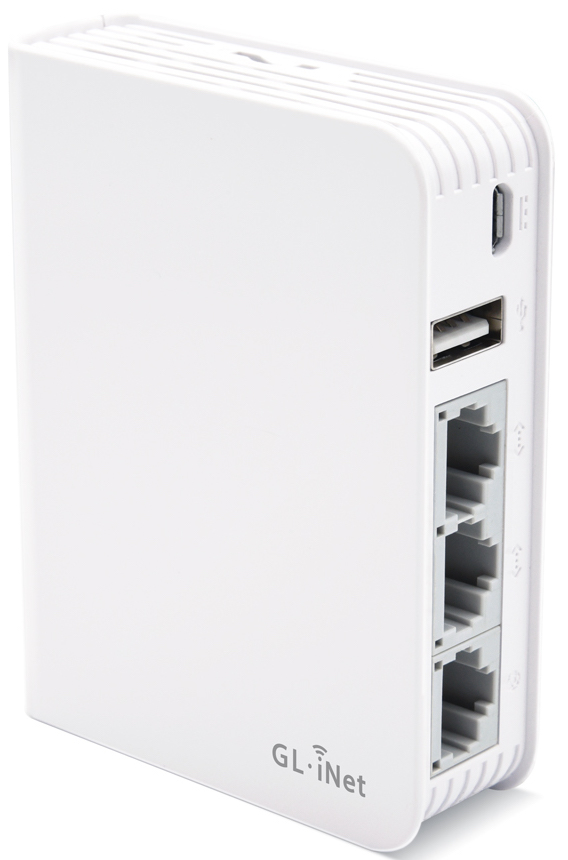
With both the GL-AR150 and GL-USB150 apparently unavailable, at least from Amazon, the next best option for personal experimentation with AREDN is the GL.iNet GL-AR750 (Creta). Creta has both 2.4 GHz and 5 GHz radios, but only the 2.4 GHz radio can be modified by AREDN. This is more useful than it seems, as you can access an AREDN GL-AR750 on 5 GHz via normal Wi-Fi and that connection is bridged over to the AREDN 2.4 GHz radio. As I type this, GL-AR750 is available on Amazon for $50 each. (Search Amazon for “GL-AR750 (Creta)“. I suggest buying at least two, preferably 3 so you can really experiment with mesh networking. Note that there are some confusing variants of “GL-AR750” - the only one supported with AREDN firmware is the version pictured above.
Once you have the units, you’re in for a bit of adventure in flashing the unit to AREDN firmware. The process generally works, but sometimes requires some “fiddling”. In my experimentation with the GL-AR750 units, after flashing it to AREDN firmware, sometimes I could connect to the unit via Ethernet, and sometimes not and I had to resort to attempting to connect via the 5 GHz Wi-Fi. In the end, all units were successfully flashed to AREDN. As a last resort, while it’s a bit involved, the GL-AR750 documentation includes a procedure to reflash it to original firmware.
But, “technological adventures” is kind of the point of all of this, right?
GPS Jamming - Correspondence with Time Nut John Ackermann N8UR
Amateur Radio is using GPS a lot more than it used to, primarily for high-resolution time synchronization for experimentation on HF, such as Weak Signal Propagation Reporter (WSPR), and more recently, the plan to use it for experiments on HF by Ham Radio Science Citizen Investigation (HamSCI).
Thus, one of the presentations I enjoyed from DCC 2022 a few weeks ago was by John Ackermann N8UR - Using a GPS as an RF Source: Possibilities and Pitfalls. As background, N8UR cheerfully confesses to being a “Time Nut”, Amateurs (not necessarily Amateur Radio Operators) who are interested in measurement of precise time and frequency.