Zero Retries 0236
2026-01-30
Zero Retries is an independent newsletter promoting technological innovation in and adjacent to Amateur Radio, and Amateur Radio as (literally) a license to experiment with and learn about radio technology. Radios are computers - with antennas! Now in its fifth year of publication, with 3400+ subscribers.
Steve Stroh N8GNJ, Editor
Ghost says this issue is too big for email clients? YES
Thus, it might be easier to read this in a web browser -
https://www.zeroretries.radio/zero-retries-0236/
In This Issue...
- Request To Send
- Paid Subscribers Update
- The Saga of the Conversion to Ghost and zeroretries.radio - Part 3
- Attending HamSCI 2026
- I'm On The New ARDC Grants Communications Team
- The Emerging ‘Technification’ of Amateur Radio
- Great Meeting with Professor Andy Klein of Western Washington University
- Breaking - ADRCS and TARPN Announce New Audio OFDM-based Mode for VHF / UHF Radios
- What Would A New, More Advanced Amateur Radio VHF / UHF Data Mode Look Like?
- What VARA FM Does Well
- Equivalent Capabilities of to VARA FM in Packet Radio
- What Could Cause This Status Quo To Improve?
- WA4DSY 56k Radio Modem
- Icom D-Star Digital Data
- New Packet Radio
- AREDN on 902-928 MHz
- LinHT Experimental Data Mode
- IP400 Mesh Network Project
- Kantronics 9612XE
- MMDVM-TNC
- Rhizomatica Mercury Modem
- Faster Data Rates in Dire Wolf Software TNC
- Conclusion
- Kenwood TM-D750A / TM-D750E Mobile Radio is Apparently Imminent
- ZR > BEACON
- OPEN.SPACE: AN OPEN SOURCE SDR BASED PHASED ARRAY FOR BOUNCING SIGNALS OFF THE MOON
- This is a New Kind of Wireless (video)
- DIY P25 Trunked Repeater System - Ham Radio (video)
- Microwave HamTV From Space (Not SSTV) (video)
- Amateur Technician Position for Repair Units - Yaesu
- Kantronics 9612XE
- ARDC’s Priority Areas for Funding
- [AMSAT-US] 2025 Symposium Papers and Presentations
- m17-texting
- The FCC Wants to Let Broadcasters Turn Off Your TV
- Closing Thanks
- Permission to Reuse Zero Retries Content
Request To Send
It will take me a while to figure out formatting (and using Markdown). Thus the form and formatting of these early issues published on Ghost won't be as "polished" as I was doing on Substack, in deference to pushing out Zero Retries on schedule(ish) on (new to me) Ghost.
Paid Subscribers Update
Administrivia Note:
Paid Subscription renewals (automatic billing) are continuing on Substack until:
- Potential domain name changes are completed, and
- I can copy the email subscriber database from Substack to Ghost and begin email transmissions from Ghost, and
- We are able to set up optional paid subscriptions in Ghost.
Once those tasks are completed, automatic billing will be turned off on Substack. Thanks for your understanding, and your ongoing financial support, while we work through the transition of Zero Retries from Substack to Ghost publishing platform.
My thanks to Newton White N4EWT for renewing as Founding Member Subscriber 0013 to Zero Retries in January!
Founding members are listed in every issue of Zero Retries!
My thanks to Paul Campbell KE7YK for renewing as an Annual Paid Subscriber to Zero Retries in January!
My thanks to Prefers to Remain Anonymous 119 for upgrading from a free subscriber to Zero Retries to an Annual Paid Subscriber in January!
My thanks to Prefers to Remain Anonymous 120 for upgrading from a free subscriber to Zero Retries to an Annual Paid Subscriber in January!
My thanks to Prefers to Remain Anonymous 20 for beginning their second year of being a Paid Subscriber to Zero Retries in January!
My thanks to Prefers to Remain Anonymous 64 for beginning their second year of being a Paid Subscriber to Zero Retries in January!
Financial support from Zero Retries readers is a significant vote of support for the continued publication of Zero Retries.
The Saga of the Conversion to Ghost and zeroretries.radio - Part 3
Some progress. The current URL is www.zeroretries.radio.
But zeroretries.radio (no www.) also now works thanks to the great and elegantly simple idea from Terry Hunt K4HNT of adding a CNAME for zeroretries.radio to redirect to www.zeroretries.radio. It works - click on the first link in this paragraph.
But I also got a great explanation / suggestion on using a .radio root domain like zeroretries.radio from Founding Member 0005 Ben Kuhn KU0HN:
The fix is to use a different DNS provider for your domain. That removes dotRadio's infrastructure and limitations from the equation.
I'm using Cloudflare and their free DNS for my own dotRadio domain, and I use a cname for the root record to point at pages.dev which hosts my Hugo site. [Cloudflare is] able to handle root as a CNAME.
KU0HN understands the issue - ku0hn.radio.
Best of all, Ghost works with Cloudflare as a DNS to be able to use a root domain!
KU0HN has offered to tutor me, and I'm grateful for that offer. I'm dithering whether the current situation - www.zeroretries.radio working... and dealing with two entities - dotRadio domains and Ghost, is good enough. Or, is it worth the added complexity to get involved with Cloudflare as a third entity in the publication of Zero Retries?
To be continued...
Attending HamSCI 2026
Tina and I had such a good experience attending the HamSCI 2025 conference (in Newark, New Jersey, USA) that we decided to attend HamSCI 2026. That conference will be 2026-03-14 and 15 in New Britain, Connecticut, USA. Apparently HamSCI 2026 is not just located near ARRL Headquarters, but it will also be "Hosted by ARRL".
Tina and I are looking forward to catching up with Zero Retries fans at this conference and perhaps arranging a meetup nearby? I'm looking forward to finally seeing ARRL HQ and W1AW.
I'm On The New ARDC Grants Communications Team
The 2026 (inaugural) ARDC Grants Communications Team has now had its first meeting, and the 2026 team is now listed on ARDC's Who We Are page:
2026 Grants Communications Team (GCT)
Staff Lead: Adam Zimmel – W0ZML
Jayadevan Gurubalan – VU33JD
Steve Stroh – N8GNJ
James Ewing – KC1UDQ
Stuart Murray – NV4T
When the announcement went out for the formation of the ARDC Grants Communications Team (GCT), I volunteered. The GCT was a substantive answer to a longstanding "missing piece" of ARDC's grantmaking. Namely... how did each ARDC grant ultimately work out? Not to mention that I had complained about this issue several times to various ARDC staff, and once they created a volunteer group to answer my plaint... it was only fair that I volunteer.
The GCT is the third of three volunteer teams involved with ARDC grants. The Grants Advisory Committee (GAC) evaluates incoming grants and recommends whether ARDC should fund a grant proposal, or not. (I served on the GAC for two years, and it's hard work.) The Grants Evaluation Team (GET) evaluates completed (or, sometimes, not completed) grants as to whether they met the goals of the grant proposal, or not. The GET's evaluations are (as I understand it) used internally within ARDC and are not made public.
The job of the brand new GCT is "close the loop" - write up a brief concluding "story" about each grant for public consumption to be added to the initial grant description so folks browsing ARDC's Awarded Grants will have some idea of how a grant turned out, perhaps as a basis for applying for a similar grant from ARDC. And, sometimes, it's just fun to read "the rest of the story". For example, I'll be fascinated to read... or perhaps write, the conclusion of the MIT's W1MX "Big Dish" restoration. I'm also looking forward to posting "the rest of the story" of this potentially significant R&D grant (which, per a private query to ARDC, didn't ultimately work out).
I'm looking forward to working with the other members of the GCT - we're a neat group of people including getting reacquainted with James Ewing KC1UDQ who is involved with 802.11ah / Wi-Fi HaLow technology.
The Emerging ‘Technification’ of Amateur Radio
On 2025-01-20, I did a presentation (references later in this issue) via Zoom to the Wellesley Amateur Radio Society (WARS) iWellesley, Massachusetts, USA) titled (per their suggestion) The Emerging ‘Technification’ of Amateur Radio.
It's still in my queue to populate the slide deck with relevant web links for the projects and subjects that I highlighted, and send it to WARS. The meeting was recorded, but I don't see a YouTube (or other video presence) for WARS where the video would be posted. I'll post my version of the slide deck when the conversion from Substack to Ghost is further along.
What's fun about doing such presentations is although I discuss the same general themes, every one is different because technological innovation in Amateur Radio is occurring continuously... sometimes dramatically different in the space of a week.
For this audience, and this title, I created a couple of new slides, the content of which are below.
Forces Driving ‘Technification’
N8GNJ’s Take
- Cheap computing power has created radio technologies that we had not imagined….
- Well, some had imagined, but didn’t have the technology (then) to make happen
- Radios are now computers - with antennas!
- OFDM isn’t a mode that was possible in earlier eras - requires significant compute capability to manage subcarriers individually.
- The current (younger) demographic in society favors data modes.
- Open source is an amplifying effect - develop in public, get help, build community.
- NewTechHams is the most powerful factor
- Now we’re in entirely new territory for digital communications
- Previous step changes were microprocessors, DSP, Software Defined Radio
- Now we’re in the era of AI and Machine Learning
- Can easily be embedded, not cloud! Raspberry Pi just announced Raspberry Pi AI HAT+ 2
- Embedded AI / ML will enable Vibe coding. Crude now, but today is the worst it’s ever going to be.
- GNU Radio 4 will be AI enabled
- What can’t we do - anything that a human can do to make an effective communications system
- We have dozens or perhaps hundreds of data modes. We’re still developing them.
- What happens if we put them all into an AI blender and ask it to create new ones or a synthesis of all of them?
Great Meeting with Professor Andy Klein of Western Washington University
In Zero Retries 0225 I wrote a brief mention of (local, to me, in Bellingham, Washington, USA) Western Washington University Develops Electrical and Computer Engineering Department (EECE).
I speculated that incorporating "Zero Retries Interesting" aspects of Amateur Radio might be useful to EECE students, especially to students choosing the (offered) specialization of Wireless Networking and Signal Processing.
Last week I met with EECE's Department Chair, Professor Andy Klein KG7WFT on the campus of Western Washington University. We had a really productive and fun meeting, and we agreed that some of my ideas regarding Amateur Radio in the EECE curriculum had merit. It's very high in my queue to follow up with a proposal to Professor Klein.
Please direct comments / feedback about Request To Send on the Zero Retries email list with the #ZR0236 hashtag.
Breaking - ADRCS and TARPN Announce New Audio OFDM-based Mode for VHF / UHF Radios
Press Announcement from Alberta Digital Radio Communications Society (ADRCS - "The Society"):
Calgary, Alberta, January 30th 2026
The Society is pleased to announce that it is collaborating with the Terrestrial Amateur Radio Packet Network group (TARPN) to implement an audio band version of [ADRCS'] OFDM technology in [TARPN's] Terminal Node Controller (TNC) [NinoTNC]. “Adding the TNC rounds out the vision of the Supernode that we presented at the Zero Retries Digital Conference last September and extends the functionality of the IP400 network to conventional radios on the 2M, 220 and 450 MHz bands, without any modifications”, says Martin Alcock, VE6VH, founder of the IP400 project.
“Adding OFDM to our TNC gives us a higher speed mode than previously implemented and practical experience with OFDM”, says Nino Carrillo, KK4HEJ, creator of the TNC. Martin goes on to say “in addition it will give us access to proven KISS mode technology that will greatly enhance the utility of our existing nodes in delivering higher data rates for conventional packet radio applications on existing terrestrial networks”.
Supporting background information (not included with Press Announcement):
- Wikipedia - Orthogonal frequency-division multiplexing
- ADRCS IP400 400 MHz Mesh Network Project page
- NinoTNC Info Page
- ADRCS Presentation (video and slide deck) at Zero Retries Digital Conference 2026
- GitHub Source code Site; there is also a (private) developer GitHub site for development / pre-release code; send email to learn more about becoming a developer and request access to the developer GitHub site.
- IP400Developers email list
In a brief email exchange with VE6VH after receiving this announcement, I clarified some points.
This new OFDM-based mode is in the early stages of specification and development. Although no data speeds have yet been established, the new OFDM modulation will enable data speeds
... higher than is currently being delivered on the [NinoTNC].
Also, VE6VH clarified that this new OFDM-based mode, over the air, will use the IP400 frame format. On the computer connection...
The TNC interface will still be AX.25 frames using KISS, as it is today. They will be reformatted internally to IP400 OFDM frames, similar to what he does today with IL2P.
Thus, after loading this new OFDM-based mode (IP400-NinoTNC?) firmware onto a NinoTNC , it will not be compatible / interoperable [on air] with any other Amateur Radio data (or digital voice) modulation currently in use in Amateur Radio.
Although this new OFDM-based mode can be used "standalone" (between two or more IP400-NinoTNCs), the bigger picture for this new capability seems to be for "IP400-NinoTNCs" paired with conventional VHF / UHF FM radios to be an inexpensive, entry level access to a tiered IP400 Mesh Network consisting of:
- IP400-NinoTNCs using (various band) VHF / UHF FM radios,
- IP400 Power Nodes operating on 420-450 MHz (minimum data speed 100 kbps),
- IP400 Supernodes
- Provides access for IP400-NinoTNCs,
- Provides access for IP400 Power Nodes,
- Interconnect to other IP400 Supernodes / Repeaters via IP400 high speed 2.39 GHz links.
Not mentioned, but a likely extrapolation, is that this new OFDM-based mode is a win for TARPN Networks. Connections in such networks are solely point-to-point links. Likely the use of OFDM modulation will enable links, with no change in hardware, to able to operate at higher data speeds than is currently feasible with "fixed" data speed modulations as currently implemented in the NinoTNC.
Kudos to ADRCS, VE6VH, TARPN, and KK4HEJ for this development! As demonstrated in a growing number of digital modes on Amateur Radio, "audio band" OFDM enables new capabilities in Amateur Radio data (and digital voice) communications.
Please direct comments / feedback about this article to the Zero Retries email list with the #ZR0236 hashtag.
What Would A New, More Advanced Amateur Radio VHF / UHF Data Mode Look Like?
By Steve Stroh N8GNJ
I had an email conversation with a very knowledgeable Amateur Radio Operator who has an engineering background and lots of deep knowledge about digital communication via radio.
I mentioned that the "current hotness" in Amateur Radio VHF / UHF was VARA FM. (I really gotta get that Zero Retries Guide finished so I can link to something more substantive than the VARA software distribution site that's inscrutable for newcomers to VARA FM.) My correspondent replied to the effect that none of the technologies (OFDM, etc.) incorporated into VARA FM is that remarkable or unique.
I replied that while their statement is accurate, VARA FM is "winning" in Amateur Radio because it works better than any other higher speed data mode in Amateur Radio VHF / UHF.
What VARA FM Does Well
From a very high level, what VARA FM does better than any other Amateur Radio higher speed data mode to date is to integrate / interleave a number of existing techniques for data communications, such as (not an exhaustive list):
- Implements Orthogonal Frequency Division Multiplexing (OFDM) in the audio passband of a typical VHF / UHF FM radio. OFDM's use of subcarriers, each which are independently modulated and decoded, is astonishingly robust compared to earlier, simpler data modulations.
- When used with a radio with a flat audio interface (or modification) and a high fidelity audio interface, can achieve 25 kbps on a standard VHF / UHF FM channel, including 12.5 kHz channels. VARA FM terminology for this combination is "WIDE".
- When used with nearly any VHF / UHF FM radio using microphone / speaker connections and any audio interface, can achieve 12+ kbps on a standard VHF / UHF FM channel, including 12.5 kHz. VARA FM terminology for this combination is "NARROW". This is pretty remarkable considering that previous higher speed data modes such as 9600 bps Frequency Shift Keying (FSK) required a flat audio connection.
- WIDE and NARROW VARA FM systems can interoperate because VARA FM does a handshake before each connection to establish fastest common speed (including synchronizing modulation methods - see next bullet), and then the WIDE station "downshifts" to "NARROW" to complete the communication.
- VARA FM "upshifts" and "downshifts" using different modulation methods as necessary. If VARA FM's fastest mode isn't working, it "downshifts" until it can pass data reliably.
- VARA FM implements Forward Error Correction (FEC) which is integral, not optional. Thus single bit errors never impact a communication.
- The existence of VARA FM (and VARA HF) has spawned an amazing application called VarAC which implements a very nice user interface and email, bulletins, file transfers, short messages, and many more capabilities. Currently, VarAC only works with VARA FM and VARA HF.
- VARA FM has a network effect, that as more and more stations use it, more and more stations are incentivized to try it out. No other Amateur Radio higher speed data mode on VHF / UHF is currently experiencing such a network effect, except, arguably, Meshtastic / Meshcore (explosive growth is mostly on unlicensed spectrum such as 902-928 MHz) and AREDN (microwave).
There are other features of VARA FM that make it so capable, but those listed above are enough to make the point that there isn't any system currently available in Amateur Radio VHF / UHF data communications that is competitive.
Equivalent Capabilities of to VARA FM in Packet Radio
There are some Amateur Radio data communications systems that are equivalent to some of the capabilities of VARA FM:
- There are data modes that are faster than 1200 bps AFSK that can be used with most VHF / UHF FM radios with microphone / speaker connections (though nothing approaching 12+ kbps).
- There are current implementations of data modes with speeds of 9600 bps and faster.
- There are current implementations of Forward Error Correction in Amateur Radio data communications systems. However, FEC is not (yet) widely used because it's not standard (though Packet Radio systems that implement FX.25 are backwards compatible with Packet Radio systems with no FEC).
- Dire Wolf is notably more reliable than any hardware TNCs used for Packet Radio because of its internal "check for flipped bits, and correct such errors" capability. Two Dire Wolf systems exchanging data at faster data rates with FEC probably work very well.
- Over the decades of Packet Radio, there have been many different network systems compatible such as Net/ROM / TheNET, ROSE, FlexNet, etc.
- There are current, and pending implementations of OFDM in VHF / UHF FM audio spectrum,
While all of the above capabilities could be integrated into a single system that could be equivalent to the elements integrated so well in VARA FM.... that hasn't been done to date, and (to my knowledge) no one / no group is working on doing so.
Why?
- There's a disincentive to even try developing such a system because VARA FM already exists and works so well. Any new system would be "competing" against VARA FM. For the "mass use case", VARA FM is available now, works well, easy (enough) to implement for average users (it's a Windows app), and there's a lot of peer support available.
- Many EMCOM groups have standardized on VARA FM, especially for Winlink access on VHF / UHF. The primary selling point for VARA FM with Winlink is that for the minor investment of an audio interface such as SignaLink USB to replace a TNC, and the one-time purchase of a VARA license key, access to Winlink on VHF / UHF becomes faster and more reliable.
- Integrating all of those techniques into a single system would be a lot of work.
- Those who have created existing capabilities, such as the faster data speeds, are content with what they've implemented to date, and don't see the need for further improvement.
One reason for VARA FM technology choices is that VARA's author chose not to incorporate almost any backwards compatibility with legacy Packet Radio technology. (The VARA software does provide a KISS interface. Thus Packet Radio applications that can communicate via a KISS interface can work over VARA.)
What Could Cause This Status Quo To Improve?
VARA FM, for all its capabilities, isn't universally accepted in Amateur Radio. Some reasons for that are:
- It's a proprietary system; it's not Open Source, it's only available from a single source, single developer software, with no transparent process for bug fixes or (requested) improvements.
- It operates only on Windows (though some have been able to run it on Linux using WINE),
- To use the highest speed capabilities requires the payment to VARA's developer to purchase a license key,
- It's not fast enough; it is possible to do faster data rates than VARA FM's maximum speed of 25 kbps on VHF / UHF,
- VARA FM is essentially a station to station file transfer system rather than a network system (though it has elements of networking, such as digipeating).
To be transparent, I personally don't consider any of the above issues to be reasons not to use VARA FM. I applaud what VARA FM's author has created and how well VARA FM actually works on Amateur Radio VHF / UHF FM radios and channels. I'm a fan of Open Source and all of the reasons to use it and embrace it and I promote Open Source as much as possible. In my personal usage, I'm agnostic about using both proprietary systems (Zero Retries is written using a Mac using MacOS) and Open Source systems.
Thus there are many folks who prefer to use Packet Radio technologies for Amateur Radio data communications on VHF / UHF because:
- Packet Radio technology is (mostly) open source,
- Packet Radio technology is (mostly) backwards compatible, including using legacy hardware that still works, such as TNCs,
- Anyone who has an idea can "innovate within the framework" of Packet Radio technology. Folks are still creating unique new devices such as new APRS trackers, new TNCs, some radios are now including Packet Radio TNCs, there are new software implementations, new (and old) networking protocols, etc.
Besides VARA FM, there are some systems already available, and some in development for Amateur Radio VHF / UHF to implement more advanced data communications. Following is a survey of various "faster" data communications systems used on Amateur Radio VHF / UHF channels.
Note that there are many implementations of 9600 bps Frequency Shift Keying Packet Radio. Those systems are widely known (example - the Kenwood TM-D700 / TM-D710 series of radios). The following systems are generally faster, and less widely known. This is a general survey, deliberately light on details.
WA4DSY 56k Radio Modem
It's largely forgotten now, but the first widely used "faster than Packet Radio" data communications mode on Amateur Radio VHF / UHF was the WA4DSY 56k Radio Modem. This was a system whose data rate was 56 kbps, and could be used on any VHF / UHF band. The WA4DSY modems could easily be configured as a full duplex repeater (there was the issue of needing a duplexer configured for 100 kHz channels). WA4DSY 56k repeaters were deployed in a number cities in North America, including an independently developed, but compatible system in Vancouver, British Columbia. The WA4DSY 56k systems fell out of favor and were eventually removed from service because the modem's output was on 28 MHz and thus required an expensive 28 MHz to (band of choice) transverter for VHF / UHF operation. In addition, the data interface (designed for the early 4.77 MHz PCs) required a unique interface board. But in this era, all of those hardware dependent issues could be vastly simplified.
Icom D-Star Digital Data
Icom has made very little mention over the past decade of its unique higher speed data communications (128 kbps) capability called D-Star Digital Data - "DD mode". DD was first implemented in Icom's (now discontinued) ID-1 radios that debuted in 2004 and operated on 1240-1300 MHz (23 centimeters).
DD mode was innovative when it debuted. It operated as a transparent Ethernet to RF bridge. DD mode is very simple - no routing, no filtering, no TCP/IP protocol stack, etc.:
Ethernet packets <-> RF transmit / receive.
One reason to consider DD mode is that Icom has offered a series of 1240-1300 MHz repeaters compatible with DD mode, including the current "third generation" repeaters to be able to create a radio Local Area Network. DD mode is included in the Icom IC-9700 and IC-905. Unfortunately, in the more than two decades since the ID-1 debuted, Icom has not improved DD, and that lack of advancement in DD mode's capabilities has left it behind in comparison to other faster data modes such as New Packet Radio.
New Packet Radio
Despite the name, New Packet Radio (NPR) has no backwards compatibility with legacy Packet Radio technology. Unlike VARA FM and typical Packet Radio technology, and like the Icom radios with DD mode, New Packet Radio is a unique data radio.
NPR provides up to 1 Mbps data rate, but it requires a 1 MHz channel to do so. NPR's minimum speed is 56 kbps (for US users on 420-450 MHz) or 100 kbps (everywhere but US), using a 100 kHz channel. NPR has much to recommend it - it's native TCP/IP using IPv4, the hardware uses an Ethernet interface, and new NPR radios for 144-148 MHz (2 meters) and 1240-1300 MHz (23 centimeters) are now available in addition to 420-450 MHz (70 centimeters) from Localino (NPR-H 3.0 units). NPR has its own hub (analogous to a well-located digipeater) networking capability by configuring one unit as a control node. The original NPR technology, including the networking, is Open Source, and being based on TCP/IP, could easily be configured to operate cross-band with a simple router.
AREDN on 902-928 MHz
AREDN's first Production software release of 2026 - 4.26.1.0 includes support for some 802.11ah / Wi-Fi HaLow devices that operate on the 902-928 MHz band (North America) at data rates up to 325 Mbps. Amateur Radio is a licensed user of the 902-928 MHz band and can use amplifiers to achieve higher ranges and higher reliability than unlicensed users. As of 4.26.1.0, AREDN devices now use the Babel mesh networking protocol for much greater reliability and far less "chatter" on AREDN networks, which has proven to provide much greater throughput and network reliability than AREDN networks using the previous mesh networking protocol (OLSR).
LinHT Experimental Data Mode
The Linux Handheld Transceiver is a project of the M17 Foundation and M17 Project currently in development as an Open Source Software Defined Transceiver. For proof of concept demonstration, the developers chose to implement the prototype LinHT in the form factor of a portable radio (Retevis C62). LinHT is implemented as a replacement circuit board for that radio. Notably, LinHT supports GNU Radio flowgraphs.
In the prototype / proof of concept stage, the LinHT developers have implemented a new, unique, high speed data mode:
Supported modes (current status)
...
🧪 Experimental 64-QAM @ 2 Mbps
IP400 Mesh Network Project
Per the (recently refreshed) IP400 Mesh Network Project website:
The next phase is the development of a node that will bridge the analog and digital worlds together, offering three different data modes, a compatible mode for an existing TNC, the IP400 network mode, and a high speed modem for linking purposes. This modem will provide speeds in excess of 1Mb/s initially, with an eventual goal of 40Mb/s
The primary band supported by IP400 is the 420-450 MHz (70 cm) band (430-450 MHz in Canada, where IP400 is being developed), with later systems operating on the 902-928 MHz (33 cm) band, and 2.39 GHz.
(I wrote the above prior to notification of the cooperation between IP400 and NinoTNC for incorporating OFDM into the NinoTNC that was announced today.)
Kantronics 9612XE
The Kantronics 9612XE is a TNC and successor to the venerable KPC-9612 product line. This mention caught my attention:
Port 2 supports 4800, 9600, 19200, 38400 bps with GMSK/DFSK modulation
See the item in ZR > BEACON later in this issue for more interesting info about the 9612XE.
MMDVM-TNC
MMDVM-TNC is replacement firmware for MMDVM modems. For details, see MMDVM-TNC is (Kind of) Real in Zero Retries 0175. MMDVM-TNC can operate at higher data speeds such as 14400 bps, 19200 bps, 24000 bps, 28800 bps, 33600, and 38400 bps. MMDVM-TNC (proposed new name - GTDATA) uses VHF / UHF FM radios with flat audio connections. MMDVM-TNC's highest speeds may require a radio with higher audio bandwidth and a 25 kHz channel. The MMDVM project is evaluating the use of newer, more capable and flexible radio chipsets for MMDVM radio hotspots. These newer chipsets may improve the feasibility of MMDVM-TNC, especially the highest speed modes.
Rhizomatica Mercury Modem
Mercury modem is an application for audio adapters to provide a robust, adaptive data communications mode on HF, providing data rates up to 5735 bps. Mercury was designed as a "workalike" mode for VARA HF, but unlike VARA HF, Mercury is Open Source.
I have have had discussions with the Mercury developers and they state there is nothing structural that would prevent Mercury from being able to be scaled to faster data rates on the wider, quieter channels available on VHF / UHF, but such a mode isn't currently on their development roadmap.
Faster Data Rates in Dire Wolf Software TNC
Dire Wolf is an application for audio adapters to provide robust Packet Radio data communications modes on VHF / UHF FM. Dire Wolf features a unique, integral "test and correct for single bit errors" capability that makes Dire Wolf more reliable for Packet Radio communications even without use of Forward Error Correction (FEC)... which Dire Wolf also supports - both FX.25 and IL2P.
Dire Wolf supports higher speed data communications:
Data rates: 9600, 14400, 19200, 28800, 38400 bps.
Conclusion
There are a variety of higher speed data communications modes / technologies available for use or "prior art" (such as WA4DSY 56k Radio Modem) for Amateur Radio VHF / UHF that could be used as building blocks for new, adaptive, higher speed data modes similar in functionality and capability to VARA FM. Many of these systems are available as Open Source.
Many of these systems were developed prior to, or in the early stages of significantly more capable technology that can be applied in the mid-2020s:
- Very fast and relatively inexpensive compute power, including CPUs, GPUs, and FPGAs,
- Software Defined Radio / Transceiver techniques and systems / chipsets,
- Community development systems such as Github,
- Vastly improved networking technology such as AREDN's new use of Babel mesh networking, and even the potential to use IPv6. Not to mention a rich history of legacy networking for low speed data such as Net/ROM / TheNET.
- The potential for Artificial Intelligence to develop new systems (Vibe Coding), and Machine Learning techniques to (potentially) add adaptive behavior.
Thus Amateur Radio spectrum, the Amateur Radio services in all countries, and Amateur Radio Operators provide...
a fertile, promising area for research and development of new radio systems for data communications.
Please offer comments / feedback about this article on the Zero Retries email list with the #ZR0236 hashtag.
Kenwood TM-D750A / TM-D750E Mobile Radio is Apparently Imminent
By Steve Stroh N8GNJ
The Kenwood TM-D750A (US) and TM-D750E (Europe) is the "successor" to the beloved, and mourned, Kenwood TM-D710GA "APRS" radio that was discontinued several years ago. It has been rumored, teased, and anticipated for more than a year. It's been Zero Retries Interesting because it would (potentially) be one of the few "data capable" radios in (new) production.
Just prior to being available for sale, radio and digital device manufacturers are required to post type certification information with the FCC, including a user manual (for consumer devices such as this radio).
Per the flurry of YouTube videos, each one more breathless than the last, the Kenwood TM-D750A / TM-D750E radios will soon to be available for sale. All of the YouTube creators are basically regurgitating features and specifications from the TM-D750A / TM-D750E USER GUIDE posted on the FCC website.
The only video I saw on the subject that was reasonable enough to link to to the source material was from Digital Rancher - Robert Theiss W5ITR, who provided this info in the text accompanying the video:
- https://www.fcc.gov/oet/ea/fccid
- [Type in] Grantee Code K44 and Product code 524000
Some Zero Retries Interesting news for this radio from keyword searching and skimming the manual:
- It does have the standard 6-pin MiniDIN Flat Audio connector (AKA "Data jack" / "9600 jack") for connecting external modems / TNCs / audio adapters (see Page 5-7):
- DATA Connector
This is the data input/output terminal. Used to operate the EchoLink node station by connecting to a PC, or to connect to the external TNC.
For details on the “DATA connector”, refer to the USER MANUAL. - The "USER MANUAL" is not yet available (that I could find) for further detail.
- DATA Connector
- The GPS receiver (Supported Satellite GPS/QZSS/Galileo) is apparently internal to the radio unit, with an external GPS connector on the back panel (see Page 5-7). (QZSS is Japan's Global Navigation Satellite System.)
- Inferring that this radio supports D-Star DV Fast Data mode (see Page 5-6):
- DATA
Appears while in data communications mode.
Blinks while receiving fast data.
- DATA
- It does have an internal 1200 bps / 9600 bps Packet Radio TNC, that can be used in "APRS" or "KISS" mode (see page 5-4):
- APRS 12 Appears when the packet speed is set to 1200 bps in APRS mode.
- APRS 96 Appears when the packet speed is set to 9600 bps in APRS mode.
- KISS 12 Appears when the packet speed is set to 1200 bps in KISS mode.
- KISS 96 Appears when the packet speed is set to 9600 bps in APRS mode.
- This was a curious "feature" (see Page 2-1) for a mobile radio:
- Supports battery charging and data transfer via USB Type-C
(I suspect that's a typo / carryover from the feature set of the Kenwood TH-D75A portable radio that shares some electronics with this unit).
- Supports battery charging and data transfer via USB Type-C
- It's been widely reported this radio would be the usual 144-148 (2 meter) / 440-450 MHz (70 centimeter) dual band, with up to 50 watts transmit power on those bands. The US version would incorporate the North America 222-225 MHz (1.25 meter) band, but the transmit power level of that band was undisclosed until this manual - 20 watts (see Page 8-2).
- Lots of Input / Output capability:
- "Wireless LAN" (apparently not licensed to say "Wi-Fi")
- WLAN Frequency Range 2.4 GHz, 5 GHz
- 802.11 a/b/g/n/ac
- Bluetooth:
- Version 5.0, Class 1
- HSP, SPP
- USB-C (both display unit and radio unit)
- MicroSD card slot (both display unit and radio unit)
- "Wireless LAN" (apparently not licensed to say "Wi-Fi")
- The APRS® (Automatic Packet Reporting System) trademark is used with permission of Tucson Amateur Packet Radio Corp., its assignee.
HamCation 2026 is in two weeks, thus it seems likely that will be the official debut of this radio for actual sale. It will be fascinating to see the price.
Please direct comments / feedback about this article to the Zero Retries email list with the #ZR0236 hashtag.
ZR > BEACON
By Steve Stroh N8GNJ
Short mentions of Zero Retries Interesting items.
OPEN.SPACE: AN OPEN SOURCE SDR BASED PHASED ARRAY FOR BOUNCING SIGNALS OFF THE MOON
RTL-SDR.com:
Open.space is an upcoming open-source project aiming to unlock affordable earth-moon-earth (EME) bounce communications for the amateur radio public. To achieve this, they have designed a software-defined radio-based tiling system that allows people to easily create phased arrays.
EME (Earth–Moon–Earth) bouncing is a part of the amateur radio hobby that typically involves using (~1m - 3m diameter) high-gain dish antennas to transmit a signal toward the Moon, reflect it off the Moon’s surface, and have it received by a distant contact on Earth with similar hardware.
A phased array consists of a grid or lattice of many small antennas working together in sync. By applying tiny delays between elements and combining their signals, the array can make radio waves add up in one chosen direction and cancel in others. This lets software steer the receive/transmit beam electronically (no motors or moving parts), improving sensitivity and reducing interference. Compared to a dish antenna, it can scan and track targets much faster, form multiple beams if needed, and is compact and low-profile without physically turning. A common phased-array antenna many may have used before is a Starlink antenna.
A single open.space tile consists of a 4x4 MIMO SDR and four antennas. The SDR's frequency range covers 4.9 - 6.0 GHz, and it has 40 MHz of bandwidth via an 8-bit ADC. The tiles can be used on their own as a general SDR, for radio direction finding, as an Open-Wi-Fi router, as a 4G/5G basestation, or for drone HD links and robotics communications.
This article is basically a nice rewrite of info already posted on the open.space website, but nicely consolidated. The writing on RTL-SDR.com is almost always Zero Retries Interesting.)
I've reached out to open.space several times since I saw prototype / mockup hardware displayed in October at Pacificon 2025, but no response to date. It's frustrating that open.space hasn't updated the information on their website much, but what they have posted is fascinating. If the open.space units perform as promised to achieve Earth Moon Earth (EME) communications, it may well inject new energy in interest in EME.
I've also speculated several times what this system might be able to do for Amateur Radio AREDN networks on the Amateur Radio portions of the 5 GHz band.
One thing I'd love to finally have from such a system is usable "wall X-ray" system that will show studs, plumbing, electrical, etc. before you make an expensive mistake with a drill.
But when reading KE9V's mention, this was the money quote that jumped out:
Expected to ship: March 2026.
My thanks to Zero Retries Pseudostaffer Jeff Davis KE9V for mentioning this article.
This is a New Kind of Wireless (video)
Data Slayer YouTube channel:
A New Band...
This video explores the arrival of dual-band LoRa, combining traditional sub-GHz LoRa with a new 2.4 GHz LoRa band that dramatically expands bandwidth and capabilities. Using the new MuziWorks Base Duo boards, the video walks through setup, Meshtastic flashing, and real-world testing—showing how 2.4 GHz LoRa pushes beyond text and GPS toward higher-data features like voice. Despite operating in a higher frequency, the range and penetration closely mirror classic LoRa behavior, even performing below the noise floor in challenging conditions. The modular Base ecosystem, paired with open-source firmware, signals a major shift toward more flexible, global, and hackable long-range wireless networks.
Muzi Works Base Duo 👉 https://muzi.works/products/base-duo
New 2.4 GHz LoRa band? New to LoRa usage, maybe...
Now added to the Zero Retries YouTube channel Watch Later queue.
DIY P25 Trunked Repeater System - Ham Radio (video)
Skyler F YouTube channel (Skyler Fennell W0SKY):
Experimental trunked phase 1 P25 repeater system with 1 Control Channel and 2 Voice channels with MMDVM Boards with the DVMProject.
In this video, I linked it to my friend Elijah KK7GKG's FNE system called "HamNet". More information here: https://hamnet.kk7gkg.com/home/
I used the Motorola XTS1500 and XTS5000 with 9600 baud phase 1 trunking. At this point, "S BAND" 450-512 radios are not supported, and you need the Q band Motorola XTS radios to use it.
One universal truth I've discerned over my decades in Amateur Radio is that nearly any radio technology can be replicated / made into an experimental, hobby system, given enough years of technology advancement... and clever, motivated, curious Amateur Radio Operators. Systems that cost tens... or hundreds... of millions of dollars to develop are now being replicated with a Raspberry Pi 5 and an inexpensive Software Defined Transceiver. For example, I can't imagine the long term implications of the hobbyist-budget phased array 5 GHz technology available at hobby budget levels (see next story).
When I (habitually) checked W0SKY's QRZ page, I found some Zero Retries Interesting content, such as...
If you're interested in Amateur Radio 902-928 MHz (33 centimeter) band radios, repeaters, and nodes, check out W0SKY's 900MHz and Repeater Gear page. Despite the title, he also offers equipment for 440 MHz.
My thanks to Joe Hamelin W7COM (Zero Retries Founding Member 0014) for mentioning the above two videos.
Microwave HamTV From Space (Not SSTV) (video)
saveitforparts YouTube channel (Gabe Emerson KL1FI):
In addition to the amateur radio repeater and occasional Slow-Scan Television (SSTV), the International Space Station has also started transmitting HamTV. This is closer to "Fast Scan TV", or traditional digital television. It's also similar to what some earlier commercial TV satellites used (DVB-S). Unlike the SSTV signals, this one is up in the microwave S-band, around 2.395GHz or almost in the Wifi band).
So far there's not much on the HamTV signal, just a black screen. Eventually they'll start using this for more school contacts and other ham radio operations. You can find more information about it at the links below:
https://wiki.batc.org.uk/HAMTV_from_t...
https://www.ariss.org/hamtv-on-the-is...
https://live.ariss.org/hamtv/
My thanks to Amateur Radio Weekly Issue 405 for mentioning this video.
Amateur Technician Position for Repair Units - Yaesu
Spotted in passing on the Yaesu website:
Job Opportunities
Yaesu USA in Cypress, CA is currently looking for an Amateur Technician for repair units. If you have experience and ability with Radio Amateur VHF and UHF mobile transceiver repair, and currently hold an FCC Amateur Radio Operator license. If this position interests you, please send your resume to: amateurtech@yaesu-us.com Attn: Mikio Maruya.
Kantronics 9612XE
I check in on the Kantronics website every so often. Apparently Kantronics has a healthy business in supplying their units to industrial customers. I was surprised to see the Kantronics 9612XE as a successor to the KPC-9612+. This paragraph caught my eye:
The 9612XE now includes the wireless modem modes engineered for dependable and versatile digital communications in the commercial operating environment. Able to communicate in a variety of formats, including TCP/IP, LSUB and TUP, 9612XE units are seamless and transparent radio link substitutes and can also operate as a data-operated switch (DOX).
I think a marketing person got a bit too enthusiastic with the prose here, at least with the mention of TCP/IP. From that mention, I was imagining that Kantronics may have embedded a TCP/IP stack into the firmware or embedded OS and implemented SLIP for the serial / USB port. But, there is nothing about TCP/IP (that I saw mentioned in the manual) in the 9612XE feature set - just the ability to use TCP/IP with KISS and external TCP/IP application.
The 9612XE is apparently not just a slightly updated version of the KPC-9612+ as there are some significant feature differences that wouldn't be possible with the legacy hardware of the KPC-9612 / +:
- Digital audio drive control – set from keyboard or by remote control (handy!)
- Easily upgradeable flash based bios/firmware (also handy!)
In browsing the 9612XE manual, I'd forgotten how rich the feature set of the Kantronics TNCs has became over the years... decades... of continuous refinement (and creeping featuritis, but the usability doesn't seem to have suffered). Kantronics implemented their own version of Net/ROM mesh networking (K-Net), a polling mode and a DAMA - a "Coordinator Node / Coordinated Node" mode. Such modes provide more reliable data transfers in a dense network. Kantronics TNCs provide a reasonable BBS, some remote access capabilities, and even some analog inputs and switch outputs, and not just KISS mode, but XKISS mode.
Most impressive, to me, is the continuous refinement of the Kantronics documentation. It's a marvel of clarity and excellent technical writing to explain the operation and the minutiae of getting a Kantronics TNC properly configured, with all the myriad options well explained.
ARDC’s Priority Areas for Funding
Email from Rebecca Key KO4KVG, ARDC Communications Manager:
With our next application deadline coming up on February 1, 2026, I wanted to follow up in case this information might still be relevant to your audience. If you’re open to sharing it again, that would be fantastic.
For reference, we introduced our Priority Areas for Funding in 2025, which reflect our broader vision and strategy: https://www.ardc.net/apply/priority-areas-for-funding/.
We’re especially interested in projects that align with the following areas:
Research & Development (R&D): open hardware and software systems that enable learning and experimentation (e.g. SDRs, open codec technologies, new modulation techniques).
Space-Based Communications: projects that create or expand access to satellite communications for amateur radio (AR) and digital communications (DC), engaging communities in wireless experimentation (e.g. GEO or HEO programs, repurposed commercial satellites, space-based tools for learning).
Open Source Education: scalable, open educational materials and hands-on projects that make AR and DC more accessible, especially for new learners and clubs (e.g. curricula, videos).
While we welcome proposals across the full range of AR and DC, projects that align with these areas remain a priority in our grantmaking.
This is timely. I recently did a presentation to an Amateur Radio club via Zoom. One of the examples of technological innovation in Amateur Radio that I (and others) feel is needed is an Amateur Radio payload in GEO orbit over the Western Hemisphere, functionally equivalent (but perhaps different hardware) to QO-100 over the Eastern Hemisphere.
In my presentation, I said it was frustrating and confusing that there was some... significant disconnect... within organizations that have some Amateur Radio satellite capability (such as AMSAT-US and AMSAT-CA) to create an Amateur Radio GEO satellite or payload in the Western Hemisphere. I've documented here in Zero Retries that there are companies that can develop / build / launch into GEO, as a turnkey service, a "Micro GEO" satellite. Amateur Radio doesn't need to build its own GEO sat, or payload - that expertise / hardware can now be purchased as a turnkey service / product.
(This seems even more viable with the emergence of open.space's 5-6 GHz scalable transmitter / antenna system. If it can do EME, it can do GEO. Generating reasonably powerful RF at 5 GHz for a 5,786 km transmission was one of the big unanswered questions of such a satellite or payload. QO-100 uses 2.3 GHz for its uplink.)
In the Q&A after my presentation, one of the attendees of the presentation (who has not followed up with me with an email, as promised) had some relationship, or insight, with the leadership of AMSAT-US. They mildly took me to task, to the effect that "AMSAT-US leadership has said that it's willing to work on a GEO, as soon as someone steps up with some funding."
I may have gotten a bit testy at that point, replying something to the effect that such a statement seems to be "willful ignorance"... because it cannot any clearer from ARDC's statement above...
At the time of this presentation, I wasn't aware that AMSAT-US had posted all the materials from their 2025 Symposium (see next item). Now I'm even more "testy" because there was a presentation at that event from ARDC, including this slide:
Areas of Interest in Space
Geostationary and highly elliptical orbit (HEO) satellites: The foundation supports projects that develop and deploy these types of satellites. HEO and geostationary satellites offer higher bandwidth, greater availability, and a wider geographic footprint than the more common Low Earth Orbit (LEO) satellites
That this was presented at the 2025 AMSAT-US Symposium leaves no doubt that anyone in leadership at AMSAT-US saying that they haven't found any source of funding for a GEO payload or satellite is "willful ignorance".
ARDC is willing to work with organizations to potentially finance (at least in part), significant space systems. ARDC even specifically mentions GEO!
[AMSAT-US] 2025 Symposium Papers and Presentations
Catch up on the fifteen presentations given at the 43rd Annual AMSAT Space Symposium and Annual General Meeting.
Presentation PowerPoints (Slides only)
Presentation Videos
Papers
I look forward to watching all of the Engineering Update presentation as that contained the primary information about the most Zero Retries Interesting projects and satellites (that I was able to find). Unfortunately, the slide deck of that that presentation was not posted.
m17-texting
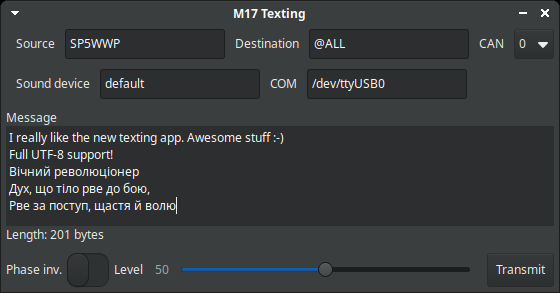
A simple C GUI app, generating M17 baseband of its packet mode. Works well with the Digirig Mobile (and a Yaesu FTM-6000).
I think stuff like this just cool. I love that it's simplistic enough to use minimal hardware and demonstrates that M17 isn't just digital voice, but also data and text messaging. The Digirig Mobile is, generically, an audio interface.
Decoding
M17 packets can be decoded with them17-packet-decoderavailable in the M17_Implementations repository.
The FCC Wants to Let Broadcasters Turn Off Your TV
John Bergmayer of Public Knowledge:
The Federal Communications Commission is considering letting TV broadcasters switch off the current broadcast standard (ATSC 1.0) and move to a new one (ATSC 3.0) on a timeline they set themselves. This could result not just in millions of TV sets becoming obsolete overnight, but could change the nature of broadcasting forever, from a free, widely-accessible service, to yet another proprietary streaming service. That’s why, along with Consumer Reports, Electronic Frontier Foundation, Electronic Privacy Information Center, Media Council Hawaii, and Open Technology Institute at New America, we filed comments with the FCC arguing against this rushed transition.
Don’t get me wrong. ATSC 3.0 itself offers legitimate benefits over ATSC 1.0. In fact, the proposed transition corrects a mistake the FCC and the broadcast industry made in setting the ATSC 1.0 standard, where for short-sighted reasons, a technology was chosen that was known at the time to be worse for mobile reception, and harder to tune in to, among other things. Whoops. Turns out most people’s primary screen these days is the one they carry in their pocket.
So, new technology is good. ATSC 3.0 could bring better reception, better picture and audio, and even improved emergency alerts. TV viewers would benefit from all of this.
But the proposed transition would also let broadcasters cut off existing signals without any requirement that consumers are ready for the switch, that affordable equipment is available, or that anyone has even heard of “ATSC 3.0.” Even worse, while encryption is not necessary for the standard to work, the broadcasters have proposed to encrypt their signals with digital rights management (DRM) for the first time in the history of broadcasting. A private entity called ATSC 3.0 Security Authority (A3SA), controlled by broadcasters, would decide which devices can receive encrypted signals, and what they’re allowed to do with them. (To name one problem: Home recording is allowed by copyright law, but do you think the broadcast industry would have ever allowed it if it was given technological veto power?) A TV might even have the “NEXTGEN TV” ATSC 3.0 logo and still be unable to display encrypted local broadcasts because the two certifications (the certification that the TV can technically receive the signal, and the certification that it has permission to decrypt the signal) are separate. A3SA licenses also expire, so your TV could stop working for encrypted broadcasts even if the hardware is fine.
The DRM issue is probably the biggest obstacle to ATSC 3.0’s adoption and has driven thousands of people to file comments with the FCC objecting to it. Even broadcast industry insiders realize it’s a bad idea.
The abject greed of the commercial television broadcasters, given that they're continuing to use spectrum for which they paid nothing... knows no bounds.
I've been casually following ATSC 3.0 for some time, and it seems, overall, to be a reasonable evolution of technology. ATSC 3.0 could provide a number of useful services including the potential addition of hyper localized Broadcast Positioning System (BPS) that could supplement position and timing data derived from Global Navigation Satellite Systems (GNSS) such as the US Global Positioning System (GPS).
One of the prime reasons that broadcast television remains relevant at all in the era of video content being primarily streamed via Internet... is the idea that in an emergency, "local television broadcasting" could provide potentially lifesaving information. But imagine the average person in an emergency fumbling around to get their (ATSC 1.0) television connected to an antenna, only to get a message on screen saying "no signal detected" because the local television broadcasters have switched to ATSC 3.0. Or doing the same thing with their ATSC 3.0 television, only to get a message on screen saying "this receiver's authorization has expired".
So, no, count me as opposed, overall, to unfettered deployment of ATSC 3.0 if broadcasters can encrypt their ATSC 3.0 transmissions and selectively provide decryption keys that can expire. There should continue to be some element of "service for the public good" in commercial terrestrial television broadcasting. Or commercial television broadcasters should just renounce all 210 MHz of prime VHF / UHF spectrum currently allocated to television broadcasting and move entirely to Internet / satellite broadcast distribution.
Please offer comments / feedback about ZR > BEACON on the Zero Retries email list with the #ZR0235 hashtag.
Closing Thanks
My ongoing Thanks to:
Tina Stroh KD7WSF for, well, everything!
Jack Stroh, Late Night Assistant Editor Emeritus
Fiona and Shreky Stroh, Late Night Assistant Editors In Training
Founding Members who generously support Zero Retries financially:
Founding Member 0000 - Steven Davidson K3FZT (Renewed 2025, 3rd year!)
Founding Member 0001 - Randy Smith WU2S (Renewed 2025, 3rd year!)
Founding Member 0002 - Chris Osburn KD7DVD (Renewed 2025, 3rd year!)
Founding Member 0003 - Don Rotolo N2IRZ (Renewed 2025, 3rd year!)
Founding Member 0004 - William Arcand W1WRA (Renewed 2025, 3rd year!)
Founding Member 0005 - Ben Kuhn KU0HN (Renewed 2025, 3rd year!)
Founding Member 0006 - Todd Willey KQ4FID (Renewed 2025, 3rd year!)
Founding Member 0007 and 0010 - Merik Karman VK1DF / VK2MKZ (Renewed 2025 x2, 3rd year!)
Founding Member 0008 - Prefers to Remain Anonymous 08 (Renewed 2025, 3rd year!)
Founding Member 0009 - Prefers to Remain Anonymous 19 (Renewed 2025, 2nd year!)
Founding Member 0011 - Rick Prelinger W6XBE (Renewed 2025, 2nd year!)
Founding Member 0012 - Ryan Tolboom N2BP (Renewed 2025, 2nd year!)
Founding Member 0013 - Newton White N4EWT (Renewed 2026, 2nd year!)
Founding Member 0014 - Joe Hamelin W7COM (New 2025)
Founding Member 0015 - Rich Stocking N7OP (New 2025)
Founding Member 0016 - Prefers to Remain Anonymous 77 (New 2025)
Founding Member 0017 - Phil Karn KA9Q (New 2025)
Founding Member 0018 - Prefers to Remain Anonymous 95 (New 2025)
Founding Member 0019 - Prefers to Remain Anonymous 0108 (New 2025)
Founding Member 0020 - Prefers to Remain Anonymous 110 (New 2025)
Founding Member 0021 - Prefers to Remain Anonymous 111 (New 2025)
Founding Member 0022 - Prefers to Remain Anonymous 112 (New 2025)
Founding Member 0023 - Prefers to Remain Anonymous 116 (New 2026)
Numerous Annual and Monthly subscribers who also generously support Zero Retries financially!
You thousands of readers of Zero Retries without which there would be little point in publishing this newsletter.
Permission to Reuse Zero Retries Content
Blanket permission is granted for Amateur Radio use of any Steve Stroh content in Zero Retries for Amateur Radio newsletters and distribution via Amateur Radio such as (but not limited to) Packet Radio Networks, Packet Radio Bulletin Board Systems, Repeater Nets, etc.
In such usage, please provide appropriate authorship credit for the content (especially for guest authors) and mention that it was first published in Zero Retries newsletter, preferably in this format:
This article is reprinted with permission. It was first published in Zero Retries newsletter, issue Zero Retries (number), (date) - (include full web link of the specific issue).
It’s appreciated (a courtesy, but not required) to notify Zero Retries Editor Steve Stroh N8GNJ of any reuse of Zero Retries content - editor@zeroretries.net.
If you’d like to republish an article in this issue for other uses, just ask.
All excerpts from other authors or organizations, including images, are intended to be fair use. Unless otherwise noted in the article, there are no paid promotional items in any Zero Retries articles.
Portions Copyright © 2021, 2022, 2023, 2024, 2025, 2026 by Steven K. Stroh.
This issue released on 2026-01-30
(end)